
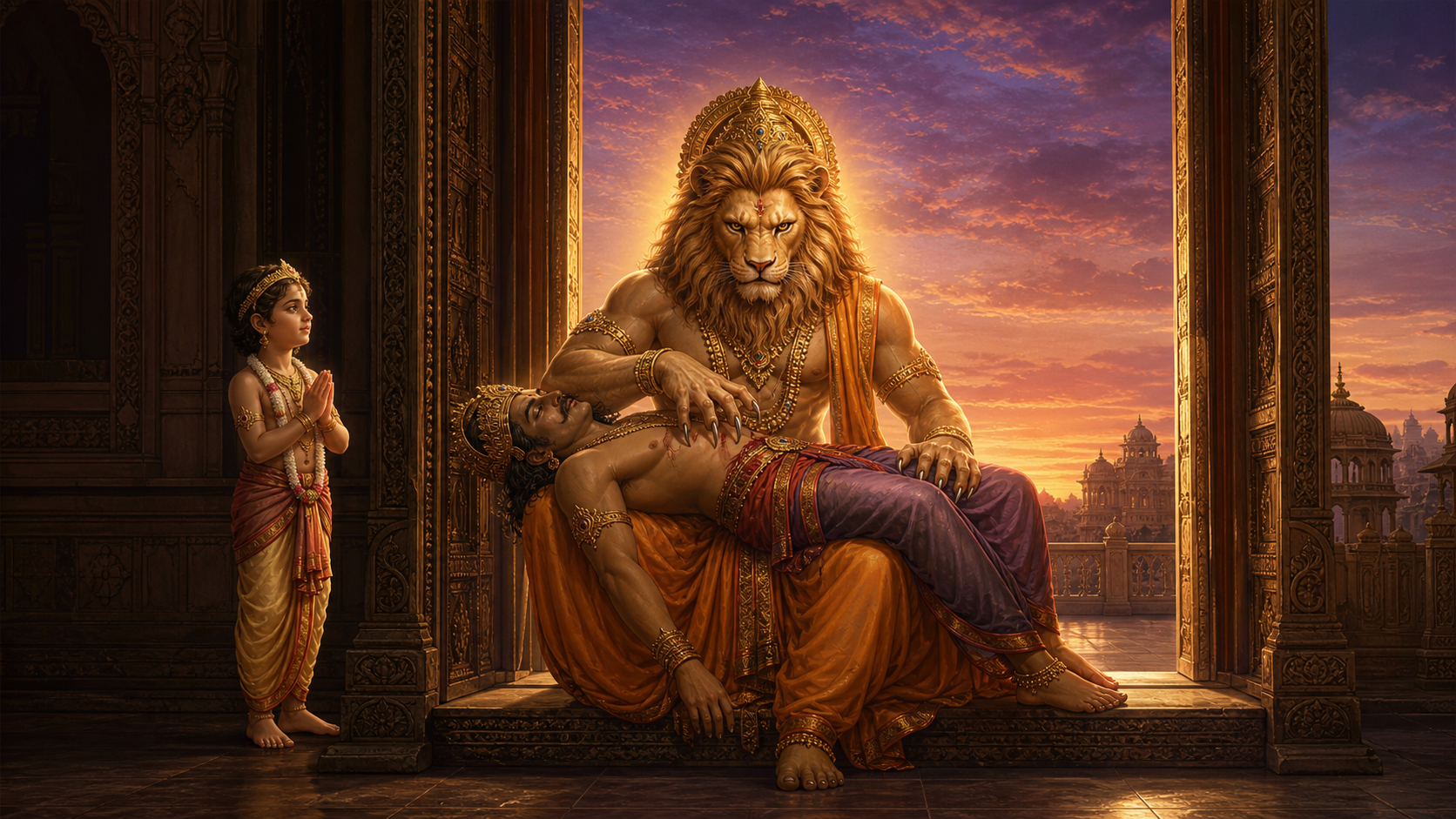
If Narasimha’s claws, mane, and terrifying expression seem difficult to reconcile with Vishnu’s preserving grace, don’t look away from that tension. It is the doorway into the theology. The image is meant to make you ask when power becomes righteous, what limits it, and how fierceness can serve compassion without becoming cruelty.
The answer lies in the complete movement of the incarnation: Prahlada remains devoted under coercion; Hiranyakashipu tries to make tyranny legally invulnerable; Narasimha appears where ordinary categories fail; force ends the threat; and wrath yields to peace. Follow that sequence, and the man-lion form becomes a precise lesson in bhakti, Dharma, courage, and restraint.
Read the incarnation as a sequence, not a monster scene
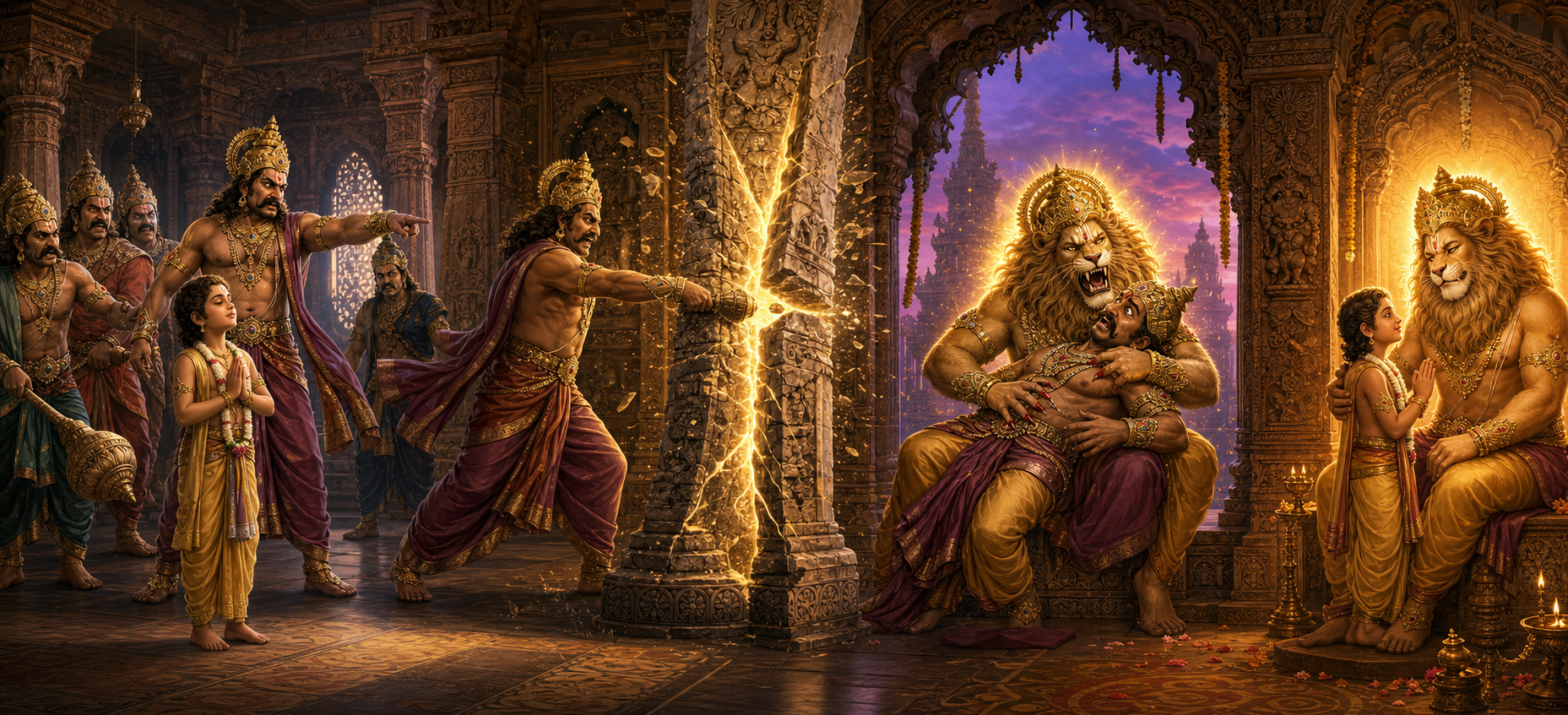
Narasimha is often called Vishnu’s most personal incarnation because the descent is centered on one persecuted devotee. Prahlada is a child inside the household of the very ruler who wants to extinguish his devotion. He cannot defeat the king politically or physically. His strength consists of remembrance of Hari, fidelity to truth, and a refusal to let persecution determine the character of his own mind.
The Bhagavata Purana, especially Skandha 7, presents the fullest narrative arc. The Vishnu Purana and Agni Purana preserve related accounts, while the Narasimha-tapani Upanishad carries the incarnation into contemplative and mantra practice. The range matters: Narasimha is not only a dramatic figure in sacred storytelling. He belongs to theology, worship, meditation, temple culture, and household devotion.
- Prahlada remains oriented toward Hari. His devotion is not a technique for controlling events. It is the truth he refuses to surrender, even when surrender would reduce his immediate suffering.
- Hiranyakashipu turns power into coercion. He demands not merely obedience in public but control over another person’s deepest allegiance.
- The boon turns language into a fortress. Safety is tied to exclusions involving creature, place, time, position, and weapon. The king treats technical compliance as immunity from moral consequence.
- Narasimha answers every exclusion without violating it. The Divine does not discard order to defeat the tyrant. The manifestation reveals that cosmic order is larger than the tyrant’s manipulation of its terms.
- The intervention concludes when its purpose is complete. Fierceness is followed by pacification. That final movement is essential to the meaning of the incarnation.
Hiranyakashipu’s protections and the circumstances of Narasimha’s appearance form a deliberate theological pattern:
| Claimed protection | Narasimha’s response | What you should notice |
|---|---|---|
| Neither man nor animal | The man-lion form is neither category alone | Reality is not confined to the categories a powerful person selects |
| Neither inside nor outside | The confrontation occurs on a threshold | A boundary cannot become a hiding place from Dharma |
| Neither day nor night | Narasimha appears at twilight | The transition between fixed states remains within divine order |
| Neither on earth nor in the sky | Hiranyakashipu is placed on Narasimha’s lap | The apparent gap between alternatives is not moral immunity |
| Not killed by a weapon | Narasimha uses divine nails rather than a forged weapon | The means of justice need not conform to the tyrant’s assumptions |
| Not killed by a conventionally created being | Vishnu manifests in an extraordinary form | The boon is honored without allowing it to enthrone Adharma |
This is not a tale about finding a more ingenious loophole than your opponent. Hiranyakashipu’s mistake is deeper: he assumes that verbal conditions can make conduct morally untouchable. Narasimha fulfills the conditions while exposing that assumption. The letter of the boon survives; the imagined right to persecute does not.
The pillar belongs to the same symbolic grammar. What appears inert, enclosed, and incapable of answering becomes the place of manifestation. You are therefore invited to notice where you have mistaken invisibility for absence. The Divine need not arrive through the channel that power recognizes or permits.
Fierce grace has an object, a limit, and an end
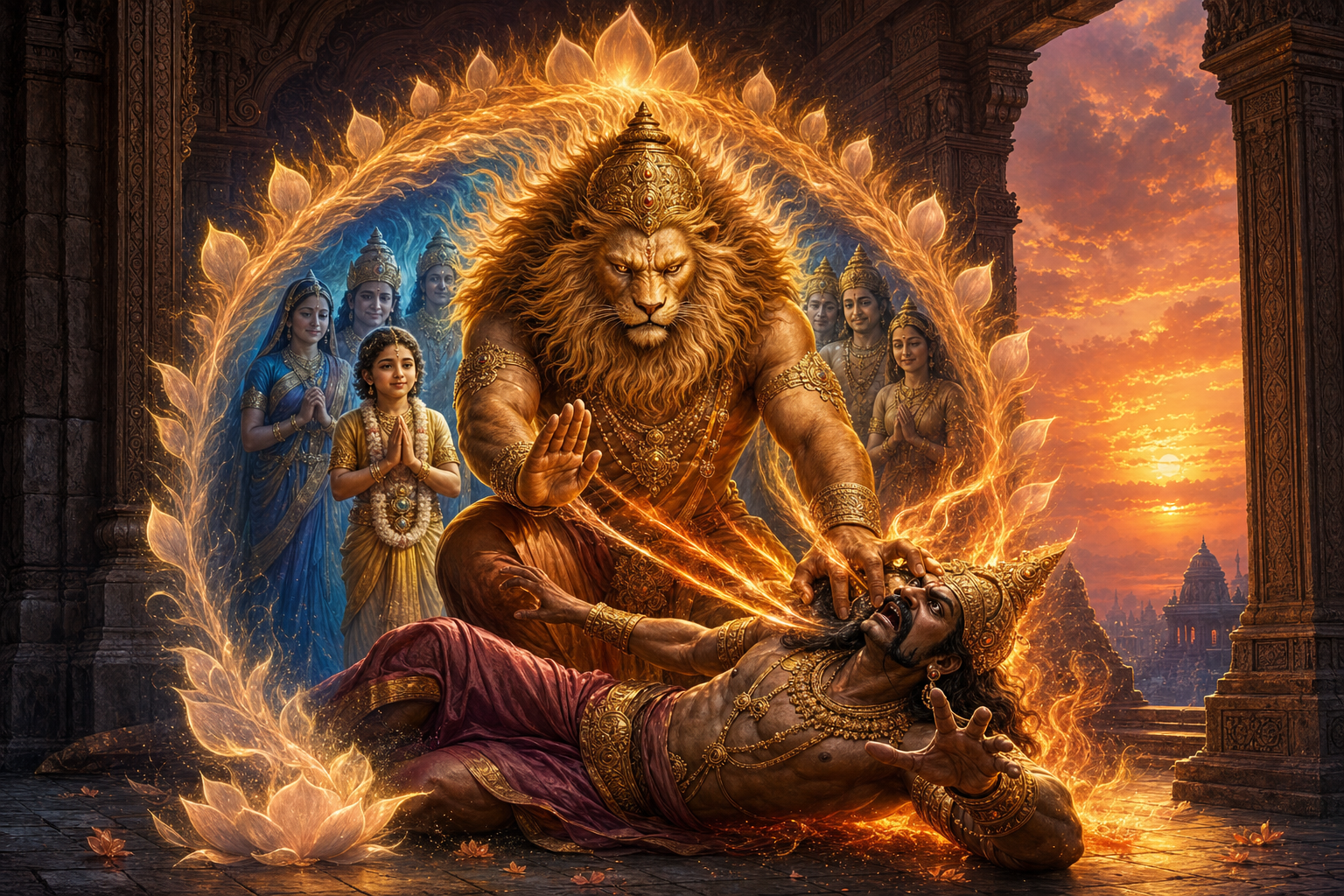
The word ugra can tempt a shallow reading. Narasimha is fierce, but the incarnation does not sanctify uncontrolled anger. His fierceness has a particular object: coercive Adharma directed against an innocent devotee. It has a limit: the exact removal of the threat. It has an end: the return from terrible intensity to auspicious peace.
Use three questions whenever someone invokes Narasimha to justify forceful conduct:
- What is being resisted? The model is resistance to persecution and domination, not rage at disagreement, wounded pride, or criticism.
- Who is being protected? The center is Prahlada, the vulnerable person whose conscience is being violated. The center is not the aggressor’s appetite for retaliation.
- What makes the action stop? In Narasimha’s pattern, power does not keep expanding after protection has been achieved. If no end condition exists, the pattern has already been abandoned.
This distinction matters in family life, public life, and civilizational self-defense. Passivity is not the only alternative to hatred. Prahlada does not surrender truth, but neither does he reproduce his father’s inner condition. Narasimha does not leave the innocent unprotected, but divine force also does not become permanent fury. Devotion and protective strength correct one another.
That is the meaning of fierce grace. Grace is not always softness toward the force causing harm. It may require a decisive boundary. Yet a Dharmic boundary is measured by what it protects and by whether power can become peaceful after its task is finished. Wrath that cannot relinquish its target is no longer functioning as protection.
The descriptions of Narasimha as the most personal and the shortest avatar are useful only with these qualifications:
- Most personal points to an incarnation centered on a single devotee. It does not mean that bhakti guarantees the immediate fulfillment of every personal preference.
- Shortest refers to the concentrated worldly interval of the manifested lila: appearance at dusk, the end of tyranny, pacification, and withdrawal. It is not a claim that Narasimha is lesser than other forms of Vishnu.
- Nitya-Narasimha preserves the other side of the theology. The historical intervention is brief, while the Lord remains eternally accessible in worship, remembrance, and contemplation.
Prahlada’s ordeal also prevents a transactional reading. Bhakti is not presented as a guarantee that the devotee will never enter danger. The assurance is that devotion is not abandoned and that Adharma cannot make itself ultimate merely by controlling the visible circumstances.
Each Narasimha form teaches a different phase of power
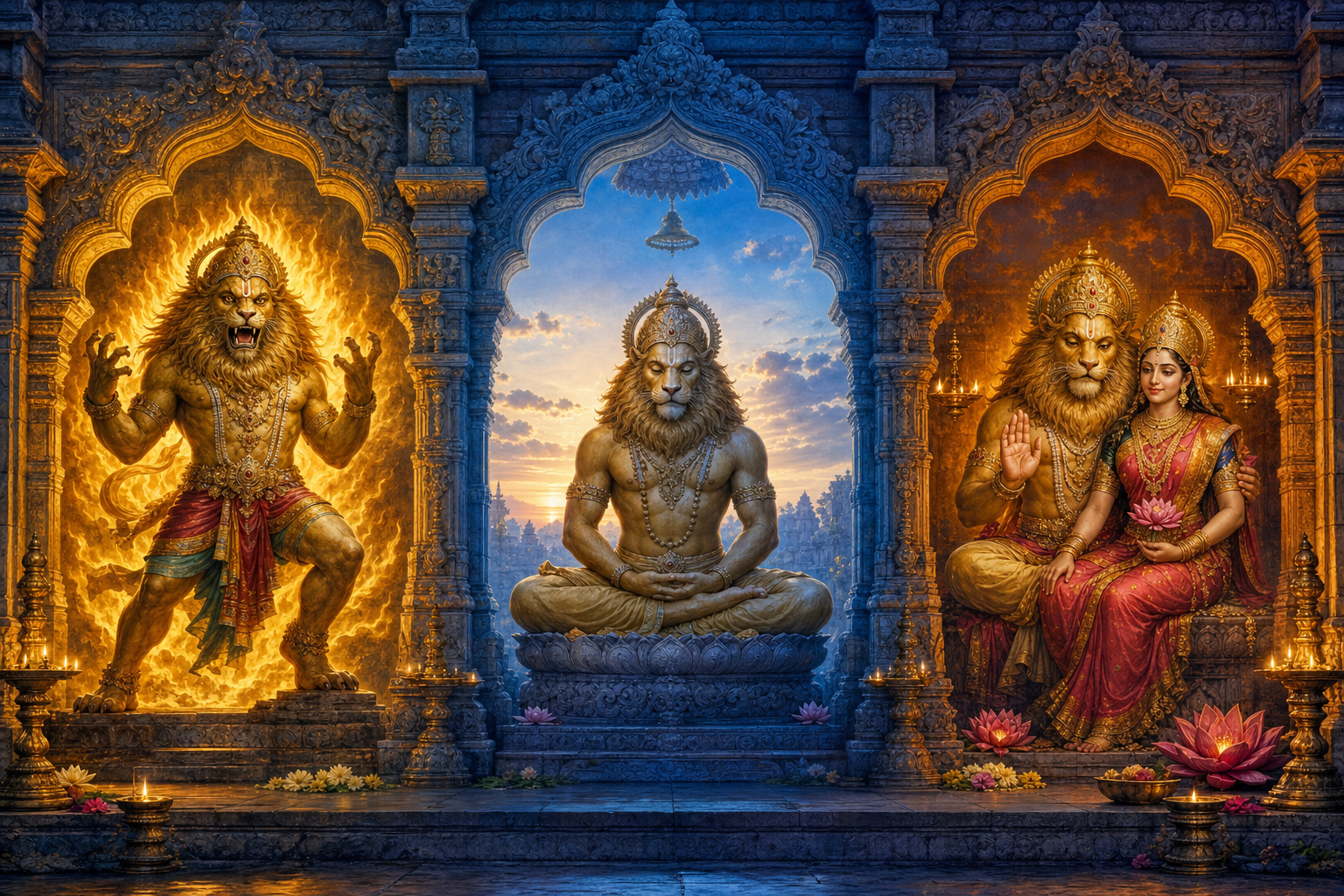
Narasimha iconography is compressed theology. The forms are not interchangeable decorations, and you should not read every murti as if it depicts the same instant. Each emphasizes a particular devotional mood and a particular phase in the passage from danger to restored order.
- Kevala-Narasimha: The Lord appears alone, often with four arms bearing the chakra and shankha. Notice protective sovereignty rather than narrative combat. This is a form for contemplating power that is already established in itself and does not need to perform aggression.
- Ugra-Narasimha: The dynamic act of deliverance comes to the foreground, sometimes with Hiranyakashipu across the Lord’s lap. Do not isolate the fearsome expression from its object and purpose. The form confronts the terror experienced by the vulnerable; it does not invite fascination with violence for its own sake.
- Lakshmi-Narasimha or Malola-Narasimha: Mahalakshmi sits upon the Lord’s lap and the mood becomes serene. The same power capable of ending tyranny is now composed, intimate, and auspicious. This form supplies the ending that an exclusive focus on Ugra can obscure.
- Yoganarasimha: Contemplative stillness becomes visible. The form joins the protective energy of Narasimha to steadiness of mind and breath. It is especially useful when your real struggle is not failure to act but the inability to settle after action.
The contrast between Ugra-Narasimha and Lakshmi-Narasimha offers a demanding test of spiritual maturity. Can you become firm without making fury your identity? Can you defend a boundary and then release the mental posture of combat? A person who can enter fierceness but cannot return to peace has understood only half the icon.
Ahobilam in Andhra Pradesh makes this range of moods into sacred geography through nine revered Narasimha forms: Jvala, Ahobila or Ugra, Malola, Kroda or Varaha-Narasimha, Karanja, Bhargava, Yogananda, Chatravata, and Pavana. Simhachalam venerates Sri Varaha Lakshmi Narasimha, while Yoganarasimha sanctums in Karnataka and Tamil Nadu give contemplative stillness a prominent place. The variety guards against reducing Narasimha to one emotional register.
When choosing a form for study or daily remembrance, begin with the question actually before you. Turn toward Ugra when you need to understand a necessary boundary; toward Lakshmi-Narasimha when you need to remember the purpose and conclusion of protective power; toward Yoganarasimha when the work is to recover steadiness; and toward Kevala-Narasimha when you need to contemplate divine protection without remaining mentally inside the scene of conflict.
Turn the symbolism into a disciplined practice
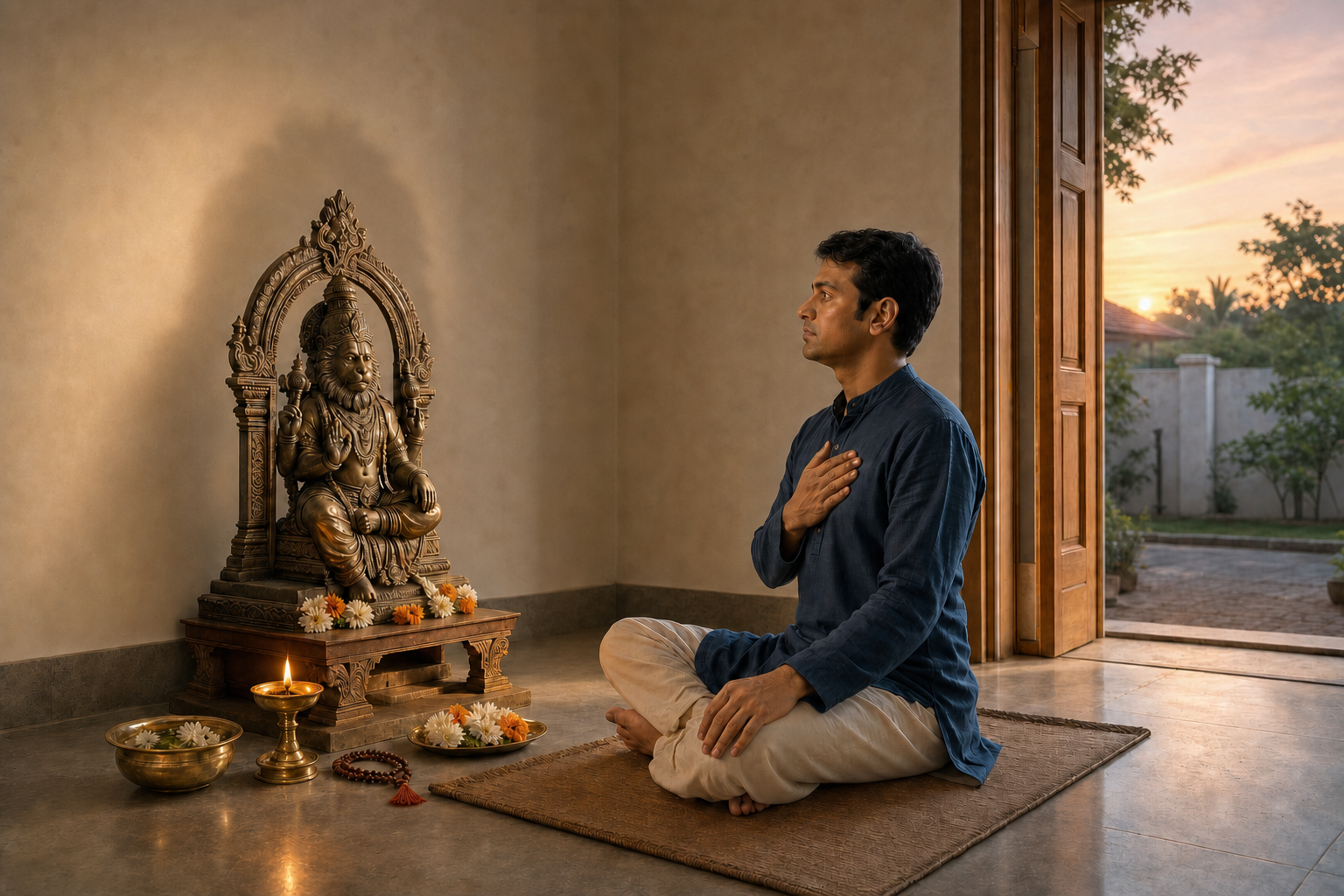
Narasimha worship should do more than intensify emotion. The symbolism can train you to respond to fear without either collapsing or becoming indiscriminate. A simple reflection can be used before mantra recitation, during a difficult decision, or when you stand before a Narasimha image.
- Name the threshold. State the two conditions between which you feel trapped: speaking or remaining silent, staying or leaving, confronting or waiting. The Narasimha narrative begins where a rigid either-or has become inadequate.
- Identify the real violation. Describe the conduct rather than turning a person into a mythic demon. Is there coercion, deception, intimidation, or an attempt to use rules as cover for harm? Precision keeps discernment from becoming projection.
- Locate Prahlada. Ask whose conscience, safety, or freedom is at risk. This moves your attention away from injured pride and toward the person or principle that needs protection.
- Choose the smallest sufficient act. Set the boundary required to interrupt the harm. Narasimha’s symbolism supports decisive action, but it does not support unlimited escalation.
- Define the return to peace in advance. Decide what completion will look like. Without this step, a protective response can harden into a permanent identity organized around conflict.
The traditional invocation holds the paradox in a compact form:
Ugram Veeram Mahavishnum Jvalantam Sarvato Mukham, Nrisimham Bhishanam Bhadram Mrityor Mrityum Namamyaham.
Traditional Narasimha invocation
The pairing of bhishanam, the formidable or fearsome, with bhadram, the auspicious, is the interpretive key. The mantra does not ask you to choose between terrible power and beneficent presence. It teaches that divine power is terrible to the force that persecutes and auspicious to the devotee it protects. Mrityor mrityum, the death of death, moves the contemplation beyond one defeated king toward freedom from fear’s apparent finality.
Recite it steadily rather than aggressively. Afterward, name one action that expresses Prahlada’s steadfastness and one limit that expresses Narasimha’s self-restraint. This prevents mantra from becoming an attempt to magnify anger or imagine the Divine as an instrument of personal revenge.
Narasimha Jayanti is traditionally observed on Vaishakha Shukla Chaturdashi, with worship focused at dusk to correspond to the time of manifestation. Practices may include fasting, abhisheka with panchamrita, and kavacha recitation. Let the outer observance preserve the theological sequence: remembrance before the crisis, courage at the threshold, protection without excess, and pacification after justice. Follow the discipline of your household, temple, or sampradaya rather than treating a general list of observances as a complete ritual manual.
Questions that clarify Narasimha symbolism
Is Narasimha simply half human and half lion?
No. That description identifies the visible combination but misses its function. The form is a theological answer to an attempt to make ordinary classifications absolute. Narasimha is neither merely human nor merely animal, so the manifestation honors Brahma’s boon while revealing that the Divine exceeds the categories on which the tyrant relied.
Why is a violent scene associated with Vishnu’s preserving role?
Preservation does not mean preserving every existing arrangement. Hiranyakashipu’s order depends upon persecution, so protecting Prahlada and restoring Dharma require that coercive order to end. The action remains preservative because it is directed, bounded, and followed by peace. Remove those limits and you no longer have the full Narasimha pattern.
What does it mean to call Narasimha the shortest avatar?
It refers to the brevity of the manifested worldly episode compared with the long terrestrial lives and extensive public roles associated with Rama or Krishna. Narasimha appears at the needed threshold, completes the intervention, becomes pacified, and withdraws. The expression does not deny Nitya-Narasimha, the Lord’s enduring accessibility in devotion.
Does the lion symbolism speak beyond Vaishnava tradition?
The theology of this incarnation is distinctly Vaishnava, but the lion carries related Dharmic resonances. Buddhist language uses the lion’s roar, or simhanada, for fearless proclamation of Dharma. Jain symbolism connects the lion with courage and the moral authority of the Tirthankaras. The Sikh ideal of the saint-soldier likewise joins spiritual commitment to protective strength. These parallels do not erase doctrinal differences; they reveal a shared insistence that compassion needs courage and that courage must remain answerable to Dharma.
The next time you encounter Narasimha, stay with the image for one minute longer than usual. Find Prahlada, the threshold, the limit placed on force, and the sign that peace can return. Then carry one part of that sequence into your day: hold to truth without hatred, protect without cruelty, or let justified fierceness end when its work is done.
References
