

You may already agree that Hindu history and culture deserve serious attention. The harder question is deciding which work deserves your limited reading time, trust and financial support. The Dharma Dispatch’s seventh anniversary offers a practical test: look for continuity, depth and transmission beyond the screen.
If you are deciding whether to subscribe, share its work or use it in your own study, do not begin with brand loyalty. Ask what seven years of sustained effort has produced, how readers have used it and whether its method can help you become a more responsible custodian of civilisational memory.
Seven years matters when continuity becomes transmission
An anniversary number is not proof of value. Longevity can preserve mediocrity as easily as excellence. What matters is whether repeated work has created something that later readers, teachers and communities can use.
The seventh anniversary acquired a specifically Dharmic frame because it fell at the opening of Sharannavaratri, following Mahalaya Amavasya and the remembrance of obligations owed to the Pitrs. That sequence places gratitude to ancestors beside the worship of Devi. It also supplies the right question for an anniversary: what have we inherited, what have we protected, and what are we preparing to pass forward?
Rna, the debt or obligation we bear, is not discharged by nostalgia. Civilisational memory survives when people preserve it, examine it and make it available to another generation. A reader who merely agrees with a historical claim has consumed information. A reader who keeps careful notes, checks the evidence, visits the place, teaches the material or preserves a copy has begun to transmit memory.
You can apply this anniversary test to your own relationship with Dharma. Write down three things: one civilisational question you need to understand, one neglected place or memory you can help preserve, and one person with whom you can share what you learn. That small exercise turns admiration into responsibility.
Deliberate boredom is an editorial discipline

Online media rewards immediacy, outrage and personal display. Those incentives are poorly suited to work that must remain useful after the day’s controversy has vanished. The Dharma Dispatch has instead made an explicit commitment to staidness, simplicity, minimalism, quiet reflection and non-intrusion.
Calling this approach boring is not an apology. It is a choice about time. A sustained historical treatment cannot be governed entirely by the demand for instant novelty. A multipart inquiry needs room to establish context, distinguish people and periods, follow consequences and preserve a coherent sequence. Quiet presentation also leaves the subject, rather than the personality presenting it, at the centre.
This does not mean that slow work is automatically sound. Slowness is valuable only when it produces clarity and depth. Before you give a civilisational platform your trust, ask four concrete questions. Will this material remain useful after the current news cycle? Can you identify the names, places and arguments well enough to check them? Does the platform build connected bodies of work rather than isolated reactions? Can it maintain its method without turning every subject into spectacle?
These questions also help if you run a temple newsletter, reading circle, podcast or cultural association. Choose a publishing rhythm you can sustain. Build sequences around important questions. Keep an accessible archive. Correct errors without drama. Use headlines that describe the subject plainly. Generational work depends less on constant excitement than on the repeated fulfilment of a modest promise.
The strongest outcomes happened beyond the screen
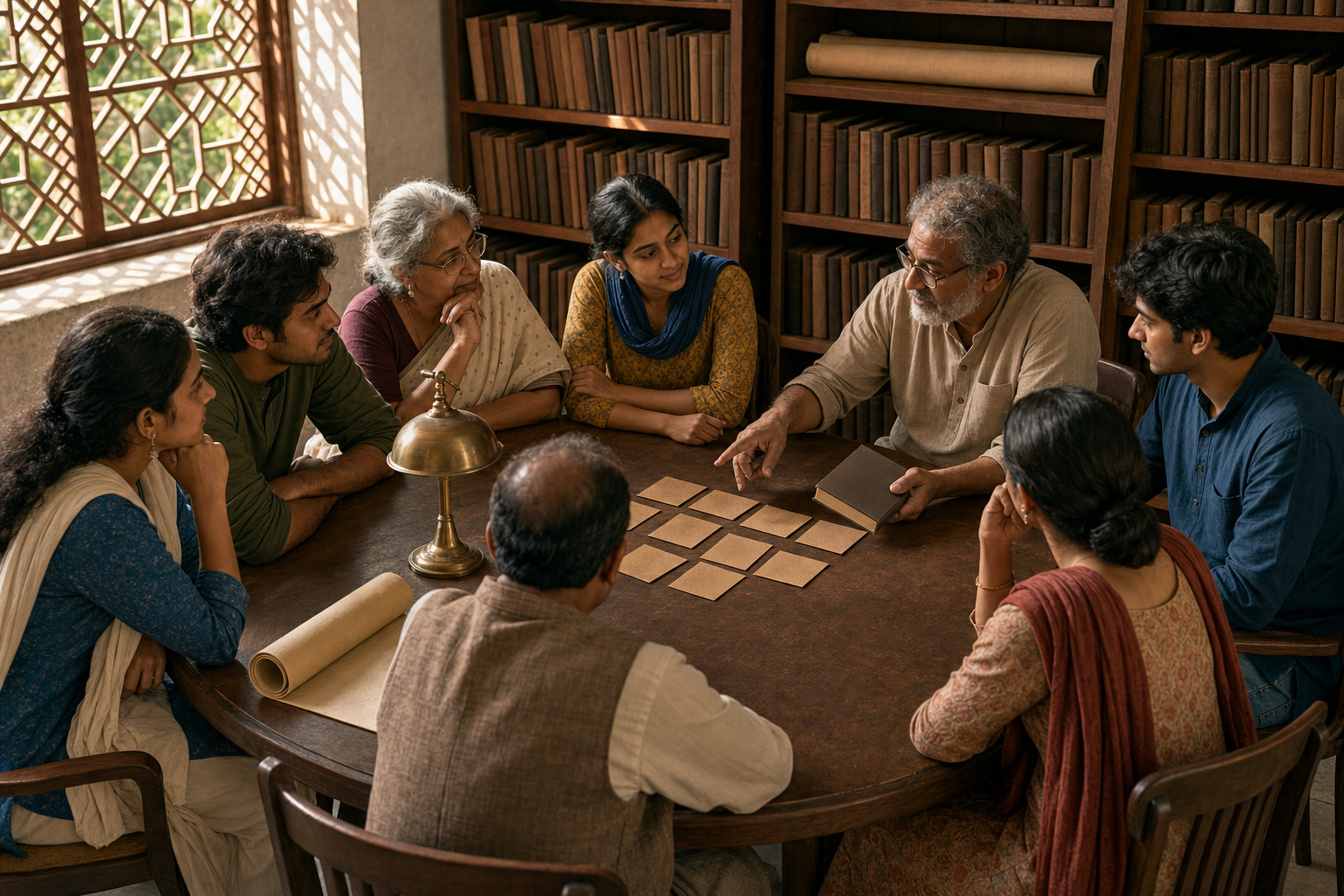
Pageviews can show reach, but they cannot tell you whether knowledge entered a classroom, changed a journey or strengthened local memory. The more revealing evidence from the seventh year is the movement from reading to use.
Readers from a broad cross-section of Hindu society, including the Sadhu-Sant Samaj, responded positively to a twelve-part treatment of Ghar-Wapsi. A Hindu resident of Murshidabad encountered the role of Murshid Quli Khan in Bengal’s history and expressed surprise that such a consequential figure had remained unknown to him. In both cases, the value lay in recovering context that slogans or abbreviated timelines cannot supply.
Scholarly and educational circulation produced another kind of result. Shatavadhani Dr. Ganesh conveyed appreciation for work on D.V. Gundappa’s contribution to renunciate poetry. A Turkish university discussed ancient connections between Bharat and Greece through the figure of Bharata Mata engraved on a silver dish found at Lampsacos. Several public and private universities in India assigned a seven-part exploration of Saartha, the mobile-caravan system of ancient and pre-medieval India.
Place-based responses went further. A reader resolved to visit Gandikota after learning about the destruction suffered by the Vijayanagara fort. A college student, moved by the history of the Mandsaur silk-weavers’ guild restoring a ruined Sun Temple during the Gupta era, planned to travel to neglected civilisational sites and document their present condition. In Tiruvannamalai, a young man distributed printed copies of material on Hindu history and culture among local residents.
These responses form a useful ladder of impact: recognition, discussion, formal study, physical encounter, documentation and community circulation. When you evaluate cultural work, ask where it sits on that ladder. Agreement is the first rung, not the final one.
Scale still matters because transmission requires access. At the anniversary, The Dharma Dispatch reported more than one million organic pageviews per month. It had also renewed its podcast focus in late 2023, maintained a pace of at least one episode a week, and reached 297 episodes on Hindu history, civilisation and culture. Those are reported measures of distribution. The classroom assignments, journeys and local print circulation show what some people did with that distribution.
Turn the archive into a personal curriculum

A large archive can become another form of distraction if you enter it without a question. Use a five-step reading method so that your attention produces something durable.
- Name one question. Choose a question narrow enough to complete: how Ghar-Wapsi is understood, how caravan networks functioned, what happened at Gandikota, or why Murshid Quli Khan matters to Bengal’s history. Do not begin with the vague aim of learning everything about Bharat.
- Follow one complete sequence. Read a multipart treatment in order. Serial work accumulates definitions, chronology and argument; sampling only the most provocative instalment can separate a conclusion from the reasoning that supports it.
- Keep an evidence ledger. On one page, separate names and dates, places and artefacts, interpretive claims, and questions that remain open. This prevents a confident narrative from blending with the facts you can independently check.
- Create one honest output. Prepare a short reading-circle note, a lesson for your family, a properly attributed print copy, or a plan to document a relevant site. When sharing material, preserve its title, byline, publication date and direct URL so another person can trace it.
- Close the support loop. If sustained work has genuinely helped you, choose a proportionate response: subscribe, share a carefully selected entry, attend to the podcast archive or make a voluntary contribution. The official anniversary page lists paid-subscription and contribution options; verify the current payment details there before sending money.
This method protects you from two common errors. The first is passive accumulation: saving dozens of links while completing none. The second is partisan repetition: forwarding a claim because it confirms your outlook without preserving its context or checking its basis. A pro-Dharma commitment does not require uncritical reading. It requires more care because the history being transmitted may shape another person’s understanding of Bharat.
If audio suits your routine, use a podcast episode as an entry point rather than the end of the inquiry. Record the main question, unfamiliar names and places, and the claims that need checking. Then connect those notes to the relevant long-form treatment. Convenience should widen access without flattening complexity.
Key takeaways for readers and supporters
- The seventh anniversary is meaningful because sustained work has begun to move through communities, universities, journeys and local circulation.
- Deliberate quiet is useful when it protects depth, continuity and the subject’s dignity; it is not a substitute for evidence or clear reasoning.
- The best measure of civilisational media is not reach alone, but what readers can understand, verify, preserve and pass forward.
- Your most useful contribution is a closed loop: choose one question, complete one sequence, keep traceable notes, create one downstream use and then decide whether to support the work.
Choose one sequence now and reserve two reading sessions for it this week. At the end, produce a single page of notes and decide on one responsible use: a conversation, a reading circle, a visit, a documented record or a properly attributed copy for someone who will benefit from it.
Then make your judgement. Support the work if it has earned your trust, and retain your discernment if it has not. Gratitude and viveka belong together. That is how an anniversary stops being a ceremonial number and becomes a renewed obligation between memory and action.
References
