
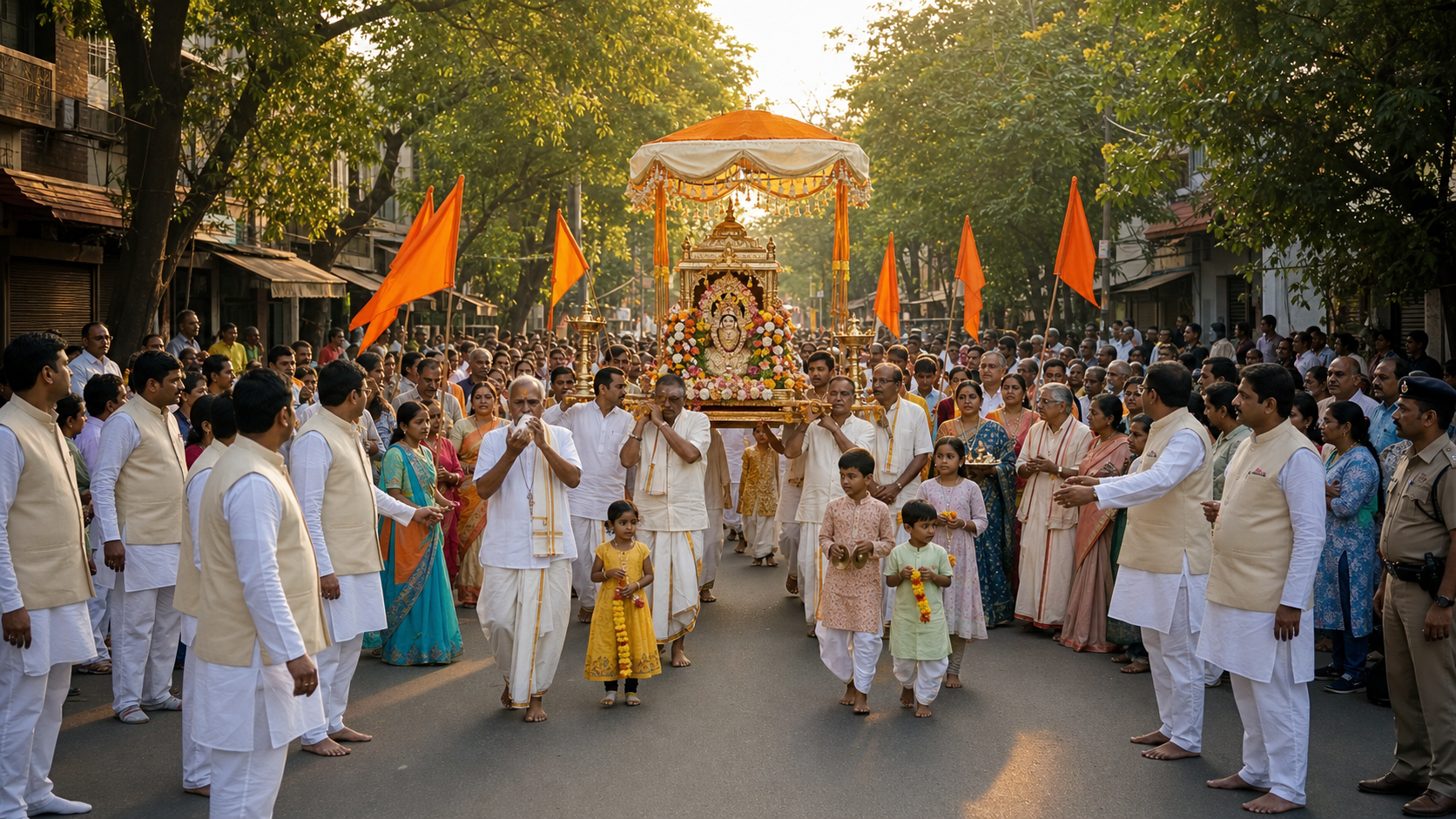
You may be preparing a temple yatra, a festival procession, or a public commemoration and facing a question that should never have become a false choice: must visible Hindu identity be softened in order to preserve community harmony?
No. A Hindu procession can be unmistakably Hindu and rigorously peaceful. The practical answer is neither withdrawal nor bravado. It is disciplined organization: state the sacred purpose, secure the route, train identifiable marshals, control information, and prepare a lawful response to provocation. Treat the procession as worship in motion, because every participant’s conduct will become part of its public meaning.
Give Hindu identity a positive center
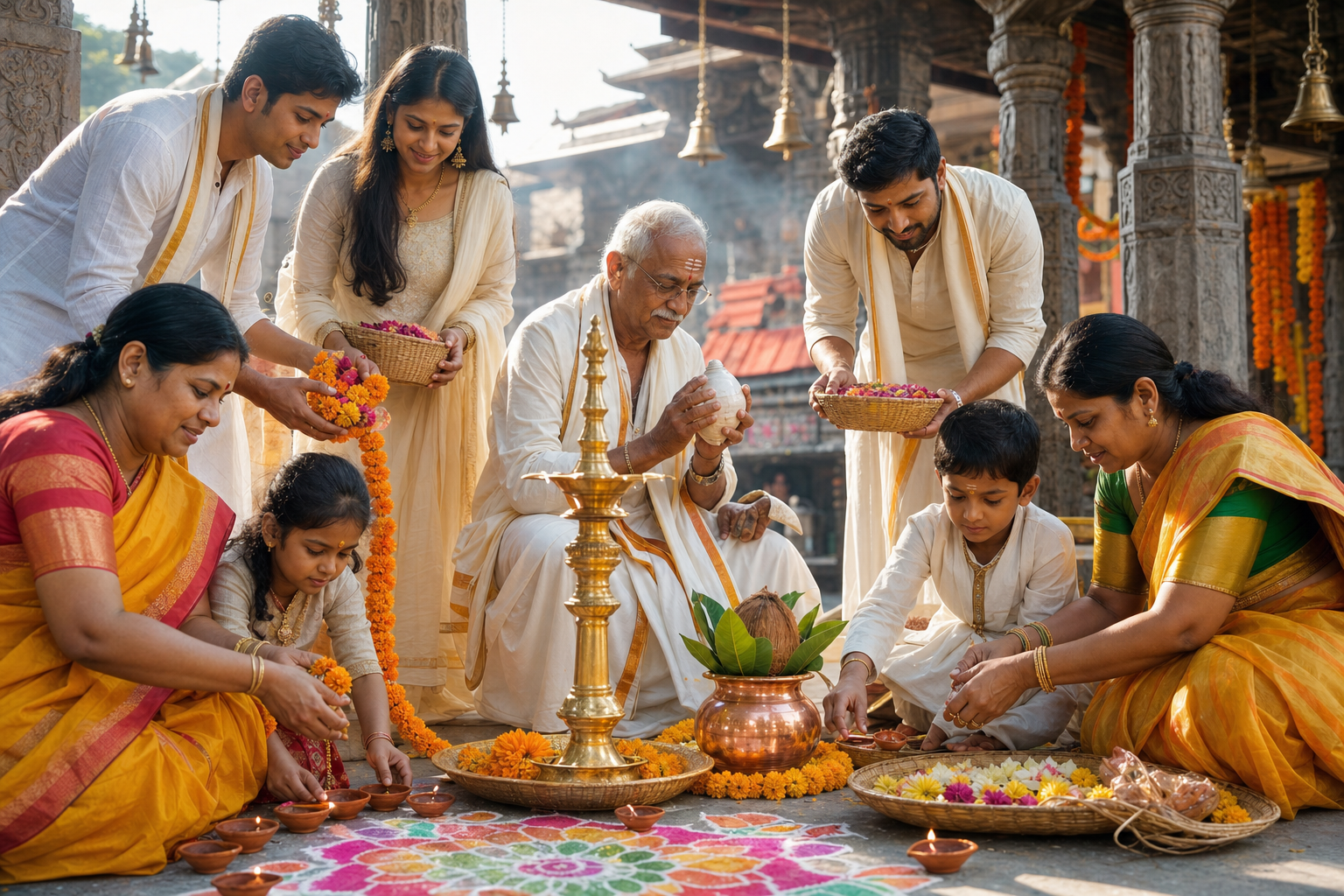
A procession becomes vulnerable to provocation when participants know what they oppose but cannot clearly say what they are celebrating. Begin with one sentence that names the affirmative purpose: darshan, remembrance, gratitude, a vrata, the honoring of a deity or civilizational hero, or the renewal of neighborhood bonds. Put that sentence on invitations, permission applications, volunteer instructions, and public notices.
This doesn’t require hiding saffron flags, devotional music, sacred images, or historical memory. Harmony is not theological sameness, and accommodation is not surrender. It means exercising a legitimate public freedom with stewardship toward worshippers, bystanders, residents, shopkeepers, emergency services, and the city that hosts the celebration.
Three distinctions keep that position clear:
- Restraint is not passivity. You can protect participants, document an offence, and demand action without retaliating.
- Accountability is not collective blame. Name the alleged conduct and seek action against responsible individuals; don’t treat an entire religious community as the accused.
- Coordination is not asking opponents for permission. Police, municipal, resident, and shopkeeper coordination removes ambiguity while preserving the organizer’s right to celebrate.
Public Hindu confidence can also take the form of hospitality. At Bargarh Dham in Kharsia, 272 people who had previously converted formally reaffirmed their Hindu spiritual alignment, while Prabal Pratap Singh Judev washed their feet as a gesture of welcome. The lesson for any public Hindu gathering is larger than that ceremony: dignity and humility can express belonging more powerfully than triumphalism.
Where a gathering includes conversion, reconversion, or a public reaffirmation of faith, freedom of conscience must remain central. Participation should be voluntary, informed, and free from coercion or material inducement. Explain the meaning of the rite beforehand, allow private questions, avoid disparaging another faith, and provide continuing social support afterward. A sacred ceremony must not be used to conceal pressure.
Write a short participant code before announcing the route. It should require devotional or commemorative conduct, obedience to marshals, respect for agreed timing and sound conditions, no abusive slogans, no disparagement of another community, and no retaliation. If organizers aren’t willing to enforce that code against their own participants, it isn’t a code yet.
The Dharmic traditions offer a strong civic vocabulary for this work without erasing their differences. Hindu self-discipline, Jain ahimsa and aparigraha, Buddhist karuna and mindfulness, and Sikh seva and humility all place limits on anger while directing energy toward service. Shared ethics don’t require shared theology. They tell us how conviction should behave in a common street.
Plan the procession before the route becomes a dispute
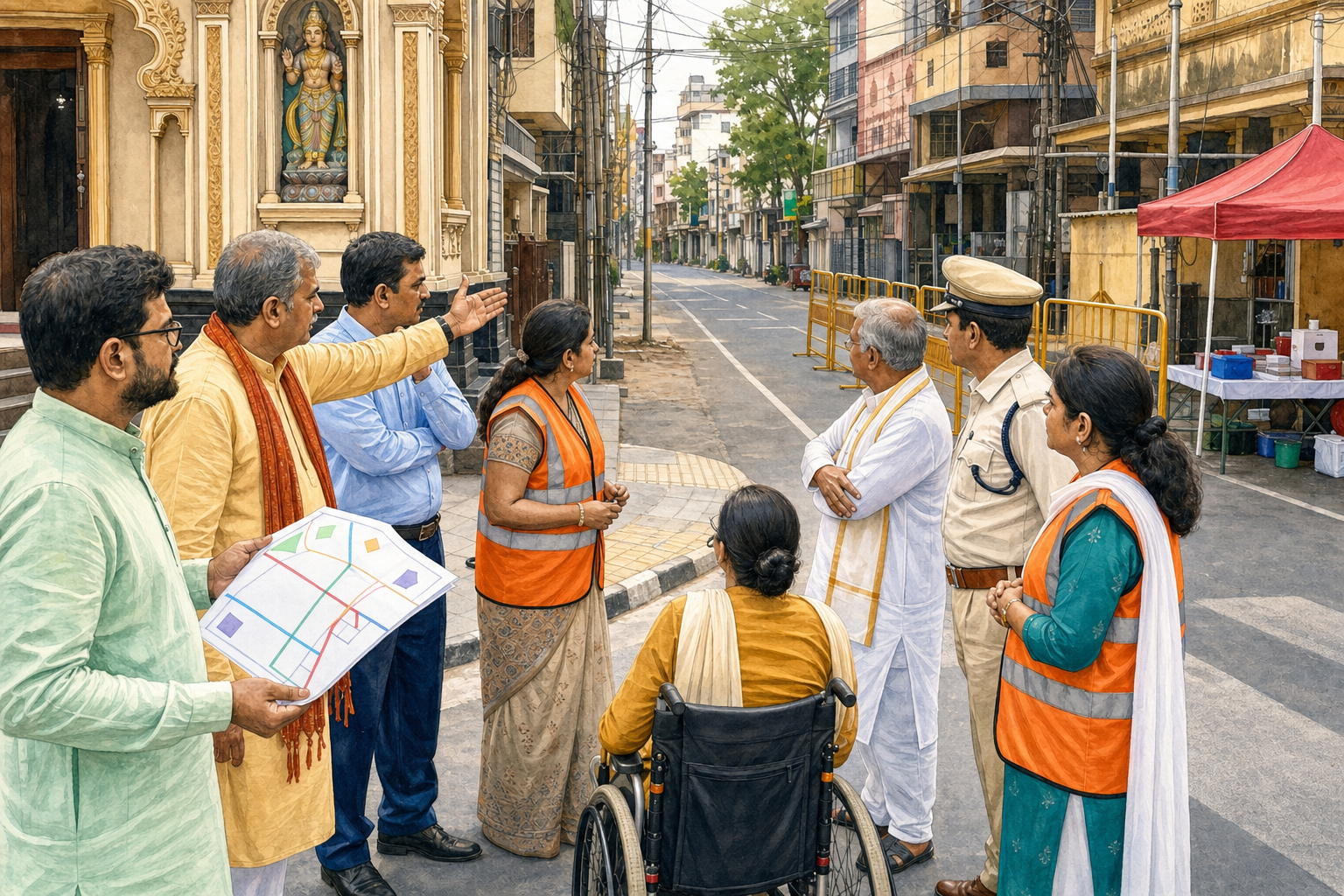
Many flashpoints begin as unresolved logistics: an unclear route, a bottleneck, a sensitive location at a sensitive time, excessive sound, blocked access, or a crowd larger than the available stewardship. Once emotion rises, those practical defects are recast as deliberate insults. Settle them while people can still read a map calmly.
- Confirm the legal and administrative conditions in writing. Record the approved route, start and end windows, sound conditions, traffic diversions, vehicle restrictions, and any documentation or notification requirements. Rules and procedures can vary by state and district. If a route is contested or legal exposure is likely, obtain current guidance from the competent authority and a qualified local lawyer rather than relying on forwarded messages or last year’s arrangements.
- Walk the entire route. Include the police liaison, traffic representative, event lead, sector coordinators, and people familiar with the neighborhood. Mark narrow stretches, blind turns, construction, overhead hazards, sensitive sites, essential-service access, first-aid points, water points, and emergency exits. A sensitive location should trigger better protection and communication, not an automatic assumption that Hindu observance must disappear.
- Speak to people whose ordinary day will be affected. Give residents, shopkeepers, transport operators, and local associations a reliable schedule and organizer contact. Ask where an ambulance, delivery vehicle, elderly resident, or customer queue could become trapped. This is operational intelligence, not a negotiation over whether the celebration is allowed to exist.
- Create a clear command structure. Name one event lead, route-sector coordinators, a police liaison, a traffic lead, a medical lead, a communications lead, and an evidence custodian. Every role needs a backup. Participants should know who may pause, divert, or resume the procession; a crowd receiving competing instructions is difficult to protect.
- Use trained, visible marshals. Color-coded vests or badges should distinguish marshals from ordinary participants. Train them to communicate, form safe lanes, reduce crowd pressure, separate disputing individuals, and summon police or medical help. They are not a private enforcement force and should not chase, punish, or interrogate anyone.
- Set sound and timing discipline before the first drumbeat. Confirm the applicable conditions, test equipment, assign one person to control volume, and agree on where music may need to pause. A devotional procession loses nothing by respecting a hospital, emergency movement, or a lawfully imposed condition. Deliberately weaponizing sound turns worship into provocation.
- Build an information channel. Publish one verified organizer account or messaging channel, preferably in the languages commonly used locally. It should carry the route, timing, changes, safety instructions, and verified incident updates. Tell participants in advance that anonymous voice notes, cropped clips, and inflammatory forwards are not official information.
- Prepare for disruption without predicting an enemy. Identify safe dispersal points, medical access, family reunification locations, vehicle exits, and the procedure for preserving photos or video. A contingency plan should be based on conduct and conditions, not a presumption that every resident from another community is a threat.
Finish this planning with a one-page route sheet. It should show the approved path, command contacts, marshal sectors, first-aid locations, emergency exits, scheduled pauses, and the official information channel. Give the same current version to organizers, marshals, police liaisons, drivers, and stage managers. Version confusion is a preventable risk.
Make discipline visible on the route
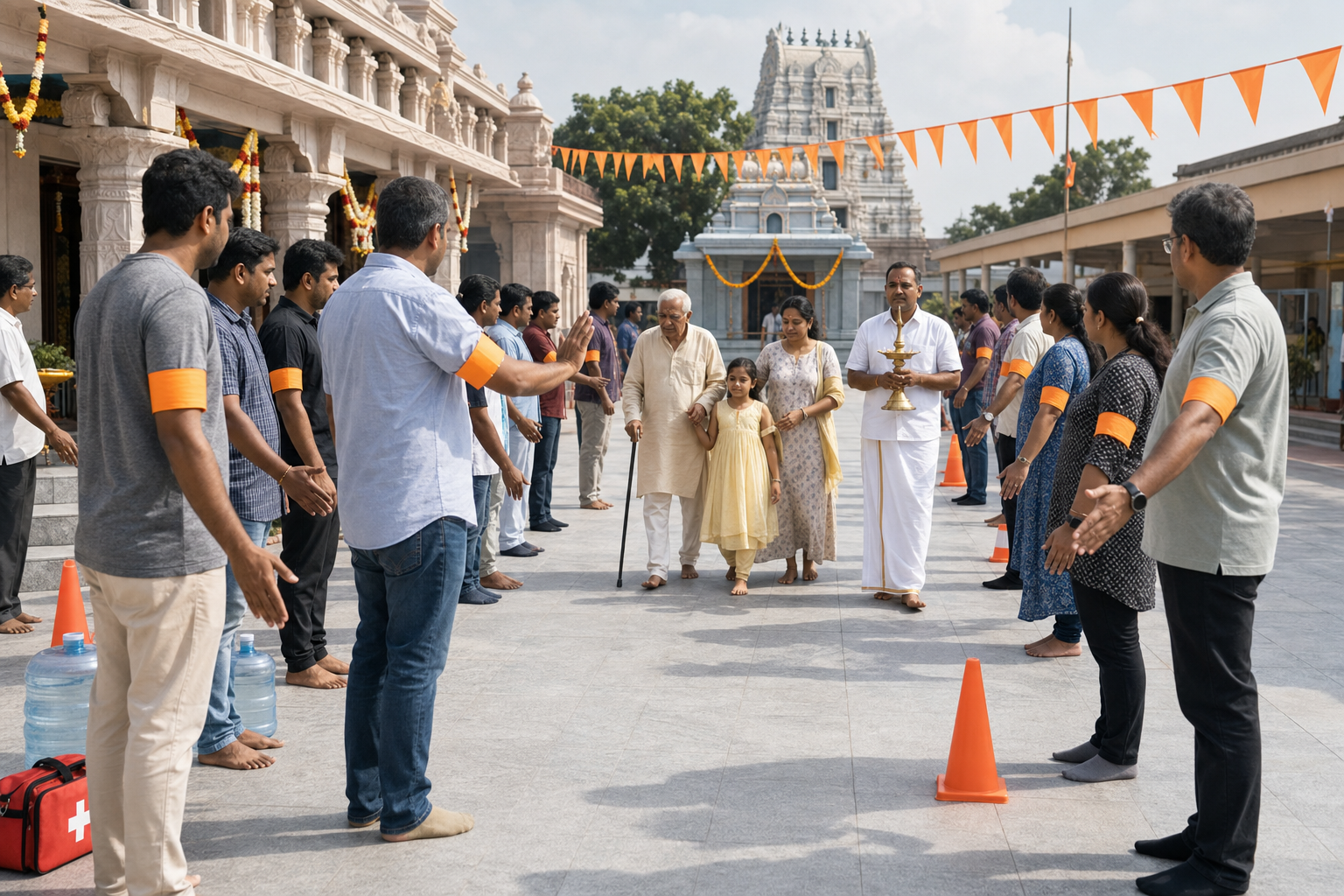
A small interruption becomes dangerous when participants cannot tell whether they are seeing a traffic delay, a disagreement, a rumor, or an attack. The answer is a practiced pause protocol. Only designated leaders should announce a change, and marshals should repeat the same instruction along the route.
What every marshal needs to know
- Who can order a pause, diversion, evacuation, or restart.
- How to contact the police liaison, medical lead, sector coordinator, and backup event lead.
- Where children, elderly participants, and people with limited mobility can be moved away from crowd pressure.
- How to keep emergency lanes and exits open even when participants want to stop and watch an incident.
- How to respond if an object is thrown: don’t throw it back, don’t lead a chase, move people out of danger, alert police, and preserve evidence only when it is safe to do so.
- How to separate witnesses and evidence handlers from the larger crowd so that fact-gathering doesn’t become confrontation.
- Which account is authorized to issue updates and why marshals must not speculate in public groups.
Marshals should correct their own side early. An abusive slogan, attempt to leave the route, confrontation with a bystander, or refusal to clear an emergency lane should not be excused as enthusiasm. Early, proportionate intervention protects the procession from both immediate escalation and later misrepresentation.
The same standard applies to public symbols. Carry them with confidence and care. Keep sacred images and ceremonial vehicles away from crush points. Don’t allow flags, poles, vehicles, or sound equipment to block the marshal’s view or the emergency lane. Reverence includes protecting the people gathered around the symbol.
A Shivaji Jayanti procession is especially ill-served by indiscipline. The commemoration invokes a ruler widely associated with restraint, protection of non-combatants, justice, and respect for places of worship. Concern surrounding a reported stone-pelting incident during a procession in Bagalkot and the ensuing demonstrations in Hubballi shows why organizers need both serious security and a lawful response plan. Until evidence is verified, describe reported details as allegations rather than settled findings.
Don’t make decibel level the measure of Hindu courage. The stronger public signal is a procession that remains devotional, protects vulnerable people, obeys its own leadership, and reaches its destination without letting a provocateur dictate its character.
When provocation occurs, protect people and preserve the truth
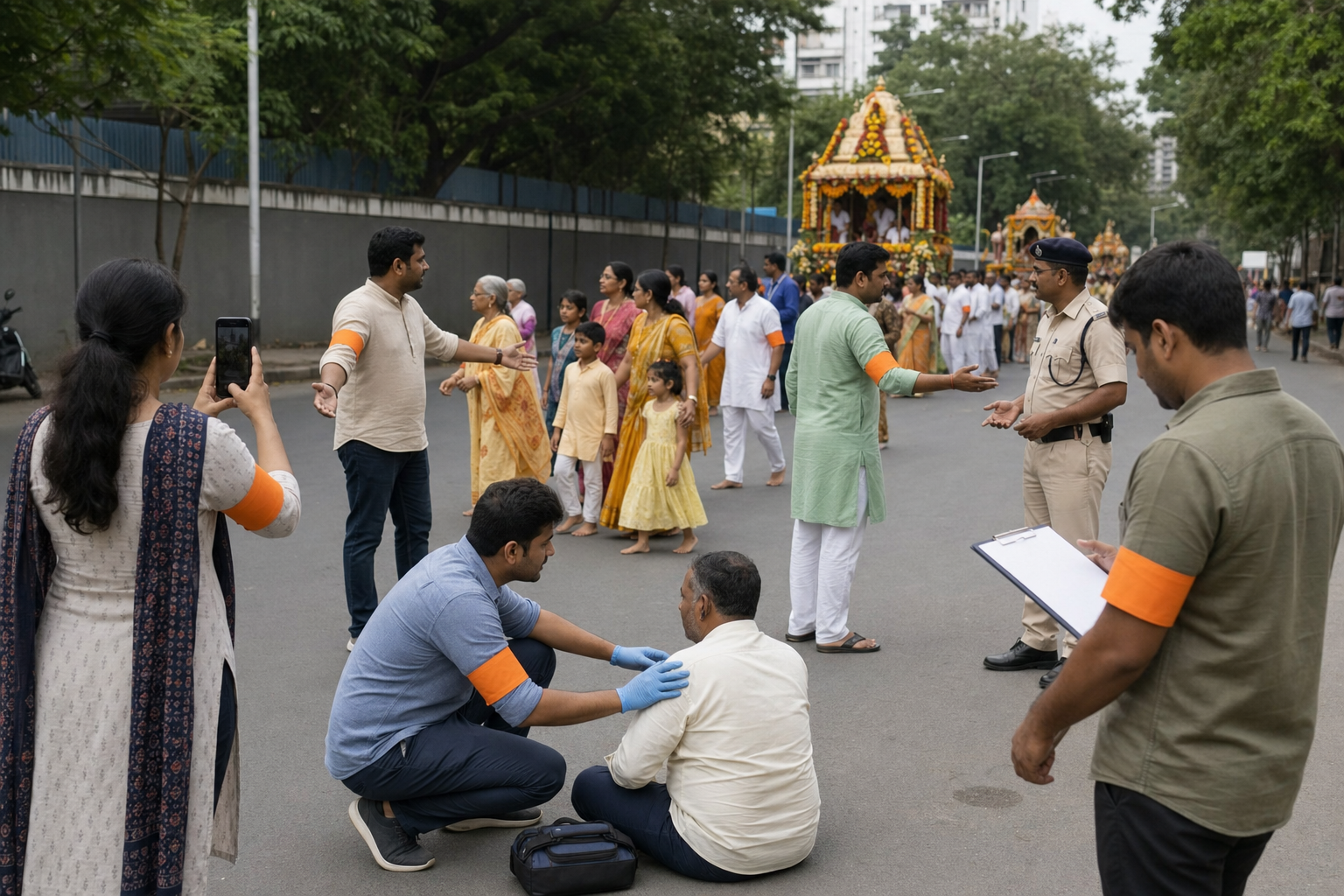
Community harmony doesn’t require silence about anti-Hindu intimidation or violence. If a procession is attacked, organizers should say so accurately, support those harmed, preserve evidence, and demand an impartial investigation. Harmony does require refusing collective punishment, rumor-driven accusation, and retaliation against uninvolved people.
Use this sequence if stones are thrown, a fight begins, property is damaged, or a serious threat emerges:
- Protect life before protecting the schedule. Pause or divert under the designated command. Move participants away from the point of danger, preserve emergency access, and prioritize children, elderly people, injured people, and anyone caught in crowd pressure. Don’t send volunteers into a violent area merely to obtain footage.
- Place police and trained responders between the crowd and the incident. Marshals should hold participants back and prevent pursuit. They should not conduct searches, seize phones, detain suspects, or use violence except where the law permits an immediate act necessary to protect someone from harm.
- Preserve original evidence. Keep the unedited photo or video file, record who made it, and note the approximate time and location. Retain the original device or a secure copy when practicable. Don’t add music, captions, filters, or speculative identifications to the evidentiary copy. Cropping and repeated forwarding can remove context and weaken its value.
- Separate confirmed facts from reports. Maintain a simple incident log with three labels: confirmed, reported but unverified, and false or misattributed. A public update should say what is known, what remains under verification, what safety action has been taken, and when another update can reasonably be expected.
- Use lawful, specific demands. Ask for evidence preservation, an impartial investigation, action against identified offenders through due process, victim assistance, and a review of the route-safety failure. A lawful protest after the event should repeat those demands without doxxing, threatening language, collective accusations, or calls for retaliation.
- Document harm and support victims. Record injuries and property damage through the appropriate official and insurance processes. Help affected people reach medical, legal, compensation, insurance, or psychosocial support as applicable. Don’t allow the public argument to make the injured person an afterthought.
One spokesperson should brief the public. That person should avoid naming an alleged offender before reliable identification, avoid assigning motives not established by evidence, and avoid converting an individual’s act into a charge against a whole community. This is not timid language. It protects the credibility of the complaint and keeps attention on conduct that can actually be investigated.
Social media needs the same discipline. Before sharing a clip, ask whether it shows the claimed place and event, whether the sequence is complete, and whether the date and uploader are known. Send doubtful material privately to the evidence team or authorities instead of testing it on the public. A dramatic falsehood can travel farther than the correction and create danger for people who had no connection to the incident.
After immediate tensions subside, conduct a review with organizers, marshals, authorities, residents, and affected businesses. Identify whether the failure involved route design, communication, sound, crowd density, policing, rumor, or deliberate violence. Assign each correction to a named role before the next event. A generic appeal for peace does not repair a specific operational failure.
Visible service can then reopen ordinary civic life. Medical assistance, help with damaged premises, a cleanup, blood donation, annadanam or langar-style food service, and support for people whose work was disrupted turn dharma into public action. Cross-community participation in such repair is not an admission that the original offence should be forgotten. Accountability and repair can proceed together.
Key takeaways
- A Hindu procession need not dilute its symbols or sacred purpose to be peaceful; it does need enforceable discipline.
- Write the event’s affirmative purpose and participant code before publishing the route.
- Confirm permissions, timing, sound conditions, and route details in writing under the current local rules.
- Walk the route, mark bottlenecks and exits, and assign visible marshals with a clear command structure.
- If provoked, protect people first, prevent retaliation, preserve original evidence, and communicate only verified facts.
- Demand accountability for individual conduct while refusing collective blame, then pair investigation with victim support and practical repair.
Before you issue the next invitation, produce the one-page route sheet and participant code, then hold a marshal briefing around them. That small act converts good intentions into shared instructions. If trouble comes, the same discipline will protect your people, strengthen the demand for justice, and keep the procession worthy of the dharma it carries.
References
- DharmaRenaissance Blog — Mahashivratri in Raigarh: 272 participants reaffirm dharma in a reverent ghar wapsi
- DharmaRenaissance Blog — Hubballi Protests after Shivaji Jayanti Clash: Key Facts, Legal Context, and Hope for Harmony
