
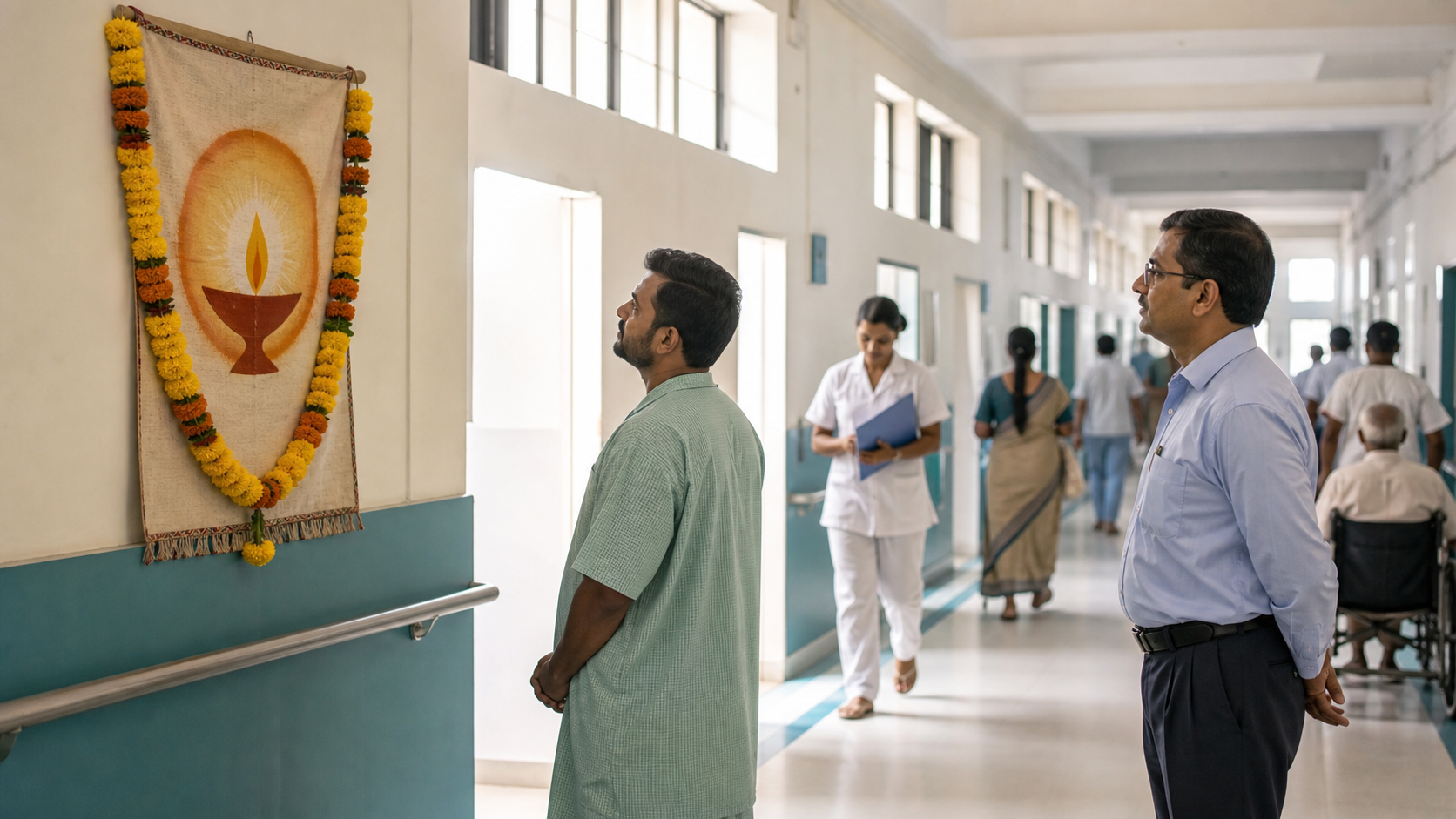
If you have noticed a religious banner in a government hospital, your first question may be whether it belongs there. Do not pull it down, confront the people associated with it, or turn a crowded corridor into a dispute. There is a safer and more effective way to act.
You can assess most displays through three tests: permission, placement and purpose. These tests keep the issue focused on public duty rather than hostility towards any faith. They also give the hospital administration a complaint it can verify and resolve.
Start with permission, placement and purpose
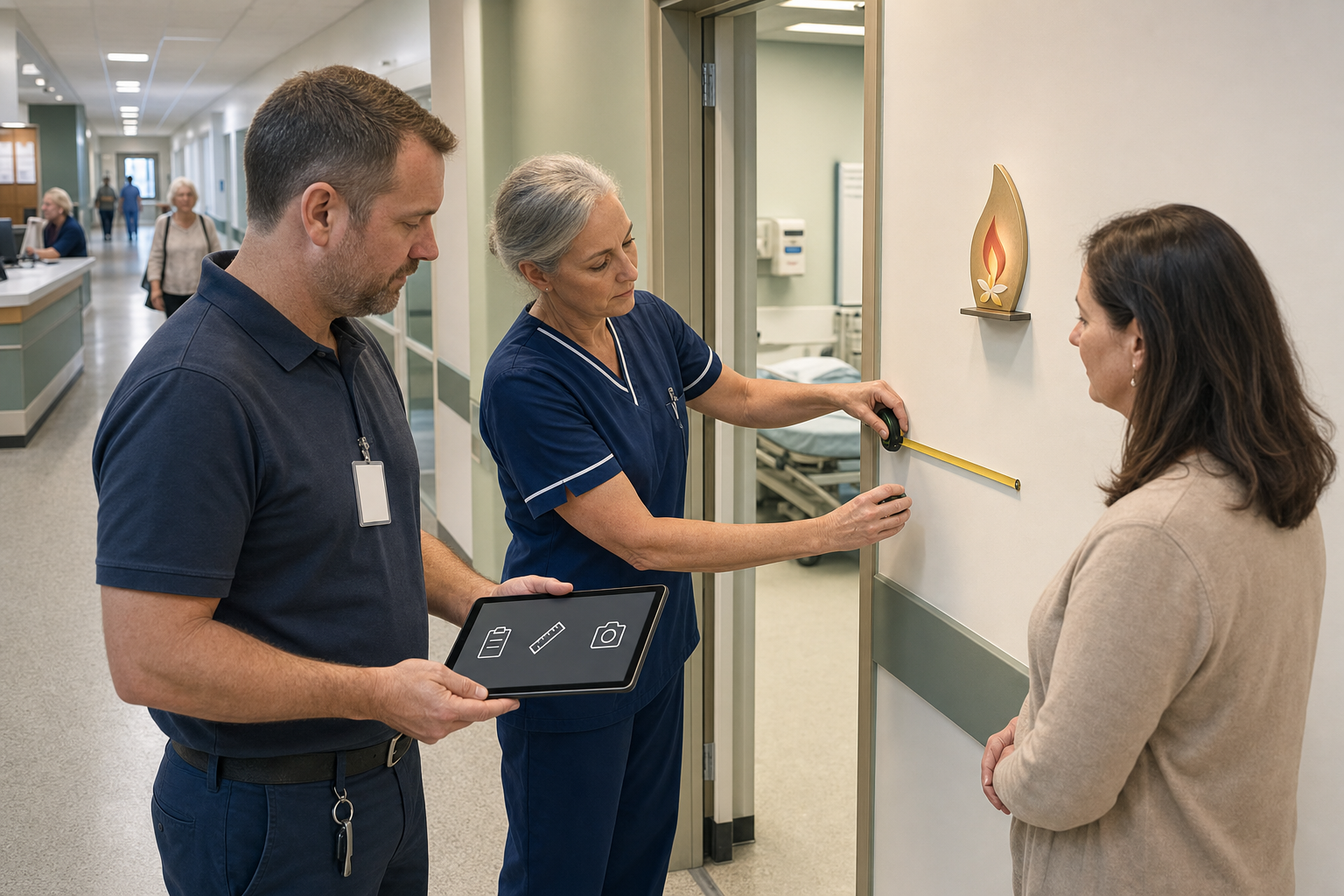
A public hospital is not neutral because everyone inside it has left religion at the gate. It is neutral when the institution controls shared space through patient-centred rules applied equally to every community. Neutrality is an administrative discipline, not a declaration that faith has no place in personal life.
Begin with permission. A Hindu symbol does not make a display unauthorised, just as a secular-looking charity banner does not make one authorised. Ask whether the hospital’s designated officer approved it, whether any required local permission exists, who owns the display and how long it is meant to remain. The absence of a visible approval number is a reason to request verification, not proof that an offence has occurred.
Next, examine placement. A valid message can still be in an unsafe location. Anything near an emergency department, triage desk, ambulance bay, staircase, fire exit or evacuation route deserves immediate scrutiny. Approval does not cure an obstruction, concealment of mandatory information or interference with clinical work.
Finally, identify the purpose. Patient-rights charters, emergency directions, treatment instructions, infection-control notices and information about government health programmes belong to the hospital’s work. An external event announcement, sectarian appeal, political message or private promotion serves a different purpose and ordinarily needs explicit clearance. Functional clinical areas are usually the least suitable place for it.
In Ratnagiri, a formal representation prompted the District Government Hospital to verify and remove unauthorised banners from its premises. The practical lesson is procedural: document the concern, place it before the competent authority and let that authority check the permission record.
In Maharashtra, an unauthorised display on government property may engage municipal by-laws as well as the Bombay Prevention of Defacement of Property Act, 1995. Depending on the location, approval may be required from both the local authority and the government facility. The precise legal route depends on the facts and locality, so use these rules as grounds for an official inquiry rather than making an unsupported criminal allegation yourself.
This distinction matters from a Dharmic perspective. Seva in a hospital is directed towards the person who needs care, without first asking which sampradaya, panth or community that person belongs to. A uniform rule protects Hindus, Buddhists, Jains, Sikhs and every other patient from arbitrary institutional messaging. It also prevents religious identity from being dragged into a dispute that is really about unauthorised use of public property.
A banner can become a clinical-safety problem

Religious content may attract attention, but content is not always the most urgent issue. In a hospital, a display can create a problem simply because of what it covers, where it hangs or how it is fixed.
- Emergency movement: A banner must not narrow a route used by stretchers, wheelchairs, staff or evacuating patients.
- Wayfinding: It must not compete with or conceal directions to casualty, wards, diagnostics, pharmacies, exits or ambulance access.
- Fire safety: Flex, cloth and similar materials can add combustible material near electrical fixtures or congested passages.
- Infection prevention: Hanging material can collect dust, complicate cleaning and interfere with airflow or routine sanitation.
- Clinical communication: Promotional material must not obscure patient notices, treatment instructions, statutory information or infection-control advisories.
- Patient attention: Families under pressure should not have to search through visual clutter to find essential directions.
These are not theoretical concerns. Non-clinical displays can interfere with cleaning, airflow, fire precautions and emergency information. If you see a banner covering an exit sign, touching electrical equipment, obstructing a passage or interfering with urgent movement, notify hospital security or the responsible staff member immediately. Do not wait for the ordinary complaint process, and do not try to detach the material yourself.
If there is no immediate hazard, resist dramatic language. Record exactly what the display does. A statement such as the banner partially covers the fire-exit arrow gives an administrator something concrete to inspect. A broad claim that the hospital has become communal is harder to verify and easier to dismiss.
How to report a display without escalating the situation

A useful complaint creates a clean administrative trail. It identifies the display, asks the right authority to check its status and requests a proportionate remedy. You do not need to settle the religious or legal question in the corridor.
- Protect care and privacy first. Stand clear of patients, staff and emergency movement. If you take a photograph, frame the display and its location without capturing identifiable patients, medical papers or computer screens.
- Record verifiable details. Note the hospital building, floor, ward or corridor; the nearest room, gate or landmark; the date and time; the wording or sponsoring organisation shown; and any sign, doorway, fixture or route affected.
- Ask who approves displays. Hospital security, the enquiry desk or the administrative office should be able to direct you to the superintendent, institutional head or designated facilities officer. Ask for the signage or display policy if one is available.
- Submit a written representation. Keep it short and factual. Address it to the competent hospital authority. Where municipal signage or public-property rules are relevant, send a copy to the appropriate local body rather than circulating accusations on social media.
- Request verification and a specific remedy. Ask the authority to check the permission record and inspect the location. Request removal if the material is unauthorised, or relocation if the message is permitted but the placement is unsafe.
- Keep the acknowledgement. Obtain an inward number, complaint number, email receipt or stamped copy. This lets you follow up without repeatedly starting the matter from the beginning.
- Ask for the recorded outcome. A useful response should state whether permission existed, whether an inspection occurred and what corrective action was taken. If the display remains, ask for its approving authority and permitted duration.
You can use this wording: Please verify whether the display at [exact location] has current institutional approval and any local permission required. It appears to [describe the obstruction or safety concern]. If it is unauthorised or improperly placed, please remove or relocate it under the applicable policy and record the action taken.
Avoid demanding removal solely because you disagree with the message. Equally, do not accept religious sentiment as a substitute for permission. The strongest representation asks for the same documentary test that should be applied to every organisation.
Do not tear down, damage or seize the display. Apart from creating a confrontation in a place of care, doing so may create a separate property or safety dispute. If the administration rejects your representation and you believe a specific law has been breached, seek advice from a qualified local lawyer or use the applicable statutory grievance channel before taking further action.
What a fair hospital signage policy should contain

Removing one banner solves one incident. A written policy prevents the next one from becoming a communal contest. If you serve on a hospital committee, local body or community organisation, ask whether the institution has the following controls.
- One approval route: A named officer or single-window process should receive applications and maintain the permission record.
- Clear display classes: The policy should distinguish mandatory clinical and statutory information from approved temporary notices and prohibited external promotion.
- A zone map: Emergency rooms, triage areas, ambulance approaches, evacuation routes, stairwells, fire exits and treatment corridors should be protected from non-clinical displays.
- Ownership and duration: Every temporary display should identify its responsible party, approving authority, location and removal date.
- Safety review: Infection-control and fire-safety rounds should include banners, posters, cloth, flex and other temporary materials.
- A takedown procedure: Staff should know who verifies permission, documents the material, authorises removal and records the outcome. Where the rules allow it, costs can be recovered from repeat violators.
- Uniform application: The same requirements should govern Hindu, Buddhist, Jain, Sikh, Christian, Muslim, political, commercial and ostensibly secular organisations.
- Public visibility: Permitted locations, approval contacts and display periods should be published on a notice board or institutional website so that staff and citizens can check the rule.
A designated community notice board outside clinical and emergency zones can provide a practical outlet for approved announcements. Festival information or community notices placed there can be reviewed for safety, duration and informational value without turning wards and corridors into advertising space.
Hospitals can also measure whether the policy works. Useful indicators include the number of display complaints, the time taken to remove unauthorised material, compliance found during safety rounds and patient feedback about wayfinding. A digital register of permissions and removal actions makes selective enforcement harder to conceal.
Neutrality fails when it becomes selective secularism: strict scrutiny for one community and indulgence for another. The remedy is not a permanent exemption for a preferred banner. It is a transparent rule, a visible permission trail and equal enforcement. That protects Dharmic communities far better than an improvised contest over wall space.
Key takeaways
- Judge a hospital display first by permission, placement and purpose, not by whether you support its message.
- Treat obstruction of emergency routes, exits, clinical information or cleaning as an immediate safety concern.
- Document facts without exposing patients, then submit a written representation to the designated hospital authority.
- Ask for verification, inspection and a recorded outcome rather than declaring illegality without the permission file.
- Support one written policy for every religious, political, charitable and commercial organisation.
If a display is in front of you now, take the smallest effective step: note its exact location, record any concrete hazard and ask the hospital administration to verify its approval. A calm paper trail can remove an unauthorised banner while preserving the dignity of patients, the authority of the institution and harmony among communities.
References
