
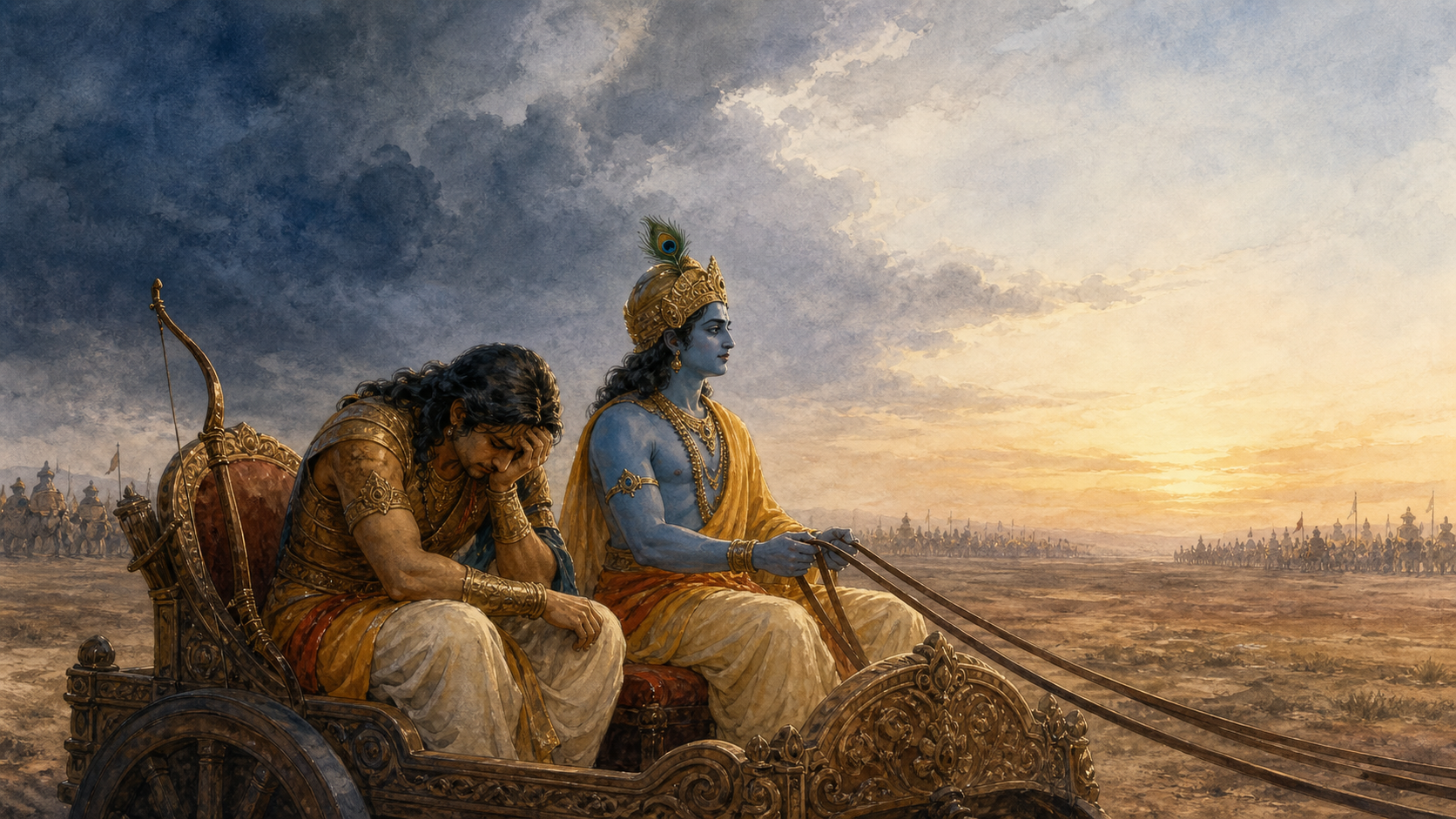
If grief has made your next duty feel impossible, the Bhagavad Gita does not ask you to pretend that pain is peace. It gives you a more exact task: let the crisis reveal where love, fear, attachment, conscience, and dharma have become entangled.
Advaita adds a second movement. You face the loss fully at the level of lived life, while learning not to reduce the whole Self to a changing state of mind. The aim is neither to glorify grief nor to rush past it. It is to move from honest viṣāda to a clear next act.
Arjuna’s collapse is a doorway, not the destination
The battle has not yet begun when Arjuna sees teachers, relatives, friends, and former companions on both sides. He anticipates not only death but the ruin of relationships, family duties, and social order. His body registers the conflict before his reasoning can resolve it: he trembles, his mouth dries, his skin burns, and his bow slips from his hand. The traditional colophon calls this crisis Arjuna Viṣāda Yoga.
That title does not mean every form of despair is automatically yoga. Viṣāda is dejection, while yoga is discipline, integration, and the yoking of your faculties to truth. Grief becomes yogic by what it sets in motion. It makes the disturbance visible, exposes the inadequacy of your usual assumptions, and forces the question that comfort alone cannot answer: what is the right thing to do?
Arjuna’s situation is also more specific than ordinary bereavement. He is experiencing anticipatory grief and moral paralysis before a consequential action. You should therefore not copy his eventual decision as though every conflict were Kurukṣetra. The transferable teaching is the inner sequence by which confused emotion becomes disciplined discernment. Your duty may be to act, refrain, apologize, protect someone, complete a ritual, accept a limit, or seek help.
- The pain is reported honestly instead of being hidden behind pious language.
- The competing obligations are named instead of being collapsed into a vague feeling of guilt.
- Self-certainty gives way to teachability.
- The search turns from immediate relief, preyas, toward the truly beneficial, śreyas.
- Counsel ends in responsible action rather than permanent withdrawal.
The hinge comes in Bhagavad Gita 2.7. Arjuna admits that his understanding of dharma is confused and says, śiṣyas te ‘ham: I am your student. Teach me. Until then, he has been arguing from within his distress. Now he recognizes that the distressed mind cannot be both the problem and the sole judge of its solution.
Kṛṣṇa does not congratulate him for remaining incapacitated. He challenges the paralysis and begins the discipline of knowledge, action, devotion, and equanimity. That gives you a practical test. If grief is being used to justify rumination, revenge, or the abandonment of every obligation, it has not yet become yoga. If it is making you more truthful, teachable, discriminating, and responsible, it has begun to serve yoga.
You do not have to force that transition on an artificial timetable. In an acute period, your immediate dharma may include eating, sleeping, receiving company, observing the appropriate rites, and postponing a nonessential decision. Honest limitation is different from making paralysis into a permanent identity.
The Advaitic shift: grief is present, but it is not the whole Self
An Advaitic reading is not the Gita’s only sampradāyic reading. It is, however, especially precise about the difference between having an experience and being defined by it. Advaita maintains two orders of reality: vyāvahārika and pāramārthika.
At the empirical, vyāvahārika, level, the person you love is not interchangeable with anyone else. A death, separation, betrayal, or failed responsibility has consequences. Promises, funeral duties, dependants, boundaries, justice, and care all matter. Advaita does not give you permission to erase these facts.
At the ultimate, pāramārthika, level, your innermost identity is not the body-mind personality undergoing one particular condition. The identity of Ātman and Brahman means that consciousness is not divided into a separate, permanently wounded substance every time its contents change. Thoughts, memories, sensations, and roles appear to awareness; they do not exhaust what awareness is.
This is why mithyā must not be translated in practice as meaningless or nonexistent. It means dependent reality: real enough to require an ethical response, but not independent or ultimate. A wave is not separate from water, yet its particular shape can still overwhelm a boat. In the same way, grief deserves care without being granted the final word about the Self.
A short inquiry when a wave of grief rises
Use this inquiry only to loosen total identification, not to suppress feeling or manufacture a dramatic spiritual state.
- Name what is known. Silently note: this pressure in the chest is known; this memory is known; this thought that life is ruined is known; this wish for the past is known.
- Notice change without arguing with it. Sensations intensify and recede. Images replace one another. Even the sentence you keep repeating has a beginning and an end.
- Turn toward the knower. Ask: what is aware of these changing contents? Do not rush to answer with the word Brahman. Let the distinction between awareness and its objects become experientially clear.
- Hold both levels together. Say: this grief is present and requires care at the empirical level; it does not contain the full truth of what I am.
- Return to dharma. Ask what the situation now requires from this body, mind, role, and relationship.
A single exercise cannot establish Advaitic realization. Traditional practice matures through śravaṇa, receiving the teaching; manana, resolving doubts through reason; and nididhyāsana, sustained assimilation. The immediate value of the inquiry is narrower and practical: it creates enough space between awareness and mental weather for a responsible choice to become possible.
Three ways non-duality becomes emotional avoidance
Mistake 1: The loss is only mithyā, so it should not hurt
This confuses dependent reality with nonexistence. Your relationship, duties, and embodied nervous system operate within empirical life. Tears do not disprove knowledge, and numbness does not prove it. Let the emotion be present while distinguishing it from the claim that you are nothing but the emotion.
If you are accompanying another grieving person, lead with presence and practical care. Metaphysics offered before it is wanted can become a refined form of cruelty. Bring food, listen, help with the necessary duty, or sit quietly. Teachings about the deathless Self belong in a relationship of readiness and trust.
Mistake 2: The Self is not the doer, so no duty remains
Ultimate non-doership does not cancel empirical responsibility. The person who uses Advaita to evade a promise is still acting at the level where promises, causes, and consequences operate. The more reliable sign of discernment is cleaner action with less egoic grasping, not a clever reason to disappear.
Ask a concrete question: which obligation would I still recognize if the emotional intensity were lower? That question separates a real duty from the impulse to make pain stop at someone else’s expense.
Mistake 3: Equanimity means becoming emotionally blank
The Gita’s samatva is steadiness amid changing outcomes, not the destruction of human responsiveness. Arjuna’s compassion needs clarification because attachment and confusion have entered it; compassion itself is not condemned. Likewise, your task is not to become incapable of sorrow. It is to stop allowing sorrow alone to issue commands.
A useful sign of growing equanimity is not that you feel nothing. It is that you can feel what is present, hear counsel you did not choose, and complete a necessary action without hatred, panic, or the demand that the outcome immediately soothe you.
Use six movements before a grief-stricken decision
When grief and duty collide, do not begin with a grand question such as what should I do with my life. Work through the conflict in an order that prevents the loudest feeling from deciding everything.
- Report before interpreting. Write four lines: what has happened; what your body is doing; what thoughts are recurring; and what you feel driven to do. Keep facts separate from predictions. The fact may be that a relationship ended. The prediction that you will always be alone belongs on the thought line.
- Name the collision of values. Complete the sentence: I am torn between this obligation and that obligation. Be specific. You may be balancing loyalty against truth, compassion against justice, family expectation against conscience, or rest against care for a dependant. A named conflict can be examined; undifferentiated guilt cannot.
- Distinguish preyas from śreyas. Ask which option offers the quickest emotional relief and which remains defensible after the emotional weather changes. They may occasionally be the same, but do not assume that they are. Immediate relief can conceal avoidance, while the right action can initially feel harder.
- Adopt the student’s posture. Take the written conflict to one competent person who is able to challenge you: a trusted guru, elder, counsellor, clinician, or mentor suited to the actual problem. Do not assemble a chorus until someone approves the choice you already prefer. Ask what you may be failing to see.
- Apply Advaitic discernment. State both truths without blending them: this grief is a present condition of the body-mind and deserves care; it is known in awareness and is not the entirety of the Self. If the second statement makes you less humane or less responsible, you are using it incorrectly.
- Complete one clean duty and release the demand for a particular feeling. Make the necessary call, attend the rite, care for the person who depends on you, tell the truth without aggression, or defer an irreversible choice that does not need to be made now. The first action should be definite enough to complete, not an attempt to solve the rest of your life in one stroke.
Before acting, run one final screen: Am I choosing what is right or merely what stops discomfort fastest? Does the action require me to deny a known fact? Does it honour the legitimate claims of everyone affected? Have I sought counsel from someone qualified for this kind of decision? Can I perform it without revenge? A no answer does not always settle the decision, but it identifies where further discernment is needed.
Spiritual practice is not a substitute for mental-health care. If you cannot keep yourself safe, are in immediate danger, or cannot manage basic care, seek urgent help from a trusted person, a qualified professional, or local emergency services. If grief continues to prevent sleeping, eating, working, or caring for yourself, speak with a clinician rather than interpreting the deterioration as advanced vairāgya. Gita study, ritual, prayer, and Advaitic inquiry can accompany appropriate care.
Key takeaways
- Arjuna’s grief is called yoga because it initiates honest examination, teachability, discernment, and action. Mere despair is not itself a spiritual accomplishment.
- An Advaitic reading does not make loss nonexistent. It holds empirical responsibility and ultimate non-duality together.
- The sentence grief is known creates a useful opening: the experience is present, but it does not exhaust the knower.
- The decisive question is not what will make me feel better fastest, but what serves śreyas, the genuinely beneficial.
- Clearer action is a better test of insight than spiritual language. Knowledge that produces avoidance, indifference, or broken duty has been misapplied.
- Severe or unsafe distress calls for human and professional support, not solitary metaphysical effort.
Before your next consequential choice, write the four-line report, name the two duties in conflict, and ask one competent person what you are not seeing. Then complete one clean responsibility without waiting for grief to disappear. That is a workable beginning: viṣāda is seen, the Self is not reduced to it, and dharma becomes possible again.



References
- DharmaRenaissance Blog — Why Arjuna’s Grief Is Called Yoga: The Transformative Power of Viṣāda in the Bhagavad Gita
- DharmaRenaissance Blog — Two Yet One: Advaita Vedanta’s Science of Oneness and a Dharmic Bridge across Traditions
