
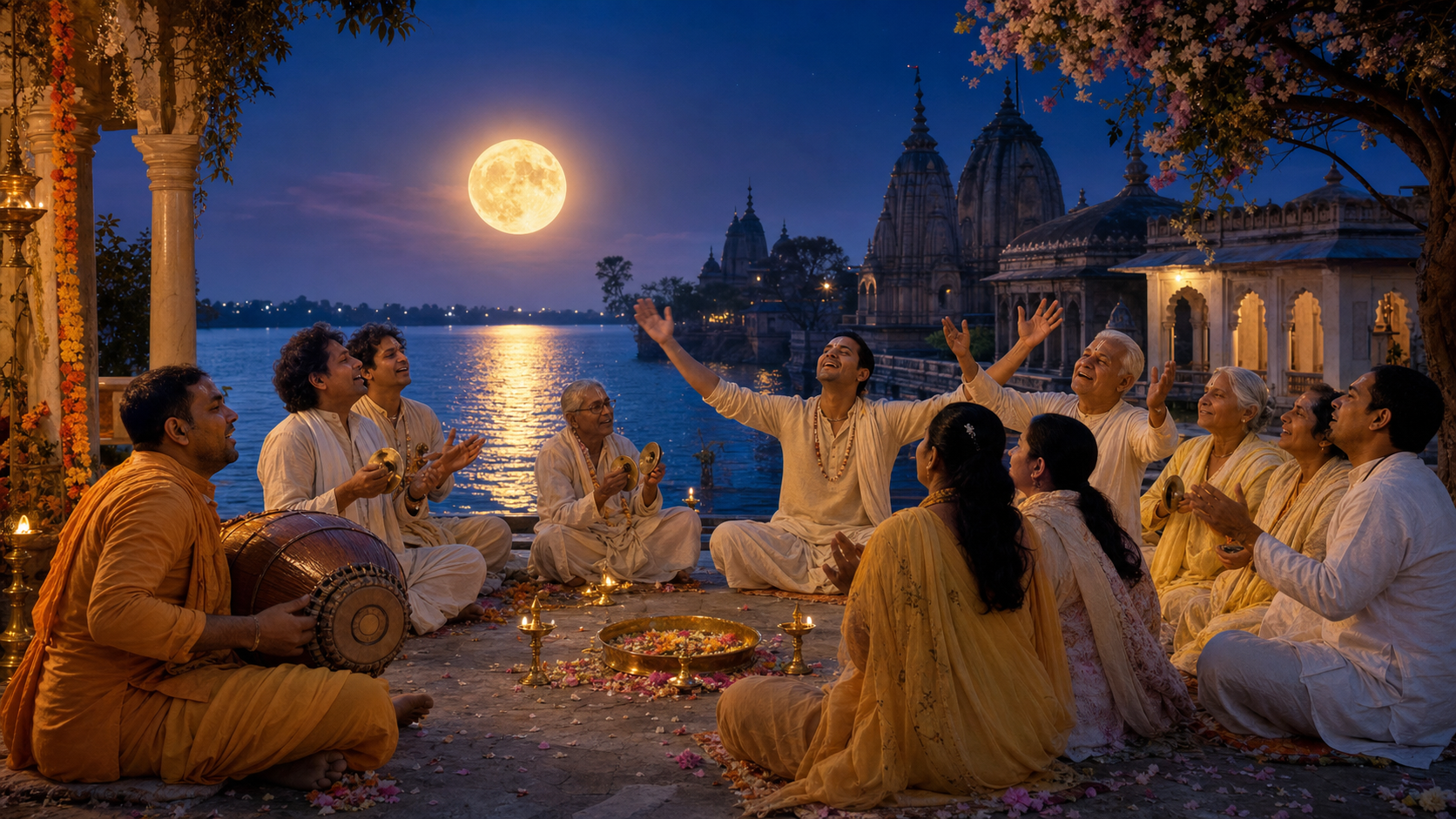
If you want March 2026 to become a month of real sadhana, a crowded festival list is the wrong starting point. The useful questions are simpler: Which tithi is active where you live? What does your sampradaya ask you to do with it? Which practice can you sustain after the lamps are put away?
Gaura Purnima gives the month a natural center. Around that full moon sit Ekadashi, Pradosham, Sankashti Chaturthi, Masik Shivaratri, Amavasya and a solar transition. You do not need to perform every possible vrata. You need a reliable local calendar, a clear devotional priority and enough restraint to keep observance from becoming spiritual clutter.
Follow the tithi, not the square on your calendar
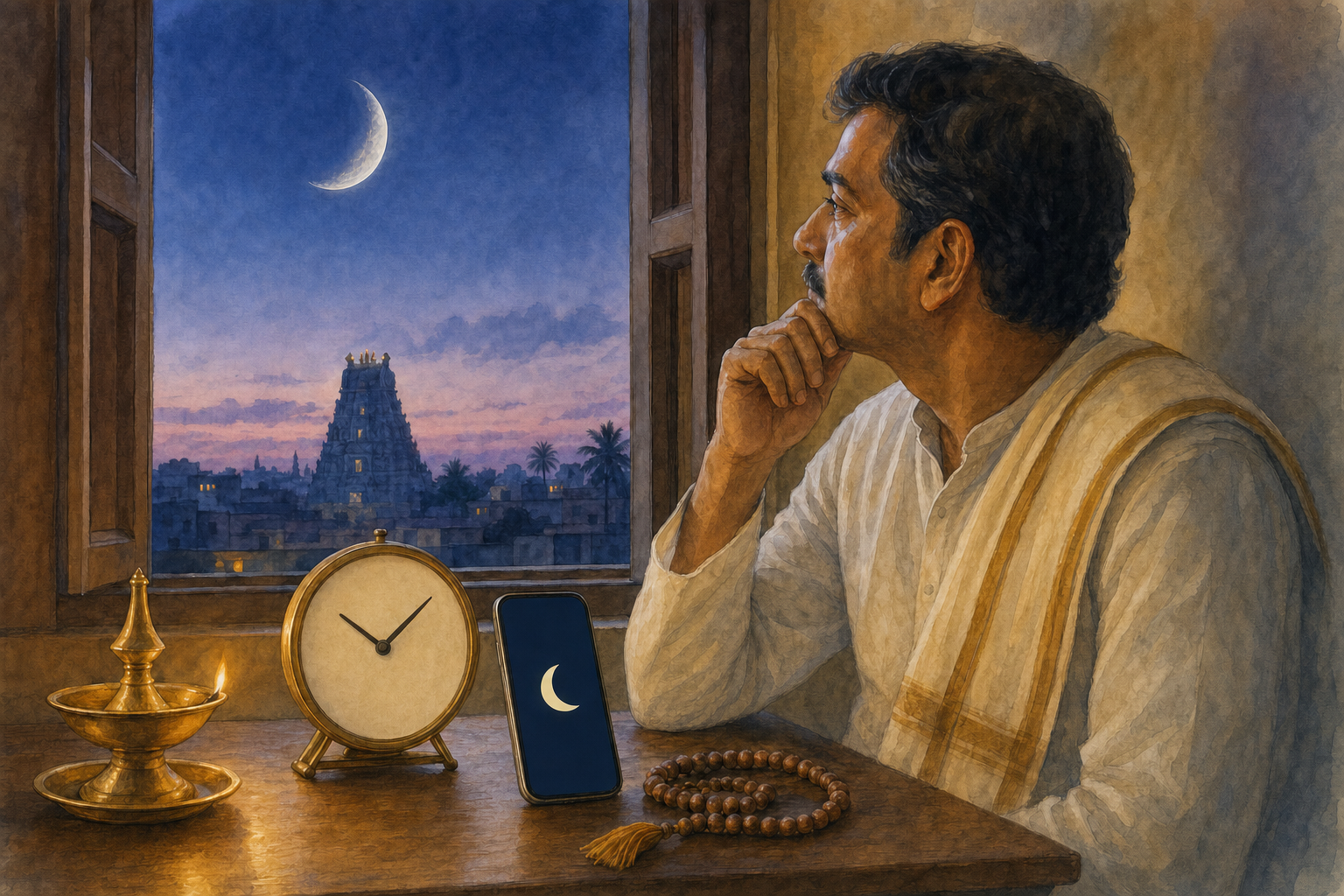
A civil date changes at midnight. A tithi does not. Each tithi corresponds to a 12-degree change in the angular separation of the Moon and Sun, so it can begin or end at almost any hour. The same tithi may touch two civil dates, and the religious observance may belong to only one of them.
This is why a festival date copied from a foreign time zone, a generic phone calendar or even another Indian city can mislead you. Sunrise may determine one vrata, sunset another and moonrise a third. Night-centered observances such as Masik Shivaratri require particular attention to the tithi prevailing during the relevant night period.
The vocabulary can also change when families use different regional calendars. March 2026 crosses a month boundary in several systems:
| Calendar tradition | March 2026 transition | What it means for you |
|---|---|---|
| North Indian Hindi calendar | Falgun to Chaitra | Gaura Purnima is identified with the Falgun or Phalguna full moon. |
| Telugu, Kannada, Marathi and Gujarati calendars | Phalguna to Chaitra | The spelling may differ, but the observance is still located by tithi. |
| Bengali Panjika | Falgun to Chaitra | This is the regional setting most closely associated with Sri Chaitanya Mahaprabhu’s appearance in Navadvip. |
| Tamil solar calendar | Masi to Panguni | The solar month changes independently of the lunar tithi sequence. |
A practical March 2026 observance map contains one Purnima, one Amavasya, two Ekadashis, two Pradosham periods, one Sankashti Chaturthi and one Masik Shivaratri. Meena Sankranti belongs to the solar calendar, while Panguni Uttiram may fall near the end of March or in early April depending on the applicable alignment. Do not force Panguni Uttiram into your March plan before a locality-specific Panchang confirms it.
Use this four-part check before writing any date into your diary:
- Set the Panchang to the place where you will actually observe the vrata. If you are traveling to Kanchipuram, use Kanchipuram in Indian Standard Time rather than your home city.
- Read the tithi’s start and end times, not only the festival label printed beside a civil date.
- Check the marker specific to the observance: local sunset for Pradosham, moonrise for Sankashti and the relevant night segment for Masik Shivaratri.
- For temple worship, confirm the institution’s final schedule. A Peetham or temple may apply its established Panchang, siddhanta and ritual conventions to a boundary case.
India does not use Daylight Saving Time. If you are coordinating a livestream, calling relatives or arriving from a country that changes its clocks, calculate the conversion for the actual date rather than relying on a familiar seasonal difference.
Gaura Purnima is a full moon with a particular claim
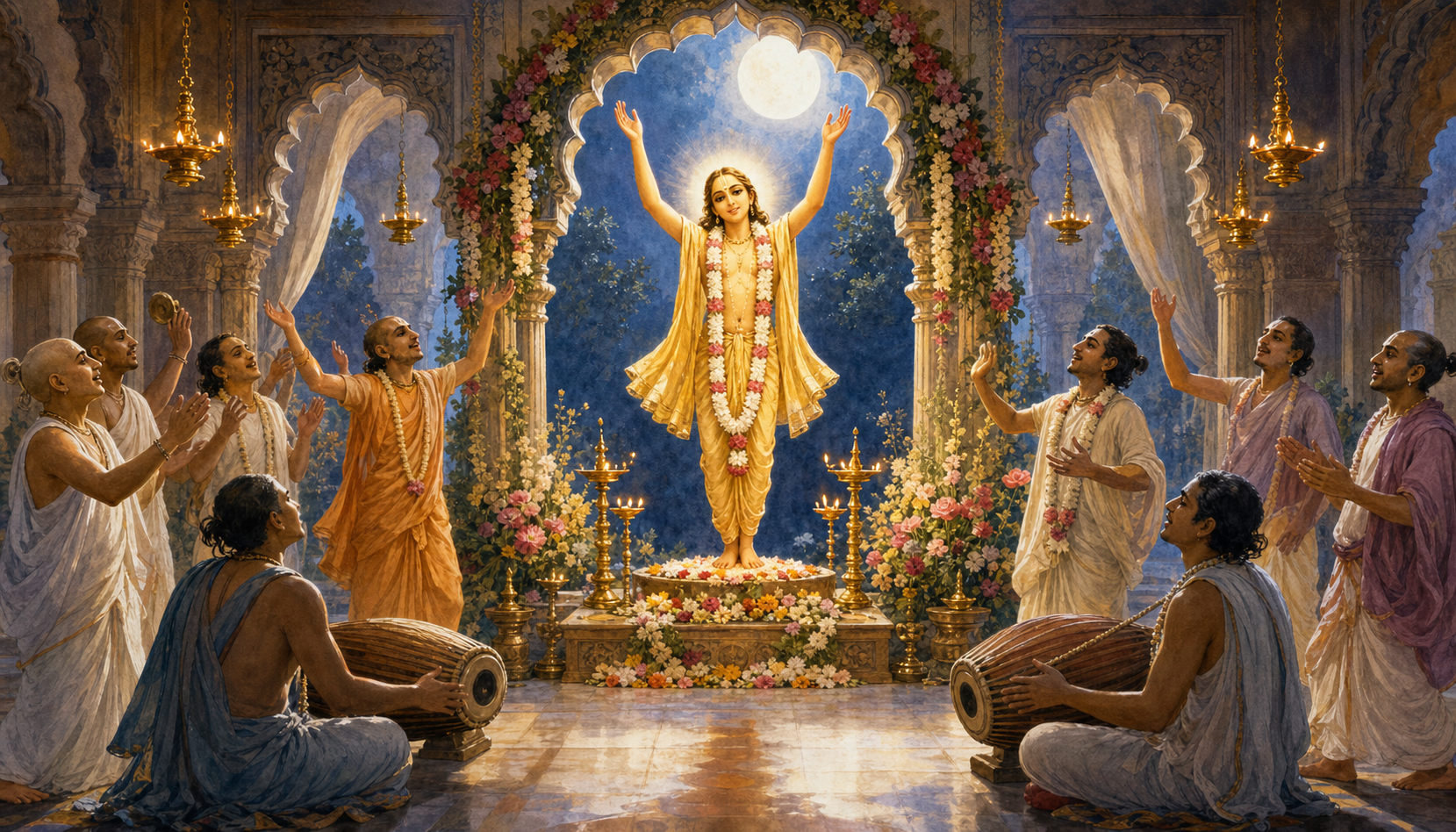
Every Purnima is a lunar culmination, but Gaura Purnima is not merely a generic full-moon puja with a regional name. It commemorates Sri Chaitanya Mahaprabhu’s appearance in Navadvip in 1486 CE and begins the Gaurabda lunar year for many Gaudiya Vaishnava communities, including ISKCON.
Its central narrative begins with Sri Advaita Acharya’s concern that religious display had displaced inner devotion. Gaudiya biographies describe him worshipping the shaligrama with Ganga water and Tulasi leaves, fasting and calling upon Krishna to descend for the sake of people struggling in Kali Yuga. Gaudiya theology understands Sri Chaitanya’s advent as the answer to that compassionate invocation.
This matters because the festival is not fundamentally about admiring a past event. It asks whether your devotion can become audible, shared and useful. Nama-sankirtana turns remembrance into collective practice. Seva tests whether the feeling awakened in kirtan changes the way you treat guests, family, strangers and vulnerable members of the community.
Gaudiya Vaishnavism expresses Sri Chaitanya’s identity through achintya-bhedabheda, the teaching of inconceivable simultaneous oneness and difference. Sri Chaitanya is revered as Krishna bearing Radha’s devotional mood, revealing love of Krishna through hearing, chanting, remembrance and surrender. You do not need to compress this theology into a slogan. If it is new to you, begin with one primary act of bhakti and learn the doctrine within the lineage that preserves it.
The nine limbs of bhakti provide a practical way to choose that act. If congregational kirtan is available, chant. If illness, distance or family duties keep you home, hear a reading, remember the Divine Name, make a simple offering or perform service. The purpose is participation, not imitation of a program you cannot honestly sustain.
Do not erase sampradaya differences in the name of unity. At a Gaudiya temple, the Phalguna full moon centers on Gaura-Nitai, kirtan, devotional reading, abhisheka and prasada. At Sri Kanchi Kamakoti Peetham, full-moon worship may emphasize Sri Chandramouleeswara, Vedic recitation and Devi upasana. Both belong within the breadth of Hindu dharma, but their ritual forms are not interchangeable. Let your lineage guide your personal vrata, and let the host institution guide your conduct when you visit another sacred space.
Build March as a sequence, not a pile of festivals
A lunar calendar becomes useful when each observance has a distinct spiritual job. Assigning every day the same long list of recitations usually produces fatigue, guilt or hurried performance. A better plan gives each tithi one clear emphasis.
- Ekadashi: March has a Shukla-paksha and a Krishna-paksha Ekadashi. Use them to simplify food, speech and distraction. Vishnu Sahasranama, a Bhagavad Gita reading and deliberate dietary restraint fit the day. Decide your vrata before Ekadashi begins so that hunger does not become the moment when you invent the rules.
- Pradosham: Each fortnight brings a Trayodashi twilight for Shiva upasana. The worship window is centered on local sunset and is commonly treated as extending roughly one and a half hours on either side. Arrive early if you are going to a temple. At home, choose bilva-archana, Panchakshari japa, Sri Rudram or Lingashtakam according to your training and capacity.
- Purnima and Gaura Purnima: Let the full moon expand devotion outward. A Gaudiya observance gives priority to nama-sankirtana, the life and teaching of Sri Chaitanya, Tulasi offering and seva. If you also maintain a family Purnima practice, keep the two commitments intelligible rather than combining mantras and procedures at random.
- Sankashti Chaturthi: This Krishna-paksha Chaturthi follows Purnima. It turns attention to Sri Ganesha, humility and the removal of obstacles. Ganesha archana and Ganapati Atharvashirsha are fitting practices. If you follow the customary fast until moonrise, use the moonrise time for your own locality.
- Masik Shivaratri: Krishna-paksha Chaturdashi carries a night-centered contemplative tone. Reduce the program if necessary, but preserve the night orientation through Shiva dhyana, Panchakshari japa or recitation you can perform attentively.
- Amavasya: Treat the dark-moon pivot as a reset. Extend japa, make a clear sankalpa and offer satvika dana. You can write one discipline at Amavasya and review it at the next Purnima; the fortnight then becomes a lived unit of self-observation rather than a sequence of unrelated holy days.
- Meena Sankranti: This is a solar ingress, not a lunar tithi. Surya arghya and reflection on right conduct fit its emphasis on steadiness. Keeping it separate prevents confusion when a lunar date and a solar transition appear close together.
If food restriction is unsafe because of medication, pregnancy, age or a health condition, do not treat physical strain as proof of devotion. Follow appropriate medical guidance and ask a qualified teacher in your tradition how to keep a non-food vrata through simplified meals, reduced indulgence, additional japa or seva.
There is a wider Dharmic grammar here without a single uniform ritual. Buddhist Uposatha uses lunar pivots for intensified practice. Jain Pratikraman cultivates disciplined introspection around recurring temporal markers. Sikh Sangrand recognizes the monthly solar ingress. These are not substitute names for Hindu vratas, and their doctrines should not be flattened into one system. What they share is the decision to make time morally and spiritually consequential.
Keep Gaura Purnima simple enough to change your conduct
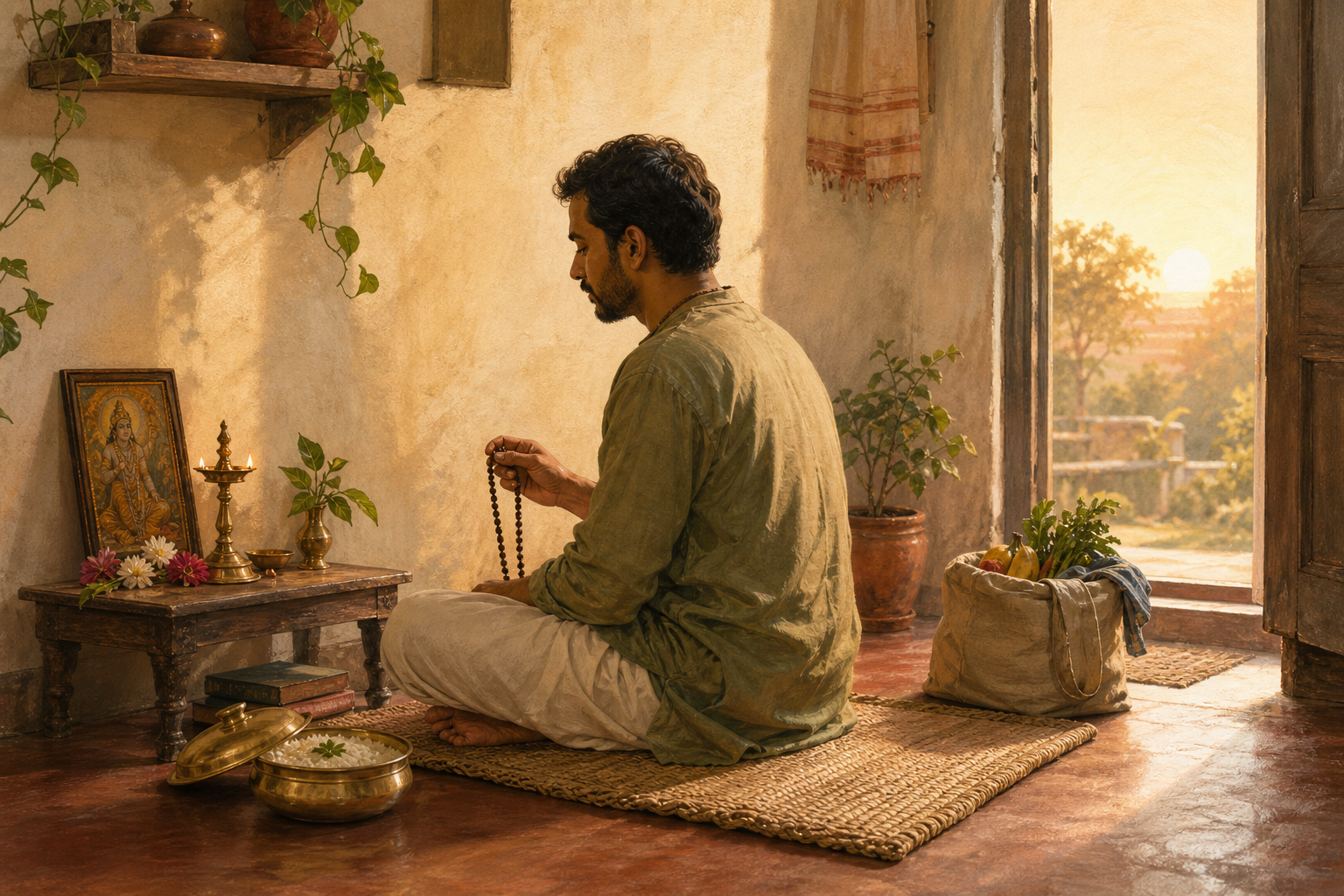
A home observance you can complete
A household does not need to reproduce a large temple festival. It needs a clean sequence in which preparation, hearing, chanting and service support one another.
- Confirm the local timing. Check which civil date receives the Phalguna Purnima observance and note the local moonrise. Do this before inviting guests or promising attendance elsewhere.
- Prepare a simple sacred space. Clean the altar area and arrange only offerings your household normally uses, such as flowers, a lamp and Tulasi. Simplicity is preferable to an improvised ceremony whose rules you do not know.
- Choose the reading in advance. Read a manageable passage from Chaitanya-bhagavata or Chaitanya-charitamrita, supported by the Bhagavad Gita or Srimad Bhagavatam. Select the passage beforehand so the gathering does not become a search through several books.
- Keep the daytime vrata according to capacity. Many Gaudiya communities fast until moonrise. Pair dietary restraint with restraint from needless argument, entertainment and self-display; otherwise the body may fast while attention remains scattered.
- Gather for evening nama-sankirtana. Offer the lamp, flowers and Tulasi, hear about Sri Chaitanya and chant the Divine Names. If formal Gaura-Nitai abhisheka is already part of your authorized household practice, perform it as taught. Otherwise, attend a temple abhisheka or retain the simpler home offering.
- Conclude with prasada and a concrete act of seva. Feed guests, support community welfare or undertake another service within your means. Before the day ends, write down one place where your religious appearance has exceeded your actual conduct. Give that one habit a specific correction for the coming fortnight.
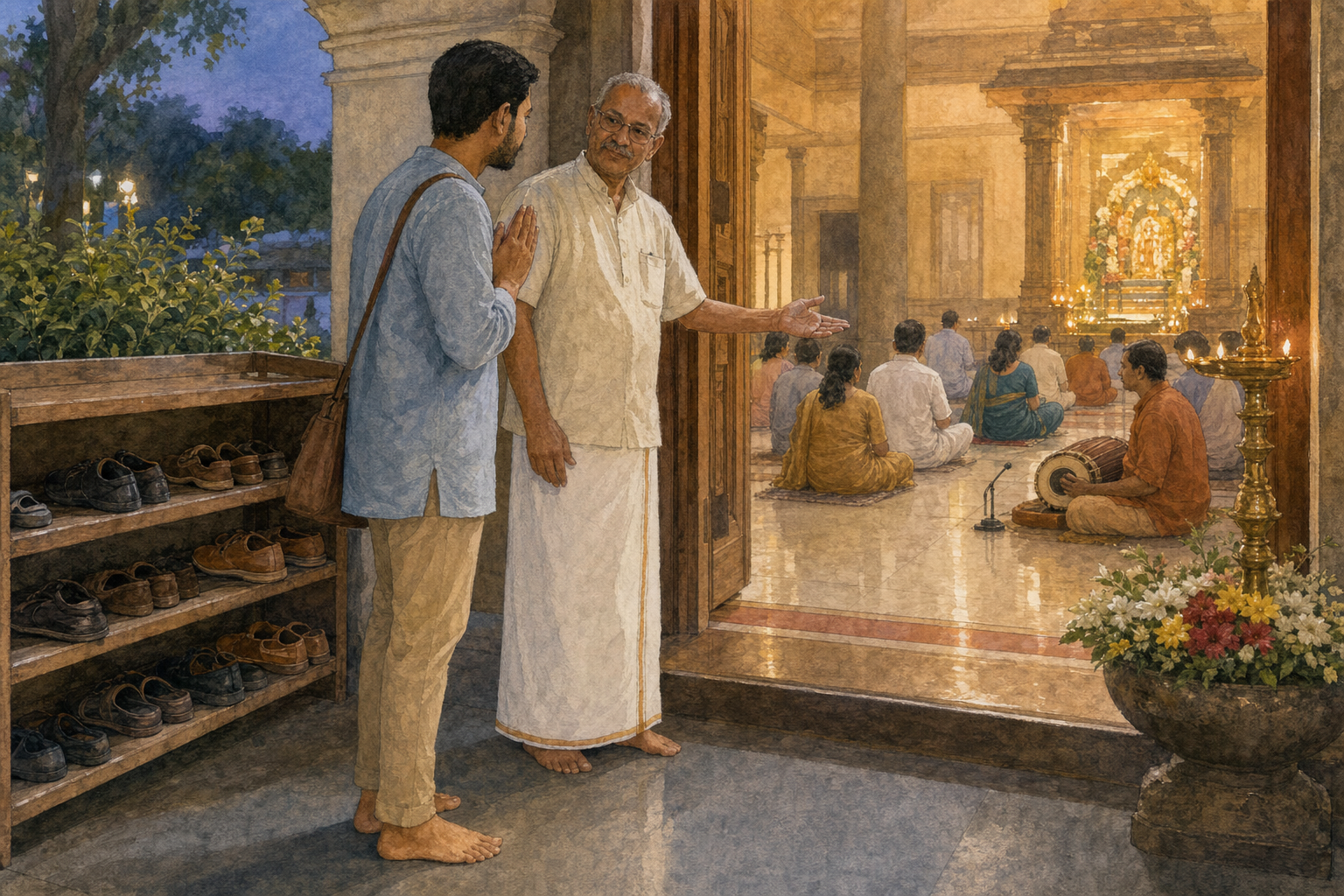
When you are attending a temple
Check whether the program includes kirtan, readings, abhisheka, moonrise arati and prasada, then arrive before the part you most need to attend. A crowded festival evening is a poor time to discover that the main worship began earlier than the public calendar entry implied.
- Wear modest clothing that lets you sit, stand and move without distracting yourself or others.
- Silence your device before entering the worship space.
- Bring only offerings the temple accepts. Fruit and flowers are generally safer than an elaborate item that may not fit local protocol.
- Do not assume photography is permitted, especially near deities, inner spaces or an ongoing abhisheka.
- Follow the temple’s arrangements for fasting, darshan and prasada rather than imposing a household routine on a public celebration.
If you cannot travel to Navadvip or reach a Gaudiya temple, you have not missed the heart of Gaura Purnima. A local kirtan, a serious reading circle and an act of service preserve the festival’s central movement: hear, chant, remember and turn devotion toward the welfare of others.
Key takeaways
- A tithi does not begin at civil midnight, so use a Panchang configured for the place where you will observe.
- Check sunrise, sunset, night and moonrise rules according to the vrata; a date label by itself is not enough.
- Gaura Purnima commemorates Sri Chaitanya Mahaprabhu’s 1486 appearance and centers on nama-sankirtana, hearing, Tulasi offering, service and prasada.
- Give Ekadashi, Pradosham, Sankashti, Masik Shivaratri, Amavasya and Meena Sankranti distinct practices instead of repeating one oversized program.
- Respect the ritual integrity of each sampradaya. Shared Dharmic values do not make Gaudiya, Smarta, Buddhist, Jain and Sikh observances interchangeable.
- If this is your first carefully planned March, keep Gaura Purnima and one recurring fortnightly vrata well rather than attempting every observance poorly.
Open your locality-set Panchang now and mark Gaura Purnima, the two Ekadashis, the two Pradosham periods, Sankashti, Masik Shivaratri and Amavasya. Write one practice beside each date and leave anything uncertain, especially Panguni Uttiram, unconfirmed until the local calendar or temple publishes its decision. That single page will give you something more useful than a festival list: a March discipline you can actually keep.
References
- Hindu Pad – March 2026 Pujas at Kanchi Kamakoti Peetham: Comprehensive Lunar Calendar and Guide
- Dandavats – Gaura Purnima Explained: Advaita Acharya’s Call that Reawakened Bhakti in Bengal
