
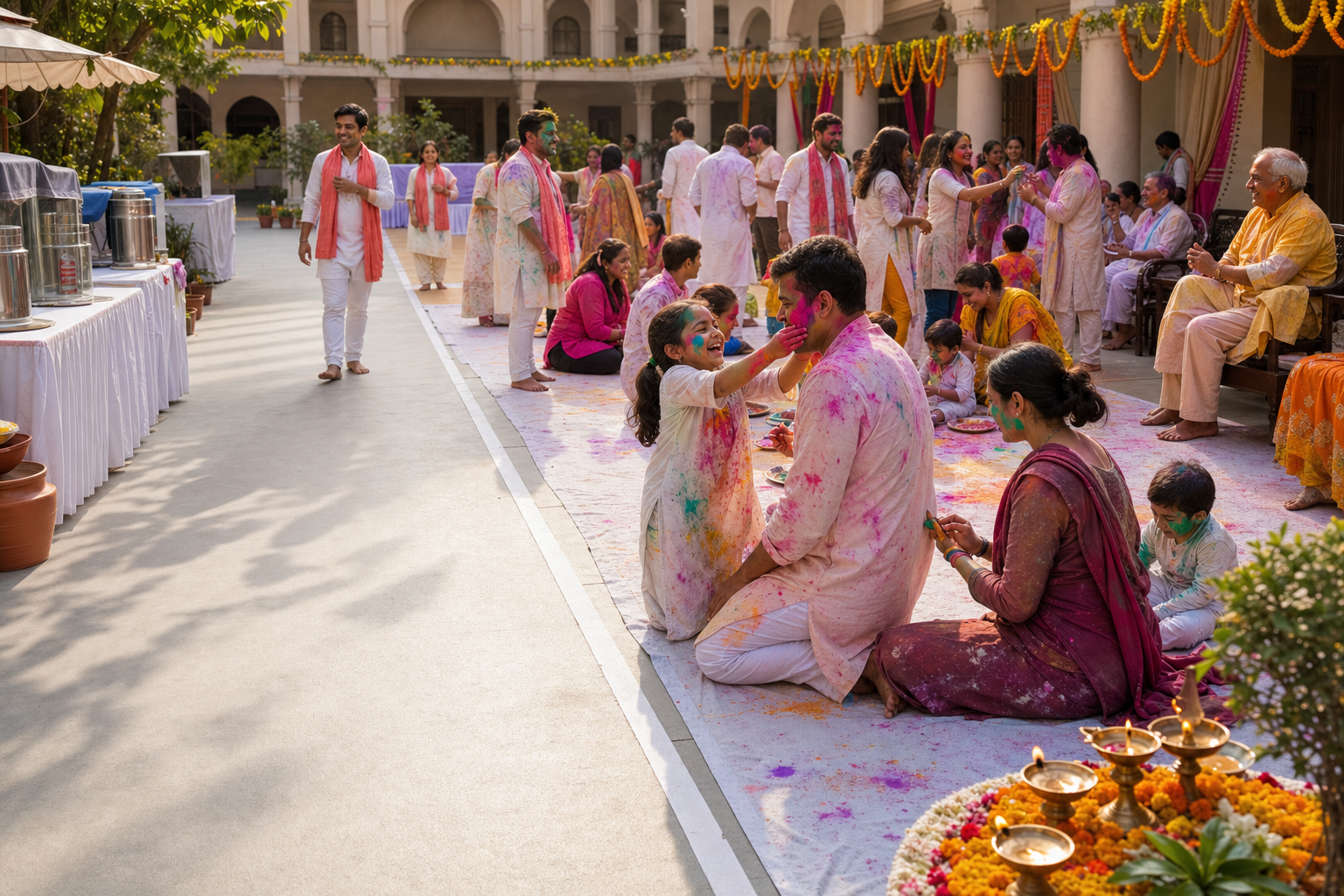
If you are organising Holi for a temple, housing society, school, neighbourhood, or cultural association, the difficult question is not whether people should celebrate. It is how to preserve devotion, colour, laughter, and community without passing the cost to drinking water, unwilling participants, sanitation workers, or the families who avoid an event because it feels disorderly.
Use a simple test: can a child, an elder, and a person who does not want colour all enter with dignity? Will nearby water remain untouched? Can volunteers return the venue clean and safe when the celebration ends? If the answer is yes, stewardship has become part of the observance rather than an apology made after it.
Begin with Holi’s meaning, then draw the boundaries
A responsible Holi does not need to become a joyless environmental programme. It should remain recognisably Holi. The festival’s themes of renewal, resilience, devotion, and the victory of dharma over adharma give organisers a firm centre around which practical rules can be built.
Start by writing one sentence that defines the event. For example: We will celebrate Holi through worship, music, fellowship, and consensual colour play while protecting people, water, and the shared venue. Put that sentence in volunteer briefings and public notices. It tells participants that the safeguards express the event’s purpose; they have not been imposed from outside it.
Then divide the venue by function. A single undifferentiated crowd is difficult to guide, especially when ritual, colour play, food service, children, and people merely passing through all occupy the same space.
- Ritual area: Reserve a calm space for puja, storytelling, bhajan, kirtan, or community singing. Where Holika Dahan is customary, manage it as a distinct ritual area rather than a backdrop for colour throwing.
- Colour-play area: Confine gulal and energetic play to a clearly marked zone. Place colour distribution inside that zone so the physical layout reinforces the rule.
- Colour-free route: Keep an unobstructed path between the entrance, seating, toilets, drinking water, first aid, and exit. Someone should be able to attend the cultural and devotional programme without entering the colour area.
- Quiet and accessible seating: Provide a place for elders, families with infants, and persons with disabilities. Do not make them cross the most crowded part of the event to reach it.
- Protected areas: Mark water bodies, catchment edges, utility installations, vehicle routes, and any ecologically sensitive ground as no-entry or no-colour zones.
- Service area: Group drinking water, first aid, lost-and-found support, waste stations, and volunteer communications where people can find them quickly.
Smaller neighbourhood celebrations can be easier to steward than one distant, highly concentrated gathering. The distributed Holikotsav format used in Sawantwadi, Kudal, and Shiroda brought the observance closer to families and elders while retaining a shared cultural purpose. If your organisation serves several localities, consider giving each one a trained team and a modest programme instead of directing everyone into one congested venue.
The programme itself can reduce disorder. Begin with the meaning of Prahlada’s steadfastness, include familiar regional music or folk expression, and give children an appropriate role in song, storytelling, or seva. When people know what they have gathered to honour, colour becomes one part of Holi rather than the only activity holding the crowd together.
Treat water protection as source control, not cleanup
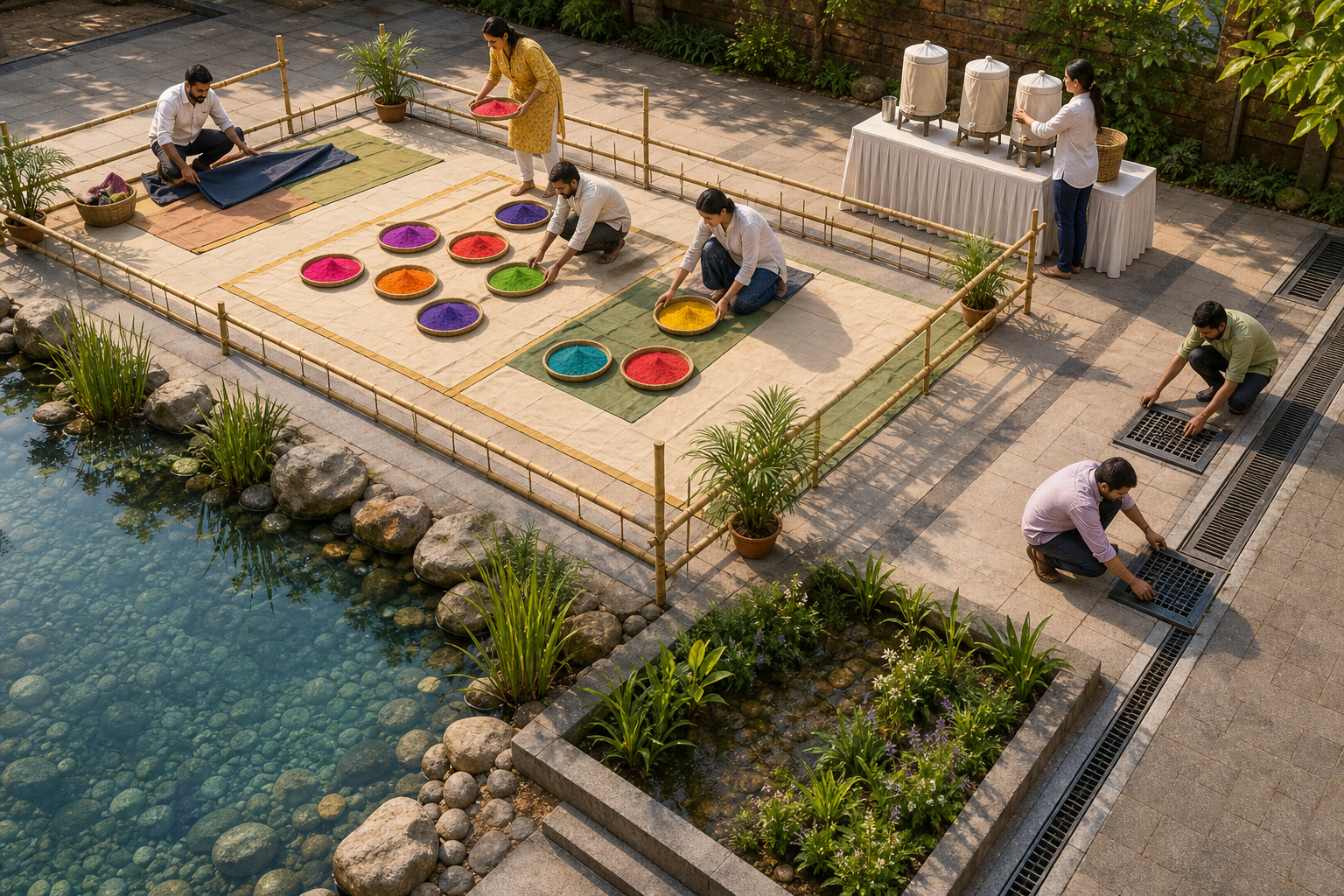
A drinking-water reservoir is not an extension of the colour-play zone. Nor should a pond, riverbank, or catchment edge be treated as a convenient place to wash off. Once colourants, foaming agents, food residue, litter, or small plastic materials enter water, a shoreline cleanup cannot retrieve what has already dispersed.
Those inputs can increase turbidity, nutrient loading, and oxygen demand. Near-shore water deserves particular attention because contaminants can collect in calmer areas where fish, plankton, and bottom-dwelling organisms are exposed. A brief festival can therefore create a concentrated local burden even when each participant believes that his or her contribution is small.
The strongest response is prevention at the water’s edge. At Khadakwasla, a volunteer human chain of more than 200 citizens protected the reservoir during the campaign’s 24th consecutive year. Its practical lesson is not that every community needs precisely the same formation. It is that a visible boundary, held by prepared neighbours who explain its purpose, can turn water protection into an expected social norm.
- Confirm the status of the water first. Ask the relevant civic body, site manager, or water authority which areas are protected and what access rules apply. If the site supplies drinking water, do not improvise a bathing or washing arrangement at its edge.
- Draw the no-entry line before people arrive. Use visible markers and brief signs that state the reason: drinking-water protection, ecological care, and public safety. A reason invites cooperation more effectively than an unexplained prohibition.
- Position stewards at approaches, not only at the shoreline. Intercepting people before they carry colour or buckets toward the water is easier and less confrontational than turning them back after they have crossed the boundary.
- Separate drinking water from play water. Keep hydration points accessible, but do not place hoses, open drums, or colour-mixing stations where they encourage movement toward a sensitive water body.
- Prepare for accidental release. Give volunteers a rapid communication channel and a clear person to contact. Remove spilled dry material and litter before rain or washing carries it into a drain or shoreline.
- Inspect the edge after the event. A shoreline or drainage-path audit can reveal cups, packets, food residue, and other material that an ordinary venue sweep misses.
If your community has legitimate technical partners, pre-event and post-event snapshots can track pH, turbidity, dissolved oxygen, biochemical and chemical oxygen demand, nutrients, and microbial indicators. Treat such community measurements as observations, not as permission to declare drinking water safe. Potability decisions belong to the responsible water authority or qualified laboratory.
Water conservation should also shape the event away from shorelines. Make dry, modest colour play the default. Announce that policy beforehand so families do not arrive expecting unrestricted water use, and give the programme enough music, worship, conversation, and cultural activity that restraint does not feel like the removal of celebration.
Make consent, dignity, and access part of the infrastructure
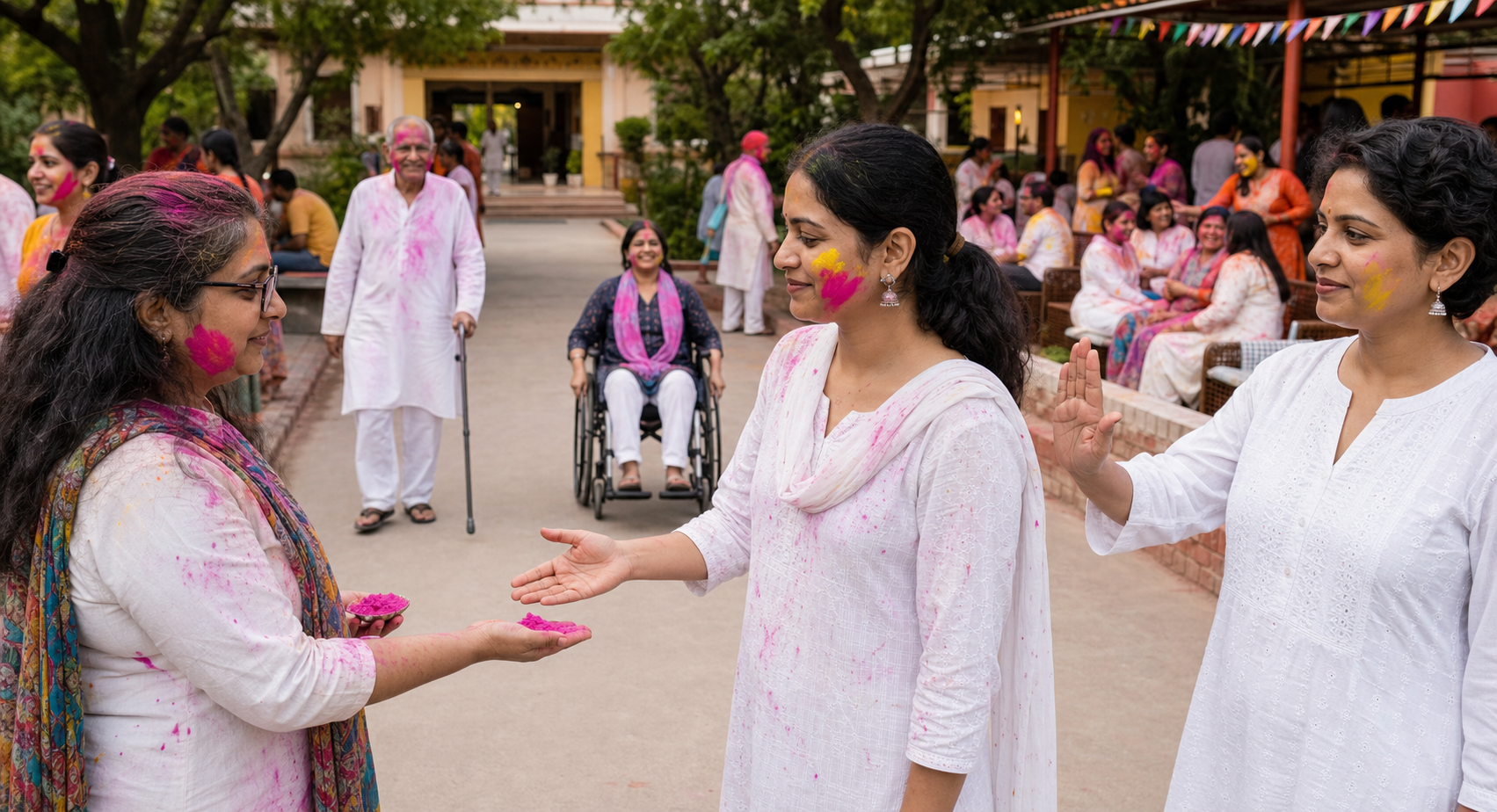
The most useful conduct rule is also the shortest: ask before applying colour. A responsible event does not assume that entry into the venue is consent to be coloured. Some people want to attend puja or meet their community without taking part in energetic play. Others may need to keep colour away from their face, clothing, or body. They should not have to argue their case in a crowd.
Make the following expectations visible at registration points, entrances, and colour stations:
- Apply colour only after receiving a clear yes.
- Respect refusal immediately and without teasing, pursuit, or social pressure.
- Keep colour inside the designated play area.
- Do not block the colour-free route, exits, first-aid point, or accessible seating.
- Follow volunteer instructions around children, ritual areas, water boundaries, and crowd movement.
- Report harassment, unsafe behaviour, a missing person, or a medical concern to the identified response steward.
Materials matter, but material choice does not replace consent. Low-quality synthetic colours may contain irritants or heavy metals. Organisers can reduce uncertainty by buying clearly identified products from accountable suppliers and favouring plant-based gulal or pigments associated with turmeric, marigold, and Butea monosperma. Do not advertise any powder as universally safe, and do not let a natural label become an excuse to throw it at someone who has declined.
Family participation depends on predictable conditions. Mark entry and exit routes, brief volunteer marshals, keep drinking water available, maintain a stocked first-aid point, and establish a lost-and-found process. Tell participants where these are before colour play begins. In a noisy or crowded setting, a facility that exists but cannot be found is not functioning.
Noise moderation is also a form of ahimsa. Set and communicate quiet hours where relevant, orient speakers away from quiet seating, and use devotional or cultural programming as more than an interval between bursts of amplification. This makes space for infants, seniors, nearby residents, and wildlife without stripping Holi of its soundscape.
Choose at least one clearly identifiable steward to whom women, children, elders, and persons with disabilities can bring a concern. Volunteers need a response path: who handles a boundary dispute, who contacts first aid, who speaks with venue management, and who can pause an activity. A code of conduct becomes credible when participants can see how it will be upheld.
Run stewardship before, during, and after the celebration
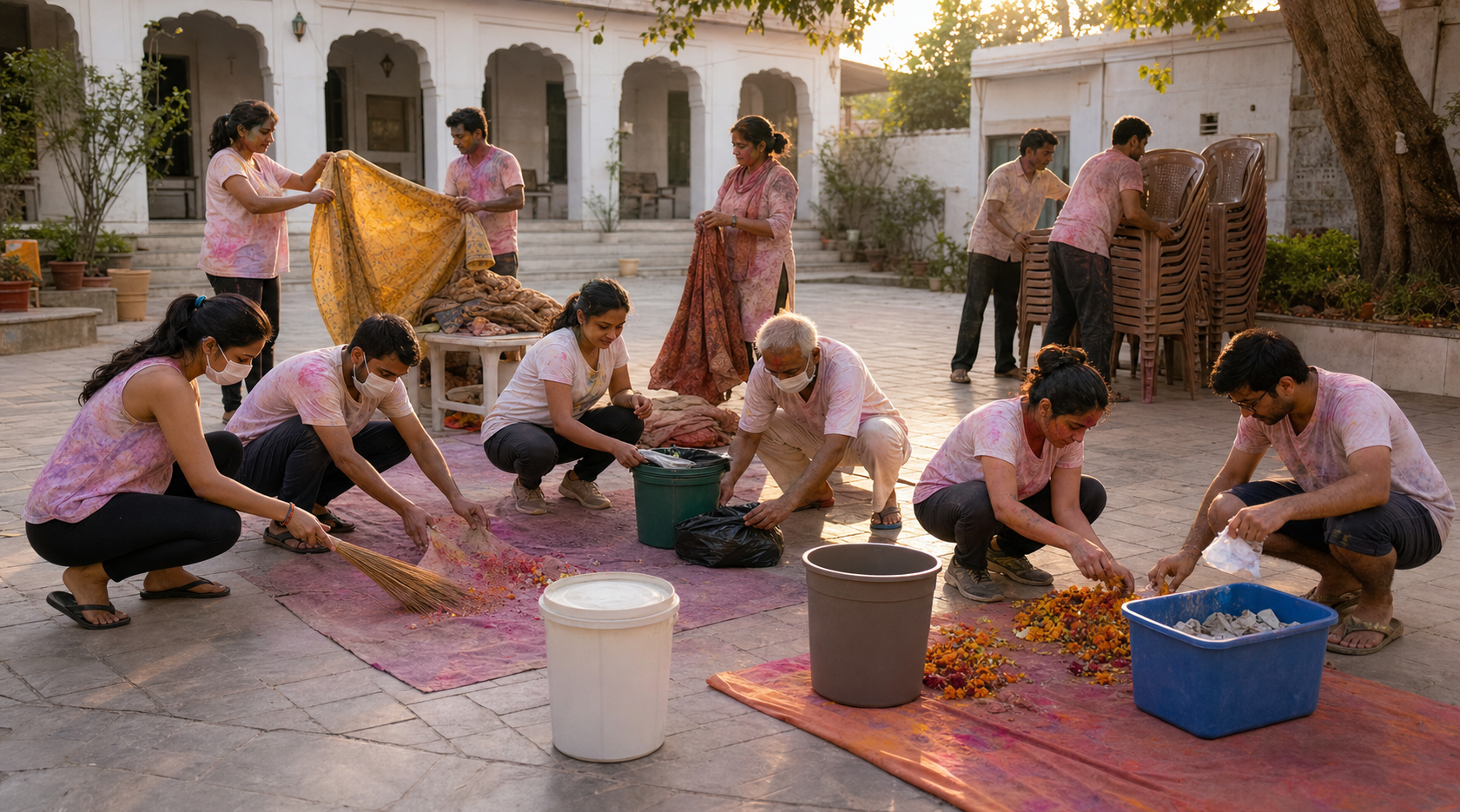
Responsible Holi is not produced by a cleanup team alone. Most preventable problems are designed into or out of the event before the first participant arrives. Divide the work into three phases and give every task a named owner.
Before: remove ambiguity
- Assign leads: Name people responsible for ritual programming, colour materials, water protection, crowd flow, accessibility, first aid, waste, and communications.
- Walk the venue: Mark entrances, exits, bottlenecks, ritual space, colour zone, colour-free route, quiet seating, service points, drains, and water boundaries on a simple site plan.
- Coordinate: Obtain applicable permissions and align with venue managers, local administration, and water managers. Record who can make which decision on the day.
- List credible risks: Include uncontrolled entry into water, blocked exits, crowd congestion, accidental spills, missing children, inappropriate conduct, litter migration, and failure of the communication channel. Pair each with an owner and response.
- Publish the rules early: Tell families what materials will be used, whether water play is restricted, where colour is allowed, how consent works, and which parts of the programme are colour-free.
- Brief volunteers: Rehearse calm explanations, escalation paths, first-aid contact, and the location of every boundary and service point. Courtesy should be planned, not left to temperament.
Give boundary volunteers a sentence they can repeat consistently: This water supports the community, so colour and bathing stay inside the festival zone; we will show you where you can celebrate. It explains the duty, states the limit, and offers a next step without beginning an argument.
During: make the responsible choice easy
- Open by stating the event’s purpose and the consent, water, and safety rules in plain language.
- Place stewards where decisions occur: at entrances, colour distribution, route junctions, the protected perimeter, and service points.
- Keep paths and exits clear throughout the event rather than checking them only at opening time.
- Refill drinking water and monitor first-aid readiness without mixing either function with colour play.
- Segregate waste at the point where food, packaging, and used materials are generated.
- Respond to misunderstandings through explanation first. If conduct threatens safety or dignity, use the event’s escalation path promptly rather than allowing repeated warnings to become permission.
A visible volunteer presence works because participants can understand the norm and see that their neighbours share it. Stewards should therefore look approachable and be easy to identify. Their role is not to hover over every moment of play; it is to protect the conditions in which play can remain joyful.
After: return the commons in good order
- Clean the venue, drains, approach roads, and shoreline or catchment edge where applicable.
- Remove segregated waste through the appropriate local channel rather than leaving filled bags beside the site.
- Check whether any colour, litter, or food residue crossed a protected boundary and notify the relevant manager if an accidental release occurred.
- Record incidents, near misses, lost-and-found cases, and recurring questions without publishing unnecessary personal details.
- Ask volunteers which signs were ignored, where crowd flow failed, and which explanations gained cooperation.
- Revise the site plan, briefing, material quantities, and roster while the experience is still fresh.
Continuity matters. The Khadakwasla effort became culturally intelligible because stewardship returned year after year. Your first event does not need that history behind it, but it should leave the next organising team a better plan than the one you inherited.
Key takeaways
- Keep Holi devotion-centred, culturally rooted, and joyful; responsibility should shape the celebration rather than replace it.
- Separate ritual, colour play, colour-free movement, quiet seating, service points, and protected areas before participants arrive.
- Keep colour, washing, litter, and festive residue out of reservoirs, catchments, shorelines, and drains. Prevention is stronger than post-event cleanup.
- Ask before applying colour. Plant-based material may reduce one category of risk, but it does not create consent.
- Make first aid, hydration, accessibility, crowd routes, quiet hours, waste segregation, and incident response visible and usable.
- Review the event after cleanup so community stewardship becomes a repeatable local practice rather than a one-day appeal.
Before your next Holi, walk the venue with three people: the ritual lead, the safety lead, and the water-and-waste lead. Mark the colour zone, colour-free route, sensitive water, exits, and first-aid point. Then publish the conduct rules before invitations circulate widely. That small act of preparation can make celebration, seva, ahimsa, and care for prakriti visible in the same public space.
References
- Hindu Janajagruti Samiti – For 24 Years, a Human Chain Has Kept Khadakwasla Reservoir Safe and Clean on Dhulivandan
- Hindu Janajagruti Samiti – Adarsh Holikotsav in Sindhudurg: Reviving Holi’s True Dharmic Spirit with Safe, Joyful Unity
