

You are trying to judge a leader who acted forcefully, or an institution that followed every rule and still failed to protect what mattered. Neither decisiveness nor procedural correctness settles the question. A Vedic test asks something harder: did power remove a genuine obstruction while remaining subject to an order it could not rewrite for its own convenience?
Indra and Varuna give you the two sides of that test. Indra represents the capacity to intervene, defeat danger, and reopen the conditions of life. Varuna represents truth, binding obligation, moral limits, and accountability. Legitimate authority needs both. Without Indra’s resolve, order becomes helpless. Without Varuna’s restraint, strength becomes self-authorizing.
One ruler, two inseparable duties
Vedic kingship does not begin with the modern assumption that power and morality belong to separate departments. Royal power, ritual responsibility, natural order, truthful speech, and the welfare of the people belong to one field. The ruler’s actions matter beyond the palace because disorder in one part of life can spread through the whole.
Indra: power must be able to break an obstruction
Indra embodies kshatra, the martial and executive capacity of sovereignty. He carries the vajra, moves with the storm hosts, and bears names such as Shakra, the mighty, and Maghavan, the bountiful. His defining title is Vritrahan, the slayer of Vritra.
The point of this power is revealed by its result. In Rigveda 1.32, Indra breaks Vritra’s confinement and releases the waters. The rivers move, space opens, and life can proceed. His strike is not celebrated merely because it is spectacular or victorious. It removes a blockage that has deprived the wider world of something necessary.
That distinction gives you a practical way to evaluate force. Ask what has actually been obstructed and what the intervention will release. A leader who can describe an enemy but cannot identify the shared good being restored is borrowing Indra’s thunder without accepting Indra’s task. Force is not made Dharmic by intensity, confidence, or religious language.
Varuna: power must remain bound by truth
Varuna embodies the encompassing authority of rta: cosmic order, truth, right relation, and the regularity that sustains the world. This is wider than a ruler’s decree. A decree can be altered by the person who issued it; rta stands above personal preference. Satya, truthful reality and truthful conduct, expresses that order in human life, while anrta marks a departure from it.
Varuna’s pasha, or noose, makes obligation visible. The ruler is not outside the bond simply because he holds office. In Rigveda 7.86-7.89, petitioners acknowledge fault and seek release from Varuna’s bonds. Accountability here is serious, but it is not merely punitive. Wrongdoing can be named, confessed, corrected, and followed by restoration.
This changes what lawful rule should look like. A Varuna-like institution does not hide failure behind procedure. It establishes a real standard, applies that standard to those who govern, detects departure from it, and preserves a path back to right order. Mercy without acknowledgment would make truth optional. Punishment without the possibility of repair would mistake the noose for the whole purpose of law.
Indra and Varuna are therefore not two candidates competing for one throne. They are invoked together as Indra-Varuna because sovereignty must perform two duties at once: it must act against disorder and remain answerable to an order higher than itself.
Why victory is not the same as legitimacy
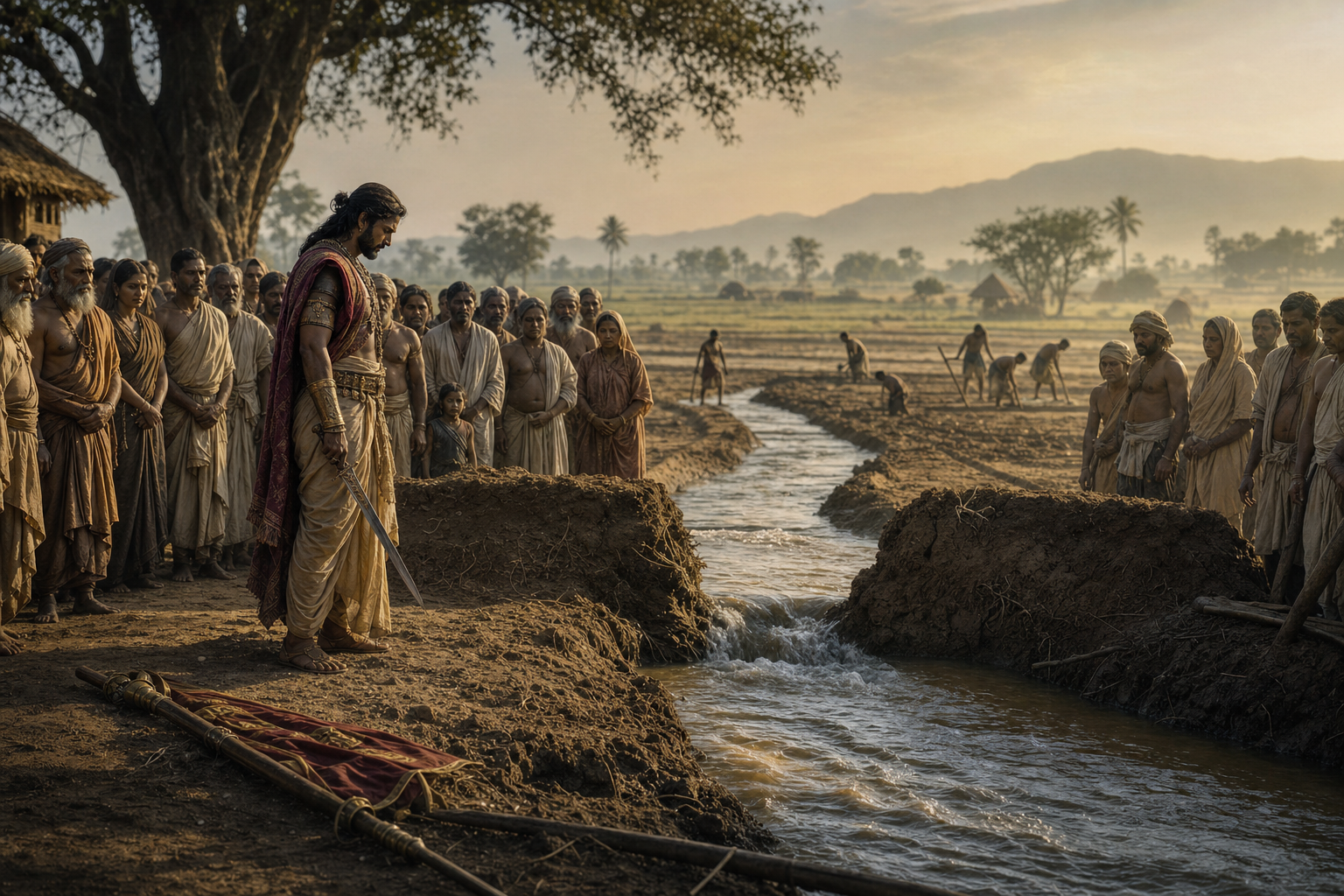
Success can prove that a ruler possesses power. It cannot, by itself, prove that the ruler had the right to use it. The Vedic image of released water supplies the missing criterion. The decisive action must restore movement, nourishment, safety, or room for life beyond the ruler’s own circle.
The ecological setting sharpens the point. Indra’s storm is associated with the arrival of life-giving rain, while Varuna’s encompassing sovereignty evokes the vast waters and the bounds that make their movement habitable. Water held back brings barrenness. Water without banks can destroy. Authority therefore has to overcome paralysis without abolishing limits.
Three common readings obscure this model:
- Indra is not a sacred costume for the strongman. His model is not simply striking an opponent. The action has to release a good that was wrongly confined. If the ruler grows stronger while everyone else becomes more dependent and afraid, the result does not resemble the liberation of the waters.
- Varuna is not a patron of bureaucratic delay. His order has sanctions, moral weight, and the capacity to bind wrongdoing. A legal system that cannot protect the conditions of life has preserved form while abandoning function.
- Varuna’s early title asura does not make him a demon. In the Rigvedic setting, the word can indicate august lordship. Its later association with opponents of the devas should not be projected backward into the oldest hymns.
The paired standard is demanding because it refuses two convenient excuses. The activist cannot say that an urgent goal cancels truth, oath, or restraint. The legalist cannot say that formal compliance excuses an obvious failure to confront harm. Courage and conscience are concurrent obligations, not stages to be handled by different people at different times.
Four tests for deciding whether power is legitimate
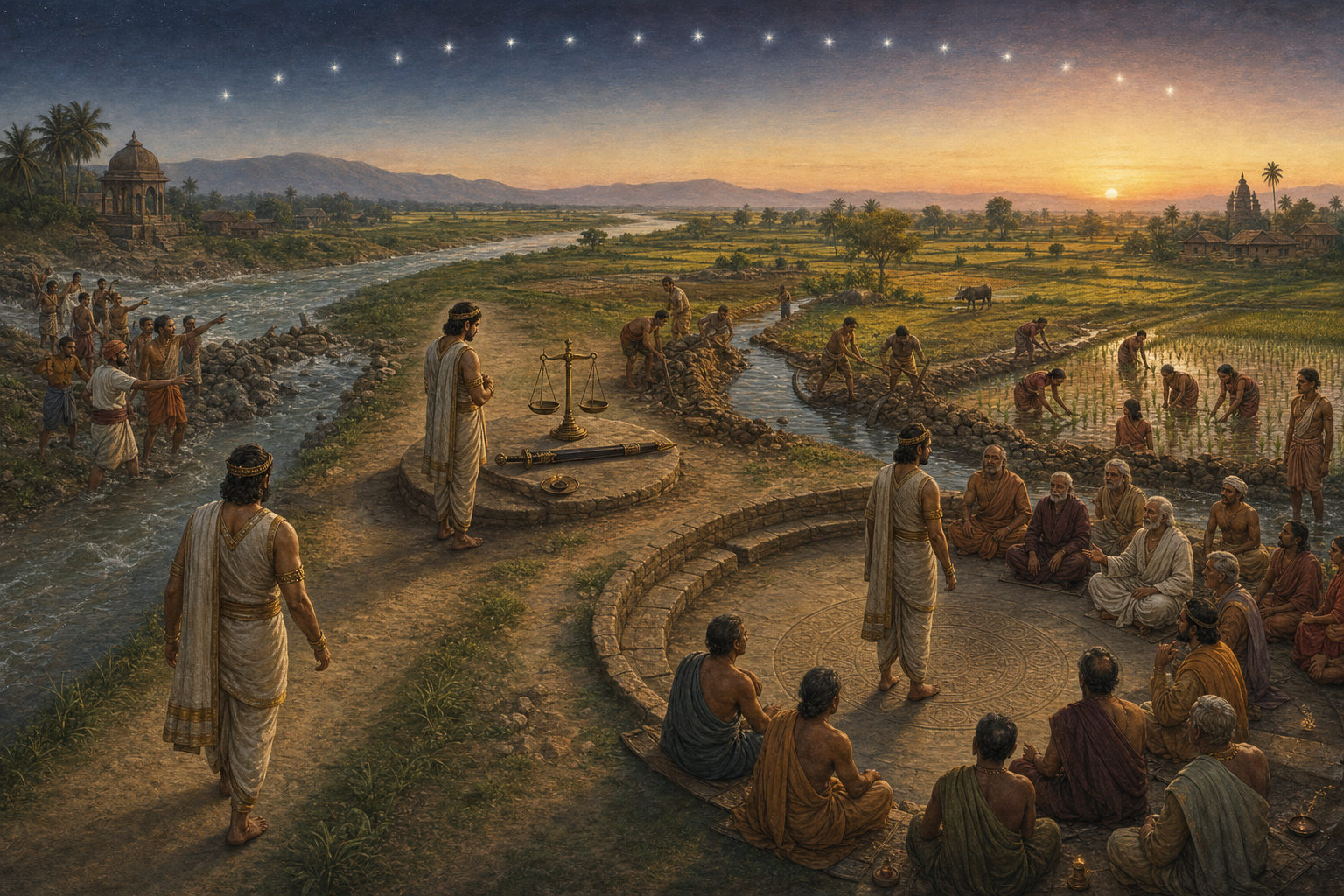
You can turn the Indra-Varuna pairing into a disciplined test for a government decision, a community dispute, an institutional crisis, or even authority within a household. Work through the questions in order. A convincing answer to only one or two is not enough.
- Name the obstruction precisely. What necessary good is being withheld, and from whom? Vritra is significant because the confined waters affect the living world. Translate that structure into the decision before you: identify the blocked good, the mechanism blocking it, and the people bearing the cost. If the diagnosis consists only of naming a disliked faction, critic, or rival, the use of power has not yet been justified.
- Name the rule that binds the ruler. What truth, oath, duty, or limit remains valid even when compliance is inconvenient? The answer cannot be merely that the leader has jurisdiction. Jurisdiction explains who may act; it does not establish that every available action is right. A credible boundary should be stated before the intervention, not invented afterward to defend its outcome.
- Identify what the action releases. Indra’s victory is verified through the movement of the waters. Apply the same result-oriented scrutiny. Will ordinary people gain room to live, work, worship, deliberate, or meet their duties, or will the intervention chiefly enlarge the ruler’s discretion? A legitimate action should restore capacity outside the seat of power.
- Preserve a route for correction and restoration. Varuna’s bonds make wrongdoing consequential, but the hymns also preserve acknowledgment and release. Decide in advance how error will be detected, who can challenge the decision, what admission of fault requires, and how avoidable harm will be repaired. Authority that cannot confess or correct itself has rejected Varuna’s jurisdiction.
These tests also reveal why popularity and legitimacy are different. A popular blow may fail the binding-rule test. An unpopular restraint may preserve order, but it still fails if it leaves a serious obstruction untouched. The relevant question is not whether the ruler looks more like Indra or Varuna. It is whether the ruler can satisfy both demands in the same decision.
How to apply the model without turning it into a slogan

Before a consequential decision, write four short statements: the obstruction, the binding limit, the good to be released, and the route for correcting error. Do not let any statement become a speech. One or two sentences for each will expose evasions quickly. If the obstruction cannot be described without demonizing a person, or the limit contains an exception for the leader, the proposal is not ready.
During the action, keep the Indra and Varuna questions open together. Urgency does not suspend the oath. An emergency may require faster action, but that is precisely when the objective, scope, and stopping condition should be clearest. Otherwise, a measure introduced to break one obstruction can become the next obstruction.
Afterward, examine effects rather than ceremony. What began to move that could not move before? Who acquired greater agency? Which limits actually constrained the decision-maker? What mistake was acknowledged and repaired? If the only measurable result is the leader’s triumph, the Vedic vocabulary of kingship should not be used to sanctify it.
Royal ritual reinforces this obligation. The rajasuya magnifies Indra’s victorious character, while oath and satya remain under Varuna’s gaze. Yajna directs shakti, or effective power, toward rta. Consecration therefore does not give the king an escape from judgment. It places his capacity inside a public and cosmic discipline.
Later developments preserve that warning. The Brahmanas remember Indra’s victories alongside lapses that require expiation. In the Kena Upanishad, Indra’s encounter with the mysterious Yaksha turns prowess toward humility and knowledge. In the Taittiriya Upanishad, Varuna guides Bhrigu through progressively deeper inquiry into Brahman. The symbols mature, but neither brute triumph nor rigid control becomes the final ideal.
You can also notice the family resemblance across distinct Dharmic traditions without pretending they teach the same theology. Buddhist accounts place Shakra in the role of guardian and interlocutor before the Buddha. Jain narratives use Indra as a title for heavenly beings who honor the Tirthankaras. Sikh teaching places pride under the discipline of hukam and truthful living. In each setting, high status is denied the power to certify its own righteousness.
Key takeaways
- Indra represents the capacity to confront a real obstruction and restore the conditions of life.
- Varuna represents the truth, oath, limits, and accountability that bind the ruler as well as the ruled.
- Victory demonstrates capacity, not legitimacy; the result must release a shared good beyond the ruler’s own power.
- Law is incomplete when it cannot act against disorder, while force becomes illegitimate when it rejects binding limits.
- A sound decision names the obstruction, the governing rule, the good to be released, and the method of correction before action begins.
At the next decision where someone asks you to choose between strength and principle, reject the choice. Put the four statements on the table and leave none blank. The Vedic ruler’s mandate is not to alternate between Indra and Varuna when convenient. It is to make decisive power answerable to truth at the moment power is used.
References
