

If you came to Kadaligarbha because karma sometimes sounds like a way to explain away unfairness, keep one distinction in view: the circumstances that have arrived are not the same as the action you choose now. The tale gives you no promise that present virtue will instantly reverse an old consequence. It does show why an unwanted result need not become a new chain.
That is where vairāgya becomes practical. It is not emotional coldness, passive acceptance, or flight from responsibility. It is the ability to meet what has ripened without making your peace depend on possession, vindication, or control.
The lesson survives the tale’s changing endings
Kadaligarbha means one gestated in a kadalī, a plantain womb. Her extraordinary appearance places her between the divine and human worlds, but it does not exempt her from the conditions of embodied life. Beauty attracts desire and rivalry. Promises meet competing interests. Earlier causes mature inside circumstances that present goodness alone cannot immediately rearrange.
Not every recension or retelling resolves those circumstances in the same way. Some lean toward household harmony or wise governance; others give greater weight to renunciation and contemplative peace. If you encounter different endings, do not force them into a single plot. Follow the stable movement beneath them:
- Wondrous appearance: grace, beauty, or auspicious circumstances enter a human life.
- Worldly entanglement: people begin to desire, claim, fear, protect, or compete over what has appeared.
- Karmic fruition: consequences arrive that cannot be cancelled merely by wishing, pleading, or pointing to present innocence.
- Discernment: freedom begins when right conduct no longer depends on possessing a preferred outcome.
This structure matters more than whether Kadaligarbha finally inhabits a palace, a household, or a renunciant setting. Vairāgya is not proved by changing clothes or locations. It is proved by the weakening of compulsive grasping. A ruler may govern with detachment; a householder may love without possession; a renunciant may still be inwardly consumed by recognition or aversion.
The same distinction protects karma from a cruel misreading. Karmic causality is not permission to tell a suffering person that they deserved what happened. You cannot inspect another person’s accumulated karma, identify the exact cause of a present ordeal, or use metaphysical speculation to excuse your own inaction. Karma is most useful as a discipline for examining your conduct, not as a verdict on somebody else’s pain.
Three forms of karma preserve a field of freedom

A common Hindu teaching model distinguishes three aspects of karma. The distinction prevents two opposite mistakes: fatalism, which denies meaningful choice, and magical thinking, which assumes correct behaviour must immediately produce the desired result.
| Aspect of karma | Meaning | What it asks of you |
|---|---|---|
| Sañcita | The accumulated store of past actions that has not yet fully borne fruit | Treat the unseen past with humility. Do not invent confident explanations for every event. |
| Prārabdha | The portion already ripening through the conditions of the present life | Face the condition honestly. Do not demand that one good deed erase an already unfolding consequence. |
| Āgāmi or kriyamāṇa | The action being made now, with consequences that continue beyond the present moment | Protect intention, speech, and conduct. This is the live field in which you can stop adding bondage. |
Kadaligarbha’s ordeals belong primarily to the middle category: conditions have already begun to unfold. Her freedom therefore cannot mean preventing every consequence. It lies in how she meets the consequence and what kind of action she adds to it.
Within this model, wisdom, devotion, and right action can purify intention and weaken karmic seeds that have not yet ripened. Prārabdha, however, is ordinarily understood to continue until its momentum is exhausted. This is why ethical conduct may transform you before it transforms the scene around you. The absence of an immediate reward does not make dharma useless; it exposes whether your goodness was a principle or a bargain.
You can test any karmic interpretation with two questions. Does it tell you that no meaningful choice remains? Then it has ignored āgāmi karma. Does it promise that sufficient virtue, optimism, or ritual will force the present outcome to obey you? Then it has ignored prārabdha. The disciplined position accepts real constraints while preserving responsibility for the next action.
This also explains why karma is not identical to fate. Fate is often imagined as a closed script. Karma is a field of inherited momentum and continuing participation. You may not have chosen the condition now arriving, but your response can reinforce anger, deception, and possessiveness, or it can establish truthfulness, courage, generosity, and restraint.
Vairagya releases the fruit, not the duty
Patañjali’s Yogasūtra 1.15 describes vairāgya as freedom from thirst for objects that are seen or heard about. The Bhagavad Gītā gives that dispassion an active ethical form: perform the action that is yours without fastening your identity and peace to its fruit. Neither teaching asks you to stop caring about what your actions do.
- Indifference withdraws care. Vairāgya removes the demand to possess what you care about.
- Suppression denies an emotion. Vairāgya notices attraction or aversion without treating it as a command.
- Passivity abandons action. Vairāgya permits dharmic action even when success is uncertain.
- Carelessness ignores consequences. Vairāgya releases entitlement to a result while remaining attentive to results.
Suppose you must speak truth in a family dispute. Detachment does not require silence, and it does not require you to feel nothing. It means speaking without making the other person’s immediate agreement the price of your integrity. In sevā, it means keeping promises, records, and deadlines without turning praise into the hidden purpose of service. In the public defence of dharma, it means opposing falsehood or adharma without making contempt, spectacle, or personal status the real fruit you seek.
A useful test is: If the response I want never comes, which action would still be truthful, non-cruel, and within my duty? The answer may be patient reconciliation. It may be a firm boundary, a correction, a refusal, or a departure from an untenable arrangement. Vairāgya does not preselect the mildest action. It clears away the craving and fear that distort your judgement of what dharma requires.
Nor does action without attachment mean action without evaluation. You can assess whether a decision worked, repair harm, change a failed method, and learn from consequences. What you release is the inner claim that reality must reward you on your preferred schedule. Niṣkāma karma is not careless karma.
Why the plantain-born image carries the philosophy

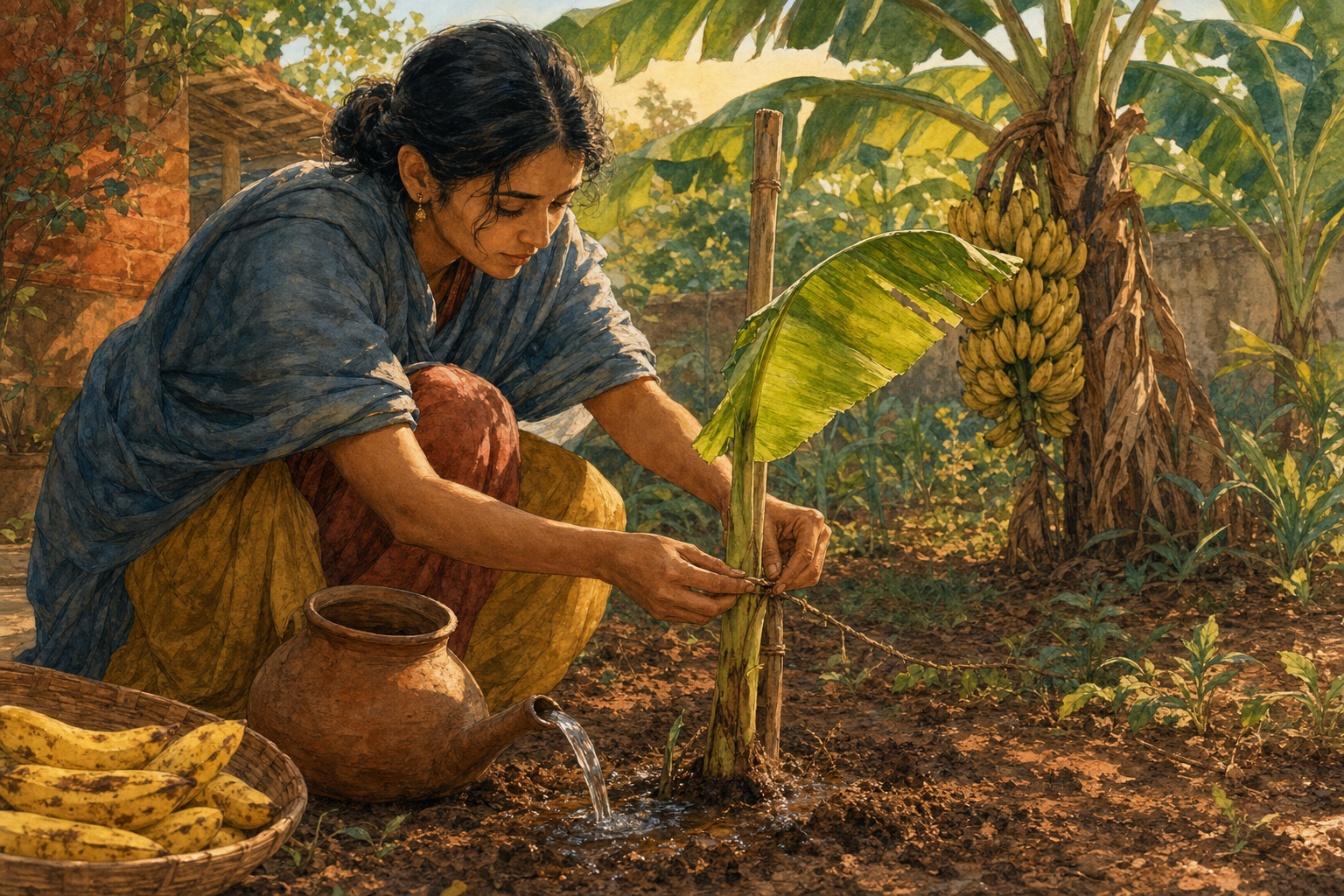
The plantain holds two meanings at once. It is an auspicious sign of fertility, prosperity, hospitality, and sacred celebration. Plantain stems appear at ritual thresholds, and banana leaves serve in offerings and hospitality. Yet the plantain trunk has no durable heartwood. Its apparently solid form consists of layers that do not yield the permanent core a grasping hand expects.
Kadaligarbha’s origin therefore joins blessing to warning. Prosperity is not condemned; beauty is not treated as evil; auspiciousness is not exposed as a fraud. The warning concerns the demand that a changing form provide an unchanging foundation. When status, beauty, relationship, victory, or abundance becomes the core of identity, fear begins guarding what time can alter.
The symbol should not be misread as declaring Kadaligarbha herself hollow. That would reduce the woman at the centre of the tale to an ornament and repeat the possessive gaze the narrative places under examination. Her movement from wonder through ordeal toward discernment gives her the interior burden of the story. The lack of heartwood points to the structures of grasping around transient forms, not to a lack of moral or spiritual substance in the heroine.
The plantain image also travels across Dharmic traditions. Buddhist teaching can compare the aggregates to a plantain trunk in which no graspable, permanent core is found. Jain thought describes attachment-saturated action as karmic bondage and answers it through disciplines such as aparigraha, or non-possession. Sikh teaching places inner detachment within life under hukam, cosmic order, rather than limiting it to withdrawal from worldly responsibility.
These traditions do not hold identical doctrines of self, karma, or liberation. Their practical convergence is narrower and more useful: grasping intensifies bondage, while disciplined non-possession changes one’s relation to an unstable world. You do not need to erase doctrinal differences to recognise that shared ethical insight.
Use the plantain image as a diagnostic. When an auspicious outer form becomes indispensable to your identity, ask what would remain if that form changed. Truthfulness, compassion, courage, self-command, and devotion can function as inner heartwood. Reputation, possession, and control cannot, because they remain partly in other hands.
Apply the tale when a consequence has already arrived

The practical moment is not when life is fully under control. It is when a decision has failed, a relationship has changed, an expectation has collapsed, or another person’s choice has closed one of your preferred paths. Use the following sequence before turning karma into either self-blame or resignation.
- Name the event without explaining it. Write one neutral sentence describing what has happened. Leave out claims about cosmic causes, another person’s motives, and what the event supposedly proves about your worth.
- Separate three fields. Identify the condition already present, the action still available to you, and the result you wish you could command. Do not place the wished-for result in the action column.
- Expose rāga and dveṣa. Complete these sentences honestly: I refuse to be at peace unless I obtain… and I believe I cannot bear… Attraction and aversion become easier to govern once their demand is explicit.
- Choose dharma before strategy. Ask which response remains truthful, proportionate, and non-harming even without applause or guaranteed success. Only then choose the method most likely to help.
- Create a pause before speech. Steady breathing can reduce the force of the first reaction. Svādhyāya, or self-study, can separate the event from the identity story built around it. Dāna can directly counter possessiveness when the mind is tightening around status or things.
- Review the karma you are making now. Did your response add deception, cruelty, vindictiveness, or grasping? If it did, correct what can be corrected. If it did not, allow the outcome to remain unresolved without reopening the same inner bargain.
This process will not tell you the hidden cause of every hardship. That limitation is useful. Speculation about former lives can distract you from the intention, word, and deed taking shape in the present. Kadaligarbha’s lesson becomes actionable when the unknown past produces humility and the available present produces responsibility.
Key takeaways
- Prārabdha names a consequence already ripening; it does not eliminate present agency.
- Āgāmi or kriyamāṇa karma is being formed through your current intention and conduct.
- Vairāgya releases possessiveness toward the fruit of action, not responsibility for the action.
- The plantain symbol joins auspicious abundance to a warning that transient forms cannot provide permanent heartwood.
- Karma should discipline your own response, not become an accusation directed at another person’s suffering.
At the next reversal, do not begin by asking how to make the fruit obey you. Ask what has already arrived, what action is genuinely yours, and what claim over the result can be released. Take the dharmic step while the mind is still demanding a guarantee. That is where Kadaligarbha’s tale becomes training for freedom.
References
