
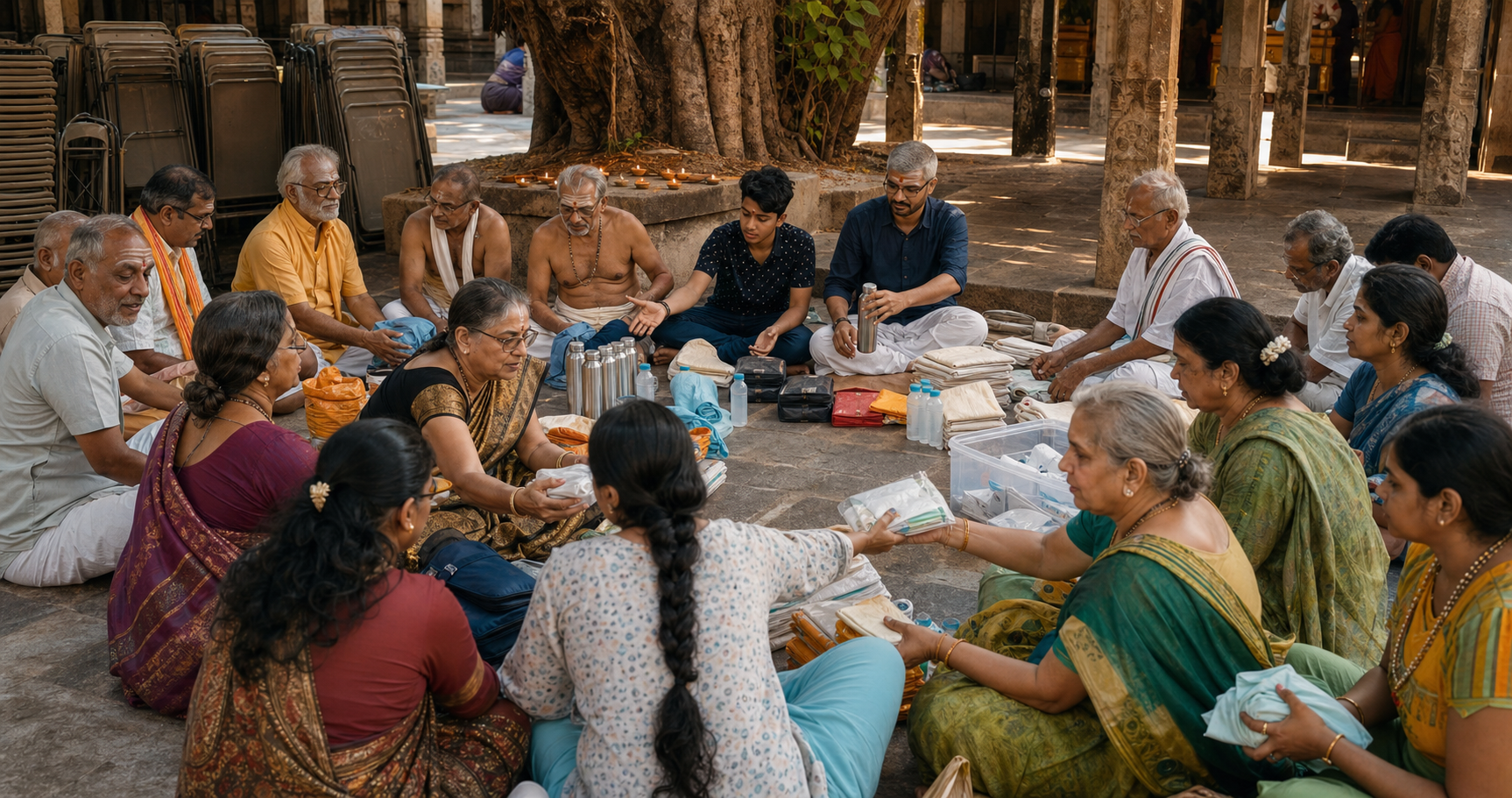
You can fill a temple courtyard, take a public pledge, and create a busy messaging group without building anything that lasts. The real test of Hindu unity begins after the gathering: can people from different sampradayas, generations, professions, and local institutions keep working together when there is no stage, no chief guest, and no surge of emotion carrying them?
If you are organizing a sabha, satsang, sammelan, temple committee, youth circle, or cultural association, your task is not to manufacture sameness. It is to turn shared dharmic commitments into trustworthy civic capacity. That requires a common covenant, serious education, accountable organization, visible seva, and a spiritual discipline strong enough to restrain anger as well as inspire action.
Begin with a civic covenant, not a demand for uniformity
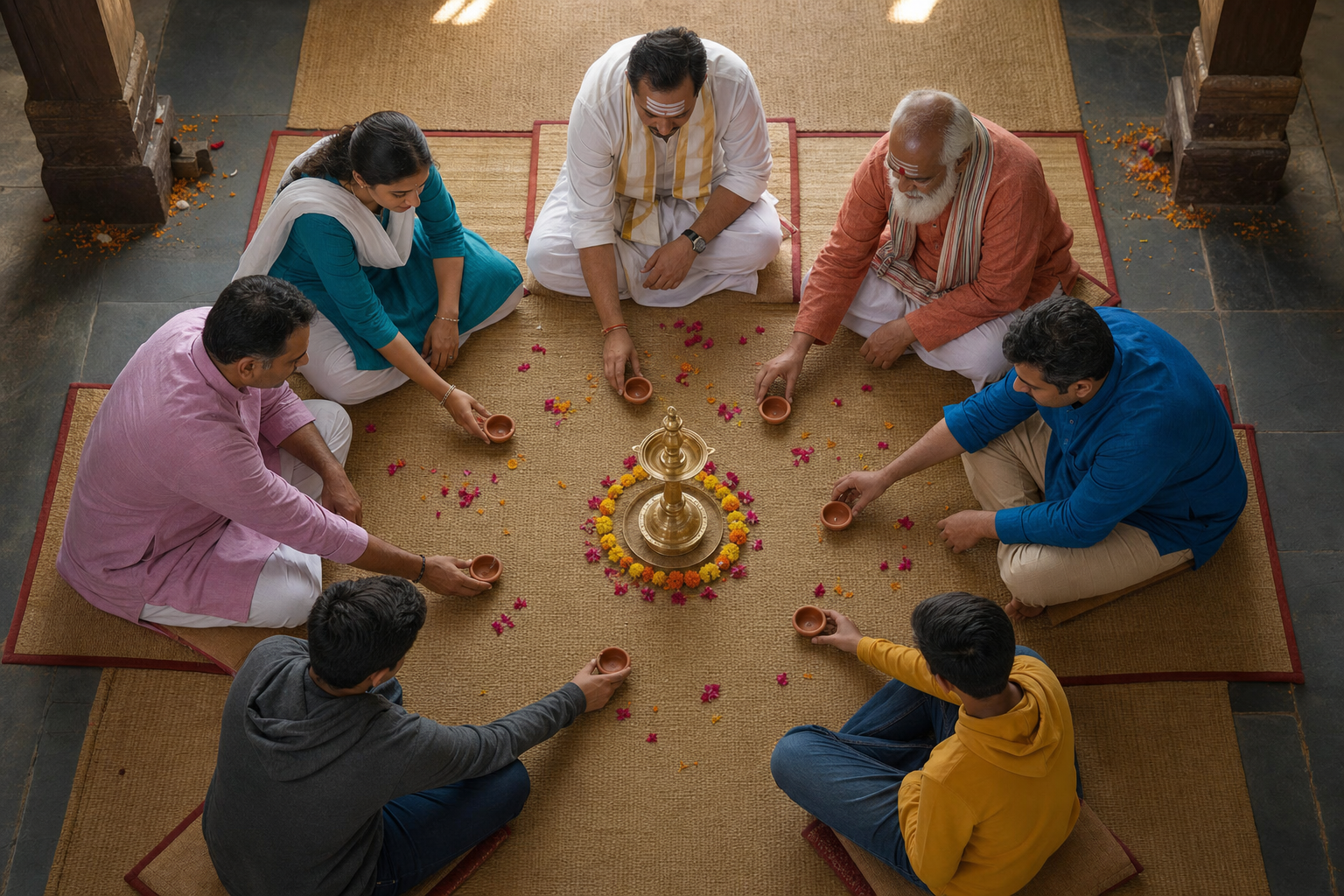
Hindu unity becomes fragile when it is defined as agreement on every deity, doctrine, ritual, guru, language, or social question. Sanatan Dharma has never depended on that kind of uniformity. A Shaiva, Vaishnava, Shakta, Smarta, Lingayat, Warkari, Vedantin, temple devotee, and practitioner of a local tradition can cooperate without pretending that their paths are interchangeable.
It helps to distinguish three forms of unity. Spiritual unity recognizes that different paths can cultivate reverence and self-mastery. Civic unity enables people to cooperate on education, heritage, service, and the lawful protection of religious life. Institutional unity establishes rules that allow cooperation to survive changes in leadership. Confusing these layers creates unnecessary conflict. A shared service project does not require a common theology, while a common platform does require common standards of conduct.
Before recruiting volunteers or inviting speakers, write a short covenant that answers the questions people otherwise fight about later:
- Purpose: State whether the platform exists for dharma education, cultural preservation, seva, temple coordination, civic literacy, or a defined combination of these.
- Dharmic floor: Name the commitments that govern everyone: ahimsa, satya, dignity, consent, self-restraint, service, and financial honesty.
- Plural discipline: Make clear that cooperation does not authorize anyone to belittle another Ishta, sampradaya, guru-parampara, language, or legitimate form of sadhana.
- Civic boundary: Prohibit threats, collective blame, unverified accusations, and the use of the platform as a vehicle for party campaigning.
- Public responsibility: Require lawful conduct, respect for sacred spaces, responsible speech, and cooperation with civic authorities where permissions or public safety are involved.
- Accountability: Explain how complaints are received, who reviews them, and what happens when a volunteer or speaker violates the covenant.
This covenant should apply to prominent guests as firmly as it applies to new volunteers. A code that can be suspended for status is not a code; it is decoration. Publish it with the event information, read its essential points during volunteer orientation, and use it when selecting speakers and partner organizations.
Where Buddhist, Jain, or Sikh organizations choose to cooperate, do not erase their distinct identities to create a superficial display of agreement. Shared commitments such as non-violence, truthfulness, disciplined living, charity, and inner cultivation provide ample ground for joint service. Unity in spiritual diversity works through principled hospitality, not through compelled labels or a lowest-common-denominator theology.
Religious freedom in India is exercised alongside obligations concerning public order, morality, and health. That makes procedural discipline part of dharmic responsibility, not an embarrassment imposed from outside. If your activity raises questions about permits, trusts, fundraising, employment, or religious rights, obtain advice appropriate to the relevant jurisdiction. A forwarded message is not legal guidance, however confidently it is written.
Give unity intellectual content through dharma literacy

A community can mobilize quickly around anxiety and still be unable to explain what it wants to preserve. That is why dharma literacy must precede slogans. People should be able to speak about a principle, practice, text, or tradition accurately enough to teach it, apply it, and discuss it without turning every disagreement into an accusation of disloyalty.
The most useful curriculum is layered by the learner’s stage rather than delivered as the same lecture to everyone:
- For children: Use stories from itihasa and purana, lives of saints, festival meanings, abhang recitation, and simple applications of satya, daya, dana, and ahimsa. Ask children what a character chose and what they might do in a comparable situation.
- For adolescents: Add guided reading, questions about interpretation, comparisons among dharmic traditions, language study, and structured shastrartha. Debate should teach accurate listening and fair restatement before rebuttal, not reward the loudest participant.
- For adults: Offer focused learning on philosophy, ritual, temple traditions, arts, local history, institutional governance, and the relationship between religious freedom and civic duty. Adults who manage organizations need ethical and administrative literacy as much as inspirational discourse.
A weekend class or digital session becomes far more memorable when it leads into a local project. Learners can document a temple’s architectural vocabulary, record an elder’s account of a pilgrimage, trace the history of a bhajan mandal, interview a traditional artist, or prepare a bilingual explanation of a festival practice. This turns heritage from inherited sentiment into knowledge that can be checked, preserved, and transmitted.
Build editorial safeguards into the teaching process. Distinguish primary text from commentary, commentary from local custom, and local custom from a universal claim about Hinduism. Identify when an explanation belongs to a particular sampradaya. Cite passages accurately. Have teachers review each other’s material, involve parents in children’s programming, and correct errors publicly when they escape review. These habits protect both credibility and tradition.
The teacher’s goal is not merely to produce agreement. Look for whether a learner can explain an idea in plain language, identify its textual or traditional setting, distinguish it from a neighboring view, and show how it changes conduct. Storytelling, recitation, structured debate, language clubs, and heritage documentation serve different learners while keeping knowledge connected to practice.
Build the institution before event energy disappears
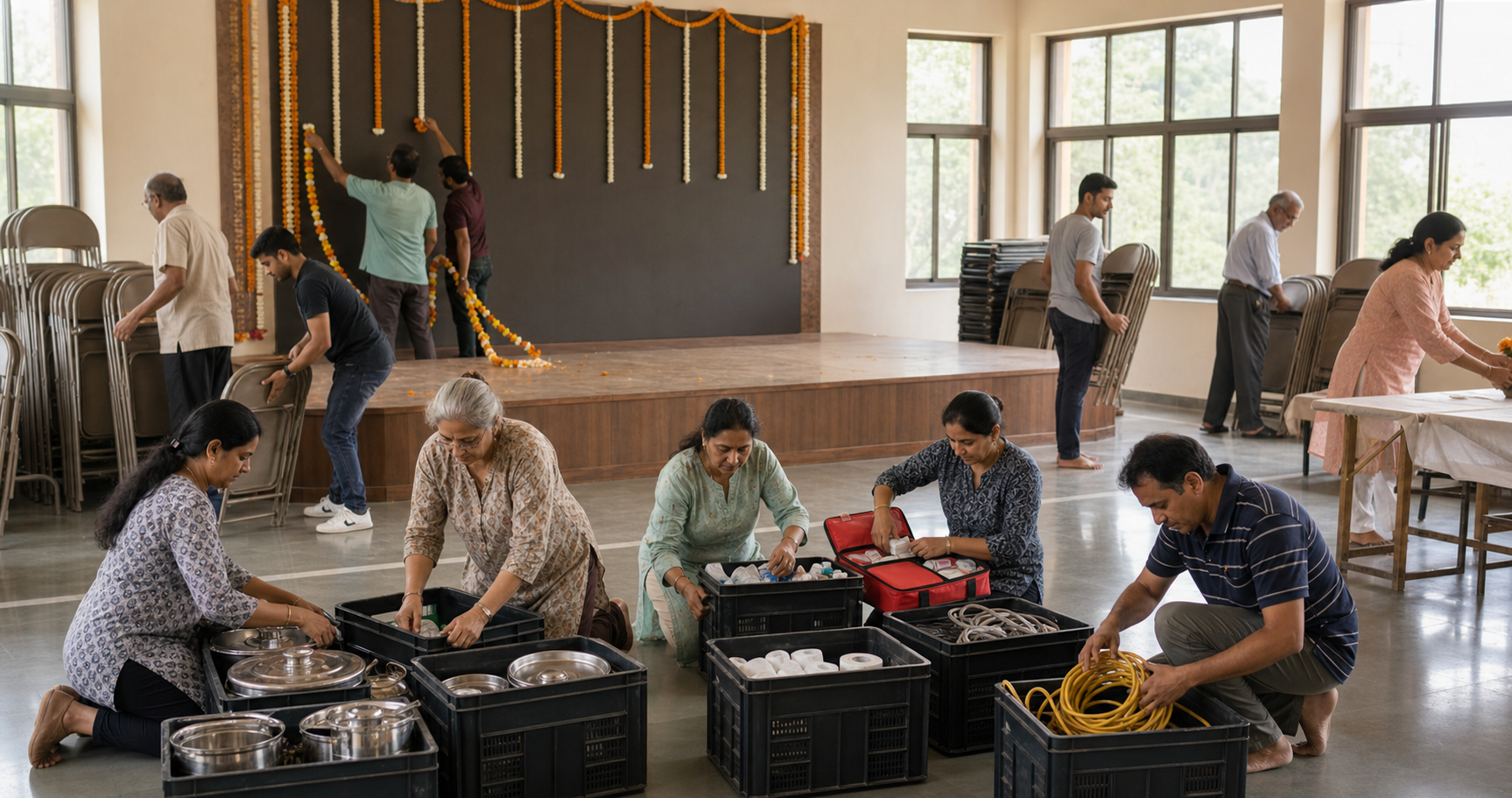
A successful gathering creates attention. It does not automatically create an institution. An institution exists when responsibilities are explicit, decisions are recorded, money can be accounted for, complaints can be heard, and work continues without depending on the charisma or memory of a single person.
The practical model is usually a federation rather than a new body trying to absorb every existing one. Temple trusts, bhajan mandals, women’s groups, youth clubs, educational trusts, and heritage organizations can retain their identities while accepting a shared charter for selected projects. Federated cooperation with clear by-laws, transparent finances, and grievance procedures reduces fear of takeover and makes participation easier to sustain.
Give the network a minimum operating spine:
- A named steward for each program, with authority and limits written down.
- A public calendar showing meetings, classes, seva activities, and decision points.
- Minutes that record decisions, responsible persons, unresolved questions, and follow-up work.
- A financial ledger supported by receipts, an approved spending process, and periodic review.
- A conduct and grievance channel that does not require a complainant to confront the person complained about in a public forum.
- Handover notes so that knowledge moves with the role instead of leaving with the individual.
Then connect every gathering to a simple continuity sequence:
- Close by naming the next complete piece of work, its steward, and the next decision that must be made.
- Circulate the decision record to participants instead of relying on recollection or scattered chat messages.
- Begin with a project small enough to finish properly, including permissions, documentation, expenditure, and review.
- Publish what was completed, what was spent, what did not work, and what changes before the next cycle.
- Give greater responsibility to people who demonstrate reliability, not merely visibility or rhetorical force.
Digital tools should support this structure without turning community membership into an uncontrolled data pool. Use open calendars for public events and controlled repositories for minutes, charters, and working documents. Keep volunteer registries restricted. Collect only the information required for a defined purpose, tell people how it will be used, and do not add someone to messaging groups or publicity lists without consent.
Leadership must also be intergenerational in fact, not only in photographs. Women should participate in budgets, curriculum, policy, and project selection rather than being confined to hospitality and logistics. Youth need real assignments with mentoring and review. Elders should be treated as living archives whose knowledge can be recorded with permission, organized, and made useful to learners. This creates a pipeline of competence instead of a recurring search for helpers.
Nonpartisanship does not require silence about civic concerns. It requires clarity about the platform’s purpose. A cultural organization can teach legal literacy, advocate lawful protection of temples and traditions, or address a documented public issue without becoming an election vehicle. Apply the same evidence standard to claims that flatter your audience and claims that alarm it. Once rumor becomes an organizing method, trust becomes expendable.
Choose seva that makes cooperation visible
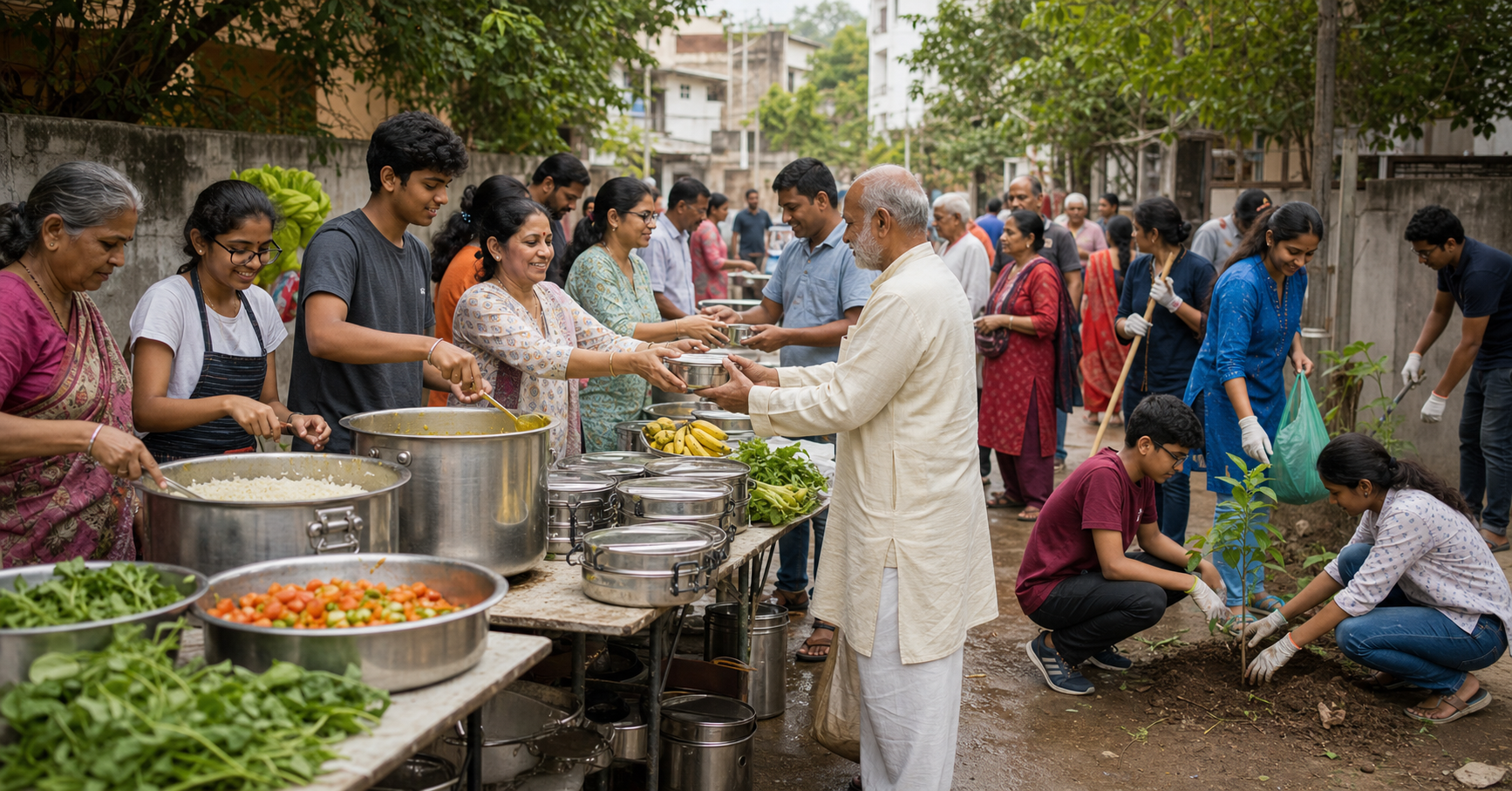
Unity becomes credible when people who usually operate separately complete useful work together. Seva is therefore not an ornamental activity scheduled beside the serious program. It is where dharmic language is tested against punctuality, fairness, competence, patience, and the dignity of the person being served.
Choose work that fits a named local need and the actual skills of your volunteers. Useful possibilities include:
- Language tutoring and educational support for children who lack access to it.
- Temple cleanliness and heritage documentation carried out with the trust’s permission and ritual requirements in mind.
- Visits and practical assistance for elders who are isolated or need help accessing community activities.
- Oral-history recording, archival organization, and digitization of temple records where custodians authorize it.
- Heritage walks that connect sacred geography, local history, artisans, music, and architecture.
- Support for traditional artists through documentation, apprenticeships, fair programming, and respectful presentation of their work.
- Food service, health outreach, first-aid training, environmental stewardship, or relief work coordinated with competent institutions.
Before approving a project, ask whether the need has been confirmed with the people affected; whether the necessary permission and competence exist; whether responsibility is visible; whether recipients retain dignity and choice; and whether completion can be verified. If the plan depends mainly on photographs, speeches, or an indefinite promise to raise awareness, it is not ready.
Service should not require beneficiaries to endorse the beliefs of the organizing group. Traditions such as anna-dana and langar show how sacred motivation can produce hospitality without humiliation. Education, health outreach, artisan support, environmental work, and relief activity can create both trust within a community and goodwill beyond its immediate circle.
Measure enough to learn, but do not confuse visibility with impact. Attendance, volunteer effort, completed educational sessions, archival outputs, participation retention, and projects initiated are useful operating signals. The deeper question is whether a new study circle continues to function, a heritage record remains accessible, a learner returns with greater competence, a partner institution wants to cooperate again, or a service recipient actually received what was promised.
Review failure openly. A cancelled program, weak attendance, budget overrun, or poorly defined role is information. Record the cause and change the process. Concealing ordinary mistakes to protect prestige creates the conditions for larger failures. Accountability is not hostile to Hindu unity; it is what allows trust to cross family, sectarian, institutional, and regional boundaries.
Apply consent to documentation as carefully as you apply it to service. A temple, ritual, manuscript, elder, artist, child, or beneficiary is not raw material for social media. Ask before recording, explain where material will appear, respect restrictions in sacred spaces, and provide a way to withdraw material when appropriate. Cultural preservation without reverence quickly becomes extraction.
Use sadhana to keep mobilization recognizably dharmic
Civic mobilization changes people through its habits. If meetings repeatedly reward outrage, interruption, rumor, and humiliation, a dharmic label will not rescue the culture being formed. If participants practice attention, truthful speech, restraint, and correction, those disciplines become institutional assets.
Japa is especially accessible because it can be practiced as vaachika, with the Name audible; upamshu, in a whisper; or manasika, mentally. Participants can follow their Ishta and lineage rather than being forced into a single formula. A consistent daily sitting of about 12 to 20 minutes was presented as a practical pattern, with regularity and sincerity carrying more weight than display.
For a collective program, announce the invocation beforehand, explain its place in the schedule, and leave room for participants whose practice is silent or different. Do not use the chosen mantra as an orthodoxy test. The purpose is to steady attention and align conduct, not to rank spiritual identities.
Connect the practice explicitly to behavior. After japa, ask volunteers to carry the pause into difficult conversation, verify a claim before forwarding it, listen fully before replying, and use the grievance process rather than a public pile-on. When a correction is necessary, make it without theatrical cruelty. When a dispute cannot be resolved internally, use the appropriate civic or professional channel instead of escalating it through rumor.
Bhajan, kirtan, satsang, and collective pilgrimage have long joined devotion with community formation. Maharashtra’s Warkari inheritance and the abhang traditions associated with Sant Dnyaneshwar, Tukaram, and Eknath offer a particularly clear model: repeated sacred participation can educate feeling as well as thought. The organizational lesson is not to reproduce one regional form everywhere. It is to connect shared spiritual practice with ethical speech, dependable service, and a community memory larger than the latest controversy.
Key takeaways
- Define Hindu unity as disciplined cooperation across legitimate differences, not compulsory sameness.
- Adopt a written covenant covering purpose, conduct, pluralism, lawful action, consent, and accountability before mobilizing people.
- Teach dharma through age-appropriate study, accurate attribution, dialogue, language, and local heritage work.
- Turn every major gathering into a documented next assignment with a steward, a decision point, and a review process.
- Use transparent finances, recorded decisions, grievance procedures, privacy safeguards, and leadership handovers to preserve trust.
- Select seva by confirmed need, competence, permission, dignity, and verifiable completion rather than publicity value.
- Let japa and collective devotion shape how volunteers speak, disagree, correct mistakes, and carry responsibility.
At your next gathering, do not end with a pledge alone. Put the civic covenant before the participants, name the work that follows, identify who will steward it, and publish how the result will be reviewed. The moment people can see what happens after the applause, Hindu unity begins to function as durable civic strength.
References
- Hindu Janajagruti Samiti – Maharashtra’s Hindu Rashtra-Jagruti Sabhas: Surging Civic Energy, Dharmic Unity, and Japa
- Hindu Janajagruti Samiti – Virat Hindu Sammelan in Saharanpur: HJS joins a powerful unifying call to safeguard Sanatan Dharma
