
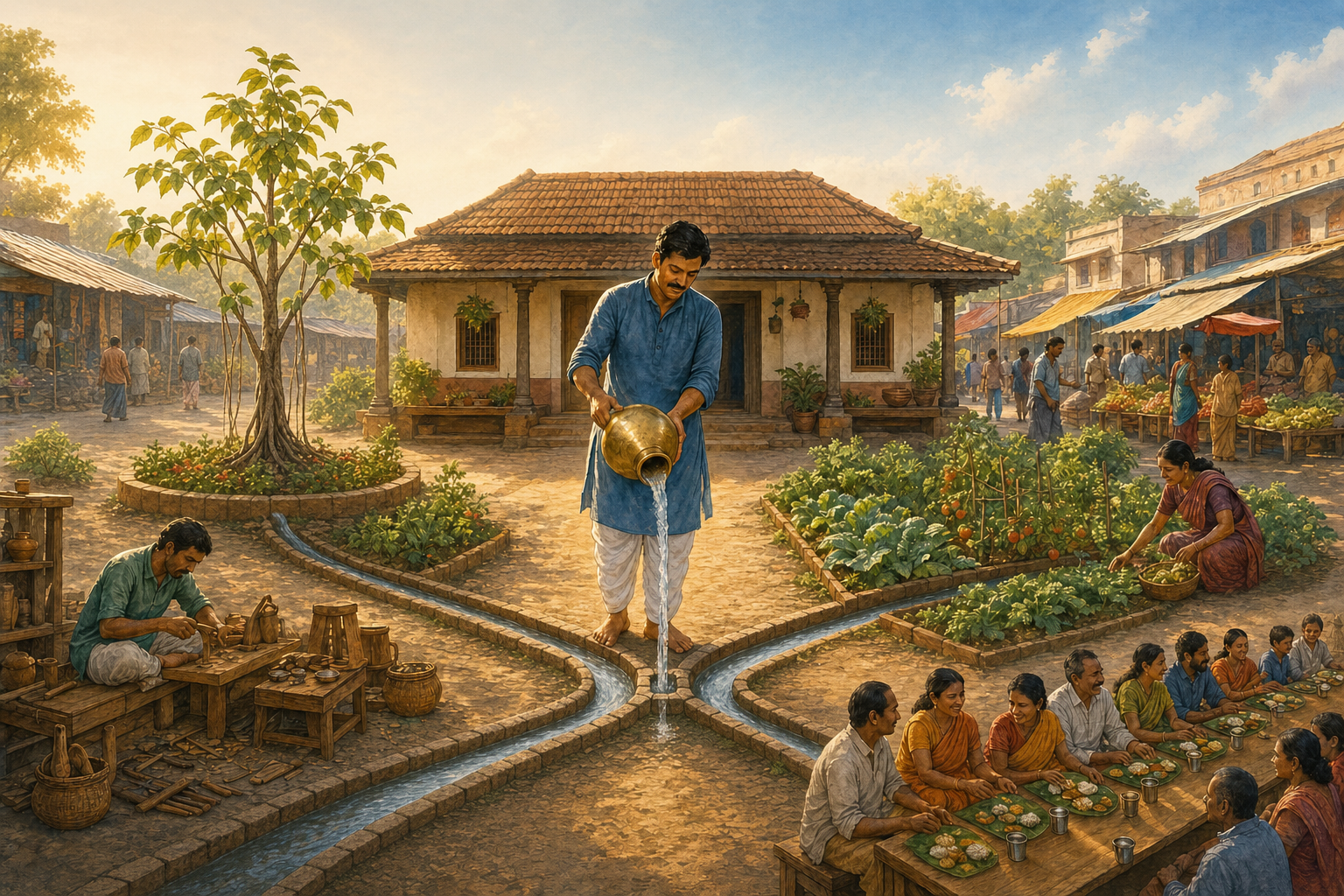
You may want to prosper, protect your family, and build something worthwhile, yet still wonder whether ambition is spiritually suspect. You may also worry that karma has already fixed the limits of what you can become.
Hindu dharma gives neither fear a simple yes. Your deepest spiritual possibility is not confined by your present condition, but possibility does not ripen by wish alone. Karma is the cultivation. Wealth is one of its most revealing fields. The practical question is not whether you possess money, but what your earning, keeping, spending, and giving are teaching you to become.
Key takeaways
- Spiritual potential is a capacity to be cultivated, not a promise that every desired worldly outcome will occur.
- Karma is neither blind fate nor a license for self-condemnation. Repeated choices plant tendencies, and disciplined choices can change the conditions in which those tendencies ripen.
- Hindu dharma accepts artha, or material prosperity, when it remains governed by dharma and protects legitimate household duties.
- Generosity cannot repair an exploitative livelihood while the exploitation continues. Pay what is owed and correct harmful practices before treating charity as the answer.
- Ethical wealth meets obligations, relieves suffering, preserves the recipient’s dignity, and gradually loosens the owner’s attachment.
Spiritual potential is a responsibility, not a prediction
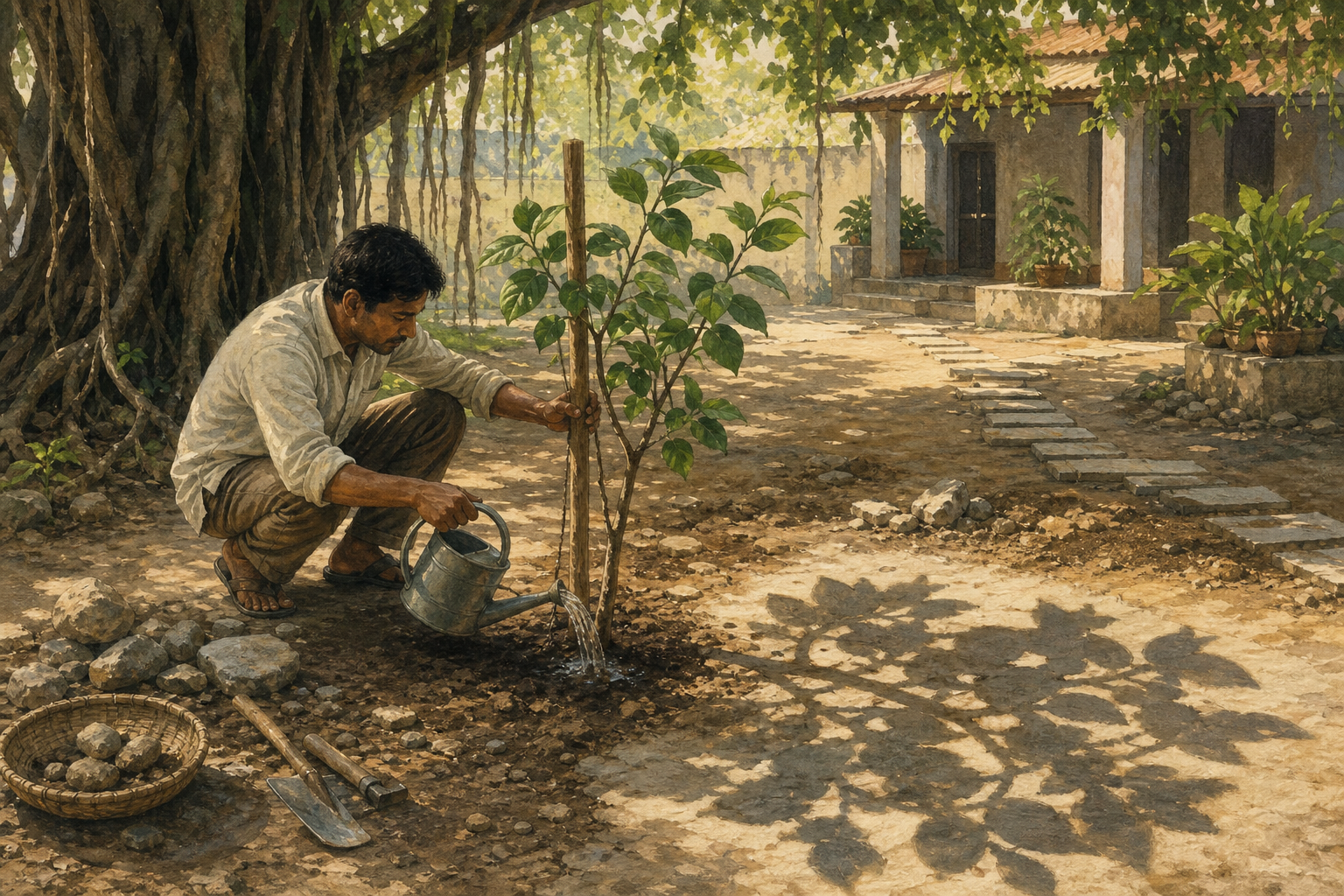
The Chandogya Upanishad uses the almost invisible essence of a banyan seed to direct attention beyond surface appearance. Nothing resembling a miniature tree can be seen when the seed is opened, yet a vast banyan can arise from it. The lesson culminates in tat tvam asi: the subtle reality from which being arises is not alien to the self.
This teaching is more demanding than positive thinking. A seed contains an ordered possibility, not a guarantee independent of conditions. Soil, water, light, time, and freedom from destruction all matter. In the same way, spiritual possibility can be obscured by neglected duties, compulsive habits, resentment, fear, or an undisciplined search for pleasure.
It also matters which level of potential you mean. Within Advaita Vedanta, the deepest truth is not that the ego will manufacture divinity through achievement. It is that the ground of consciousness and being is already more fundamental than the limited identity to which the ego clings. Recognition is required. On the practical level addressed by Yoga, however, your character still needs training. Latent tendencies must be weakened, redirected, or allowed to become fruitful through practice.
Keep three questions separate when judging yourself or another person:
- What is fundamentally worthy? A person’s spiritual dignity is not measured by income, status, talent, health, or present success.
- What is presently possible? Abilities and opportunities differ because embodied life includes real conditions, constraints, and prior tendencies.
- What can be cultivated now? This is the field of dharma: the next truthful action, restraint, discipline, act of service, or correction that conditions allow.
Confusing these questions produces two opposite errors. One is fatalism: “My circumstances prove that I cannot change.” The other is entitlement: “Because my potential is infinite, the outcome I want must occur.” The seed image supports neither conclusion. It asks you to respect what is present, study the conditions honestly, and cultivate without demanding that reality obey the ego’s preferred schedule.
Use this distinction when a failure shakes your confidence. Do not turn one failed attempt into a verdict on the self. Identify the missing condition instead. You may need knowledge, steadier practice, a better environment, ethical repair, or freedom from a habit that repeatedly consumes your attention. That diagnosis turns an abstract belief in potential into a dharmic responsibility.
Karma is cultivation, not a permanent verdict
Karma is often invoked as though it were a label attached to a person: fortunate, cursed, deserving, or doomed. That usage hides the part of karma you can actually work with. Karma concerns action and consequence. Samskaras are impressions or tendencies formed through experience and repetition. When described as bija, or seeds, they may remain latent until supporting conditions let them sprout.
This is why the Yoga disciplines of abhyasa, sustained practice, and vairagya, dispassion belong together. Practice nourishes a chosen direction. Dispassion stops feeding the grasping that drags attention back toward an old pattern. One plants; the other clears the ground.
You can apply that model without pretending to calculate an invisible karmic balance sheet. Choose one recurring fruit in your life and trace its cultivation:
- Name the fruit without euphemism. It might be harsh speech, avoidance of duty, jealous comparison, reliable study, patient listening, or spontaneous generosity.
- Identify the seed you repeatedly nourish. Look for the thought, action, emotional rehearsal, or small permission that precedes the visible result.
- Find the supporting condition. A pattern may be strengthened by a particular setting, relationship, possession, fear, convenience, or unexamined reward.
- Remove one source of nourishment from the unwanted seed and give the desired seed a concrete action. An apology, a truthful conversation, a period of study, a completed obligation, or an act of seva is more useful than a vague intention to improve.
- Review the action at the end of the day. Ask what you fed, what you interrupted, and what condition needs to change next. Do this without turning honest accountability into self-hatred.
This approach neither denies past causes nor surrenders to them. Strong tendencies may not disappear after one contrary action. A seed already germinating has momentum. Even so, your present action joins the causal field and changes what will be easier to repeat later. Patience is therefore part of karmic intelligence, not an excuse for delay.
Apply karma inward before applying it to someone else’s suffering. You do not know the complete causal history of another person, and the doctrine does not authorize indifference. Deciding that poverty, illness, or misfortune must be deserved turns karma into a pretext for withholding compassion. Your visible encounter with need creates a present ethical choice for you, whatever unseen causes may have preceded it.
Nor should dana be treated as a purchase that cancels misconduct. Giving can reshape attachment and redirect future conduct, but it does not make an unpaid worker, deceived customer, or exploited supplier whole. Where your action has caused identifiable harm, correction and restitution come before the comforting thought that an unrelated donation has settled the account.
Dharma does not reject wealth; it judges its movement
Artha has a legitimate place among the purusharthas, the aims of human life. A householder may earn, save, plan, support dependents, grow an enterprise, and prepare for foreseeable responsibilities. Recklessness is not renunciation, and making your family insecure in order to appear detached is not sound stewardship.
But artha is not morally self-governing. Dharma asks at least three questions of it: How was this wealth obtained? Which obligations must it meet? What happens when there is more than those obligations require?
The first question prevents generosity from becoming moral camouflage. If money depends on withheld wages, deliberately unfair terms, exploitative pricing, or payments delayed for leverage, the problem begins upstream. Asteya, non-stealing, reaches conduct that can hide behind ordinary commercial procedure. A public donation does not sanctify value extracted through a practice you are still able and unwilling to correct.
The second question distinguishes prudence from miserliness. Food, shelter, care, education, debts honestly incurred, fair compensation, and commitments to dependents are not enemies of dana. They are part of the ethical structure within which giving becomes sustainable. Traditional householder obligations also extend attention beyond the private family toward guests, other living beings, ancestors, teachers, and the sacred.
The third question tests whether wealth has become a trust or a fortress. The Bhagavad Gita sharply compares enjoyment without returning a share to theft. Its account of sattvika dana joins a worthy recipient, the right place and time, and freedom from expectation of repayment. The amount alone cannot tell you whether a gift is sattvika. Intent, context, dignity, and consequence matter.
This is where the Puranic image of Suchimukham becomes useful. The name evokes a needle-like mouth and a fate fitted to a life narrowed by hoarding. It is especially associated with refusing to relieve basic suffering despite having the capacity to help. Some Hindu readers understand Naraka as an actual post-mortem realm administered through precise karmic consequence; others emphasize its psychological and allegorical force. In the Puranic moral frame, the consequence is typically corrective and finite rather than an eternal sentence.
Either interpretation exposes the same danger. Hoarding does not merely leave resources unused. It trains perception to experience every request as a threat, every dependent as a burden, and every gift as a loss. The mouth becomes narrow before any other-worldly consequence is considered. Deliberate dana reverses that training by making responsible circulation habitual.
Generosity still requires discernment. Immediate food, shelter, and medical support answer urgent needs; education, skills, and community health can build longer-term capability. Respectful giving asks what is needed rather than using a recipient as the setting for the giver’s virtue. It also checks whether the channel is transparent and whether the help reaches people without humiliation or needless control.
This ethic belongs to a wider Dharmic family. Jain aparigraha disciplines possession, Buddhist dana trains generosity, and Sikh seva and dasvandh give social form to sharing. Their doctrines are not interchangeable, but they converge on a practical warning: attachment hardens when resources are treated as a private absolute, and freedom grows when responsibility and compassion govern their use.
Use a five-gate wealth audit before your next decision
You do not need to renounce ordinary life to test whether your wealth serves dharma. Run the following audit when income arrives, when an obligation becomes due, before a major discretionary expense, and when you set a giving budget. The order matters because charity should not distract you from correcting the way wealth is produced or from meeting duties already owed.
- Origin: Ask what actions produced the money. Look beyond formal legality to truthfulness, consent, fair dealing, environmental or social harm you can identify, and whether a vulnerable party carried a hidden cost. If the source contains a correctable wrong, begin there.
- Obligation: List the people and promises for which this money is already responsible. Secure legitimate household needs, pay workers and vendors fairly and promptly, and honor commitments. Money owed to another person is not charitable surplus.
- Sufficiency: Separate prudent provision from fear-driven accumulation. Name the actual duty your saving serves. If you cannot name one and the only answer is that no amount ever feels safe, the issue may be attachment rather than stewardship.
- Circulation: Set aside a repeatable dana amount according to your real capacity instead of waiting to see what remains after every desire is satisfied. Give urgent relief where suffering is immediate, and support education, health, or capability where sustained help can open future choices.
- Inner freedom: Examine what you demand in return. Recognition, access, obedience, control, favorable publicity, or the feeling of superiority can turn a gift into another form of possession. Give with accountability for the result, but do not try to own the recipient.
If you own or manage an institution, apply the same audit to the core operation before highlighting philanthropy. Review wages, payment schedules, customer terms, grievance channels, and supplier treatment. Corporate giving is valuable, but it is secondary to ensuring that the business itself does not create the deprivation its donations claim to address.
Measure more than the sum donated. Check whether obligations were paid when due, whether recipients retained dignity, whether promised help arrived, and whether the intervention did what it was meant to do. This feedback protects dana from becoming an exercise in intention alone.
Keep the audit proportionate to your role. An employee deciding how to use a salary and an owner setting labor terms do not control the same causes. Work on the actions genuinely within your authority, document concerns where you have a duty to raise them, and do not claim personal purity for harms you simply moved out of sight.
If a proposed change could endanger housing, essential care, dependents’ security, contractual duties, or the solvency of a household or organization, do not improvise the financial mechanics. Preserve the dharmic principle, then obtain qualified financial, tax, or legal advice for the decision itself. Generosity is not served by creating a new preventable crisis.
Finally, bring the audit back to spiritual potential. Wealth magnifies whatever samskara is repeatedly allowed to direct it. Fear can become hoarding. Vanity can become display. Care can become service. Steady accountability can become trustworthy stewardship. Money is therefore not separate from sadhana; it reveals which inner seed is receiving water.
Before your next money decision, write three lines: the duty this money must meet, the harm it must not create, and the good its genuine surplus can support. Correct the clearest breach first, then make the gift you can sustain without bargaining for praise. That is a small karmic seed, but small seeds are precisely where disciplined vision begins.


References
- DharmaRenaissance Blog — Seeing the Banyan in a Seed: Profound Hindu Wisdom on Infinite Potential and Dharmic Unity
- DharmaRenaissance Blog — Suchimukham Unveiled: The Chilling Karmic Price of Hoarded Wealth in Hindu Dharma
