

You may understand the teaching that you are not the body, yet lose that clarity as soon as criticism, craving, fatigue, or anxiety takes hold. If that gap between philosophy and daily reaction is your problem, Kapila’s teaching to Devahuti offers a precise way forward: distinguish the conscious seer from material nature, learn how the mind becomes entangled, and redirect the whole person toward the Supreme through bhakti.
That final movement is essential. In the theistic Sankhya of the Bhagavata tradition, liberation is not emotional numbness, intellectual self-observation, or escape from ordinary duties. It is freedom from false identification joined to loving service. You can begin that work where Devahuti received it: within the complications of an actual human life.
Start with the Kapila who teaches Devahuti
The setting tells you what kind of path this is. Kapila appears in the household of Kardama Muni and Devahuti as the Lord’s promised son, charged with disseminating real knowledge. His instruction does not arrive in a setting removed from relationships and responsibilities. A home becomes the place where metaphysics, devotion, trust, and liberation meet.
This also identifies which meaning of Sankhya is relevant. Later classical presentations of Sankhya are often framed in non-theistic terms. The Bhagavata’s Kapila teaches a God-centered analysis in which knowledge of purusha and prakriti serves bhakti. The difference is not a minor addition to the same system. It changes both the goal and the means: discrimination loosens bondage, while devotion positively attaches consciousness to the Supreme.
Begin with a direct observation exercise. It turns a doctrine into something you can test during an ordinary disturbance.
- Describe the event without adding a judgment: a harsh sentence was spoken, a desire appeared, or the body became tired.
- Name what changed in the body and mind: tension, heat, an image, a memory, an argument, or an urge to withdraw.
- Notice that these changes are known. The sensation, thought, and mood are objects of awareness; the knower is not identical to any one of them.
- Ask what action would serve Dharma and the Supreme now. This prevents witnessing from becoming passive detachment.
The fourth step keeps the exercise theistic. You are not trying to become an indifferent spectator who denies the body or abandons responsibility. Body, senses, mind, and intelligence remain instruments of action. The task is to stop mistaking the instruments for the self and then use them in service.
Use Sankhya to locate bondage as it happens

Kapila’s analysis becomes useful when you can identify the mechanism of entanglement. Prakriti includes the body-mind machinery through which experience unfolds. Manas receives and organizes impressions. Buddhi can discern and decide. Ahaṅkara appropriates experience by declaring, in effect, “I am this condition” and “this belongs to me.” The draṣṭā, the conscious seer, becomes bound through misidentification with that machinery.
This is why changing the content of a thought is not yet liberation. A pleasant identity can bind as surely as a painful one when ahaṅkara claims it. “I am successful,” “I am spiritual,” and “I am a failure” differ emotionally, but all three can conceal the witnessing self when they are treated as its complete identity.
The three guṇas help you diagnose the condition of the instrument before choosing a remedy:
- Rajas appears as agitation, compulsive activity, comparison, acquisition, and the inability to stay with one practice. Do not answer it by collecting more teachings. Restrict inputs, keep one text open, and finish the practice already chosen.
- Tamas appears as dullness, avoidance, confusion, and inertia. Do not rename it peace. Support wakefulness through orderly sleep and diet, use audible kīrtana when silent attention collapses, and place practice before the part of the day when lethargy usually wins.
- Sattva brings clarity, restraint, and steadier perception. Cultivate it, but do not mistake refinement for final freedom. Even clarity can feed subtle pride when it is claimed as personal superiority. Offer it through humility and seva.
When you are triggered, use one diagnostic sentence: “This is a movement in prakriti, it is known by the seer, and it still requires a dharmic response.” The first clause prevents identification. The second restores perspective. The third prevents philosophical evasion.
Why devotion completes analytical knowledge

Analysis can reveal that you are not a passing mental state, but negation alone does not determine what should command your love, attention, and action. An attention freed from one attachment can quickly find another. Theistic Sankhya therefore does more than separate purusha from prakriti: it reorients the conscious self toward the personal Supreme.
Faithful śravaṇa, or attentive hearing about Kṛṣṇa, is the practical beginning of that reorientation. What you repeatedly hear supplies material for memory. Memory shapes attention, attention feeds desire, and desire influences action. Sacred hearing is therefore not background inspiration. It deliberately changes what the mind returns to when no immediate duty controls it.
The principal practices work on different parts of the same problem:
- Śravaṇa gives the intelligence a true object of contemplation and interrupts the mind’s habitual narratives.
- Kīrtana and mantra-japa bring speech, hearing, memory, and attention into a single devotional act.
- Smaraṇa carries what was heard into the unstructured moments when old impressions usually reclaim the mind.
- Seva tests whether devotion has moved beyond sentiment by converting energy, skill, and time into an offering.
- Sat-saṅga creates a social environment in which speech, habits, and priorities can be recalibrated.
Bhakti does not make disciplined effort unnecessary. Kardama’s mature yoga preceded the Lord’s promised descent, while the descent itself expresses grace and divine reciprocity. Hold both sides together: practice sincerely without treating liberation as a personal manufacture, and depend on grace without using grace as an excuse for indiscipline.
You may recognize related disciplines elsewhere in the dharmic family: hearing the Dhamma and cultivating compassion in Buddhism, aparigraha in Jainism, or nām-simran and kirtan in Sikh tradition. These resonances can deepen mutual respect, but they should not be used to erase real differences. Bhagavata Sankhya is specifically devotional and theistic; its account of liberation is shaped by relationship with the Supreme.
Turn the teaching into a household sādhanā
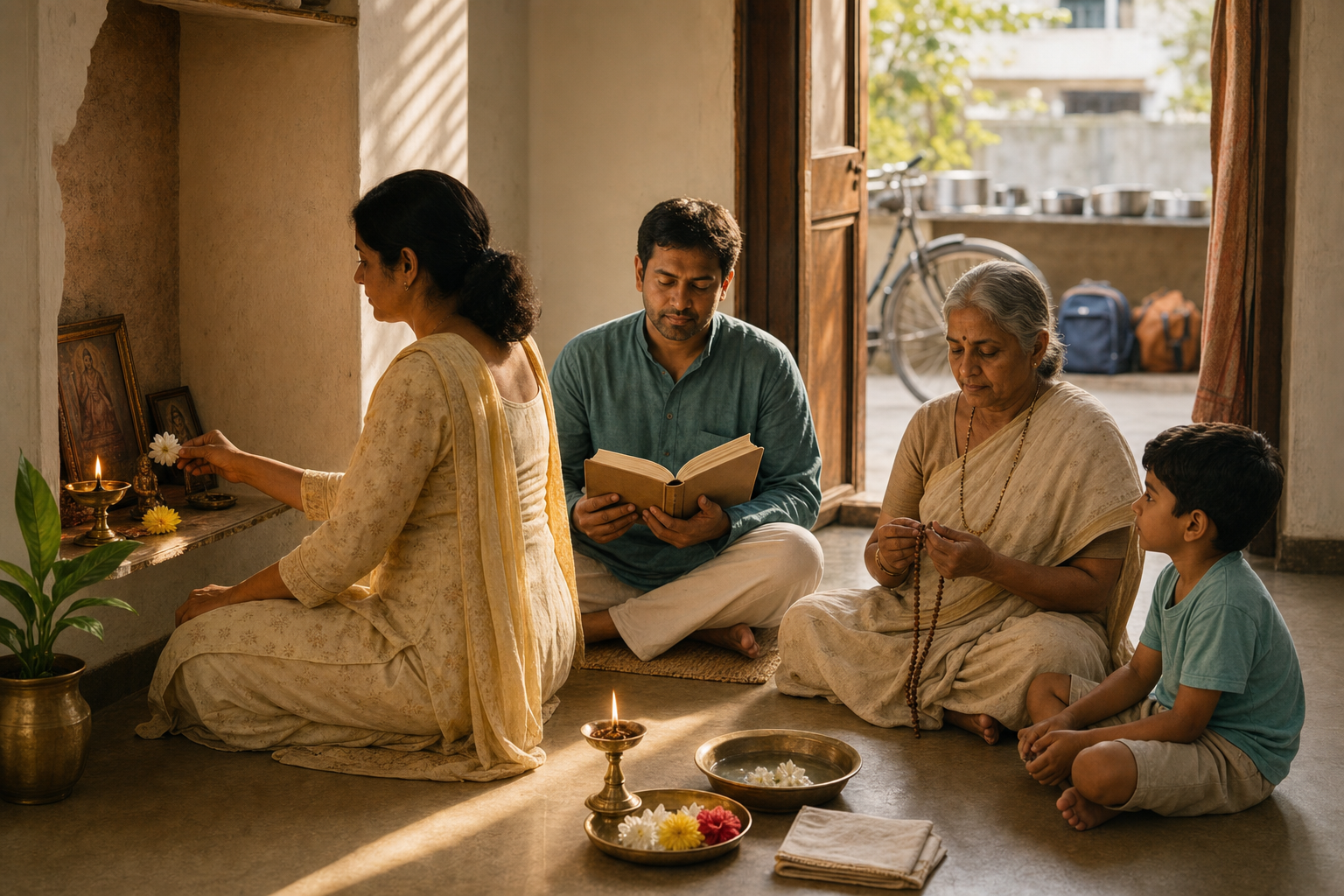
Do not wait for a retreat, a quieter home, or a purified mind before beginning. Devahuti receives liberating instruction within family life, and Kardama’s household becomes a place of revelation. Your home can likewise support practice when devotion is attached to repeatable cues rather than left to fluctuating motivation.
Use this four-part sequence as a minimum viable discipline:
- Hear one coherent passage. Read or listen to a selected portion of the Kapila-Devahuti dialogue in the Third Canto of the Śrīmad-Bhāgavatam. Stay with the chosen passage instead of moving through an endless feed of unrelated spiritual content. At the end, state its central distinction in your own words.
- Continue with the holy name. Move directly from hearing into kīrtana or mantra-japa. When the mind wanders, return through the meaning or quality of the Supreme that the passage placed before you.
- Name one act of seva. Decide what devotion will look like in conduct before the day fills with demands. It might be patient care for a family member, work performed honestly, help offered without display, or a specific responsibility completed as an offering.
- Close with svādhyāya. Record brief answers to four questions: What disturbed me? Which guṇa was most visible? Where did I identify with body or mind? What response would better express service?
Protect this sequence by subtracting one source of friction. Disable nonessential notifications during practice. Keep the chosen text ready instead of searching for something new each time. Simplify the space enough that sitting down does not require preparation. A protected period without digital input can reveal how much apparent spiritual restlessness was being continuously manufactured by stimulation.
Vairāgya in this setting is intelligent restraint, not contempt for the world. Reduce possessions, media, and consumption where they repeatedly capture attention without serving Dharma. Do not turn minimalism into another identity to display. Its value is measured by the time and clarity it returns to hearing, remembrance, relationship, and service.
Household practice also includes fidelity. The Lord’s fulfillment of His word to Kardama gives promise-keeping a theological weight: truth is not ornamental to devotion. Keep small commitments, speak accurately, and repair a broken promise instead of hiding it behind spiritual language. A home becomes a place of sādhanā when its members can trust one another.
Measure progress by changed responses, not special moods

A quiet meditation can be encouraging, but it is not enough to show that misidentification is weakening. Look at recurring situations. Are you less easily provoked by the same criticism? Can you notice an urge without immediately obeying it? Does gratitude arise more readily? Has your circle of concern widened? Is service becoming less burdensome while unnecessary consumption loses some of its fascination?
These are directional signs, not certificates of liberation. They matter because they reveal whether knowledge is becoming character. The seer is standing apart from the machinery of reaction, and the machinery is becoming more available for devotion.
Correct predictable distortions early:
- If you keep changing teachers, texts, mantras, or techniques, examine rajas before assuming that the practice is inadequate.
- If practice produces passivity toward duties, examine whether tamas is being mistaken for detachment.
- If witnessing makes you dismiss another person’s pain, return to seva. Genuine discrimination should reduce egoic reactivity without reducing compassion.
- If sattvic habits become grounds for comparison, conceal some good work, serve without recognition, and remember that clarity is a condition for practice rather than personal ownership of holiness.
- If doubt remains entirely abstract, give it a fair test: sustain hearing, remembrance, and service consistently, then evaluate changes in conduct rather than waiting for a dramatic inner event.
Key takeaways
- Kapila’s theistic Sankhya distinguishes the conscious seer from prakriti while orienting the self toward the Supreme.
- Manas, buddhi, and ahaṅkara are instruments to understand and purify, not the complete identity of the knower.
- Sattva supports clarity, but bhakti carries the practitioner beyond attachment even to refined material consciousness.
- Śravaṇa, kīrtana, smaraṇa, seva, and sat-saṅga turn philosophical discrimination into a devotional way of life.
- Reduced reactivity, steadier attention, trustworthy conduct, gratitude, and expanding compassion are more useful measures than unusual spiritual moods.
Before your next day begins, choose the Kapila passage you will hear, decide what event will cue the practice, name one act of seva, and remove one predictable distraction. At your next regular review, examine one recurring trigger rather than asking vaguely whether you feel more spiritual. Liberation is approached through that repeated movement: see the machinery clearly, refuse false identification, and place the recovered attention in loving service.
References
- Dandavats – Transformative Bhakti: Śrīmad-Bhāgavatam 3.32.22-36 Reveals a Clear Roadmap to Moksha
- Dandavats – When the Lord Becomes a Son: Kardama Muni and the Descent of Real Knowledge (SB 3.24.30)
