

If you have been sent the viral rooftop fall video and asked whether it proves a communal attack, pause before accepting the caption. The visible danger is serious. The person’s identity, motive, location, and medical outcome are not established by the circulating clip.
If you organize Holi, live above a celebration route, or help manage your locality, you do not need to solve the internet’s argument before acting. You need to remove overhead hazards, control terrace access, give volunteers a clear response plan, and keep an accident or reckless act from becoming a second emergency.
What the viral clip establishes – and what it cannot
The street-level footage appears to show a person at a roofline holding a bucket-like container. Loose material is tipped over the edge, the person’s weight moves forward, and the person falls. That observable sequence justifies concern about dangerous conduct and rooftop safety.
It does not, by itself, establish who the person is, what the material is, why it was released, where or precisely when the event happened, where the person landed, or how badly anyone was injured. The reviewed version has no visible timestamp or reliable location marker, and the landing and immediate aftermath are unclear. Claims that the person survived have circulated, but no official police or hospital confirmation was identified.
That distinction matters. A dangerous action can be condemned without assigning an unverified religion, criminal intention, or collective guilt. A caption is not evidence, and repeating an inflammatory label can turn a preventable safety incident into retaliation against people who had nothing to do with it.
When a clip from your locality begins circulating, use this verification sequence:
- Write down only what is directly visible. Keep identity, motive, location, and outcome in a separate list marked unconfirmed.
- Find the earliest available upload or original file. Repeated downloads, crops, subtitles, and reaction edits can remove the clues needed for verification.
- Take clear keyframes and run reverse-image searches. Look for distinctive signs, roof shapes, road layouts, utility poles, and shopfronts rather than relying on a caption.
- Compare additional viewpoints if they emerge. Shadows and apparent weather can support an estimate of place or time, but neither should be treated as decisive on its own.
- Ask local police, organizers, and medical authorities for confirmation. Do not convert silence into proof of either guilt or innocence.
- If the incident is local, preserve the unedited file and send it privately to the appropriate authority. Publicly circulating witness names or home addresses can create further danger.
Turn every overlooking roof into a controlled space
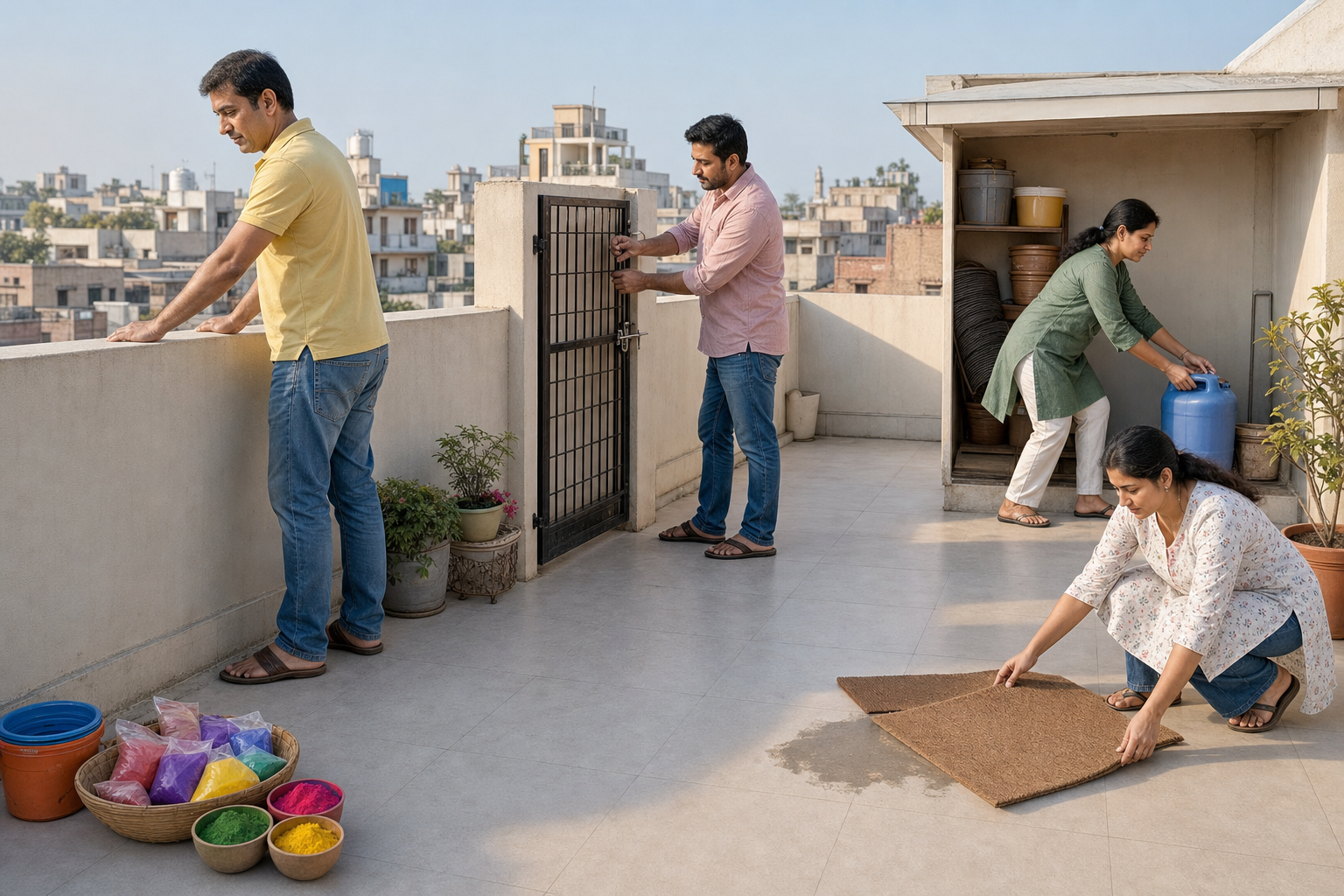
The most effective rooftop control is access. If nobody needs to be on a terrace during the busiest part of the celebration, close it and keep the key with one responsible adult. A roof should not become an improvised viewing gallery merely because it overlooks the route.
Where access is necessary, inspect the terrace before the street fills. The National Building Code of India commonly calls for guarding or parapets of at least 1.05 metres in many accessible-terrace settings. That number is not proof that a particular roof is compliant: occupancy, construction, local rules, later alterations, and the condition of the guard all matter. Missing masonry, a loose railing, a climbable ledge, or an informal extension should make the roof a no-entry area until a competent person assesses it.
Do not place chairs, stools, drums, or stacked materials beside a parapet. They create a step from which a child or adult can pass above the effective guarding height. Keep people away from water tanks, sheet-roof additions, and other surfaces that were not designed as viewing platforms.
Remove anything that could be thrown, dropped, kicked, or blown into the lane: buckets, loose soil, broken masonry, bottles, tools, flowerpots, and unsecured decorations. Intent does not reduce impact. A container released accidentally can injure someone as severely as one thrown deliberately.
The physics makes the point concrete. Gravitational potential energy is calculated as E = m x g x h. A 1.5-kilogram object seven metres above the street represents about 103 joules of potential energy before aerodynamic and other losses. That is an illustration, not an injury threshold; the result depends on the object, impact angle, contact area, and the part of the body struck. It is still enough to show why nothing should be released from a roof into a crowd. Even loose material can concentrate in its container or strike the head, face, or eyes.
Traction is the second control. Smooth ceramic tile may have a static coefficient of friction around 0.4 when dry and below 0.2 when wet. The exact value varies with the tile, footwear, contaminants, and surface condition, but the direction of risk is plain: colored water, oils, and damp powder can make a small forward lean at the edge unrecoverable.
Use one dry route from the access door to a designated observation point set back behind sound guarding. Keep drainage clear. Do not store water or prepare color at the edge. Anyone carrying a container should stay away from the perimeter, and no one should lean over to see what is happening below.
Build the lane plan around overhead risk
A procession or neighborhood gathering should be planned in three dimensions. Looking only at the road misses roofs, balconies, projecting signs, weak facades, overhead cables, and windows from which objects might fall.
Before the event, walk the route with residents, organizers, and the local authority responsible for public safety. Mark buildings with unguarded terraces, fragile additions, loose materials, or a history of conflict. Speak to occupants before the crowd arrives. If a hazard cannot be removed, shift the route or barricade the exposed perimeter so celebrants do not gather beneath it.
A workable lane plan should assign names, not merely responsibilities:
- A route lead who can pause or divert movement.
- Marshals at useful vantage points who watch roofs, balconies, and intersections instead of joining the celebration.
- A resident liaison with contact details for households overlooking the busiest stretches.
- A police liaison who knows when and how to escalate a hazard.
- A medical-response contact who can open a clear access lane and meet arriving help.
- A communications lead authorized to issue one verified update rather than letting several volunteers publish conflicting accounts.
Keep entry and exit flows separate where the layout permits, identify a safe zone away from roof edges and bottlenecks, and protect emergency access from parked vehicles or color stations. Marshals need a shared phone or radio chain and simple language. A useful public-address message is: “Nothing is to be thrown or poured from roofs or balconies. Report an overhead hazard to a marshal. Do not confront the occupant or gather below the building.”
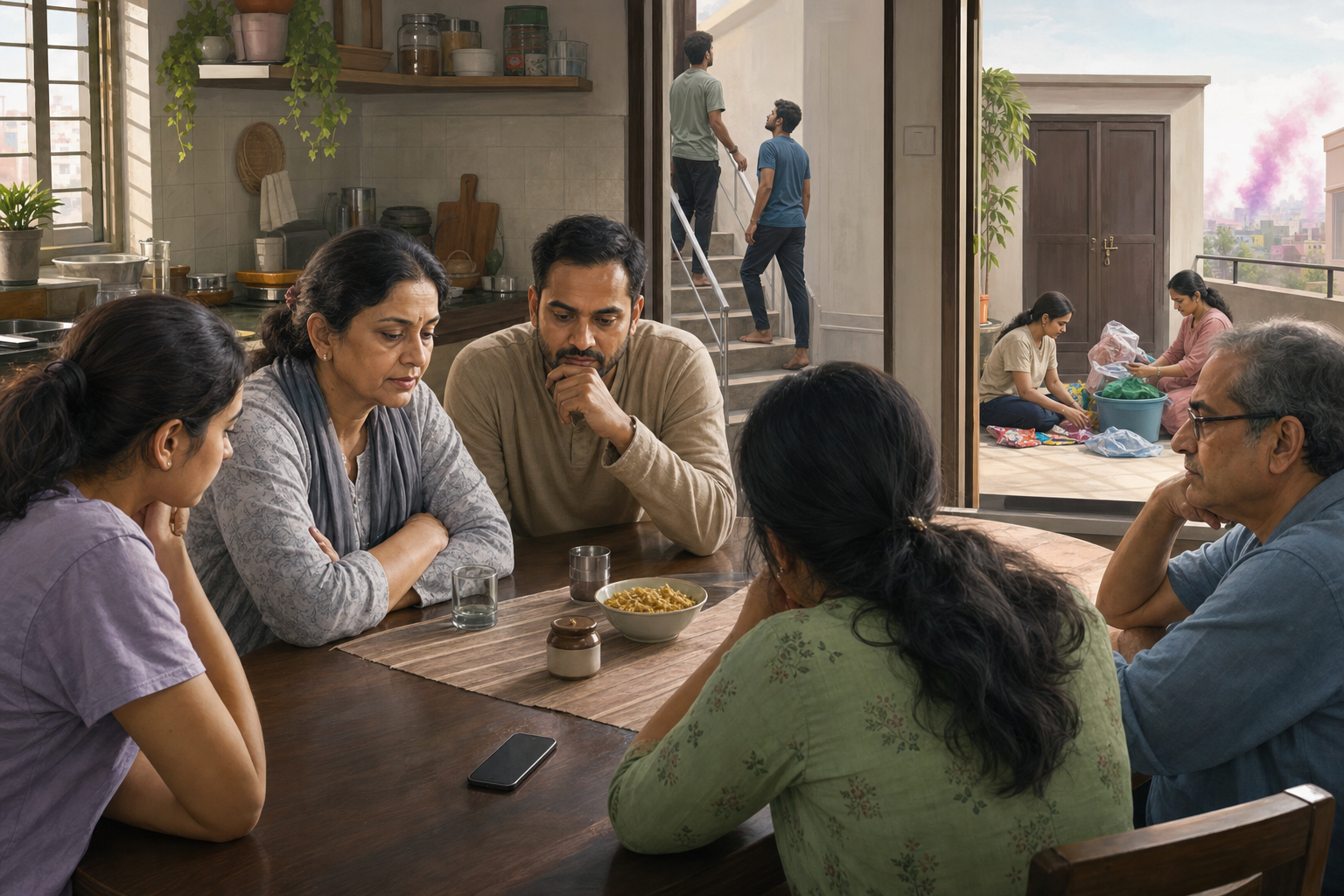
Mixed-faith volunteer teams and mohalla committees are especially useful where different communities share a dense lane. Their purpose is practical: residents know their buildings, organizers understand the route, and recognized local contacts can communicate without a shouting match. Early coordination also makes it harder for an unknown social-media account to define the incident before anyone nearby has established the facts.
Participants have duties too. Respect private property, do not enter a terrace or house without permission, follow marshal and police directions, and report misconduct instead of trying to punish it. A festival crowd is not an investigative body or a court.
Handle an unsafe act or fall without creating a second emergency
If someone is at an edge throwing or tipping material, move people out from directly below before doing anything else. Do not send an angry group onto the roof, surround the building, or encourage the crowd to shout upward. Confrontation can distract or panic a person who is already in an unstable position.
Use the following response order:
- Clear the fall zone and stop more people entering it. One marshal should give short directions while others keep exits open.
- Contact police or the appropriate local authority. Give the exact address, roof position, visible conduct, and whether material is still falling. Describe what you see without assigning a motive.
- If anyone falls or is struck, summon emergency medical help immediately and follow the dispatcher’s instructions. Do not infer injury severity from a person’s appearance or an unverified online claim.
- Create space for trained responders. Do not let filming, arguing, or attempts to inspect the material block medical access.
- Keep people away from unidentified debris. Note where it landed and allow trained authorities to decide whether it should be collected.
- Record the exact time and location, preserve the original video, and identify willing witnesses. Keep the evidence unedited and provide it to authorities rather than publishing personal details.
- Designate one person to issue a factual community update. State what happened, what remains unknown, and what safety action has been taken.
Reckless conduct that endangers people can bring criminal, public-nuisance, and civil consequences, but the applicable provision depends on the current law, jurisdiction, and established facts. Let police document the event and obtain qualified legal advice where necessary. Quoting a section number from an old social-media message is not a substitute for current legal guidance.
Restraint is not passivity. It is the disciplined choice that protects the injured, preserves usable evidence, and leaves responsibility with due process. It also reflects ahimsa in its most immediate form: prevent avoidable harm before defending a narrative.
Key takeaways for a safer Holi
- Condemn the visible unsafe act, but do not invent an identity, motive, location, or medical outcome that the footage cannot establish.
- Close unnecessary roof access, remove loose objects, keep surfaces dry, and create one observation point behind sound guarding.
- Treat a missing, weak, or unusually low parapet as a reason to keep the terrace closed, not as an inconvenience to work around.
- Map overhead hazards along the route and assign named marshals, resident contacts, police coordination, medical access, and public communications.
- When danger appears, clear the area, call trained responders, preserve original evidence, and prevent confrontation or retaliation.
- Protecting Holi’s dignity requires both cultural confidence and self-restraint. Joyful celebration and firm safety rules belong together.
Before your next community celebration, choose one person to control rooftop access and one marshal to own each exposed stretch of the route. Put their names and contact details on the plan. That small act turns collective responsibility from a slogan into something people can use when seconds matter.
References
