

If you came here because your mind feels too fast, your mood has gone flat, or sleep no longer restores you, the useful question is not simply whether yoga is good for the brain. It is which part of yoga fits your present state, how to practise it consistently, and how to tell whether it is helping outside the session.
Yoga can support mental health, but it is not a promise of permanent calm. Think of it as training your capacity to notice activation, regulate it, and recover without being carried away by it. Asana, pranayama, dhyana, mantra, and yoga nidra contribute in different ways. You will get more from a modest practice chosen for the right purpose than from an impressive sequence you cannot sustain.
The useful effect is better recovery, not the absence of stress

A stressful event activates the body before you have time to reason through it. Breathing changes, muscles brace, attention narrows, and thoughts begin circling the perceived threat. Yoga works on this whole pattern. Movement gives physical tension somewhere to go, regulated breathing influences autonomic activity, and meditation teaches you to see a thought without immediately obeying it.
Some effects can appear within a single session. Moderate asana and breath-led movement can increase endorphin and endocannabinoid activity, while magnetic resonance spectroscopy has detected acute increases in GABA after yoga. GABA helps inhibit excessive neural excitation and is relevant to anxiety regulation. These mechanisms can help explain why you may feel different after practice, but one calm evening is a temporary state change, not evidence that a condition has been cured.
Repeated practice matters because the longer-term effects involve several interacting systems. Regular yoga has been associated with higher brain-derived neurotrophic factor, healthier serotonin and dopamine regulation, lower basal cortisol, and less pronounced stress reactivity. Yoga has also reduced anxiety and depressive symptoms in randomized trials. The careful conclusion is that consistent practice can support mood and stress regulation; it does not guarantee the same response in every person.
Breathing is one of the most direct levers. Slow diaphragmatic breathing at approximately six breaths per minute can raise heart-rate variability, strengthen baroreflex sensitivity, and support vagal tone. Those are signs of greater autonomic flexibility: the ability to mobilize when needed and then settle again. Nadi shodhana, bhramari, and gentle ujjayi can encourage parasympathetic activity and steadier interoceptive attention. Six breaths per minute is a useful reference, not a test you must pass. If slowing the breath creates strain, air hunger, or light-headedness, return to an easy natural rhythm.
Brain imaging adds another layer, although it is often overstated. Experienced meditators have shown differences in gray-matter density in the hippocampus, anterior cingulate cortex, and insula, regions involved in memory, attention, emotional regulation, and awareness of bodily signals. Meditation has also been associated with stronger prefrontal-amygdala connectivity and more efficient activity in the default mode network, which is relevant to rumination. These are patterns observed with sustained contemplative practice, not proof that a short sequence remodels the brain overnight.
Mental health is not confined to the skull. Chronic stress also affects sleep, inflammatory activity, pain, digestion, and muscular tension. Regular yoga has been associated with lower C-reactive protein and interleukin-6, as well as downregulation of NF-kB signalling. Evening restorative practice can shorten the time it takes to fall asleep, while yoga nidra may support non-REM restoration and melatonin regulation. These pathways help explain why progress may first appear as less jaw tension, calmer digestion, deeper sleep, or fewer racing thoughts rather than a dramatic change in mood.
Key takeaways
- Asana can change energy and reduce bodily tension; pranayama trains autonomic regulation; dhyana trains attention and your relationship to thought.
- A pleasant session is useful, but durable change depends on repetition across weeks.
- Choose the practice for the state you are actually in: agitation, low energy, rumination, and sleeplessness do not call for identical methods.
- Judge progress by recovery, sleep, attention, and conduct in daily life, not by how serene you look during practice.
- Yoga can complement mental-health care. It should not replace assessment or treatment for a serious or worsening condition.
Choose the practice by the state you are in
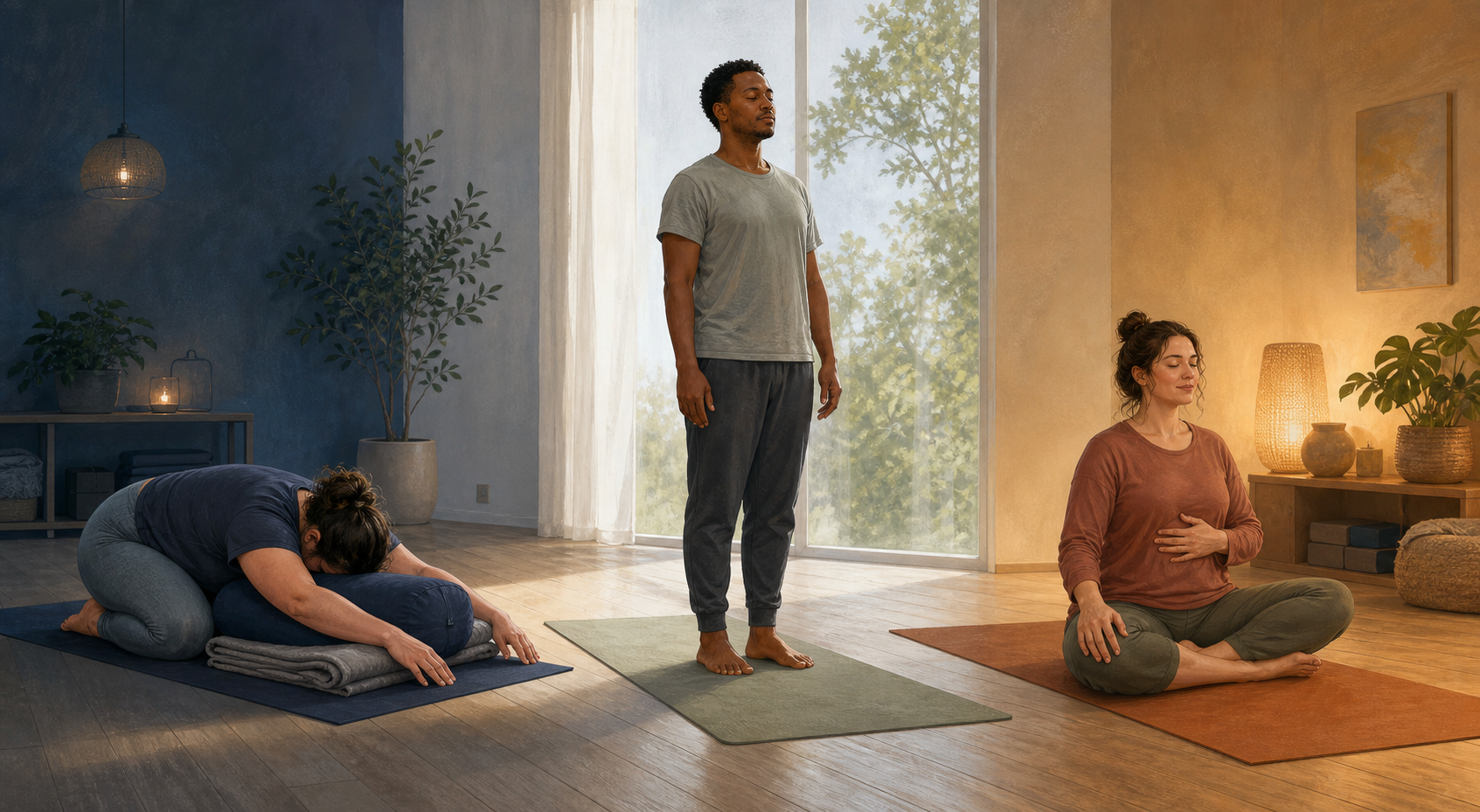
The word yoga covers practices with very different effects. A vigorous sequence may lift low energy but leave an already agitated person more activated. Yoga nidra may be restorative at night but may not be the most useful first response to daytime lethargy. Before you begin, name the state you are trying to work with. That single decision makes the session more precise.
When anxiety feels physical
If anxiety is showing up as shallow breathing, a clenched jaw, stomach discomfort, or restless movement, begin with the body rather than an argument with the mind. Use gentle spinal mobility and unhurried postures, then move into diaphragmatic breathing. Finish with nadi shodhana without breath retention or with soft bhramari. The purpose is not to force relaxation. It is to give the nervous system repeated evidence that activation can rise and then settle.
Keep the breathing easy enough that you could continue without bracing. Slower is not automatically better. If counting makes you anxious, drop the count and attend to the movement of the abdomen or the sound of bhramari instead. The practice succeeds when breathing becomes quieter and less effortful, not when you reach a prescribed number.
When mood and energy are low
For low mood accompanied by heaviness or inertia, use moderate breath-led movement rather than making every session sedating. A short sequence of comfortable standing and spinal movements can create enough activation to interrupt immobility. Morning light combined with breath awareness and movement can also reinforce circadian timing and steadier daytime energy.
End with a brief seated pause so that stimulation resolves into attention. If exercise reliably leaves you depleted, unusually agitated, or unable to sleep, reduce the intensity and discuss persistent symptoms with a qualified health professional. Yoga should make daily functioning more available, not become another demand that drains it.
When the same thoughts keep returning
Rumination needs attentional training, not endless analysis during asana. After moving enough to sit comfortably, choose one anchor: the breath, a mantra, or a steady bodily sensation. Each time attention wanders, identify that it wandered and return. The return is the repetition that matters. Dhyana strengthens attentional stability, while pratyahara develops the ability to disengage from stimuli that do not deserve your next response.
Carry that skill into a difficult moment. Before opening a message that usually provokes you, pause for one minute, feel the contact of the body with the chair or floor, and let one full exhalation finish before acting. This is pratyahara in ordinary life: not withdrawal from responsibility, but freedom from an automatic reaction.
When sleep is the main problem
Evening practice should reduce effort rather than become a final workout. Choose gentle or restorative postures, allow the exhalation to become slightly longer without forcing it, and finish with brief dhyana or yoga nidra. Pair the sequence with the same lights-out cue each night. The predictable order teaches the body what comes next.
Do not turn sleep into a performance score. Notice whether settling becomes easier across several nights and whether you feel more restored the next day. Persistent insomnia, marked daytime impairment, or a major change in sleep need warrants professional assessment; a relaxation practice cannot identify the underlying cause.
Build one routine small enough to survive an ordinary day

Intensity attracts attention, but consistency changes the pattern. A workable routine needs a stable cue, a sequence you can remember without negotiation, and a finish line that remains realistic on a busy morning. Start with this twelve-minute practice rather than waiting for an ideal hour.
- First five minutes: breath awareness. Sit or lie in a stable position and notice the breath as it is. Let unnecessary effort soften. You are observing before trying to regulate.
- Next five minutes: gentle spinal mobility. Move the spine through comfortable ranges in coordination with breathing. Keep the movement smooth enough that attention can remain with bodily sensation.
- Final two minutes: nadi shodhana. Alternate the nostrils gently and omit breath holds. If alternation feels awkward or congested, use uncomplicated diaphragmatic breathing instead.
The five-five-two structure gives asana, breath awareness, and pranayama distinct jobs without demanding a large opening in your schedule. It is a starting routine, not a claim that twelve minutes will produce every neurological effect associated with long-term practice.
At midday, use a one-minute reset before the task or conversation most likely to scatter your attention. Box breathing uses four equal, comfortable phases: inhaling, pausing, exhaling, and pausing again. Do not strain to hold the breath. If retention is uncomfortable or medically inappropriate, remove the pauses and let the exhalation lengthen gently instead.
At night, make the routine simpler still: a restorative posture, easy extended exhalations, and a short period of dhyana or yoga nidra. Link the three practices to existing cues: waking, the midday break, and lights-out. Stable cues reduce the need to decide afresh every day, while a visible calendar or journal makes continuity harder to misremember. Regularity can begin to feel more automatic within weeks when practice is paired with consistent cues.
If you miss a session, resume at the next cue. Do not repay one missed day with an exhausting practice. Abhyasa is built through return. A routine that survives interruption is more valuable than one that depends on a flawless streak.
Measure change where mental health is actually lived
A calm feeling during savasana is welcome, but it is not the most informative measure. The real question is whether your response to ordinary friction changes. Use a brief journal for several weeks and look for trends in a few concrete areas.
- Recovery: After a stressful exchange, do your breath, muscles, and thoughts settle more readily, or does activation continue to dominate the rest of the day?
- Attention: When you become distracted, can you notice it and return to the chosen task with less inner argument?
- Sleep: Is settling at night becoming easier, and do you wake with a more stable level of energy?
- Somatic stress: Are jaw tension, digestive discomfort, restless breathing, or recurring muscular bracing becoming less frequent?
- Conduct: Is there more space between feeling provoked and speaking or acting? Are honesty, moderation, contentment, and compassion becoming easier to practise?
Write one short line after practice and another at the end of the day. Record what you did, the dominant mental state, sleep quality, and one example of how you responded under pressure. This separates a practice that merely feels virtuous from one that is changing how you live.
Resting heart rate and heart-rate-variability trends can provide additional information, but they are proxies, not diagnoses. Compare your own pattern over time rather than treating another person’s HRV as a target. Device readings can fluctuate for many reasons, so give more weight to a repeated pattern that agrees with sleep, mood, and daily functioning.
If progress plateaus, change one variable rather than abandoning the whole routine. You might slow the breathing slightly, add a compassion or mantra practice, or move the session to a time when you are more likely to complete it. These small adjustments can restore momentum while preserving the habit you have already built.
Keep the practice both Dharmic and clinically responsible

Reducing yoga to a nervous-system technique misses part of its purpose. Asana creates bodily steadiness, but yama and niyama ask what that steadiness serves. Dhyana is not valuable only because it improves concentration; it also exposes craving, aversion, self-criticism, and reactive habits. Ahimsa, moderation, truthfulness, and contentment turn mental regulation into conduct.
This wider frame is shared across Dharmic traditions without making them identical. Buddhist anapanasati and metta, Jain preksha dhyana, Sikh simran or naam jap, and Hindu practices of pranayama, mantra japa, and dhyana all train attention, relationship to breath, and alignment with values. Their common direction is greater clarity, compassion, and steadiness in action, not withdrawal from the responsibilities of life.
Yogic anatomy and neuroscience can illuminate experience at different levels, but they should not be collapsed into each other. You may experience grounding in relation to muladhara, warmth around anahata, or freer expression associated with visuddha. Modern language may describe these changes through interoception, autonomic balance, attention, and emotional regulation. A chakra is not thereby proven to be a brain region or a branch of the vagus nerve. You can respect the traditional map while allowing scientific claims to remain testable and appropriately limited.
Safety also belongs to ahimsa. Modify the practice at the point where risk arises:
- If you have glaucoma, minimize prolonged inversions rather than treating them as required milestones.
- If you have uncontrolled hypertension, avoid forceful breathing and breath retention. Use unforced breathing and seek individualized medical guidance.
- If you have a trauma history, choose trauma-informed practice that emphasizes choice, grounding, and control over intensity. Stop when a technique produces overwhelming activation or dissociation rather than pushing through it.
- If you are receiving care for major depression, bipolar disorder, PTSD, or another significant mental-health condition, coordinate yoga with qualified clinical care. Do not stop medication or alter treatment because a session temporarily improves your mood.
- If symptoms are rapidly worsening, you cannot function safely, or you may harm yourself or someone else, seek immediate local emergency care. A yoga routine is not an emergency intervention.
Tomorrow, attach the twelve-minute morning sequence to waking and put one visible mark on a calendar when it is done. Keep the practice modest for several weeks, then read your notes for changes in recovery, sleep, attention, and conduct. Continue what improves life beyond the mat; revise what does not; and bring persistent or worsening symptoms to a qualified professional.
References
