
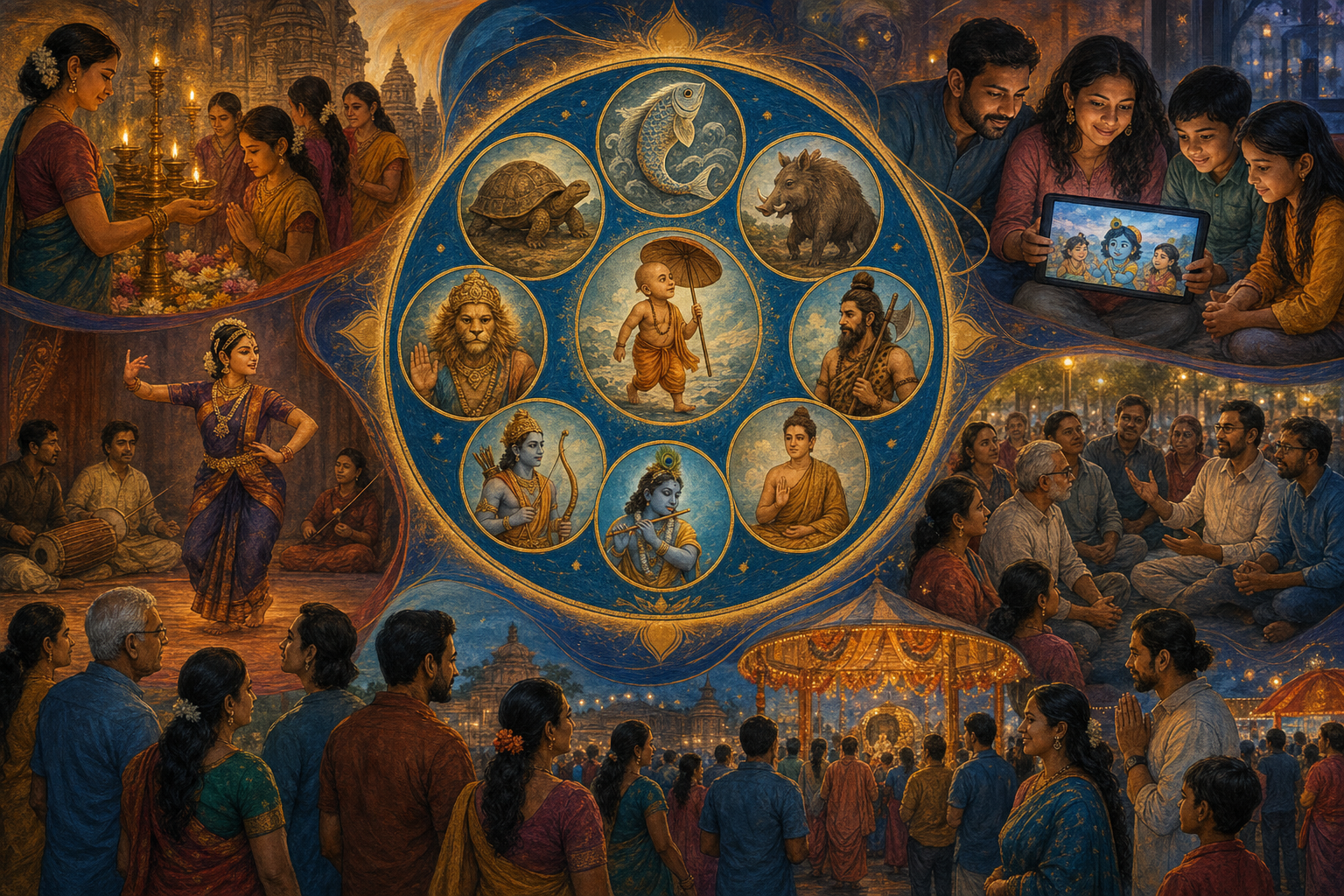
You see Rāma in an election speech, Kṛṣṇa in a leadership meme, Narasiṁha in a protest image, and the Dashāvatāra in a children’s animation. The same sacred figures also live in temple worship, family recitation, classical performance, television nostalgia, and diaspora festivals. How should you tell devotion from entertainment, ethical teaching from political branding, or creative adaptation from careless distortion?
You do not have to choose between uncritical approval and reflexive outrage. A better response begins by identifying what an avatāra is doing in its present setting, which dimension of dharma is being invoked, and whether the public use preserves the moral weight of the tradition.
Begin with the avatāra, not the public personality
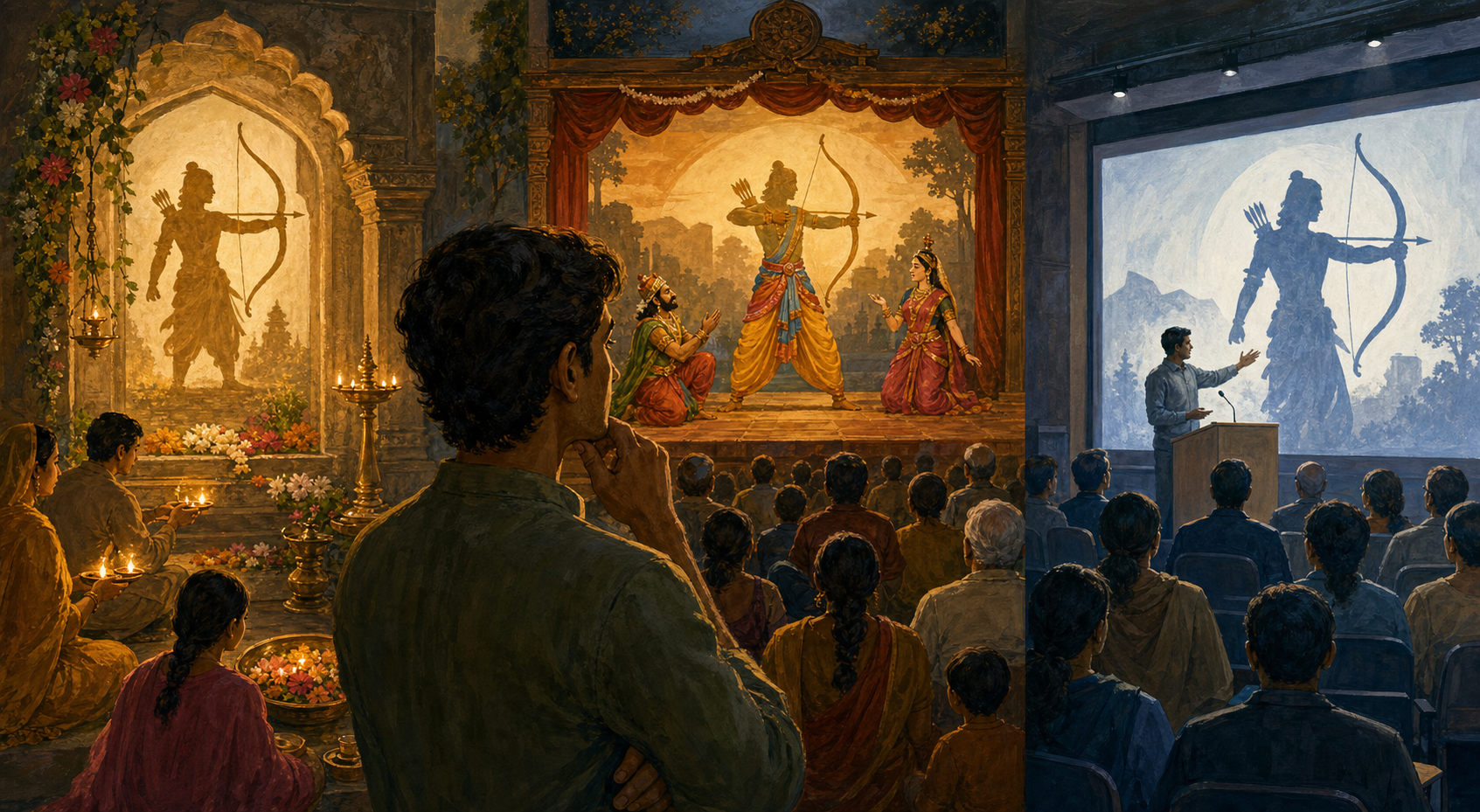
An avatāra is not simply a famous hero wearing sacred symbolism. Across the Bhāgavata Purāṇa, Viṣṇu Purāṇa, Rāmāyaṇa, and Mahābhārata, Viṣṇu’s manifestations make divine protection present within particular crises of dharma. Each form responds to a different disorder. That relationship between form, circumstance, duty, and restoration is more important than visual resemblance alone.
The familiar Dashāvatāra sequence includes Matsya, Kūrma, Varāha, Narasiṁha, Vāmana, Paraśurāma, Rāma, Kṛṣṇa, Buddha or Balarāma in variant enumerations, and Kalki. The variation is not a defect that must be hidden. It reminds you that Hindu traditions have transmitted a shared theology through different regional, sectarian, and textual lineages. Pañcharātra and Vaikhānasa traditions shaped temple worship and iconography, while Śrī Vaiṣṇavism and Gauḍīya Vaiṣṇavism developed distinct devotional emphases. Public culture inherits this plurality even when a film, poster, or social-media caption does not explain it.
Before asking whether a modern representation looks accurate, ask a prior question: what relationship among Viṣṇu, the avatāra, and dharma does it assume? A muscular image may be visually impressive yet remove the discipline that distinguishes protective force from rage. A playful Kṛṣṇa reference may preserve affection but lose the ethical seriousness of duty, responsibility, and lokasaṅgraha, the welfare and cohesion of the wider world. A solemn Rāma image may signal reverence while leaving unanswered whether the conduct attached to it reflects restraint and rule-bound responsibility.
Key takeaways
- Separate sacred presence from celebrity imagery: an avatāra is defined by a relationship to dharma, not merely by fame, power, or costume.
- Identify the immediate function: worship, moral instruction, entertainment, political rhetoric, cultural identity, or commerce.
- Ask which textual, sectarian, or regional lineage is being represented before treating one version as the only Hindu version.
- Judge ethical continuity as carefully as plot or visual fidelity: protection, restraint, duty, compassion, and accountability are part of the meaning.
- When sacred language enters politics, translate it into a public standard that can be applied equally to rulers, allies, opponents, and citizens.
Use the Dashāvatāra as a civic lens, not a policy manual
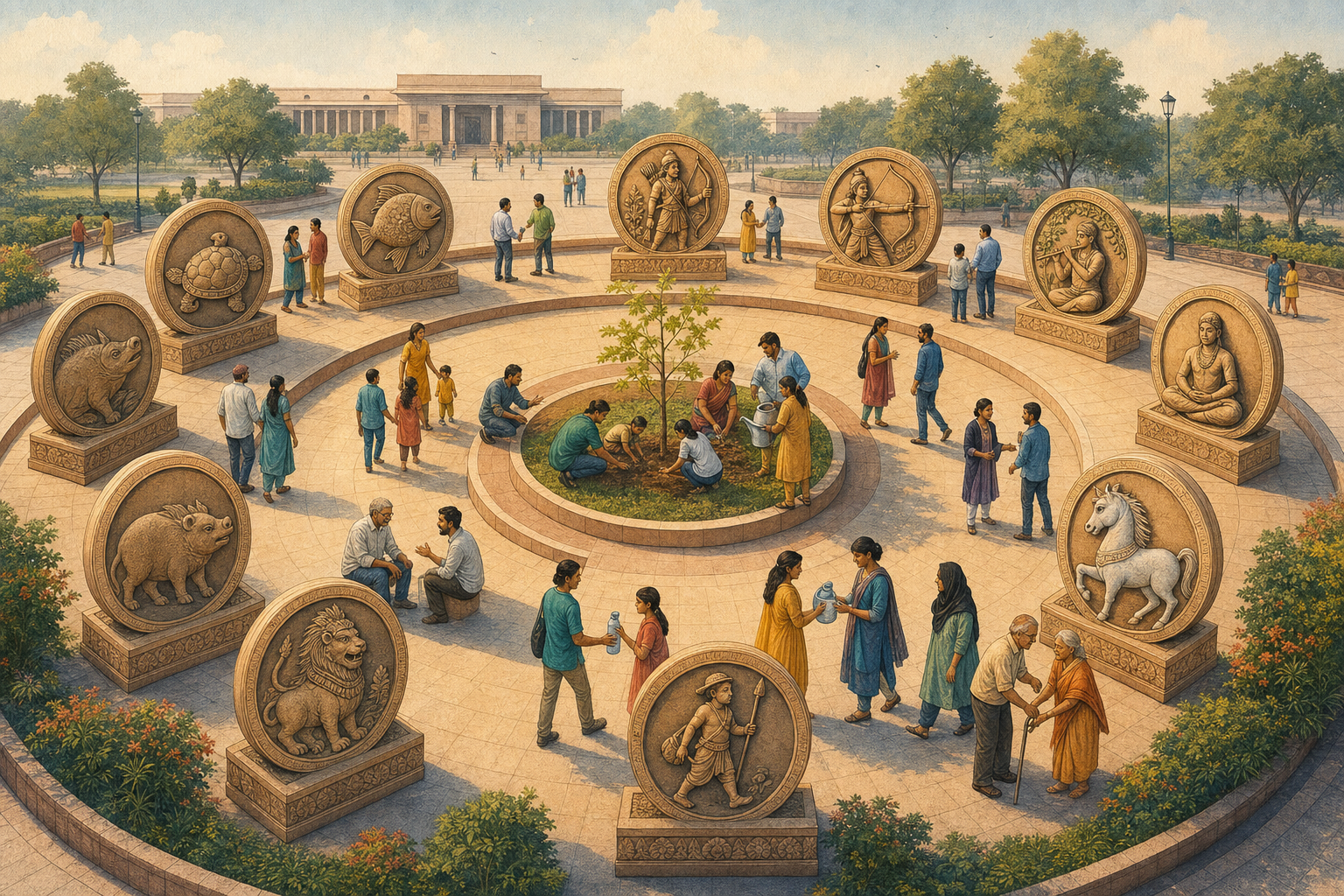
Contemporary public culture often turns the Dashāvatāra into a vocabulary for leadership and governance. This can make difficult ideas memorable, but only if the analogy remains an analogy. The following civic reading of the ten forms is an interpretive tool, not a claim that ancient narratives prescribe a modern administrative programme.
| Avatāra | Contemporary public concern | The useful question |
|---|---|---|
| Matsya | Disaster readiness and early warning | Was danger recognised early enough to preserve life, knowledge, and continuity? |
| Kūrma | Institutional stability and cooperation | Which durable institution carries the weight when competing groups pull in different directions? |
| Varāha | Ecological restoration | Does development repair the conditions that sustain life, or merely extract from them? |
| Narasiṁha | Checks on abusive power and protection of the vulnerable | What lawful boundary prevents authority from making itself untouchable? |
| Vāmana | Proportion, redistribution, and social justice | Can concentrated power be limited through a calibrated and legitimate intervention? |
| Paraśurāma | Reform of entrenched injustice | How can corrupt structures be corrected without romanticising vengeance or violence? |
| Rāma | Rule of law and disciplined leadership | Does the leader accept limits even when power could be used for personal advantage? |
| Kṛṣṇa | Duty, strategy, diplomacy, and conflict de-escalation | Does strategic action serve dharma and collective welfare rather than cleverness for its own sake? |
| Buddha in many lists; Balarāma in others | Compassion-centred welfare or the distinct emphasis carried by the variant lineage | Has the interpretation named its tradition accurately instead of concealing the variation? |
| Kalki | Accountability when corruption becomes systemic | Have lawful remedies been exhausted, and who remains accountable for any final coercive action? |
The guardrail matters. Narasiṁha is not a blank cheque for anger. Paraśurāma is not a licence to sanctify private violence. Kalki is not permission for vigilantism or fantasies of eliminating opponents. Once an image enters civic life, protective power must be translated into institutions, due process, proportionate reform, and accountability. Otherwise, a symbol of restored dharma can be made to serve the very arbitrariness it is supposed to confront.
You can test any avatar-based policy metaphor by asking whether it produces an observable public obligation. Matsya should lead to preparedness, not a decorative fish motif. Varāha should lead to ecological repair, not a slogan detached from land and water. Rāma should bind the powerful to law, not merely adorn their stage. Kṛṣṇa should sharpen judgement about duty and collective welfare, not excuse manipulation. The metaphor earns its place only when it increases scrutiny.
Judge screen retellings by more than visual fidelity
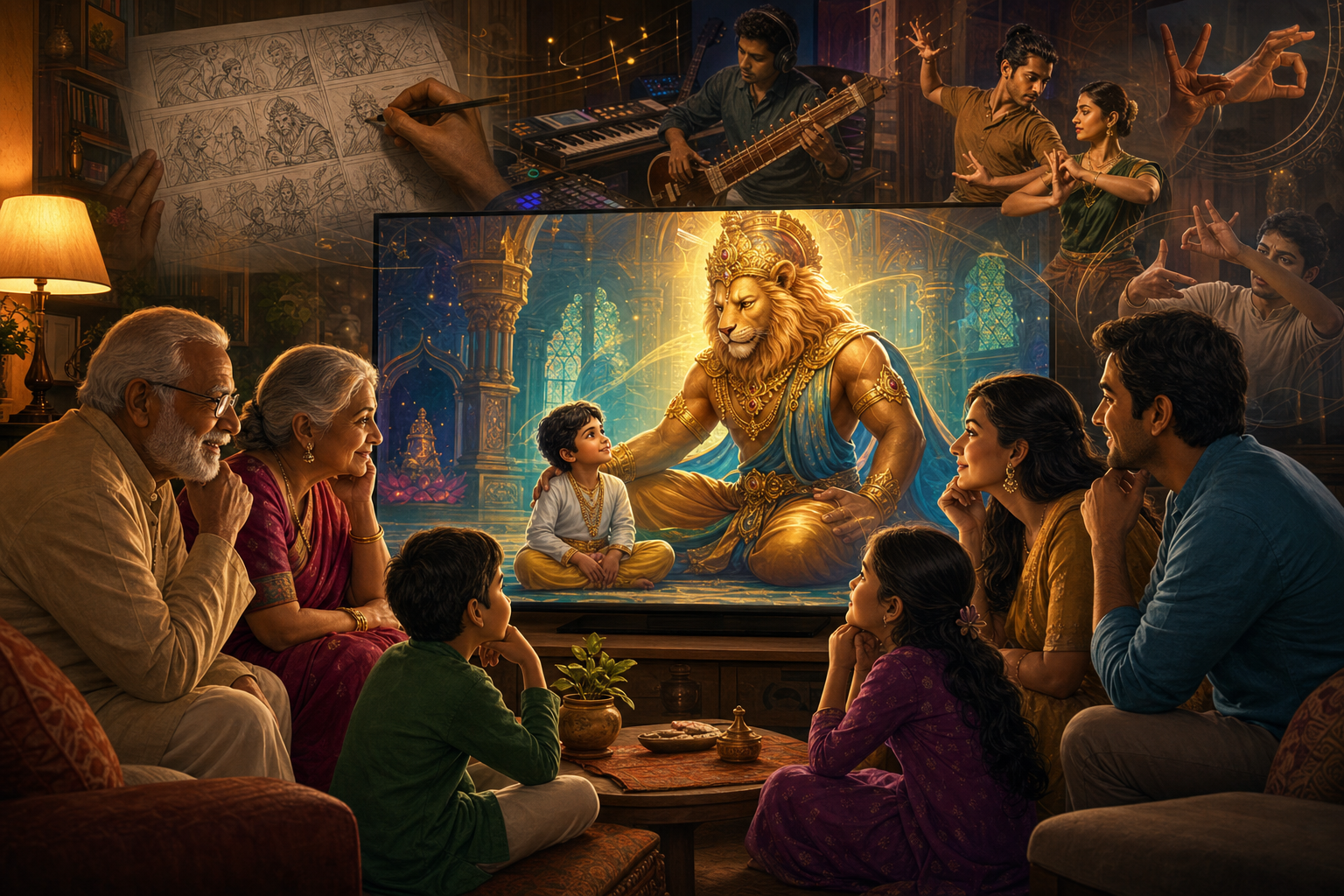
Ramanand Sagar’s Ramayan of 1987-88 and B.R. Chopra’s Mahabharat of 1988-90 became shared viewing experiences across families, regions, and languages. Their importance did not rest only on sets, costumes, or special effects. Scheduled family viewing placed the epic within an intergenerational setting in which a child could watch a scene, hear a grandparent’s explanation, and encounter the same figures again through festivals, songs, or temple practice.
Streaming, short video, animation, podcasts, comics, games, and memes change that setting. They make access easier, especially for young people and the diaspora, but they also detach scenes from narrative consequences. A moral dilemma that unfolds across relationships and duties can become a reaction image. Kṛṣṇa’s counsel can be reduced to motivational cleverness. Narasiṁha’s protection can be reduced to aggression. Rāma’s restraint can disappear behind royal spectacle.
The public response to Adipurush in 2023 showed that audiences judge an epic adaptation by more than technical ambition. Dialogue, characterisation, tone, and the dignity granted to Rāma, Sītā, and Hanumān all affect whether creative freedom feels rooted or careless. The practical lesson is not that every adaptation must reproduce an older television serial. It is that innovation needs an intelligible relationship to the tradition being reworked.
Use five checks when you assess a retelling:
- Identify the declared form. A devotional presentation, children’s animation, political allegory, and fantasy film make different promises. Do not judge them as if they were interchangeable.
- Locate the chosen lineage. Ask whether the work follows a Sanskrit epic, a Purāṇic episode, a bhakti tradition, a regional performance form, or a modern composite. Variation is legitimate; pretending there is no choice is misleading.
- Track the ethical centre. Note what the character protects, what limit the character accepts, and who bears the cost of the action. Plot points without these relationships can preserve the shell while losing the dharmic argument.
- Listen to voice and dialogue. Contemporary language can make a story accessible, but flippancy changes character. Ask whether the speech fits the moral and emotional situation rather than merely supplying a viral line.
- Examine the after-effect. A sound adaptation should leave you better able to approach the larger narrative, a living performance tradition, or a primary text. If it presents itself as the complete tradition, treat that confidence cautiously.
If you are creating such material, bring textual scholars, Sanskritists where relevant, performers, and practising communities into the process before the imagery and dialogue are fixed. If you are introducing a child to an avatāra through a comic or animation, pair the screen version with one fuller episode from a family telling, temple tradition, or age-appropriate text. That second encounter teaches the child that an adaptation is an entry point rather than the final authority.
Make political invocations answer to dharma
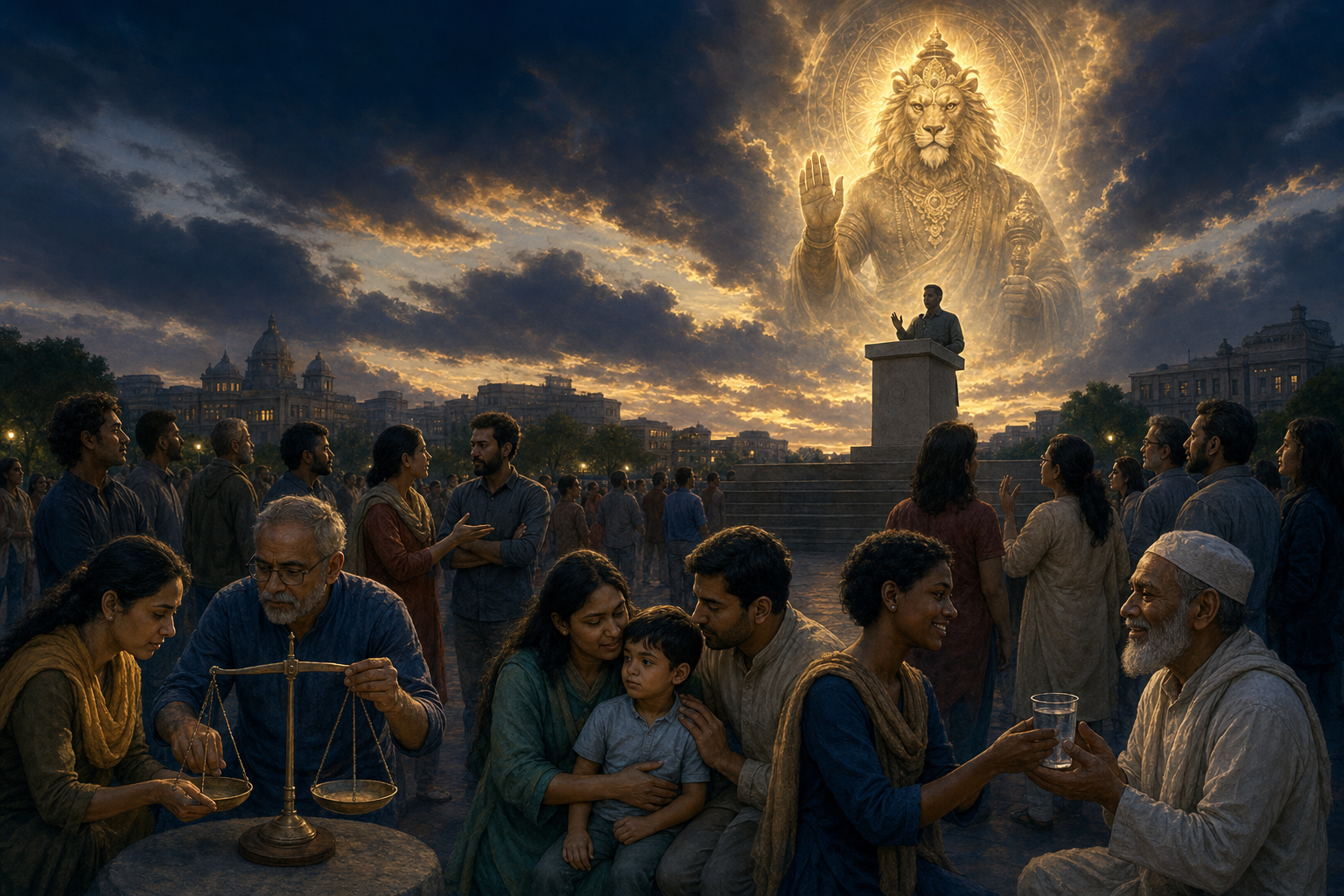
Sacred language becomes politically weak when reverence is used as a substitute for scrutiny. Rāma, Kṛṣṇa, Vāmana, and Narasiṁha can illuminate questions of leadership, justice, restraint, strategy, and protection. They can also be reduced to signals of group loyalty. You can distinguish the two by asking whether the invocation creates a duty for the speaker or merely an emotion in the audience.
Rāma-rājya has long carried more than one political emphasis. During the nationalist era, Gandhi used it as a horizon of just and equitable governance rather than a programme of theocracy. That history matters because it keeps the phrase tied to the quality of rule. In contemporary debate, invoking Rāma-rājya should therefore invite questions about equal law, restraint in office, public welfare, and the ruler’s obligations. It should not end those questions.
India’s constitutional secularism places limits on the state’s use of sacred identity, while popular discourse continues to draw ethical metaphors from sacred narratives. The Supreme Court’s 2019 Ayodhya judgment and the later prāṇa-pratiṣṭhā of the Rāma Mandir made the intersection of law, pilgrimage, civic ritual, cultural production, and electoral conversation especially visible. The Election Commission’s campaign codes, with their preference for issue-based contestation, offer a useful democratic principle: sacred resonance should lead back to assessable public conduct.
Apply a four-part test whenever an avatāra appears in political rhetoric:
- Universality: Can the promised justice protect citizens who do not share the speaker’s sect, party, region, caste, or religious practice?
- Specificity: Which law, institution, budget choice, or administrative act embodies the claimed dharmic value?
- Restraint: What limit will the leader accept when expediency conflicts with the principle being invoked?
- Accountability: Will the same standard be applied to allies and office-holders, or only to opponents?
If a speaker invokes Rāma, ask how the proposal strengthens rule-bound government and whether the rule also constrains the speaker’s allies. If Kṛṣṇa is invoked, ask which duty is unavoidable, how strategy serves lokasaṅgraha, and whether de-escalation was attempted. If Narasiṁha is invoked, ask which lawful check protects a vulnerable person without destroying due process. If Vāmana is invoked, ask who gives up concentrated advantage, who benefits, and what keeps redistribution proportionate.
Devotion does not require you to endorse every political use of a sacred name. Careful examination is itself dharmic because the ruler, the institution, and the majority remain subject to moral limits. A symbol is being honoured politically only when it raises the standard of conduct expected from power.
Protect plurality without emptying the tradition
Vishnu’s avatāras travel across sects, regions, artistic forms, and Dharmic communities, but shared vocabulary does not mean identical theology. Buddha appears in many Dashāvatāra lists, while Balarāma appears in others. The Buddhist Daśaratha Jātaka, the Jain Paumacariya associated with Vimalasūri, and Sikh use of Rām as a name of the Divine do not become interchangeable versions of one doctrine. Their proximity can support dialogue precisely when their differences are named.
The same discipline applies within Hindu culture. Yakshagana in Karnataka, Kathakali in Kerala, Kuchipudi in Andhra Pradesh, and Odissi in Odisha interpret sacred narratives through different languages of gesture, music, costume, and dramaturgy. Temple iconography shaped by ritual schools does different work from a touring stage production. A Gauḍīya Kṛṣṇa kīrtan carries a devotional emphasis that cannot be reduced to a generic celebration of Indian mythology. Context is not an obstacle to unity; it is the form through which civilisational unity remains alive.
This is especially important in diaspora life. ISKCON communities, temples, cultural centres, Gītā study groups, Janmāṣṭamī celebrations, rāsa-līlā performances, and khol-kartāl kīrtan circles allow families to practise devotion while introducing neighbours to Indian civilisation. Live-streamed ārati, virtual darśan, and digital saṅkīrtan widen access, but they should complement rather than erase embodied worship, local community, and service.
When you teach, share, or comment on avatar-related material, four small habits preserve both accessibility and depth:
- Name the frame: devotional, textual, regional, artistic, civic, or comparative.
- Explain variation directly instead of presenting it as an embarrassment or forcing every tradition into one account.
- Connect the symbol to a practice or ethical demand, such as worship, study, restraint, compassion, protection, or seva.
- Correct an inaccurate meme or adaptation by supplying the missing context, not merely by declaring offence.
Gender and agency deserve the same seriousness. Popular retellings can flatten Sītā into passive suffering even when a closer reading asks you to confront her truthfulness, judgement, endurance, and agency. Kṛṣṇa’s līlā can likewise be detached from its theological setting and turned into a caricature of licence. In either case, ask whose voice has disappeared, which responsibility has been removed, and whether the retelling protects the vulnerable or merely aestheticises their predicament.
The next time an avatāra appears on your screen or in public speech, pause before sharing, praising, or condemning it. Name the context, identify the dharmic claim, check the lineage, and test the consequences. That short discipline lets you participate in a living tradition without surrendering either reverence or judgement.
References
