
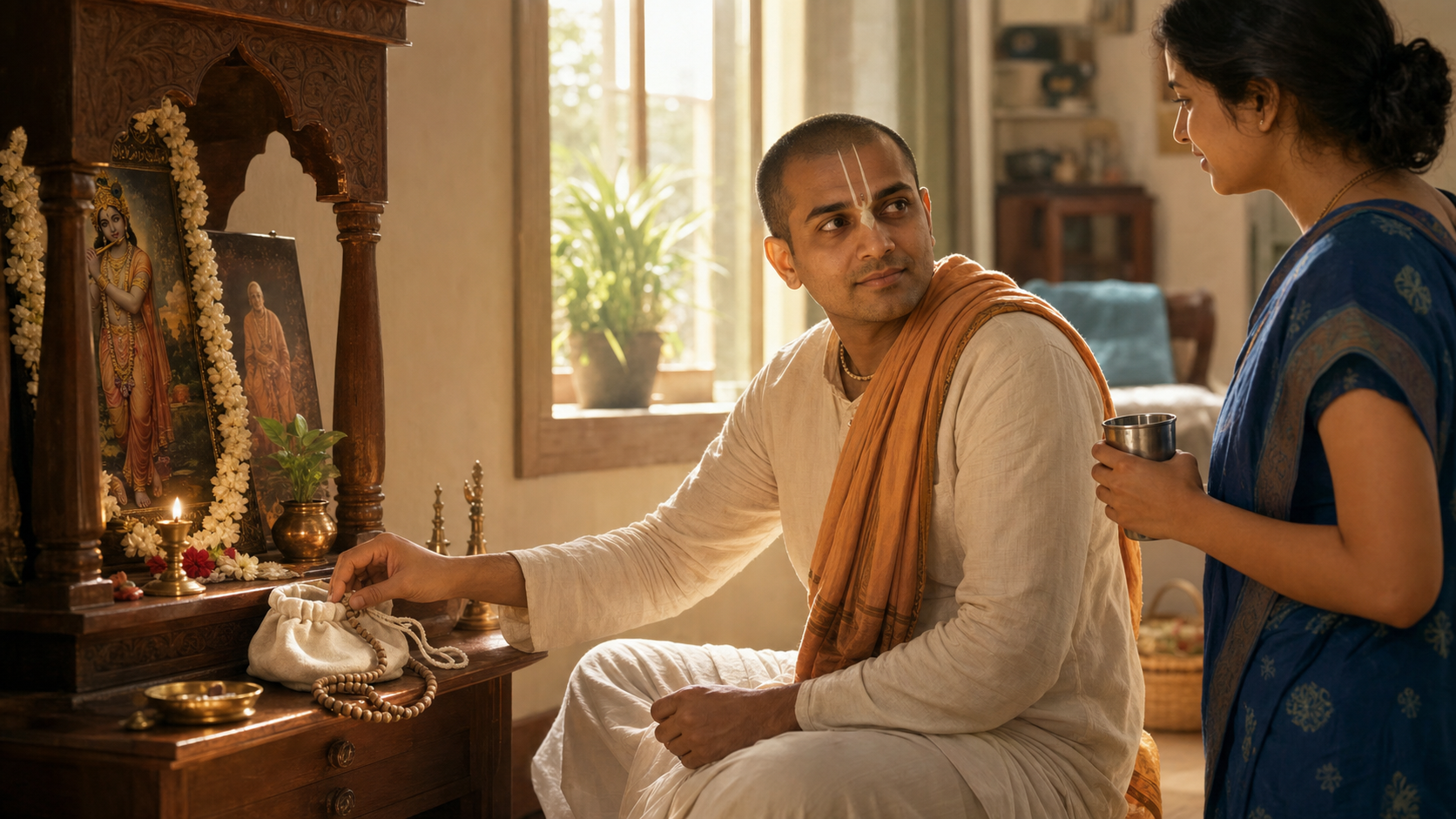
You finish your japa, put the beads away, and meet the same irritation, comparison, or restless desire that was present yesterday. It is natural to wonder whether your Vaishnava practice is actually changing you or merely giving sacred form to an unchanged routine.
Do not answer that question from the intensity of a meditation session. Look at the next interruption, the next criticism, another person’s success, and the duty no one applauds. Inner transformation becomes visible when remembrance of Bhagavan starts governing those ordinary moments.
Measure transformation where your reactions begin
Bhakti is more than devotional mood management. It gradually moves the center of life away from bodily identification, self-protection, and the demand to be important. The Bhagavad Gita’s distinction between the changing body and enduring atma gives this movement its philosophical ground. Loving devotion gives it direction: you are not merely trying to become calmer; you are learning to remember, love, and serve Bhagavan.
This change is usually incremental and behavioral. A morning practice affects how you schedule the day. Mantra gives the agitated mind somewhere sacred to return. Prasadam reshapes consumption into gratitude. Satsanga influences speech and friendship. Seva converts conviction into conduct. None of these changes requires a dramatic spiritual experience before it becomes real.
- Watch attention: after distraction, can you return to the holy name without feeding frustration?
- Watch speech: when anger appears, does it still control what you say and how long you continue saying it?
- Watch comparison: can you sincerely welcome another person’s good fortune, recognition, or spiritual progress?
- Watch service: do you remain dependable when a task is repetitive, private, or beneath the status you imagined for yourself?
- Watch appetite: are your choices becoming more sattvic, deliberate, and compatible with ahimsa?
These are more reliable signs than visions, tears, unusual sensations, or the feeling that a particular session was elevated. Pleasant states may accompany practice, but attachment to them can become another distraction. A quiet session that weakens a harsh reaction may be more transformative than an ecstatic session followed by pride.
The Bhagavata ideal of a nirmatsara heart gives you an especially demanding test. Freedom from matsarya, or envy, is inseparable from the maturation of prema. If practice makes you more competitive about learning, lineage, purity, recognition, or access to a guru, the religious form has advanced further than the heart. That gap is not a reason to abandon sadhana. It tells you exactly where sadhana must now work.
Give daily sadhana a sequence your life can carry
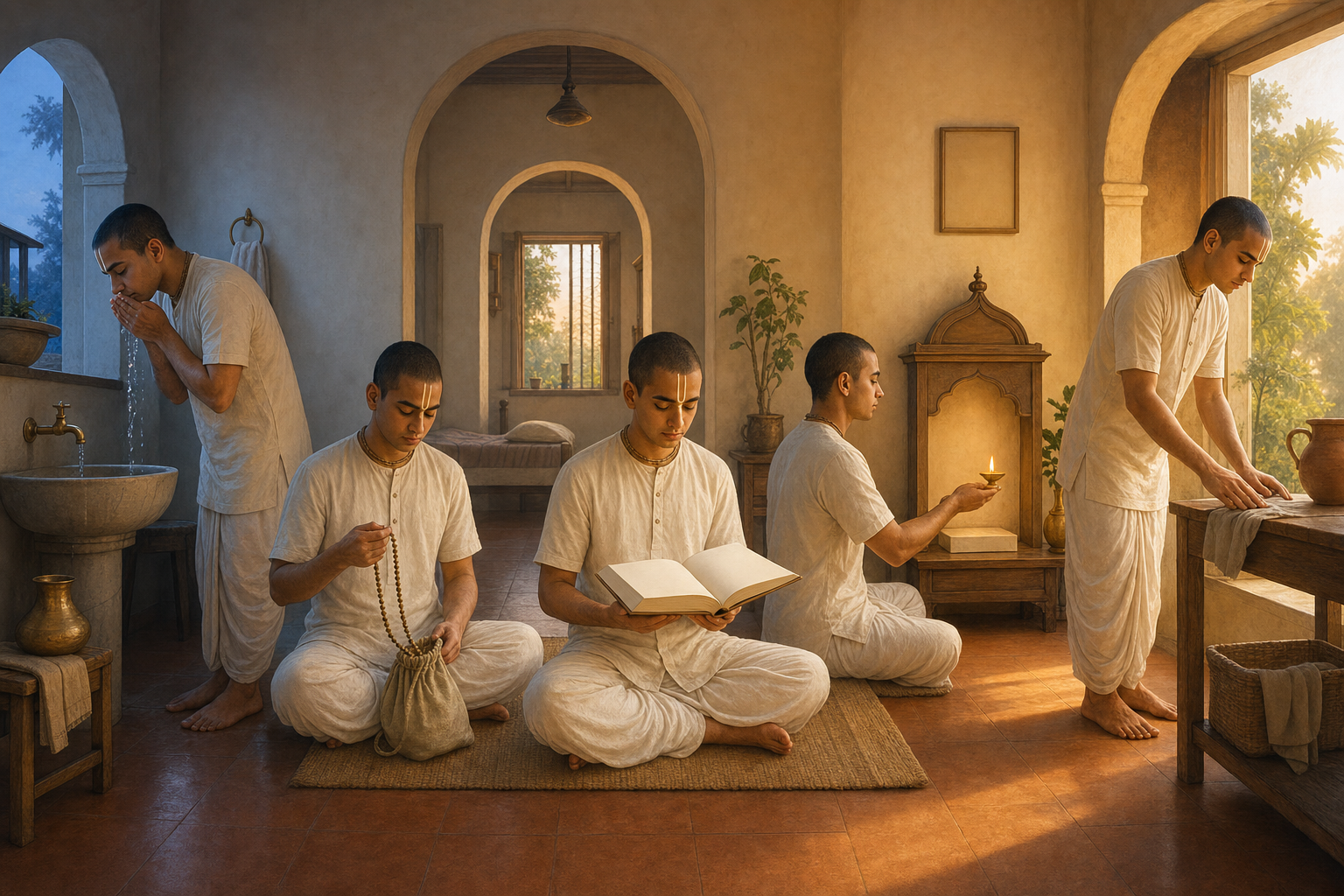
A sustainable Vaishnava routine joins remembrance, understanding, sanctified consumption, association, and service. When one element is isolated, the ego can appropriate it. Mantra without reflective hearing can become mechanical. Learning without service can nourish superiority. Seva without remembrance can become resentment or a search for approval.
- Begin with sankalpa. State the purpose plainly: “May this practice make me fit to remember and serve Bhagavan today.” A useful sankalpa points beyond the session and toward conduct.
- Hear the mantra you are chanting. In Gaudiya Vaishnava practice, this may be japa of the maha-mantra. Other Vaishnava traditions may use Om Namo Narayanaya, passages from the Vishnu Sahasranama, or another mantra taught by their lineage. Do not turn variety among sampradayas into a contest or invent a mixture when your tradition already gives coherent guidance.
- Read or hear a manageable passage of shastra. Carry one instruction into the day instead of collecting several ideas that never reach behavior. The Gita’s teachings on disciplining the mind in 6.5-6.6 and the qualities of a devotee in 12.13-12.20 are particularly direct mirrors.
- Offer food according to your tradition and honor it as prasadam. This moves eating away from entitlement and toward relationship, gratitude, restraint, and non-harm.
- Connect practice to satsanga and seva. Communal kirtan, shared prasadam, scriptural discussion, and dependable service create a setting in which spiritual intentions are tested and supported.
The sequence matters because its elements close one another’s loopholes. Mantra gathers attention. Shastra corrects private fantasy. Prasadam reaches desire through the kitchen and dining table. Satsanga reveals how you behave around equals. Seva shows whether devotion survives inconvenience.
On crowded days, shorten the length rather than discard the whole pattern. Chant attentively, hear a small passage, consciously honor prasadam, and perform the service already in front of you. The goal is not to manufacture an impressive schedule that collapses under work or family obligations. It is to establish a dependable current of remembrance through the life you actually have.
Brahma-muhurta, sunrise, and sunset are traditionally favorable periods because they help separate practice from the day’s noise. Yet a nominally ideal hour is of little use if you repeatedly miss it. Protect the most stable time available, prepare the seat and beads beforehand, and remove the first predictable distraction. Devotional images, tilaka, music, and temple or home-altar spaces can reinforce memory, but use them as invitations to remembrance, never as evidence of superiority.
Use Virat Purusha dhyana when the mind has become small

Resentment, anxiety, and comparison contract attention around a very small story: my injury, my scarcity, my status, my plan. Dhyana on Vishnu as the Virat Purusha directly challenges that contraction. It places bodies, worlds, rivers, mountains, directions, luminous forces, and living beings within the contemplative form of the Divine Person.
This is not the claim that the visible universe exhausts Vishnu. The devotional insight is that Bhagavan pervades the cosmos and also transcends it. You are learning to see the world as held within divine order while preserving the intimacy of relationship with Narayana.
Begin with a session of 15-20 minutes. Extend it toward 30-45 minutes only when attention remains steady and the practice does not displace essential duties. The image does not need to become photographically vivid. Contemplative meaning matters more than visual perfection.
- Sit steadily with the spine upright but not rigid. Let the face, jaw, and shoulders soften.
- Allow the breath to become even and unforced. A gentle 1:1 rhythm, or a comfortable 1:2 rhythm, may be used if it is already familiar. Do not strain, compete with yourself, or force breath control. Natural breathing is sufficient.
- Repeat your Vaishnava mantra and bring attention to the heart-lotus. Contemplate Narayana there as radiant, present, and compassionate.
- Let the form expand. Contemplate the heavens as the head, the sun and moon as eyes, the directions as ears, fire as the mouth, mountains as bones, rivers as veins, forests and herbs as body-hair, oceans as the belly, and the earth as the feet.
- Include the beings you normally overlook. People you love, people you resist, animals, communities, and ecological systems all appear within one immeasurable life. Do not erase moral distinctions; release the assumption that anything exists outside divine concern.
- Let the detailed correspondences soften into a sense of pervasive presence. If subject and object briefly become less rigid, remain quiet without trying to possess the state.
- Return to mantra, breath, and the physical seat. Close with gratitude and name a form of service through which the enlarged vision will enter conduct.
The closing resolve is essential. If you contemplate rivers as the veins of the Virat Purusha and then treat water carelessly, the image has not yet reached action. If you place other beings within Vishnu’s cosmic form but continue to enjoy their humiliation, the contemplation remains incomplete. The fruit should appear as humility, responsibility, compassion, and sarva-bhuta-hita, concern for the welfare of all beings.
If the vast imagery produces intense fear or destabilization, stop expanding the visualization. Return to natural breathing, the familiar mantra, the heart-centered form of Bhagavan, and awareness of the room. Anyone with a history of severe psychological distress should undertake intensive contemplative work with an experienced teacher and, where appropriate, a qualified health professional. Dhyana can support spiritual formation, but it is not a substitute for psychological or medical care.
Treat matsarya as a practice problem, not a personality verdict
Envy is a valuable diagnostic because it reveals what you believe another person’s flourishing takes away from you. The desired object may be money, beauty, knowledge, recognition, closeness to a teacher, a temple role, or the reputation of being advanced. Matsarya then recruits lobha, grasping, and mada, conceit, to protect that imagined shortage.
Shame rarely uproots this pattern. Honest recognition can. When the contraction appears, work through recognition, redirection, and realignment before the mind converts it into gossip, sectarian argument, passive aggression, or withdrawal.
- Recognize the event without self-condemnation. Say inwardly, “Matsarya is present.” Then distinguish the fact from the story. “This person was praised” is a fact. “Their praise proves that I am invisible” is an interpretation.
- Redirect attention toward appreciative joy. Offer a deliberate blessing: “May this person’s service please Bhagavan and benefit others.” You do not have to counterfeit an emotion. You are training the direction in which attention moves.
- Realign through conduct. Congratulate the person without inserting your own achievement. Assist the service. Share useful information. Complete an unnoticed duty. A concrete act of goodwill prevents envy from remaining an entirely private argument.
- Examine the attachment underneath the episode. Ask whether you wanted to serve or wanted to be seen serving. The answer identifies the claim that needs surrender.
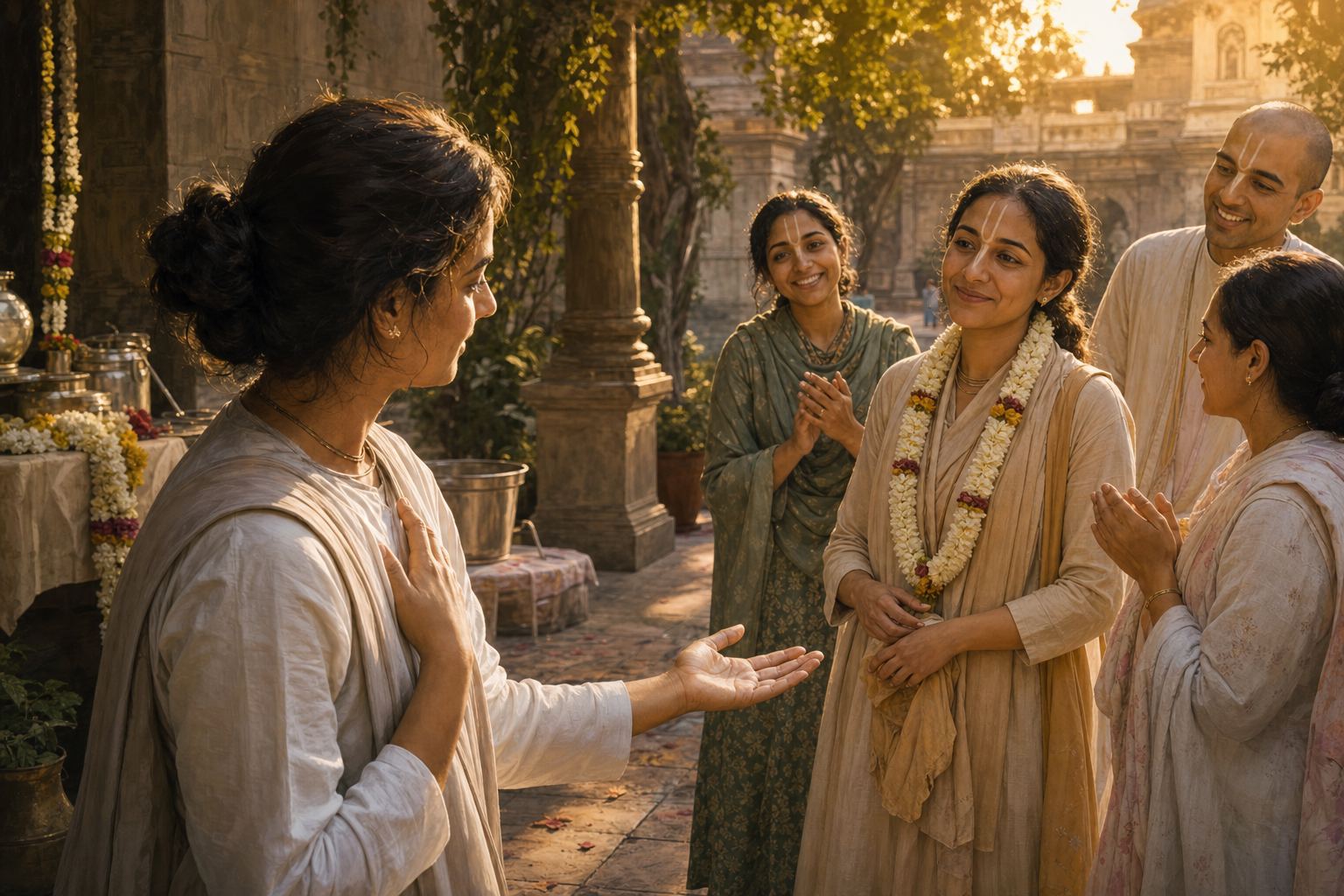
Suppose another devotee’s kirtan receives warm praise. You may not be able to produce immediate delight, but you can refrain from diminishing the person, acknowledge the service, and help put away the instruments. If a responsibility goes to someone else, ask whether your distress concerns the quality of the service or the loss of visibility. Then support whatever genuinely serves Bhagavan rather than whatever restores your status.
This discipline should not be confused with refusing to discern error. Disagreement is not automatically envy. Test your motive by asking whether you can describe the concern accurately, avoid enjoying another person’s embarrassment, accept correction yourself, and continue wishing for that person’s welfare. If you cannot, purify the motive before speaking. Sacred vocabulary does not make rivalry less corrosive.
The remedy belongs to a wider dharmic grammar. Buddhist cultivation of mudita trains appreciative joy. Jain aparigraha and maitri loosen possessiveness and rivalry. Sikh Naam Simran and seva join remembrance to non-competitive care. Vaishnava sravana, kirtana, smarana, sadhu-sanga, and seva work in the same ethical direction without dissolving the distinctions among traditions. The shared lesson is practical: benevolence becomes stable through repeated attention and action, not through a declaration that envy should already be gone.
Key takeaways for your next cycle of practice
- Judge sadhana by its effects on attention, speech, appetite, relationships, and service, not by the intensity of a devotional mood.
- Keep mantra, scriptural hearing, prasadam, satsanga, and seva connected so that each part corrects the blind spots of the others.
- Use Virat Purusha dhyana when anxiety or comparison has reduced life to a narrow personal story; close by translating the widened vision into care.
- When envy appears, recognize the fact, redirect attention toward another’s welfare, and realign through a concrete act of service.
- Respect the discipline of your sampradaya. A coherent practice followed with abhyasa is more useful than collecting methods for novelty or status.
- Seek appropriate support if contemplative practice produces intense fear or destabilization; spiritual persistence does not require ignoring psychological safety.
At the end of the day, ask where remembrance survived contact with inconvenience and where it disappeared. Record a concrete instance of defensiveness, appreciative joy, restraint, or service. Let that observation shape the next sankalpa. Your next act of practice then begins with the truth of your present condition rather than an idealized image of yourself.
When you next take up the beads, bring one actual relationship, attachment, or recurring reaction before Bhagavan. Chant with that part of life included. Then, after the beads return to their bag, perform the corrective act the prayer requires. That movement from remembrance to conduct is where a Vaishnava routine becomes a transformed heart.
References
- DharmaRenaissance Blog – Beholding Vishnu’s Virat Purusha: A Scholarly, Step-by-Step Guide to Transformative Dhyana Practice
- Dandavats – Hare Krishna in Ireland: Vedic Wisdom Transforming Lives and Nurturing Dharmic Unity
- Dandavats – Overcoming Envy (Matsarya) to Awaken Prema: A Dharmic, Nirmatsara Roadmap for Inner Freedom
