
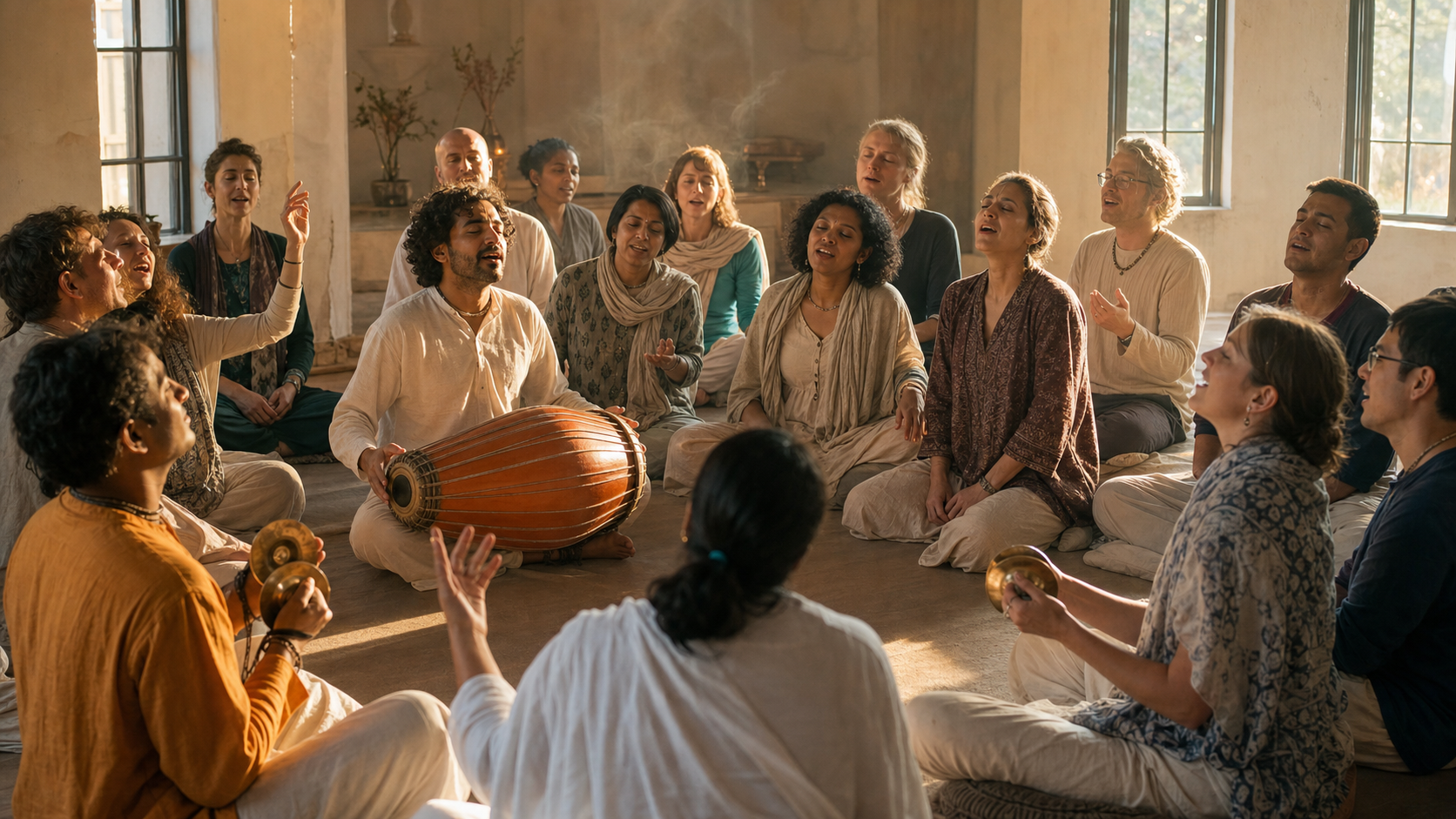
You may know the Hare Krishna mantra and still leave a kirtana wondering whether anything actually happened. Your mind wandered. Your voice felt self-conscious. No wave of devotion arrived. If intensity is your only measure, an ordinary chanting session can look like a failed one.
The first verse of Siksastakam gives you a more reliable way to understand the practice. It describes a sequence: perception is cleaned, inner burning is cooled, spiritual good begins to unfold, knowledge becomes lived, joy deepens, and the whole person is renewed. Sankirtana becomes transformative when you cooperate with that sequence instead of trying to manufacture an elevated mood.
Read the first verse as an ordered map, not an instant promise

ceto-darpana-marjanam bhava-maha-davagni-nirvapanam shreyah-kairava-candrika-vitaranam vidya-vadhu-jivanam anandambudhi-vardhanam prati-padam purnamritasvadanam sarvatma-snapanam param vijayate sri-krsna-sankirtanam
Sri Caitanya Mahaprabhu, Sri Siksastakam, verse 1
The verse ends with param vijayate: let Sri Krishna sankirtana be supremely victorious. But the victory is not presented as a single emotional event. Seven expressions precede it, and their order matters. Clarity comes before sustained relish. Cooling comes before the expanding ocean of bliss. The practice first makes you capable of seeing what is present.
| Sanskrit expression | Transformative image | What you can notice in practice |
|---|---|---|
| ceto-darpana-marjanam | Cleaning the mirror of consciousness | Distraction, resentment, vanity, and fear become easier to recognize before they control your response. |
| bhava-maha-davagni-nirvapanam | Quenching the great forest fire of conditioned existence | Compulsive reactions begin to cool, even when the outer problem has not disappeared. |
| shreyah-kairava-candrika-vitaranam | Moonlight opening the night-blooming lotus of spiritual good | Wholesome inclinations unfold gradually; they do not need to be forced into a performance. |
| vidya-vadhu-jivanam | Giving life to the bride of knowledge | Teachings remembered during chanting begin to shape choices rather than remaining abstract ideas. |
| anandambudhi-vardhanam | An ocean of bliss that continues to increase | Devotional joy can become fresh and deep without depending entirely on novelty or stimulation. |
| prati-padam purnamritasvadanam | Tasting complete nectar at every step | Attention returns to each name and response instead of waiting only for a musical climax. |
| sarvatma-snapanam | Bathing the entire self | The effects reach speech, relationships, responsibility, study, and service rather than remaining a private feeling. |
This sequence corrects a common misreading. Seeing more dust on the mirror does not mean the cleaning has failed. You may become newly aware of envy, impatience, self-display, or an old grievance during chanting. That recognition can be the first evidence of ceto-darpana-marjanam. The distortion was already influencing you; now it is becoming visible.
Cooling can also arrive before happiness. You may notice that an insult does not occupy the mind for as long, that an anxious impulse loses some authority, or that you can pause before speaking. Those changes are quieter than ecstasy, but they fit the verse’s movement from cleansing to quenching.
The theology behind this map is distinctly Gaudiya Vaishnava. The holy name is understood to be non-different from Krishna, so chanting is not treated merely as a symbolic reminder or a technique for changing mood. Sacred sound is an encounter with divine presence. You do not have to imitate advanced realization to honor that claim. You honor it by hearing carefully, returning when attention wanders, and refusing to reduce the name to background noise.
Build a sankirtana practice that actually trains attention
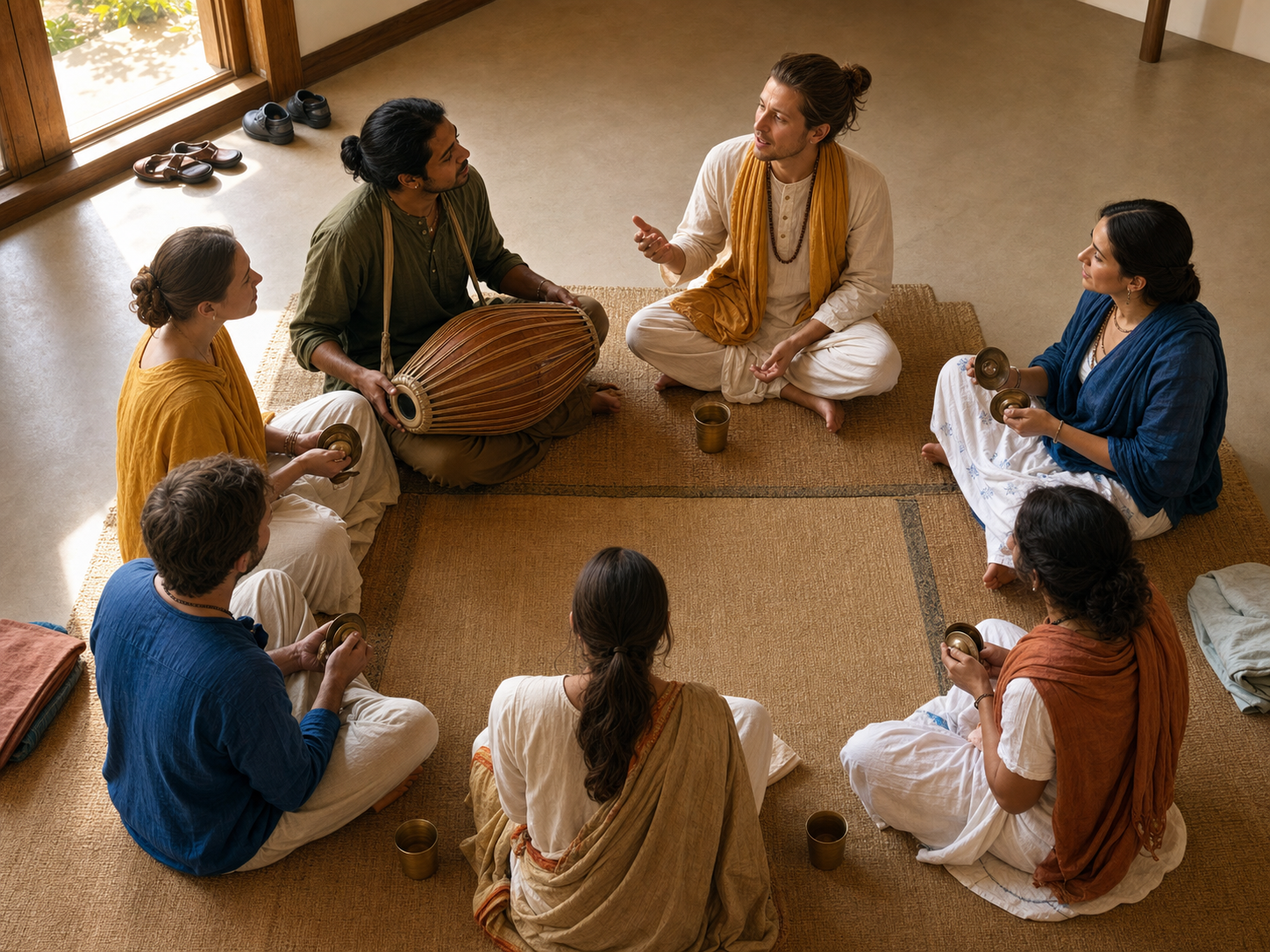
Japa and sankirtana support one another, but they do not train attention in exactly the same way. Japa cultivates steadiness and devotional intimacy through personal repetition. Sankirtana adds a congregation, melody, rhythm, call-and-response, and a shared intention. In japa, you repeatedly bring your own hearing back to the name. In sankirtana, you also learn to receive, respond, and support the attention of others.
Use the following sequence when you attend a kirtana. It is deliberately simple because complexity can become another form of distraction.
- Set an intention of service. Before the chanting begins, choose a plain intention: hear the names clearly and help the congregation chant together. This shifts the center of the practice away from judging the music or advertising your own devotion.
- Listen to the complete call. Do not rush to predict the next phrase. Receive the leader’s words, melody, and pace before responding. Call-and-response then becomes a repeated movement from hearing to offering.
- Articulate the names carefully. Clear pronunciation matters more than volume. Chant in a range that lets you form the words without straining. If the melody becomes demanding, keep your attention with the names rather than competing with the tune.
- Let posture and breath support attention. Use a steady, unforced posture and breathe naturally. Movement can serve rhythm and devotion, but it need not become a spectacle. If physical expression is making you less able to hear, simplify it.
- Return on the next name. When the mind wanders, notice where it went without conducting a trial against yourself. Rejoin the response that is already happening. The return is not an interruption of the practice; it is one of the practice’s central actions.
- Allow repetition to reveal depth. Do not demand a new tune or emotional escalation every time attention becomes restless. Repetition exposes whether you are meeting the name or merely consuming stimulation.
- Carry the chanting into seva. Help restore the space, welcome someone who stood alone, complete an unglamorous task, or repair a strained interaction. Service gives the internal movement somewhere concrete to go.
If you lead kirtana, your responsibility is not to demonstrate the widest vocal range in the room. Choose phrases the congregation can hear and answer. Leave room for a full response. Watch whether people are chanting with you or struggling to chase you. A leader serves sankirtana by making participation possible.
Shared rhythm and melodic repetition can help attention settle and can strengthen a sense of social connection. Those embodied effects may illuminate part of the forest-fire image, but they do not prove or exhaust its spiritual meaning. In Siksastakam, the fire is bhava: the condition of repeated entanglement in samsara, not merely a stressful afternoon.
Use difficulty as feedback, not as a verdict on your devotion
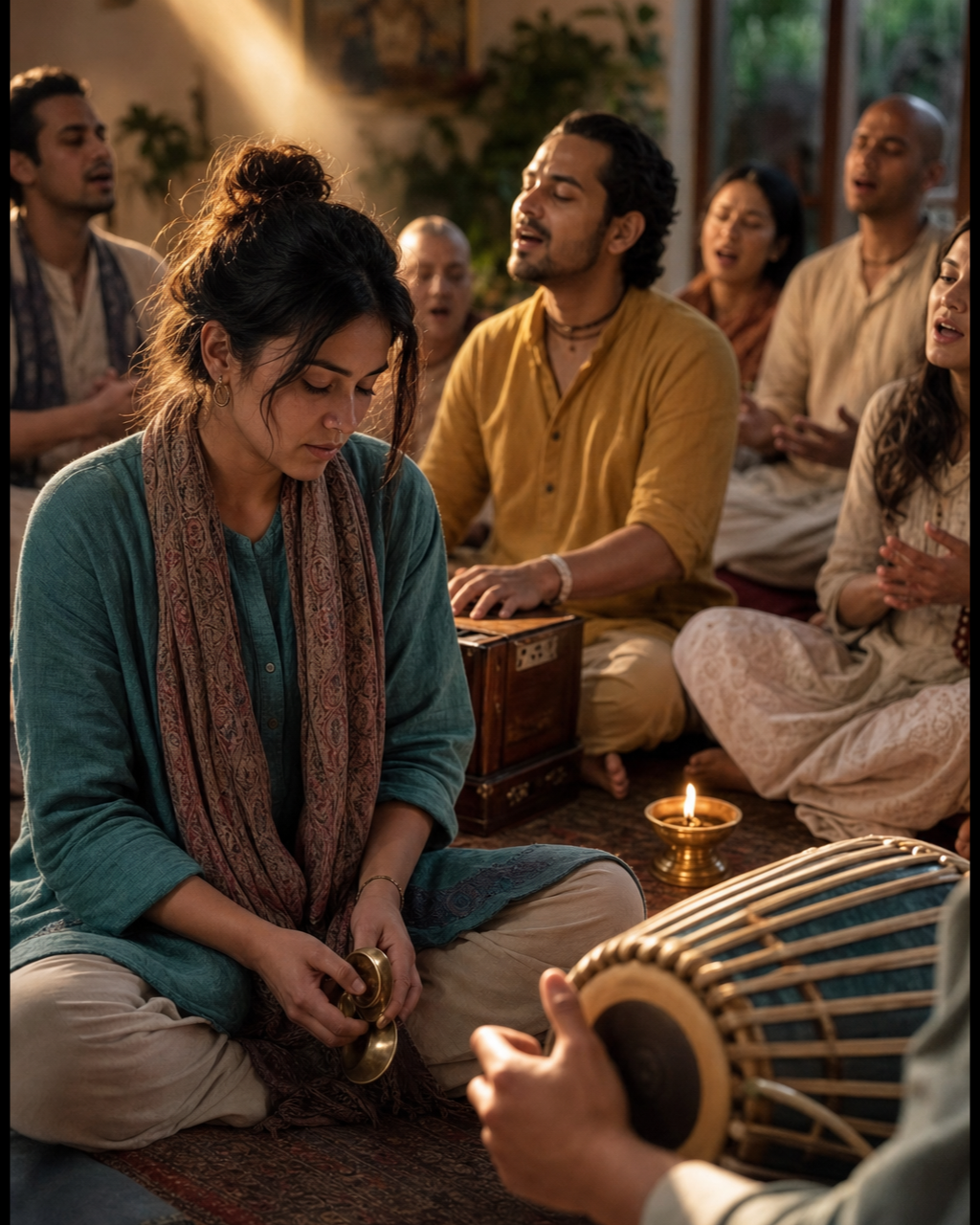
A disciplined practice gives you information. Restlessness shows where attention habitually goes. Self-consciousness shows how strongly you are monitoring your image. Irritation with another singer may expose a desire to control the devotional environment. You do not need to approve of these movements, but you do need to see them before they can be offered and transformed.
- If the mind is scattered: shorten the distance between noticing and returning. Do not wait for the next melody, the next session, or a better mental state. Re-enter on the next audible name.
- If chanting feels dry: do not conclude that nothing is happening solely because emotion is absent. Check the controllable parts of the practice: Are you listening? Are you pronouncing the names? Are you present for the response? Are you serving afterward?
- If gratitude, contrition, or tears arise: let them pass through without displaying them as proof of attainment. Emotional release may accompany a softening heart, but chasing its repetition turns attention back toward your own experience.
- If the music produces exhilaration: receive it gratefully without confusing energy with realization. The stronger test comes later, when another person frustrates you and no instruments are playing.
- If uncomfortable material surfaces: give yourself enough quiet not to act immediately from it. Chanting may make an existing wound, resentment, or fear easier to see; visibility is not the same as resolution.
Sankirtana is a spiritual discipline, not a substitute for medical or psychological care. If distress is persistent, disrupts ordinary functioning, or involves danger to you or someone else, seek qualified professional help. Receiving appropriate care does not negate devotional practice.
Humility here is practical. It means you stop demanding that Krishna’s name confirm a preferred image of yourself. You let the practice show you what requires purification, and then you respond through steadier chanting, honest guidance, repair, and service.
Test the fruit after the instruments become silent
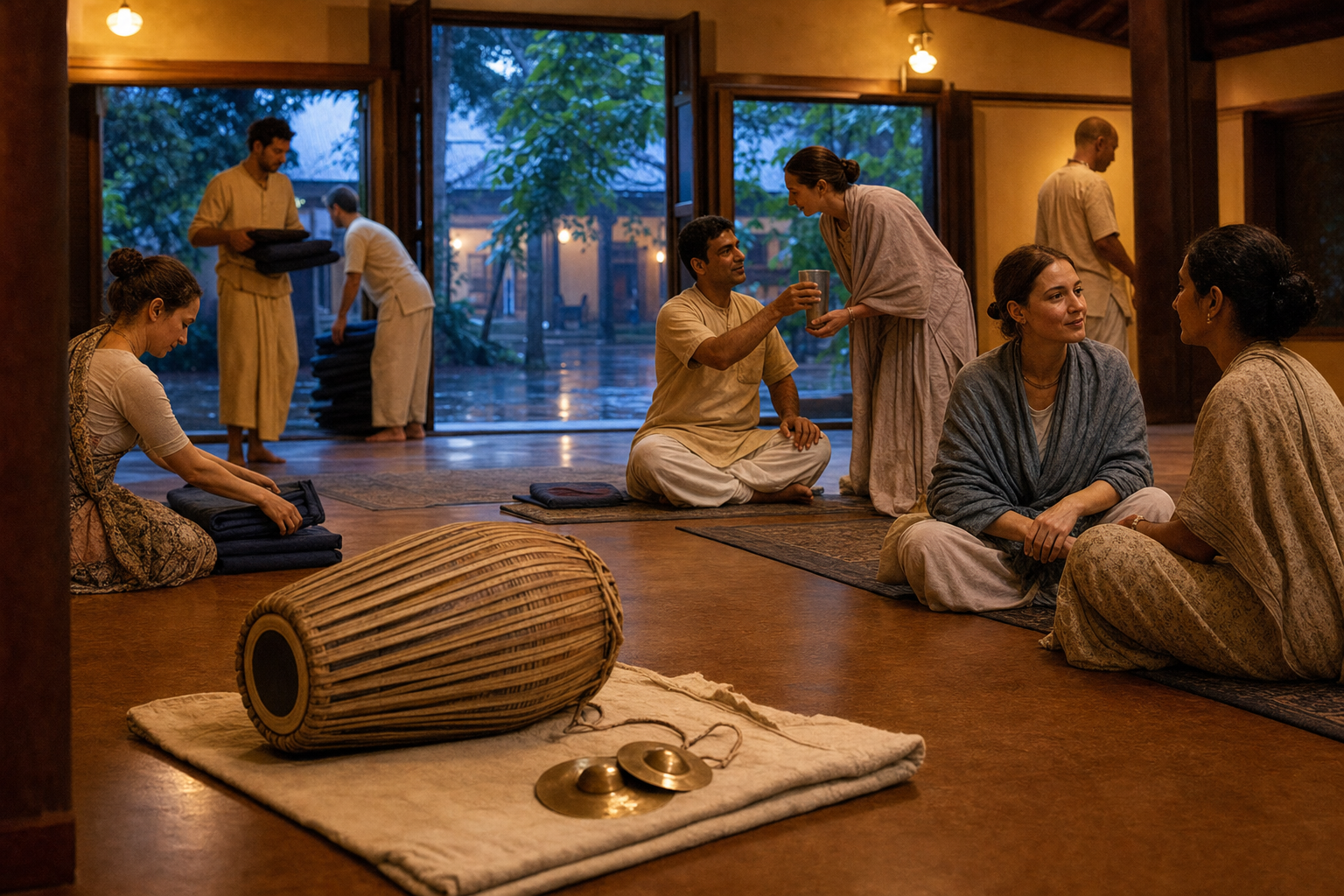
Sarvatma-snapanam, the bathing of the entire self, prevents sankirtana from being reduced to private catharsis. If the whole person is being touched, some effect should eventually become visible in how you speak, decide, disagree, study, and serve. The question is not whether you have become flawless. It is whether reactivity is losing ground and responsibility is becoming easier to accept.
After kirtana, use a brief audit. Ask yourself:
- What tendency became visible while I was chanting?
- What reaction feels cool enough that I no longer have to obey it immediately?
- What act of seva, restraint, gratitude, or repair will embody that change?
Keep the answers concrete. “I felt peaceful” is less useful than “I can now answer that message without trying to wound the sender.” “The kirtana was powerful” reveals less than “I noticed how much I wanted recognition, so I will take the necessary task that nobody sees.” This is how you connect inner movement to dharmic conduct without pretending that one session has completed the work.
The phrase vidya-vadhu-jivanam gives you another test. Knowledge is alive when it participates in perception and action. Before chanting, carry one teaching or one phrase of the verse into the practice. During sankirtana, hear the names in its light. Afterward, identify where that teaching applies to an actual choice. Shastra, sadhana, and sanga reinforce one another: study gives articulation to practice, practice softens the ground in which knowledge takes root, and community provides a field in which its truth is tested.
This test also protects a community from confusing devotional intensity with spiritual maturity. Loud chanting does not excuse harsh speech. Musical skill does not establish moral authority. Public emotion does not cancel responsibility for repair. When sankirtana is victorious, its social trace is greater tenderness, more reliable service, and less need to dominate.
Key takeaways for your next sankirtana
- Expect the first fruit to be clearer perception, not necessarily bliss.
- Treat every noticed distraction as an invitation to return on the next name.
- Listen to the call fully before offering the response.
- Prefer clear articulation and shared participation to volume or musical display.
- Let japa cultivate personal steadiness and sankirtana cultivate responsive, communal attention.
- Measure progress through speech, restraint, repair, study, and seva after the chanting ends.
Sankirtana also belongs within a wider Dharmic recognition of sacred sound. Sikh kirtan and Naam Simran, mantra recitation in Buddhist traditions, and the Jain Namokar Mantra each affirm the formative power of disciplined remembrance. These are not interchangeable practices, and their distinct lineages, objects of contemplation, and theological meanings should not be flattened. Their kinship lies in a shared civilizational confidence that sound, sustained attention, ethical refinement, and community can belong to one path of transformation.
At your next kirtana, do not wait for a dramatic state. Hear one call completely. Return with one response. Notice one distortion without defending it. Then let the chanting become one act of service after the music stops. That is a practical beginning to the victory Siksastakam describes.
References
