
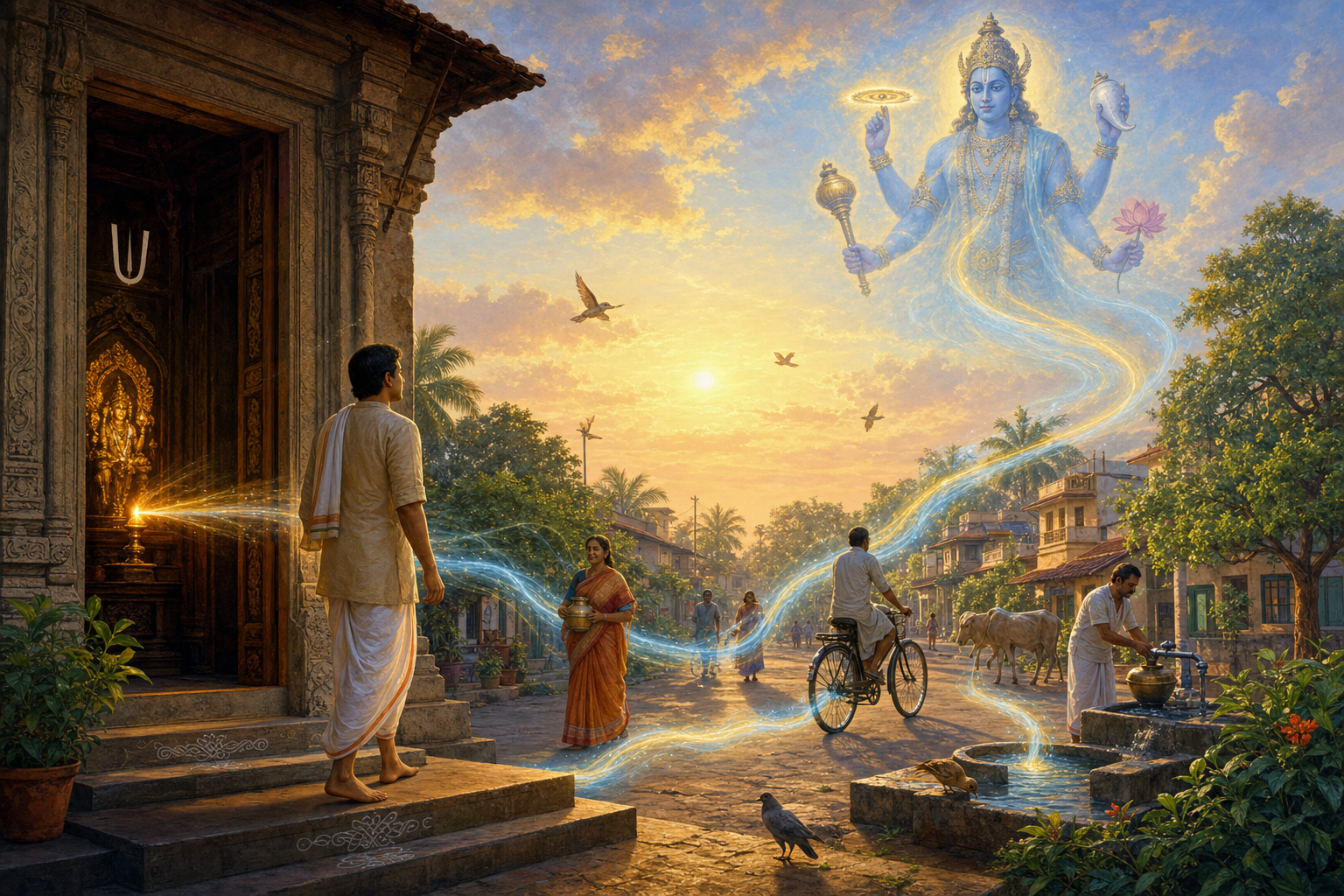
You may sincerely believe that Vishnu pervades the universe, yet find that the belief fades as soon as you leave the shrine. The lamp is extinguished, the commute begins, another person tests your patience, and the sacred seems to have remained behind the temple door.
The way forward is not to search for extraordinary signs. It is to connect remembrance to ordinary experiences you already have: drinking water, breathing, eating, working, speaking and meeting another being. Done carefully, this turns omnipresence from a vast idea into a disciplined way of seeing without pretending that every object is identical to the consecrated arcā.
Everywhere does not mean every form is interchangeable
Begin with a necessary distinction. To say that Vishnu is all-pervading is to say that no being, element or region of the cosmos exists outside His sustaining presence. It does not mean that every impulse is divine guidance, every action is righteous or every physical object has the same ritual status.
The Īśā Upaniṣad opens with īśāvāsyam idam sarvam, placing the whole world within the Lord’s pervasion. The Chāndogya Upaniṣad declares sarvaṁ khalvidaṁ brahma, while the Nārāyaṇa Sūkta speaks of the Supreme as present within and without. These are not instructions to abandon discrimination. They are instructions to stop treating any part of life as spiritually irrelevant.
The Bhagavad Gītā makes the same truth usable at three levels. In 9.4, Kṛṣṇa declares that the entire universe is pervaded by Him. In 7.8, He identifies Himself as the taste in water. In 15.15, He says that He is seated in the heart of all. The movement is deliberate: from the whole cosmos, to an immediate sensory experience, to the inward center of every being.
- When the idea feels too large, return to something direct, such as the taste of water.
- When devotion becomes private and self-enclosed, remember the Lord seated in every heart.
- When daily life feels spiritually empty, ask what response dharma requires in the situation already before you.
Hindu philosophical schools explain the relationship between the Lord, the world and the individual differently. Advaita Vedānta emphasizes non-dual reality at the level of essence. Viśiṣṭādvaita affirms the reality of souls and the world in an inseparable relationship to Vishnu, often expressed through the image of the cosmos as His body. Dvaita maintains a lasting distinction between the Lord and individual beings while affirming their complete dependence upon Him. You do not have to blur these differences in order to practice remembrance. In each framework, ordinary life remains answerable to a reality greater than the isolated ego.
Five modes keep an unlimited presence spiritually precise
Vaishnava theology gives Vishnu’s presence a fivefold articulation. This protects you from two opposite mistakes: confining Him to a shrine and dissolving Him into a vague spiritual force.
- Para: Vishnu in His transcendent fullness in Vaikuṇṭha. This preserves the truth that the Supreme exceeds the universe He pervades.
- Vyūha: Vāsudeva, Saṅkarṣaṇa, Pradyumna and Aniruddha as ordered cosmic manifestations and functions. This directs attention to divine order rather than an impersonal or accidental cosmos.
- Vibhava: the avatāras through whom Vishnu becomes accessible within sacred history. Rāma, Kṛṣṇa and other avatāras make divine qualities visible through lives, choices and līlā.
- Antaryāmi: the indwelling presence who sustains and witnesses from within. This is the mode to remember when no shrine, pilgrimage or public ritual is available.
- Arcā: the Lord’s consecrated and approachable presence in the worshipful form. Arcā gives your senses, hands, voice and attention a definite center.
Use these modes as a diagnostic tool. If your devotion has become abstract, return to arcā, mantra and concrete service. If you behave as though worship ends at the shrine, remember antaryāmi. If the Divine has become merely familiar or convenient, contemplate para. If Vishnu seems limited to a distant age, attend to His indwelling presence now. If events appear wholly chaotic, remember the ordering significance expressed through vyūha.
This balance matters. A devotee does not have to choose between a personal Lord and an all-pervading reality. The same Vishnu who transcends the cosmos makes Himself available through avatāra, indwelling presence and arcā. His accessibility does not diminish His transcendence.
Build remembrance into actions you already repeat
Smaraṇa, or remembrance, is not the manufacture of a dramatic mystical feeling. It is the repeated return of attention to what distraction makes you forget. The most reliable cues are actions that already occur throughout your day.
- At your first conscious breath, remember dependence. Air is not something the ego produces. Notice one natural breath and repeat a divine name inwardly, without forcing or manipulating the breath.
- Before drinking, pause at the taste of water. Recall Kṛṣṇa’s words, raso ‘ham apsu kaunteya: He is the taste in water. Receive the water before consuming it automatically.
- When lighting a lamp, attend to fire as witness. Let agni mark a change in the quality of your attention. The point is not merely to complete the gesture but to become inwardly present for worship.
- Before eating, remember Bhūmi Devī. Food depends upon earth, water, warmth, air and the labor of many beings. Gratitude should therefore affect how carefully you receive food and how little you waste.
- Before beginning work, offer its honest completion. Seva is not limited to formal volunteering. Livelihood becomes an offering when you refuse deceit, do the work entrusted to you and consider whom its consequences affect.
- Before answering another person, remember the indwelling Lord. This does not require agreement or passivity. It requires speech that opposes wrong without treating the person as spiritually disposable.
- At the end of the day, return scattered attention through japa or hearing. A portion of the Viṣṇu Sahasranāma, kīrtana or the divine name you regularly practice can gather the mind before rest.
Do not adopt every cue at once if that turns remembrance into another burden. Choose the cue you cannot easily avoid, such as your first sip of water. Keep it until the pause becomes dependable. Then attach remembrance to another repeated action.
The pañca-mahābhūtas, the five great elements, provide a compact map for extending this practice beyond formal worship.
| Element | What to notice | How to respond |
|---|---|---|
| Earth, pṛthivī | Food, soil, shelter and bodily support | Receive them as gifts associated with Bhūmi Devī; reduce waste and avoid careless extraction. |
| Water, ap | Taste, refreshment and the rivers that sustain communities | Pause in gratitude before drinking; treat polluted or wasted water as a failure of reverence as well as utility. |
| Fire, agni | The worship lamp, household flame, warmth and transformation | Let fire recall witness, clarity and responsibility rather than mere consumption. |
| Air, vāyu | The natural movement of breath | Use an unforced breath as a cue for the divine name and for dependence upon what you do not control. |
| Space, ākāśa | The openness in which sound and vibration are heard | Listen before speaking; use mantra, recitation and kīrtana to make sound an offering. |
Let divine presence become visible in your conduct
The doctrine of antaryāmi becomes demanding when it reaches another person. If Vishnu is seated in every heart, contempt cannot be dismissed as a private mood. Your treatment of workers, relatives, strangers, animals and vulnerable people belongs to your spiritual practice.
This does not make every behavior acceptable. Divine indwelling is not divine endorsement of cruelty, deception or adharma. You can set a boundary, resist harm or speak a difficult truth while still refusing to deny the deeper dignity of the being before you. Discernment judges the action; devotion guards the heart from hatred and dehumanization.
Several forms of seva make this theology concrete. Annadāna responds to hunger through the offering of food. Care for animals and trees recognizes that life is not merely raw material for human convenience. Honesty in livelihood prevents worship from becoming a compartment used to excuse conduct elsewhere. These acts are not decorative additions to bhakti. They are what bhakti looks like when it enters relationships and institutions.
The same test applies to sacred landscapes. Gaṅgā’s association with Vishnu’s grace cannot be separated coherently from responsibility toward rivers. Mountains and sacred groves cannot be honored ritually and treated only as objects of extraction. If a place carries sacred meaning, care for its material condition is part of that meaning.
Natural forms such as the Śāligrāma-śilā from the Gaṇḍakī river, the Dvārāvatī-śilā and Tulasī bring this responsibility into the home. Reverence includes how a sacred object or plant is acquired, handled and maintained. An object obtained through exploitation or ecological injury exposes a contradiction between the ritual act and the conduct surrounding it.
Use a simple conduct audit when devotion and daily behavior seem disconnected:
- Did convenience cause you to treat another being as invisible?
- Did you take, consume or discard more than the situation required?
- Did your livelihood demand a dishonest act that you tried to separate from worship?
- Can the next ordinary duty become seva through greater care, truthfulness or restraint?
If remembrance produces more ritual activity but no change in speech, consumption or responsibility, it has not yet reached the part of life where omnipresence makes its strongest claim.
Let the temple concentrate attention, then carry it outward
If Vishnu is everywhere, why go to a temple? Because an all-pervading presence can still be difficult for an untrained mind to notice. The temple gathers sound, fragrance, gesture, image, community and sacred time around a single center. Arcā gives definite form to attention that would otherwise remain diffuse.
The sanctum draws the gaze inward. Darśana interrupts the assumption that only the visible ego is the center of experience. Processions carry sanctity beyond the inner chamber. Festivals align households and communities around remembrance, restraint and shared worship. The temple therefore does not contradict omnipresence; it teaches you how to perceive it.
Practice this as a two-direction movement:
- Concentrate. In the temple or at a home shrine, give undivided attention to arcā, a simple pañcopacāra according to your tradition, japa, recitation or kīrtana.
- Extend. On leaving worship, choose one encounter in which you will remember antaryāmi and one task you will consciously perform as seva.
This keeps two distortions in check. Temple worship without extension can become compartmentalized. Universal language without concentrated worship can become vague and undisciplined. The shrine trains the senses; the world tests whether the training has entered your conduct.
Key takeaways
- Vishnu’s omnipresence means that nothing exists outside His sustaining presence; it does not make every action righteous or every form ritually interchangeable.
- Para, vyūha, vibhava, antaryāmi and arcā preserve transcendence, cosmic order, avatāra, inward presence and accessible worship without forcing them into one vague category.
- Water, breath, food, work, speech and sound can become stable cues for smaraṇa because they already belong to your day.
- Recognition of the Lord in all hearts must affect honesty, service, consumption, ecological care and the way you oppose wrongdoing.
- Temple worship concentrates attention so that remembrance can continue in kitchens, workplaces, roads, fields and relationships.
Begin with your next sip of water. Pause before drinking, remember raso ‘ham apsu kaunteya, and receive what you would normally consume without attention. Then let the remembrance govern one choice that follows. When this small act becomes steady, add another cue. Vishnu’s all-pervading presence becomes a lived truth as attention, devotion and dharma begin to move together.




References
