

If you are drawn to Kamyakali because you need help with work, study, family, protection, or a difficult decision, you do not have to pretend that you are free of desire. You do have to examine the desire you are placing before the Divine Mother.
That examination is central to Kamyakali worship. She is not a divine mechanism for getting whatever the mind happens to want. She is Kali’s fierce, compassionate, and boon-giving power encountered at the point where longing must become truthful, disciplined, and beneficial. The practical question is therefore not merely whether your wish will be fulfilled. It is what the wish, the worship, and your response to the outcome are making of you.
Begin by placing desire under dharma
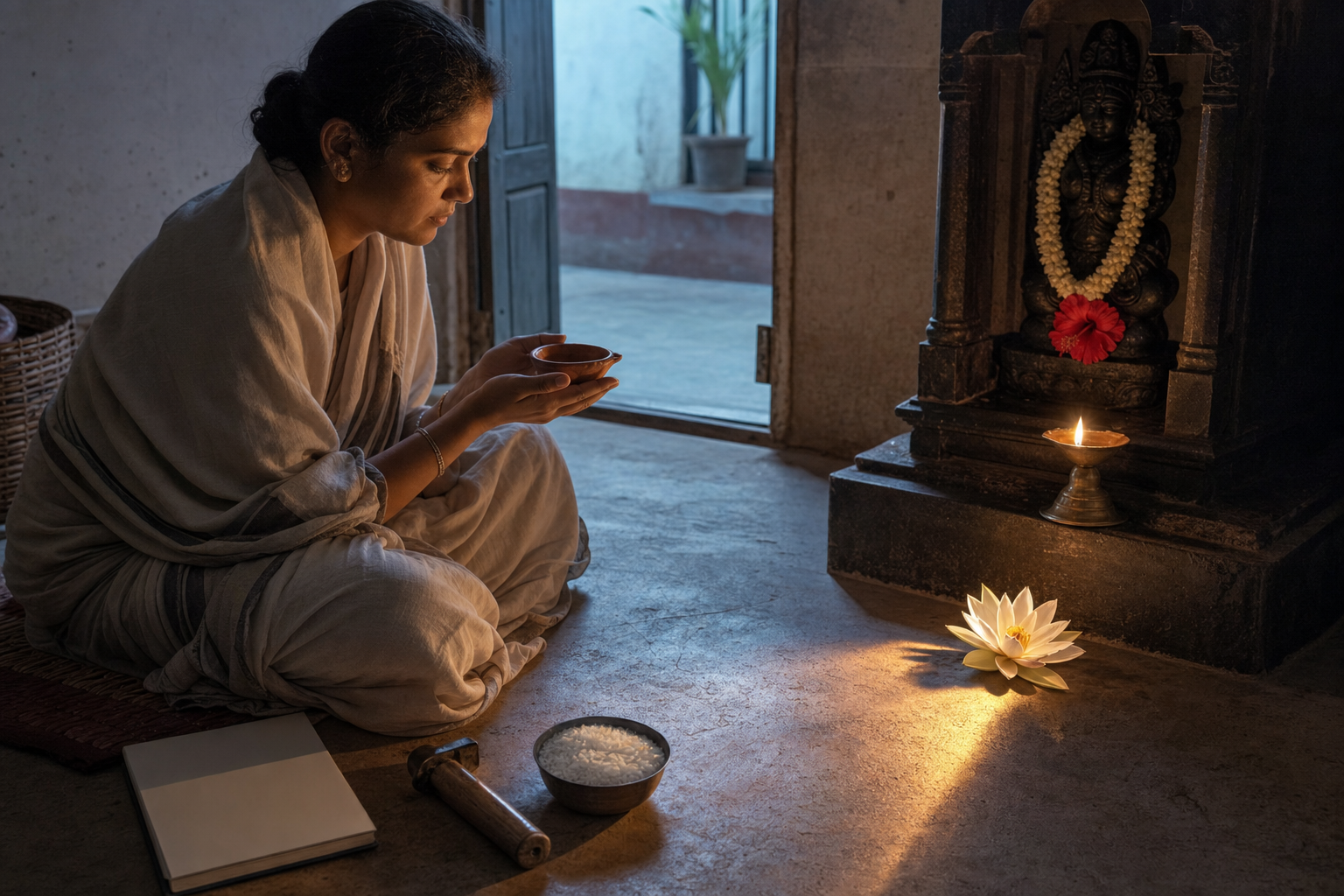
The Sanskrit word kāmya refers to something desired or sought. In Dharmaśāstra and Mīmāṁsā usage, kāmya-karman is an optional, aim-directed rite rather than an obligation that everyone must perform. Kamyakali brings that aim-seeking impulse into the presence of Kali, where it can be purified rather than merely indulged.
This distinction prevents two opposite mistakes. The first is treating all desire as spiritually shameful. A householder may legitimately seek livelihood, knowledge, family welfare, protection, or the capacity to serve. The second is assuming that religious desire is automatically righteous because it has been expressed during puja. An unethical wish does not become dharmic when incense is placed beside it.
Some Shakta lineages count Kamyakali among eleven revered forms of Kali, but such enumerations vary across texts, regions, and temple traditions. Do not make a disputed list, one painting, or one local ritual the test of whether every other expression is authentic. The more stable theological thread is Kamyakali’s governance of aspiration: will, understanding, and effective action must move together.
You can apply that theology through the four puruṣārthas: dharma, artha, kāma, and mokṣa. Before making a saṅkalpa, pass the desire through four questions:
- Dharma: Can you pursue this without deception, cruelty, exploitation, or betrayal of a real responsibility?
- Artha: Are you seeking the resources genuinely needed for a worthy life and duty, or using spiritual language to conceal possessiveness and status anxiety?
- Kāma: Will fulfillment contribute to wholesome relationship, beauty, affection, or joy, or will it strengthen a compulsion that already governs you?
- Mokṣa: Can you offer the outcome back to the Mother, including the possibility of delay, redirection, or refusal, without making it the measure of your worth?
If the desire fails one of these tests, do not abandon prayer. Rewrite the intention. Instead of asking for victory over a rival, ask for the capacity to perform your duty well, recognize injustice accurately, and accept a fair outcome. Instead of asking vaguely for wealth, name the responsibility the resources would support and the limits you will observe while seeking them. A clear saṅkalpa turns wanting into accountability.
The ethical boundaries are concrete: ahiṃsā, satya, asteya, aparigraha, and thoughtful brahmacharya keep boon-seeking from becoming a spiritual cover for harm, falsehood, taking what is not yours, accumulation without limit, or misuse of intimate energy. In Kamyakali worship, ethics are not preparation that can later be discarded. They are part of the offering.
Let Kali’s symbols question your saṅkalpa
Kamyakali’s appearance is not standardized across every region and lineage. She usually remains recognizably within Kali’s iconographic world, while artists and ritual communities may give greater prominence to her protective and boon-bestowing character. A dark form, unbound hair, fierce implements, and the gestures of abhaya and varada can coexist because her compassion is not sentimental. It protects what is wholesome by confronting what binds you.
Read the imagery as a discipline of attention, not as decorative horror:
- The dark form: The darkness can signify the ground from which forms appear and into which they return. When the outcome is uncertain, can you remain present without inventing an answer?
- Unbound hair: Freedom from rigid convention is not permission for indiscipline. Ask whether a convention is protecting dharma or merely protecting fear, vanity, or inertia.
- The sword: It signifies viveka, the discrimination that cuts confusion. Name the fact you have been avoiding before you ask the Mother to remove an obstacle.
- The severed head: This is a severe image of ignorance and ego-surrender. Ask which identity must be loosened: the need to be admired, to be right, to control another person, or to receive one particular result.
- The garland of heads or letters: It may be contemplated as the diversity of speech and knowledge gathered into a deeper unity. Examine whether your words are clarifying the situation or multiplying conflict.
- Abhaya and varada: Fearlessness and blessing belong together. A boon that leaves you more frightened, dependent, or dishonest has not been received wisely.
- The foot upon Shiva: This image need not be reduced to a contest between deities. It can express Shakti awakening consciousness into movement. Your prayer must therefore be joined to the right action that is actually yours to perform.
Red hibiscus is often foregrounded when Kamyakali’s blessing aspect is emphasized, but the flower is not a substitute for the inner offering these symbols demand. If you bring a hibiscus while protecting the very confusion the sword represents, the ritual remains incomplete. The useful habit is to select one symbol before worship and let it expose one contradiction between your stated intention and your conduct.
A simple Kamyakali puja for household practice
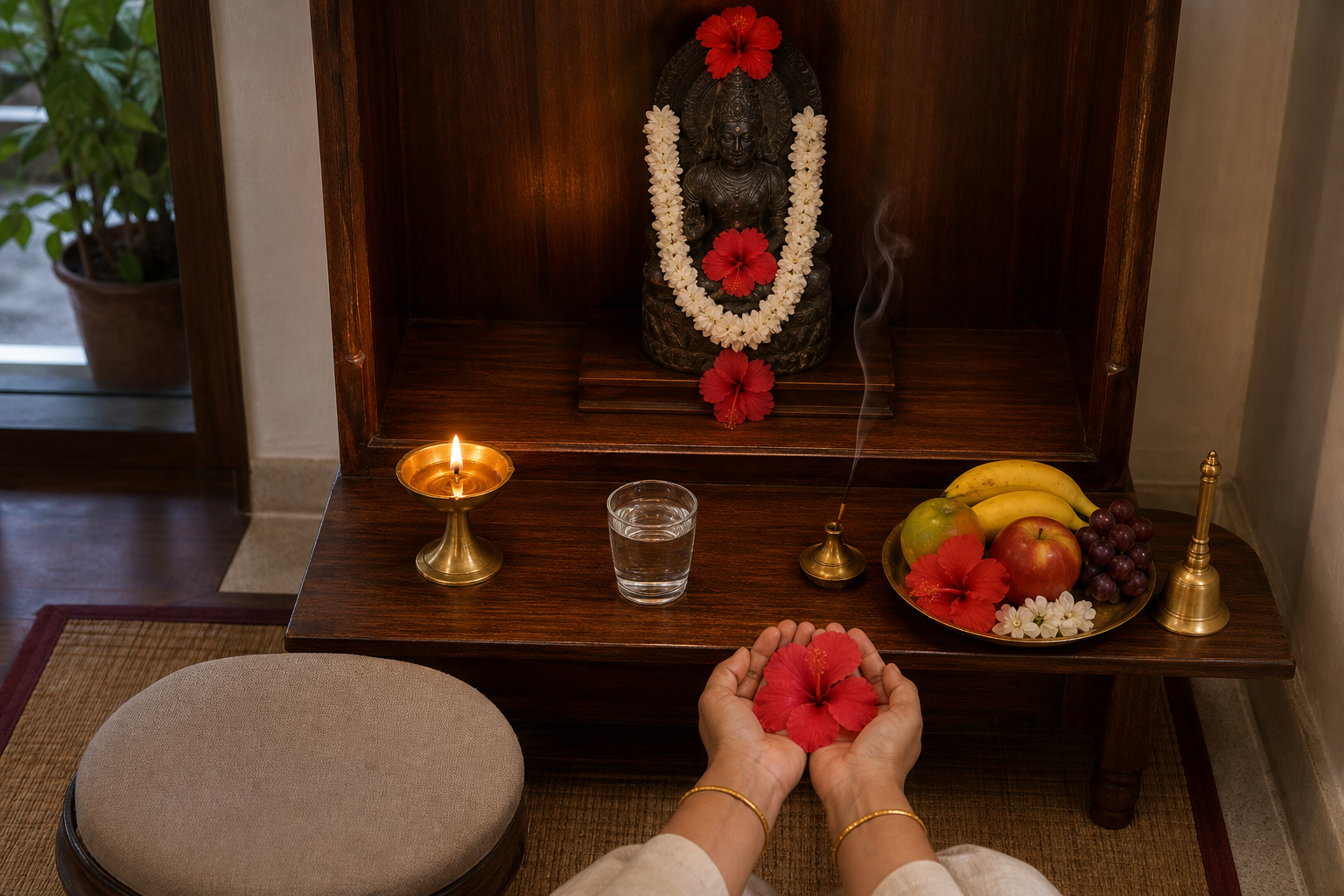
You do not need an esoteric setting to begin devotional worship. Although cremation-ground imagery has an important place in Kali’s esoteric symbolism, most household observance is quiet, orderly, and suitable for a home shrine. Its practical form is an encounter with impermanence, ego-surrender, courage, and ethical renewal.
Kartika Amavasya is widely observed as Kali Puja in eastern India and coincides with Deepavali. Tuesdays and Saturdays are also favored in several communities. These are meaningful opportunities, not proof that worship on every other day is ineffective. Follow your family, temple, or guru’s calendar where one exists; otherwise choose a rhythm you can maintain without neglecting your duties.
A restrained household sequence can proceed as follows:
- Prepare a quiet, clean place. Place the image used by your family or tradition respectfully. Wash your hands, silence avoidable distractions, and sit steadily. The purpose is not theatrical atmosphere but collected attention.
- State one saṅkalpa. Name the intention plainly and attach it to dharma. A usable form is: Mother Kamyakali, may this worthy aim be fulfilled if it serves dharma; remove my confusion, show me my duty, and give me courage to accept the right outcome. Do not crowd one worship period with a catalogue of unrelated demands.
- Settle the breath. Let the breathing become natural and unforced. Notice fear, bargaining, excitement, or resentment without pretending those reactions are absent. This brief pause helps distinguish a deliberate intention from an impulse.
- Make the five offerings. The household Panchopachara sequence consists of gandha, fragrance; puṣpa, flowers; dhūpa, incense; dīpa, a lamp; and naivedya, consecrated food. Red hibiscus may be offered where it is available and appropriate. Keep flame and smoke physically safe; if an item cannot be used safely in your home, offer it mentally rather than creating a hazard.
- Pray or perform japa. A broadly attested Kali mantra is Om Krīm Kālikāyai Namaḥ. Krīm is associated with Kali’s transformative power. Do not present this as the one universal Kamyakali formula, because mantra forms, pronunciation, nyāsa, meter, and prescribed counts differ by lineage. If you have received instruction, follow it. Without such instruction, keep the recitation devotional and modest, or use a simple prayer in a language you understand. Some traditions favor silent japa because it settles attention and preserves ritual inwardness.
- Remain silent after the final recitation. Do not rush from prayer directly into messages, argument, or entertainment. Let the saṅkalpa return to mind and notice whether a neglected responsibility has become clearer.
- Complete one corresponding action. If you prayed for livelihood, prepare the application or learn the needed skill. If you prayed for reconciliation, decide what truthful and non-accusatory conversation is yours to begin. If you prayed for protection, establish the practical boundary or seek appropriate support. Puja can orient action, but it must not replace medical care, legal assistance, or immediate safety measures when those are needed.
- Receive the naivedya reverently. Consume or share it as prasāda according to your household custom. Then carry one ethical commitment from the shrine into the rest of the day.
The simplicity is deliberate. Adding more substances, more names, or a larger count does not necessarily make worship deeper. At the household level, steadiness, truthful intention, reverence, and follow-through are more useful measures than ritual display.
Know where household devotion ends and initiation begins

Kali traditions contain sophisticated tantric disciplines, and their existence should neither be denied nor casually imitated. The safe boundary is easy to state: perform the devotional worship you understand, and receive specialized procedures through a responsible lineage.
Image worship, Panchopachara offerings, ethical reflection, simple prayer, and quiet contemplation fit ordinary household life. Prescribed nyāsa, specialized mantra meters and counts, and advanced tantric procedures require instruction. Do not assemble them from disconnected fragments merely because each fragment looks traditional on its own. A ritual is not made coherent by collecting Sanskrit terms.
The same caution applies to the Panchamundi Asana and cremation-ground motifs. Interpretations of the Panchamundi symbolism include conquest of inner limitations and integration of five sheaths or elements. That contemplative meaning is not an instruction to construct or imitate an advanced ritual setting without initiation. For a contemporary householder, the relevant cremation ground is often the inward place where pride, fixation, and false identity are allowed to end.
When seeking instruction, ask direct questions. What is the lineage? Which practices are authorized for an uninitiated householder? Which details must be received rather than improvised? How is the practice bound to ahiṃsā, truthfulness, restraint, family responsibility, and service? A teacher who can describe boundaries is more useful than one who turns secrecy itself into proof of authority. Treat guaranteed boons, pressure, and demands to suspend ethical judgment as reasons to step back.
This boundary also protects the mantra. Krīm may appear in a widely used devotional invocation, but that does not make every bīja arrangement or ritual application interchangeable. Follow the form you have responsibly received, and do not confuse intensity with maturity.
Key takeaways: judge Kamyakali worship by its fruit
The first prayer may be plainly kāmya: help with study, work, family, or protection. Its deeper movement is toward niṣkāma devotion, in which you still act purposefully but become less possessive about the reward. The transition is gradual. It can be noticed in the quality of your choices before it appears in any outward result.
- Kamyakali does not erase desire; she places desire under dharma, discernment, restraint, and responsibility.
- A worthy saṅkalpa names one aim, the people it affects, the ethical limits on pursuing it, and openness to a different right outcome.
- Her fierce imagery should expose fear, ego, confused speech, and neglected action rather than feed fascination with danger.
- Household worship can remain simple: intention, natural breathing, Panchopachara offerings, devotional prayer or japa, silence, and one corresponding action.
- Lineage-specific nyāsa, mantra prescriptions, and advanced tantric settings should not be self-initiated.
- The clearest fruit is not excitement or a dramatic claim. Look for greater courage, composure, honesty, compassion, and freedom from compulsive bargaining.
After worship, ask yourself five practical questions. Is the desire now clearer and less frantic? Am I acting more truthfully? Can I accept delay without abandoning dharma? Does the hoped-for benefit widen beyond me? Has devotion made me more courageous and compassionate toward the people affected by my decision? If the answers repeatedly move in the opposite direction, revise the saṅkalpa, simplify the practice, and seek sound guidance.
A yogic reading describes this maturation as raw impulse becoming luminous energy through discipline and care: the turbulence associated with svādhiṣṭhāna is schooled by maṇipūra’s resolve and anāhata’s compassion. Treat that as a contemplative map, not as a mechanical promise. Its value lies in helping you notice whether energy is becoming service or merely acquiring sacred vocabulary.
Readers from other Dharmic traditions may recognize the pattern without declaring the traditions identical. Vajrayana’s fierce-compassionate protectors such as Mahākāla, Jain tapas and aparigraha, and Sikh commitment to sat and hukam each show, in their own theological settings, how power and desire can be governed by truth, restraint, and a purpose larger than the individual. These resonances support conversation rather than ritual fusion.
For your next worship, bring one desire rather than many. Pass it through the four puruṣārthas, place it before Kamyakali, and leave the shrine with one action that makes the prayer truthful. That is where desire begins to become sādhana.

References
