
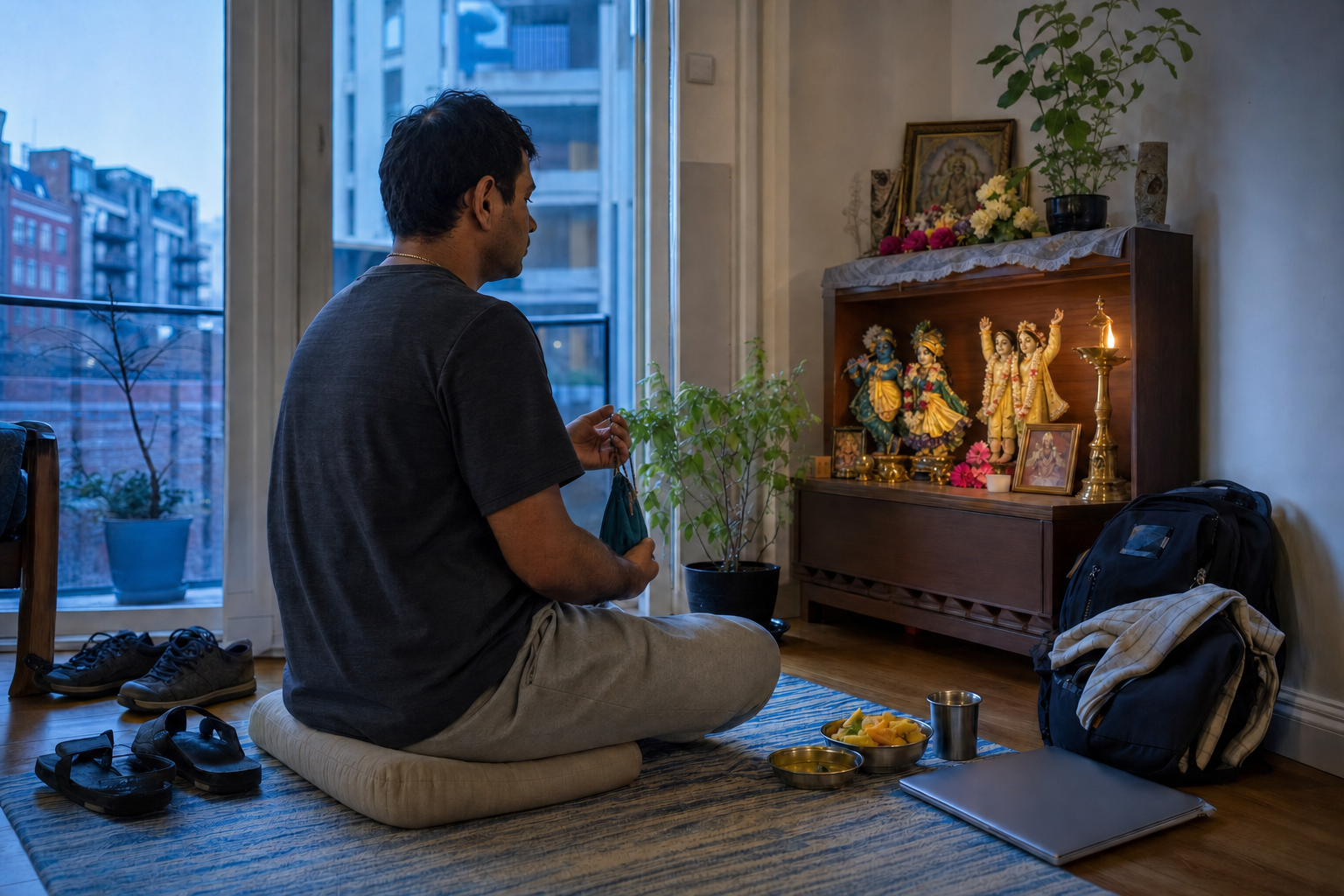
You may leave a temple kirtan feeling wholly oriented toward Krishna, then find that work, family duties and the noise of the next ordinary day scatter that attention. The difficulty is usually not a lack of sincerity. It is the absence of a devotional structure that can survive changing schedules and uneven energy.
A sustainable ISKCON life does not depend on keeping yourself at festival intensity. It links japa, kirtan, sadhu-sanga, seva and scriptural study so that each practice supports the others. Personal sadhana establishes direction, good association corrects drift, seva turns intention into conduct, and festivals renew the sacred imagination. Here is how to build that cycle without reducing bhakti to either private self-help or constant temple activity.
Protect a daily anchor that works on difficult days
Do not begin by copying a temple timetable that your present responsibilities cannot support. Begin with the devotional commitment you can protect even when the day is crowded. For most practitioners, japa is the clearest anchor because it places Krishna’s name at the centre of attention without requiring an event, an audience or a particular emotional state.
Attach that practice to a transition that already happens: waking, completing morning duties, beginning a commute or returning home. Some urban devotees integrate japa into public-transport journeys, but a commute is useful only when you can chant attentively and remain aware of your surroundings. If travel is noisy or unpredictable, reserve the commute for listening and protect another setting for deliberate japa.
Make the anchor concrete before the day begins:
- Define the minimum practice that remains non-negotiable on a demanding day. If you have accepted a specific spiritual commitment, treat that commitment as the standard rather than quietly replacing it with a more convenient one.
- Remove the first point of friction. Keep your beads and other necessities ready, and put the phone beyond casual reach.
- When attention wanders, return to the sound of the holy name instead of turning the lapse into a judgment about your spiritual worth.
- Notice the recurring cause of interruption. A vague plan requires willpower every day; a stable cue removes a fresh negotiation.
Japa should not be assessed only by whether it makes you feel peaceful. In bhakti, the name is not merely an instrument for changing your mood. Chanting is remembrance, address and offering. Some sessions will feel collected and others dry. Continuity matters because it keeps the relationship from being governed by passing emotion.
Place a manageable amount of sastra beside this anchor. Read a passage from the Bhagavad-Gita or another foundational text used in your lineage, then identify the instruction or question you will carry into the day. This keeps study from becoming information collection. It also gives your chanting and decisions a shared theological direction.
Private practice and congregational kirtan do different work. Japa exposes the habits of your own attention; kirtan lets your voice be supported by the voices, rhythm and devotion of others. If one has displaced the other, restore the missing side rather than demanding that a single practice perform every function.
Choose sadhu-sanga by what it cultivates
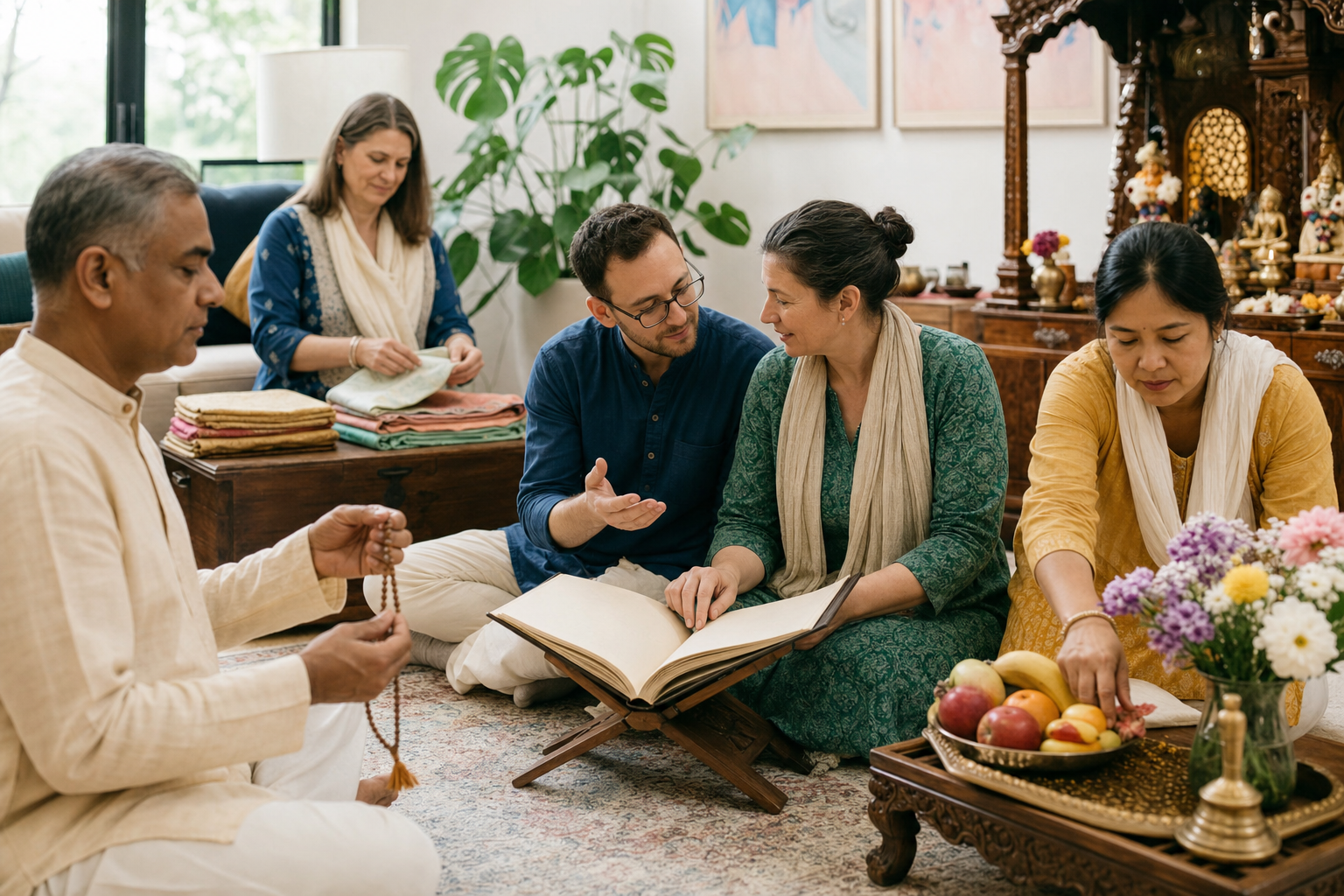
Sadhu-sanga is more than being in a room with devotees. It is association that changes what you remember, discuss, value and do. A crowded programme can leave you anonymous, while a modest gathering can offer accountable friendship and careful guidance. Choose association by its effect on your devotional conduct, not by its size or visibility.
Look for a community or small sangha where:
- Krishna-katha, kirtan, japa, prasadam and seva are treated as connected practices rather than unrelated activities.
- You can ask an honest question without being shamed for not already knowing the answer.
- Participants encourage commitments without competing over displays of austerity, access or status.
- Language is handled thoughtfully. In a multilingual congregation, people should know which language a session uses and whether interpretation or parallel discussion is available.
- Leaders can explain codes of conduct, volunteer responsibilities and the way a concern or grievance is handled.
Urban communities do not always need a large building to provide meaningful association. Small gatherings in apartments, near transit routes or around workplace schedules can preserve continuity when property costs, shift work and long travel make frequent temple attendance difficult. Hybrid Bhagavad-Gita classes can serve the same purpose when you cannot be physically present.
Digital access is best used as a bridge, not as an automatic substitute for relationship. A stream can carry a lecture or kirtan, but it cannot by itself notice that you have disappeared, help you repair a misunderstanding or share responsibility for a practical task. If most of your contact is online, establish a direct connection with devotees who know your circumstances and can speak with you candidly.
You should also expect to contribute to the quality of association. Arrive prepared, listen without turning every discussion into a debate, keep confidences, and follow through when you accept a task. Sadhu-sanga becomes durable when participants stop treating the community as spiritual content supplied by somebody else.
Accept seva with a clear scope and an accountable structure
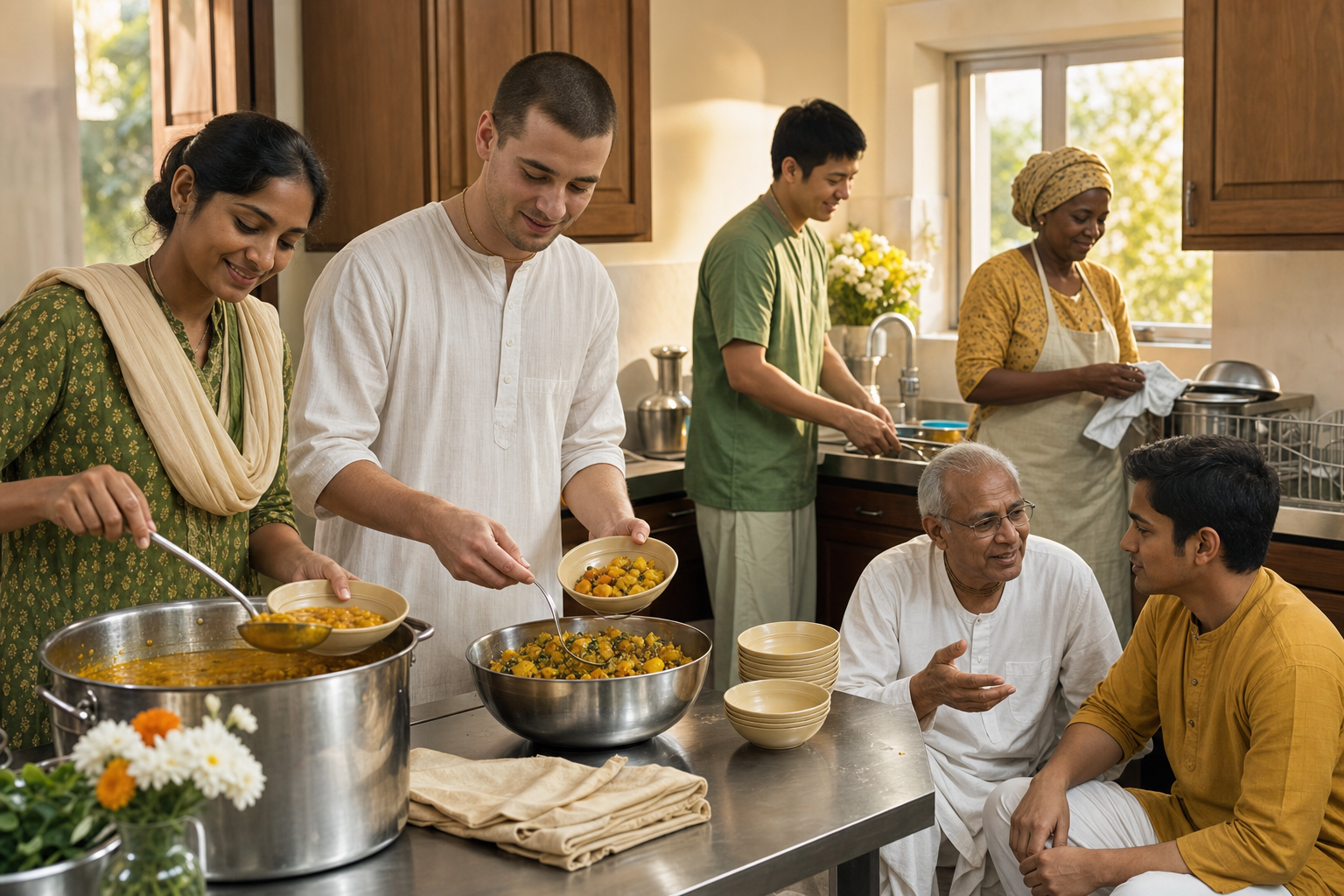
Seva carries inner practice into the world. Temple maintenance, kitchen work, welcoming visitors, facilitating study and mentoring younger practitioners can all become ways of offering time and ability to Krishna. The test is not whether a task looks prominent. It is whether you can perform it carefully, cooperatively and without using it to build a devotional identity for public display.
Before accepting an ongoing responsibility, ask practical questions:
- What exactly belongs to this role, and what does not?
- Who trains you, and who makes the final decision when instructions conflict?
- How is the duty handed over when work, health or family responsibilities prevent you from attending?
- Does the community rotate demanding tasks, or does the same dependable person silently carry them until exhaustion?
- Where should you report a food-safety, child-protection, financial or interpersonal concern?
These are not bureaucratic questions imposed on spiritual life. Clear roles protect both the offering and the person making it. Rotating seva rosters, transparent financial reporting and appropriate safety protocols allow trust to rest on more than good intentions. Prasadam distribution still requires sound food handling. Programmes involving children still require child-protection practices. Sacred purpose does not make ordinary safeguards unnecessary; it makes conscientious accountability part of the seva.
If service is producing chronic resentment, first inspect the structure. The role may be undefined, the workload may have expanded without consent, or nobody may be available for a handover. Narrowing a duty can be more responsible than continuing badly or leaving the entire community in frustration. Speak early, while the problem can still be corrected without a crisis.
Notice who is being prepared to lead as well as who currently holds a title. Women facilitating satsang, guiding study, leading appropriate community activities and mentoring newer practitioners help responsibility pass across generations. A healthy community develops people; it does not depend permanently on a few indispensable volunteers.
Seva can also connect ISKCON communities with the wider dharmic family without erasing theological distinctions. Food relief, environmental care and public conversations about ahimsa, remembrance and service provide workable areas of cooperation with Hindu, Buddhist, Jain and Sikh communities. The honest approach is shared action with clear language: unity does not require pretending that every tradition teaches the same doctrine.
Enter festivals as concentrated practice, not spectacle
A festival can compress theology into sight, sound, movement and shared memory. That concentration is valuable, but it is easy to consume the beauty as a spectator and leave unchanged. Prepare for the lila being enacted, participate with discipline, and give the experience somewhere to go afterward.
The Nauka Vihar celebration held at ISKCON Vrindavan on 11 March 2026 illustrates this method. Its narrative comes from Krishna’s boat pastime preserved in Gopal Champu by Srila Jiva Goswami. Krishna appears as a boatman when the gopis arrive at Manasi Ganga carrying yogurt and butter. Their playful exchange becomes a meditation on loving surrender: the water can be contemplated as life’s difficult currents, the boat as shelter under grace, and the cargo as both the devotee’s offering and the attachments brought before Krishna.
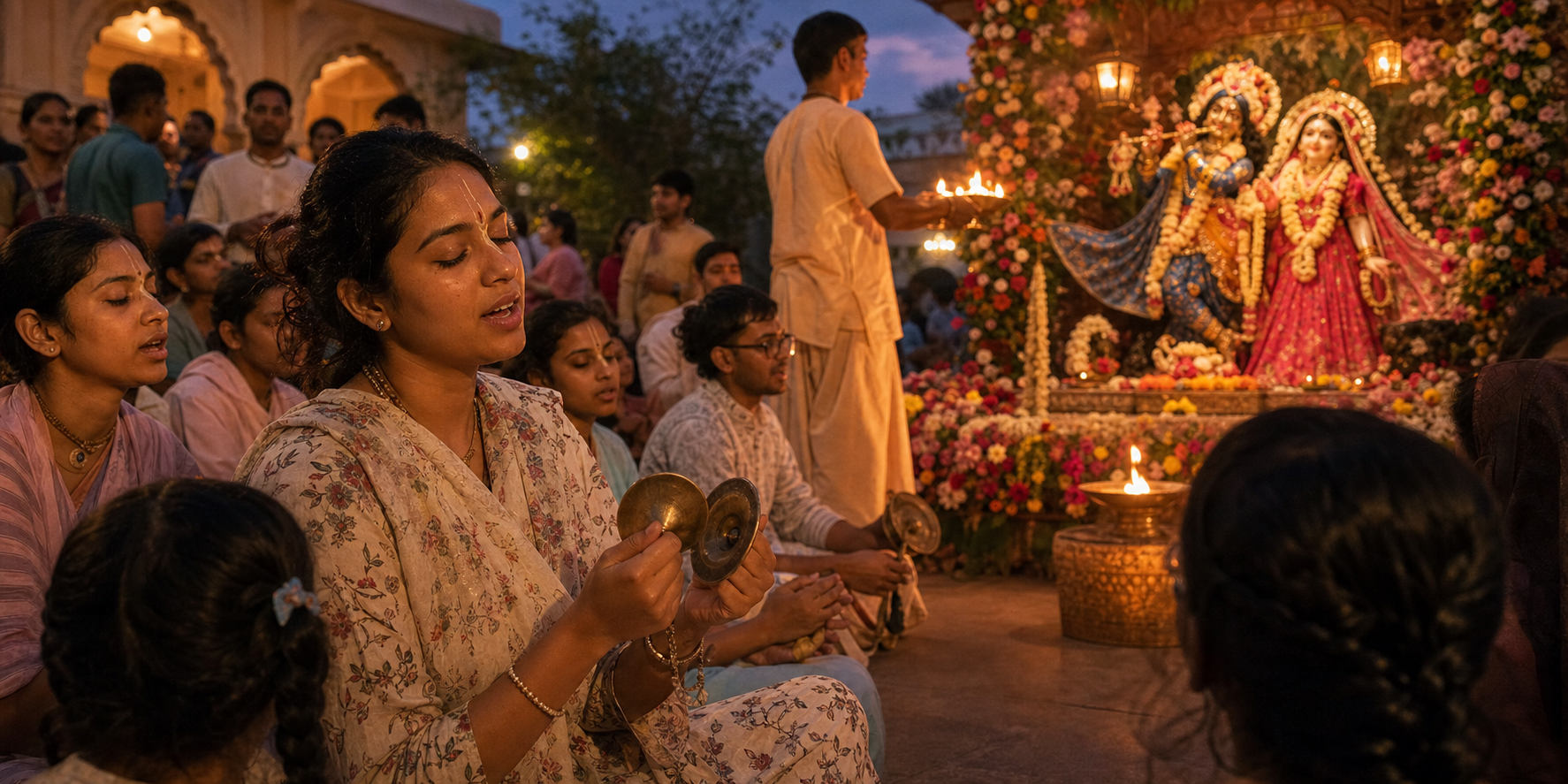
Within the temple, a flower-covered boat, a temporary kund, darshan and responsive kirtan bring that sacred geography into congregational worship. Lamps, blossoms, conch, mrdanga and kartals are not decorations around the real practice. Properly attended to, they direct the senses toward the divine names, forms and pastimes.
Use a simple three-phase approach when you attend such a festival:
- Before arriving, learn the central lila and identify what the ritual asks you to remember. For Nauka Vihar, consider what you are trying to carry by your own strength and what it would mean to place that burden in Krishna’s service.
- During the event, let queueing become preparation rather than irritation. Chant quietly, follow volunteer directions, preserve space for elders, children and people with mobility needs, and honour the temple’s photography rules. At darshan, look deliberately before reaching for a device.
- Afterward, name the image or teaching that remained with you and connect it to ordinary practice. The boat may prompt renewed dependence on grace; the offered cargo may prompt a concrete act of generosity; the coordinated worship may prompt you to take up a neglected seva.
For families, this approach turns colour and movement into theological learning. A child can first notice the flowers, water and music, then be invited to ask what the boat carries and why Krishna appears as a boatman. The point is not to force an abstract lesson during darshan. It is to let a remembered image open a later conversation about offering, protection and loving play.
If you help organise a festival, the devotional meaning should shape the material choices. Seasonal local flowers, composting of petals, measured water use, recirculation where feasible and biodegradable temporary materials express care for Krishna’s creation. Crowd routes, stable access and clear sightlines similarly protect worshippers from preventable confusion while preserving the contemplative centre of the event.
The festival has done its work when its intensity returns you to steady practice. If inspiration survives only until the decorations come down, the event has remained external. Let the next japa session, scriptural passage or act of seva receive what the festival awakened.
Key takeaways
- Build devotional life as a connected cycle of sadhana, sadhu-sanga, seva, sastra and festival remembrance, not as a search for continuous spiritual intensity.
- Protect a daily japa anchor that remains workable on a demanding day, and attach it to a stable transition instead of renegotiating it every morning.
- Choose association by the honesty, discipline and care it cultivates. Small or hybrid sanghas can sustain continuity, but direct relationships still matter.
- Accept seva with a defined scope, training, handover and grievance path. Accountability protects the devotee, the community and the offering.
- Approach festivals through preparation, attentive participation and follow-through so that ritual beauty changes ordinary conduct.
Begin with the next ordinary day. Fix the cue for your daily practice, contact the sangha or devotee who can help you remain accountable, and define the seva you can perform reliably. Contemporary devotional life becomes real in that quiet coordination of remembrance, relationship and responsibility.
References
- Dandavats – ISKCON Vrindavan Boat Festival (11 March 2026): Nauka Vihar History, Rituals, and Visitor Guide
- Dandavats – Inside Hong Kong’s Hare Krishna Community: Unsung Devotees Powering Faith, Service, and Unity
