
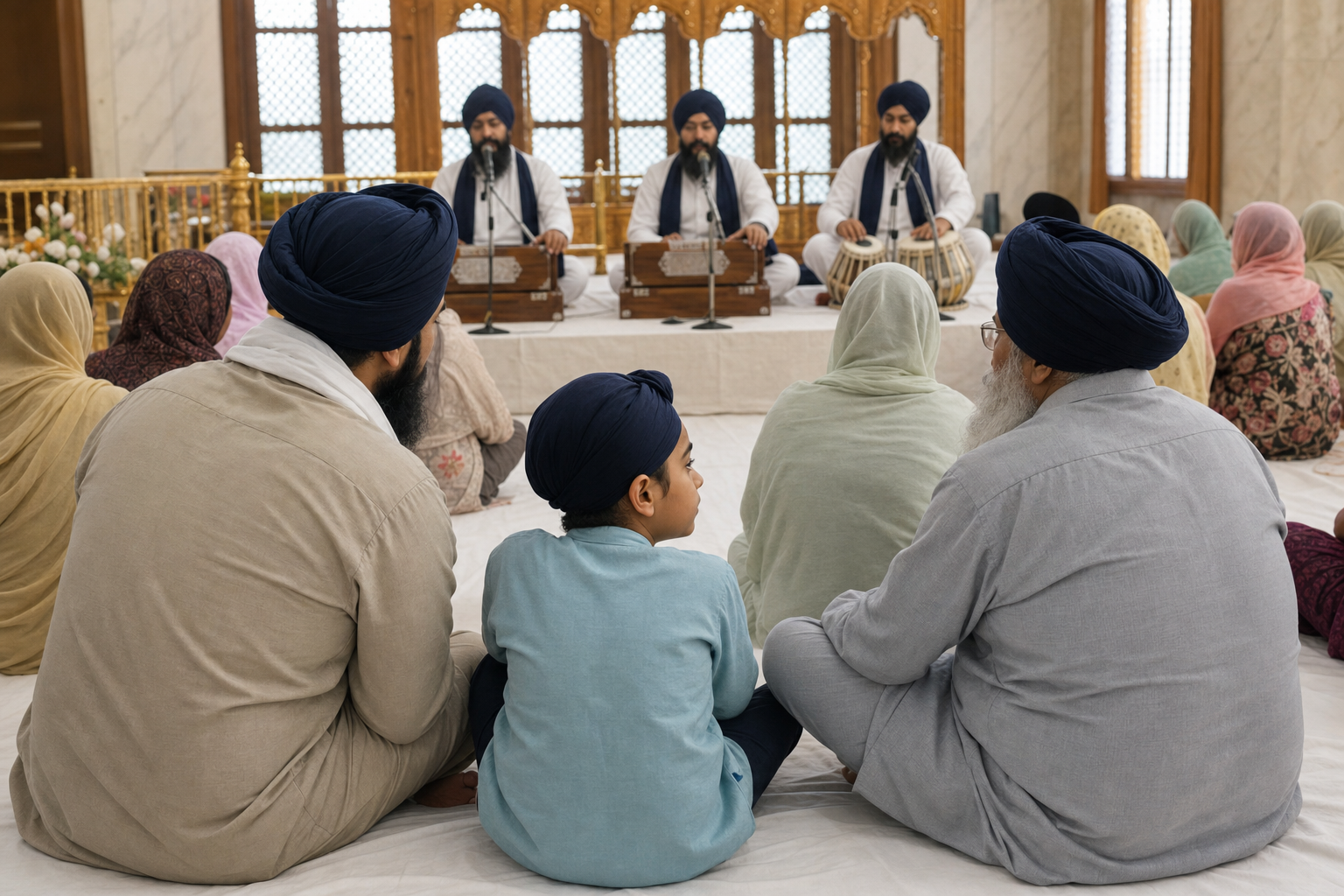
Your child can recognize a familiar tune, sit through kirtan, and perhaps repeat its opening words. Yet when you ask what the Shabad is asking of them, the answer may be silence. The difficulty is not necessarily a lack of devotion. Exposure produces familiarity; formation requires a living connection between sound, attention, understanding, repetition, and conduct.
You can build that connection without turning the home into another classroom. The aim is to let Shabad become a dependable way of hearing, thinking, and acting. That begins by preserving what is distinctive in the Sikh understanding of Shabad, then placing it in respectful conversation with the wider Dharmic use of sacred sound.
Formation begins when Shabad is treated as Guru, not ambience
Shabad in Sikhi is not a general name for soothing religious music. Nor is it merely a poetic message placed inside a melody. The decisive principle is that the Shabad Guru is the Guru: the revelatory Word instructs, corrects, and liberates. Music serves that encounter, but it does not replace it.
This distinction changes your role as a parent or teacher. Your first responsibility is not to make the experience entertaining. It is to help the learner become available to the instruction carried by bani. A beautiful performance that leaves the words unintelligible may create a devotional mood, but mood alone is not Dharmic formation.
Four connected practices keep Shabad from becoming background sound:
- Suniai: Listen with undivided attention. Put down the other task, face the sound, and notice which words return.
- Paath: Recite carefully enough that consonants, vowel lengths, pauses, and phrasing remain audible.
- Vichaar: Ask what the bani reveals about the mind, the Divine, and the way a person should live.
- Kirtan: Sing the Word so that raag, rhythm, breath, and collective participation deepen attention to its meaning.
These are not four competing methods. They form a cycle. Listening prepares accurate recitation. Recitation makes the words available for reflection. Reflection identifies the required change in conduct. Kirtan returns that instruction to memory through melody and Sangat.
You can tell where a learner is in this process by making three distinctions. Familiarity means they recognize the tune or opening phrase. Competence means they can recite or sing it with reasonable care. Formation becomes visible when they can state its central instruction in their own words and connect that instruction to an actual choice.
The rahau line is often the best doorway into that deeper encounter. It functions as a thematic pivot within a composition. Before explaining every line, locate the rahau and ask: What thought is the Shabad asking us to hold? What habit does it expose? What quality does it cultivate? Where will that quality be tested in ordinary life?
This keeps explanation focused. A child does not need a lecture covering every possible interpretation before participating meaningfully. They need an accurate point of entry, a chance to listen again, and an opportunity to live what they have understood.
Build a daily rhythm that can survive ordinary family life
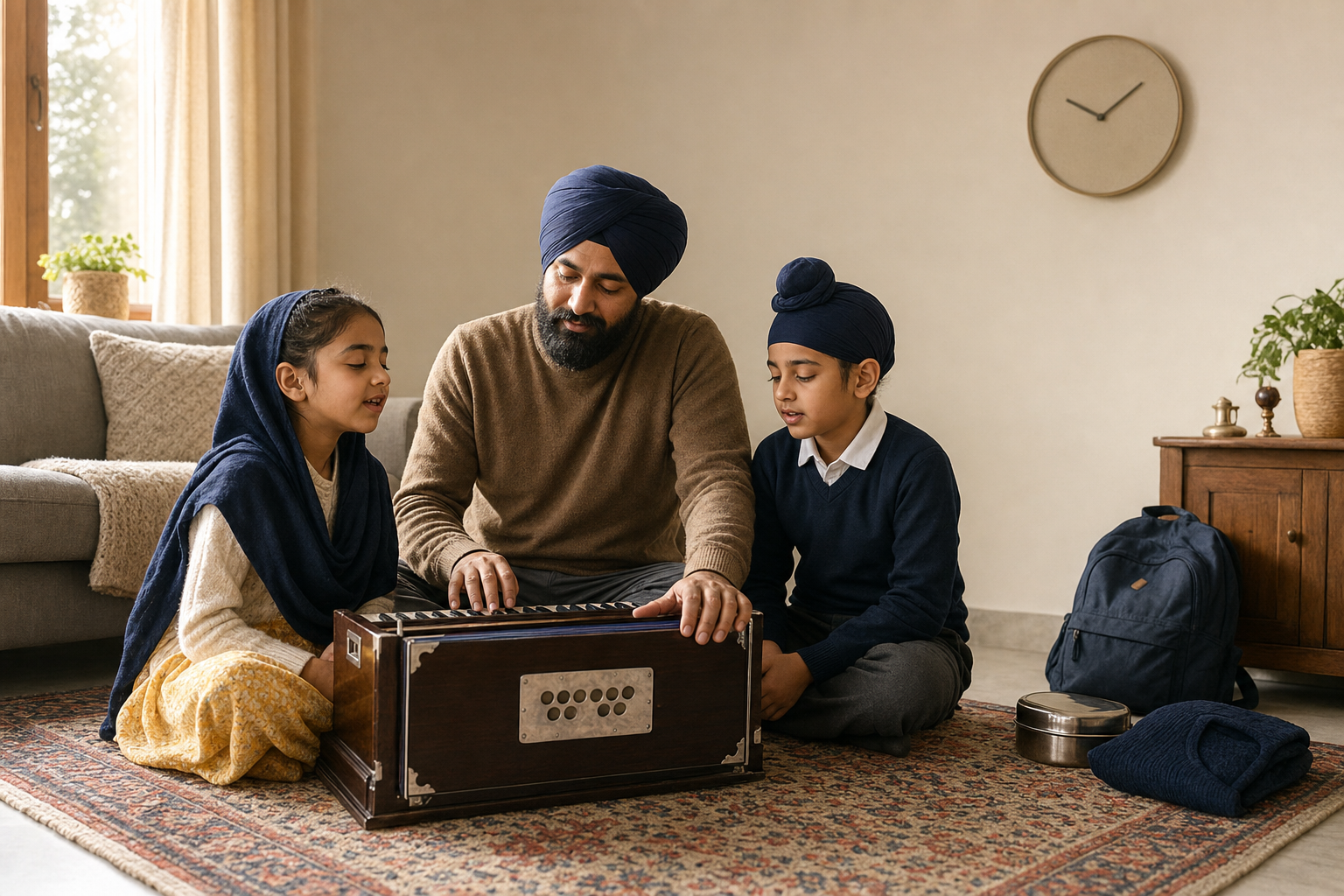
Formation depends less on occasional intensity than on dependable return. Nitnem provides that larger daily architecture. Japji Sahib, Jaap Sahib, Tav-Prasad Savaiye, Chaupai Sahib, Anand Sahib, Rehras Sahib, and Kirtan Sohila place recitation within the changing rhythm of the day, from morning clarity to evening reflection and rest.
If your household already follows an established Nitnem discipline, do not replace it with a simplified educational exercise. Attach explanation and reflection to what is already being practised. If the family is rebuilding a neglected rhythm, begin at a stable point in the day rather than designing an ambitious schedule that collapses under school, work, and travel.
A workable family encounter with a Shabad follows this sequence:
- Arrive before reciting. Stop the competing activity and allow a short transition into attentive listening.
- Hear the words once. Let the learner notice cadence and pronunciation without trying to perform immediately.
- Recite or sing along. Keep the pace slow enough that bani remains intelligible.
- Locate the rahau. Read it separately and identify the thought around which the composition turns.
- Clarify a key word or phrase. Use the language the learner understands best, while keeping the original wording visible.
- Name an action. Decide where humility, truthful living, fearlessness, non-enmity, remembrance, or service will have to appear before the next return.
- Begin the next encounter with reflection. Ask what happened when the instruction met daily life, then listen again.
The sequence matters. If action is omitted, meaning remains theoretical. If meaning is omitted, repetition can become mechanical. If listening is omitted, correction feels like an interruption rather than part of devotion.
Adapt the same structure to the learner rather than abandoning it. A young child can echo a short phrase and connect it to a visible act such as helping with langar. A developing reader can track the words in Gurmukhi while listening. An older child or adult can examine the rahau, historical context, vocabulary, and ethical demand in greater depth. The intellectual load changes; the relationship between hearing and living does not.
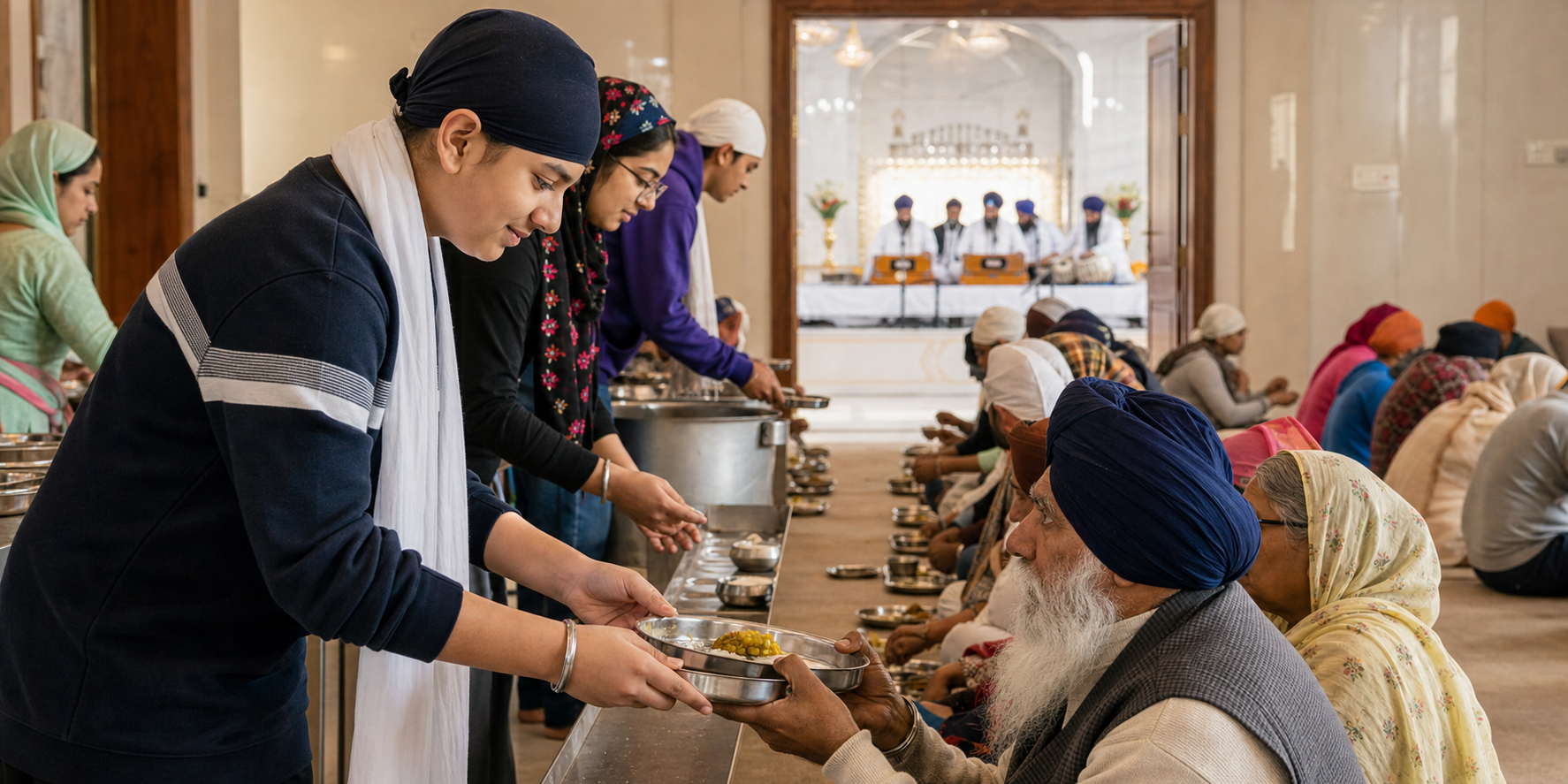
Communal participation gives the home practice somewhere to belong. In Sangat, the learner discovers that their voice does not have to be impressive to be carried by collective singing. In Pangat and seva, they encounter the social form of what they have heard: dignity, equality, humility, and responsibility are practised with other people, not admired from a distance.
Use recordings and digital aids when distance or scheduling makes them useful, but check the integrity of the text and pronunciation. A convenient version that repeatedly obscures bani teaches the wrong lesson with great efficiency. Digital access should extend the relationship with Shabad, not displace careful paath, embodied Sangat, or guidance from people who know the tradition.
Use translation as a bridge and Gurmukhi as a destination
Diaspora families are often handed a false choice: preserve exact sounds that the child does not understand, or use the local language and risk losing the original. You do not need to choose either failure. Comprehension and fidelity can grow together when each tool is given the right job.
Translation answers a meaning question. Transliteration helps a learner approach an unfamiliar script. Neither reproduces the full sound, grammar, or interpretive range of bani. Treating either as a permanent replacement for Gurmukhi leaves the learner dependent on another person’s choices about pronunciation and meaning.
A graduated path works better:
- Begin with accurate listening. The learner first needs a stable sound pattern, not a page crowded with explanations.
- Use transliteration temporarily. Let it support participation while making clear that it is scaffolding, not the final text.
- Introduce Gurmukhi alongside familiar audio. Known phrases help the learner connect visible akhars with sounds already held in memory.
- Place translation beside bani. Read enough meaning to make reflection possible without letting the translation take over the recitation.
- Return to the original after discussion. The learner should hear how increased understanding changes attention to the same words.
Pronunciation deserves patient precision because Punjabi distinguishes sounds that an English spelling may blur. Aspirated and unaspirated consonants, dental and retroflex articulation, vowel timing, and tonal features can affect what a listener hears. Speed and musical ornament make these distinctions harder to recover once they have been hidden.
Correct in an order that protects both accuracy and confidence. First let the learner hear the phrase clearly. Isolate the sound that needs attention. Demonstrate where the tongue or breath changes. Let them repeat the whole phrase rather than drilling an orphaned syllable indefinitely. Then return it to the melody. Correction should make the bani more accessible, not make the learner afraid to open their mouth in Sangat.
A simple test can expose overdependence on transliteration: hide the Romanized line and ask the learner to follow the same phrase in Gurmukhi while the audio plays. If they cannot find their place, keep the transliteration available but move it farther from the centre. If they can track familiar words, begin using those words to teach recurring letters and sound patterns.
Meaning also needs active checking. Asking, Do you understand? usually produces an easy yes. Ask instead: What is the speaker turning away from? What orientation is being cultivated? Which word carries that change? What would it look like at school, at work, or during disagreement? A learner who can answer those questions has moved beyond recognition into vichaar.
Make music answer to meaning, and meaning answer to conduct
The Guru Granth Sahib is not a book of words to which music was attached casually. Its arrangement uses 31 primary raag frameworks, with internal signs such as ghar and rahau helping to govern musical and interpretive attention. Gurmat Sangeet therefore gives the learner more than a collection of attractive tunes. It gives disciplined ways of carrying bani through pitch, rhythm, time, and breath.
Raag provides an emotional and contemplative contour. Taal cycles such as Teentaal, Ektal, and Rupak organize movement and return. The rabab associated with Bhai Mardana belongs to the historical sound world of Sikh devotion, while harmonium, dilruba, and taus have become familiar in later and contemporary practice. Instrument choice matters, but it remains secondary to intelligibility and fidelity.
Before adding ornament or complexity, use a bani-first audit:
- Can a listener hear the words without already knowing them?
- Does the melodic phrase respect the natural length of vowels and the sense of the line?
- Can the learner identify the rahau after hearing the composition?
- Does taal steady the recitation, or force words into rushed and unnatural accents?
- Is the vocal range comfortable enough to preserve breath and pronunciation?
- Does musical elaboration deepen attention to bani, or redirect attention toward the performer?
If a flourish makes the Word harder to hear, remove it. Technical accomplishment has a legitimate place, but virtuosity is not the measure of whether Shabad has been served. The governing question is whether music has made the instruction more available to the listener.
Time can also become part of the pedagogy. Morning practice, including the world of Asa and Asa di Vaar, can accompany emergence, resolve, and clarity. Evening recitation can support reflection and release. This is not merely a scheduling convenience. It teaches the learner that discipline belongs within embodied time: waking, working, serving, examining oneself, and resting.
The body participates as well. Predictable cadence supports memorization. Repeated melodic phrasing helps a learner hear and retain unfamiliar sound patterns. Paced recitation coordinates phrasing with breath, while communal singing makes an individual voice part of a shared rhythm. These effects can support attention and steadiness, but calm is not the final purpose. A person can feel calm and remain unchanged. The purpose is to become receptive to instruction.
That instruction needs a visible destination. After recitation, choose the ethical movement that is actually present in the Shabad rather than attaching a generic moral. If the movement is toward humility, identify a task you usually consider beneath you. If it is toward seva, serve without bargaining for recognition. If it concerns truthful living, name the situation in which convenience tempts you to distort the truth. If it cultivates Nirbhau or Nirvair, examine how fear or hostility is shaping an approaching conversation.
At the next recitation, do not ask only whether the learner liked the tune. Ask what happened when the Shabad met resistance. Was the instruction remembered? Was it attempted? What became difficult? Listening then becomes more exact because conduct has revealed where understanding is still shallow. The movement is reciprocal: Shabad refines conduct, and the struggle to act refines the next act of listening.
Teach Dharmic kinship without pretending every sound is the same
A child growing up among Hindu, Buddhist, Jain, and Sikh communities may quickly notice that all of them use recitation, repetition, and sacred sound. That recognition can nurture respect, but it is only the beginning. Saying that every path chants in order to feel peaceful flattens distinct traditions into a vague wellness practice.
The more useful comparison asks four questions: What is recited? What authority does it carry? What kind of attention does it train? What form of conduct should follow? Those questions reveal real Dharmic resonances without erasing doctrinal and practical differences.
| Dharmic path | Sacred-sound expression | Formative emphasis | Distinction to protect |
|---|---|---|---|
| Sikhism | Shabad, paath, Naam Simran, and kirtan | Receiving the Guru’s instruction through listening, reflection, remembrance, and lived seva | Shabad Guru cannot be reduced to a mantra technique, musical genre, or devotional mood |
| Hindu traditions | Shabda-pramana, Nada Brahman, and mantra-sadhana | Sacred testimony, sound as a dimension of reality, and disciplined repetition within particular lineages | Hindu traditions contain multiple schools and methods; no single sound theory exhausts them |
| Buddhist traditions | Paritta, dharani, and sutra recitation | Stabilizing attention and cultivating protective or compassionate intention | These practices should be understood within Buddhist teaching rather than renamed as Shabad Guru |
| Jainism | Namokar Mantra, samayik, and pratikraman | Universal reverence, equanimity, self-examination, Ahimsa, and vow-oriented conduct | Its recitations carry a distinct Jain ethical and spiritual orientation |
The common ground is substantial. Sacred sound trains perception rather than merely decorating belief. Repetition forms memory. Breath and rhythm gather attention. Recitation places the individual within a lineage and community. Ethical teaching turns interior discipline outward through compassion, Ahimsa, truthful living, service, and restraint.
Yet unity does not require sameness. Jain Anekantavada cautions against treating a single vantage point as the whole. The Hindu recognition of an Ishta allows a chosen form or approach to serve as a genuine bridge to the Absolute. Sikh respect for human dignity and freedom of worship makes room for solidarity without asking Sikhs to dilute the status of the Shabad Guru.
If you teach these traditions together, avoid an activity that merely plays samples and asks which one sounds most relaxing. Ask learners to identify the text, setting, purpose, authority, and ethical consequence of each practice. Respect becomes more durable when it rests on accurate differences rather than sentimental resemblance.
Key takeaways
- Treat Shabad as an encounter with the Guru’s instruction, not as religious ambience.
- Keep suniai, paath, vichaar, and kirtan connected so that listening develops into understanding and conduct.
- Use the rahau line as a practical entry into a composition’s central orientation.
- Let transliteration support participation temporarily, while accurate listening, Gurmukhi literacy, and meaning grow together.
- Judge musical choices by whether they clarify bani, respect pronunciation, and sustain attention.
- Attach each encounter to an ethical action, then revisit that action when the Shabad returns.
- Teach kinship among Dharmic sound traditions through precise comparison, not by declaring their meanings interchangeable.
At your next family recitation, begin with a Shabad the household already recognizes. Read the rahau before singing, clarify a central term in the language your child understands, recite with care, and name the conduct it requires. When you return to it, begin with what happened in life. That recurring movement from hearing to action is how sacred sound becomes an inheritance within the person, not merely around them.
References
