
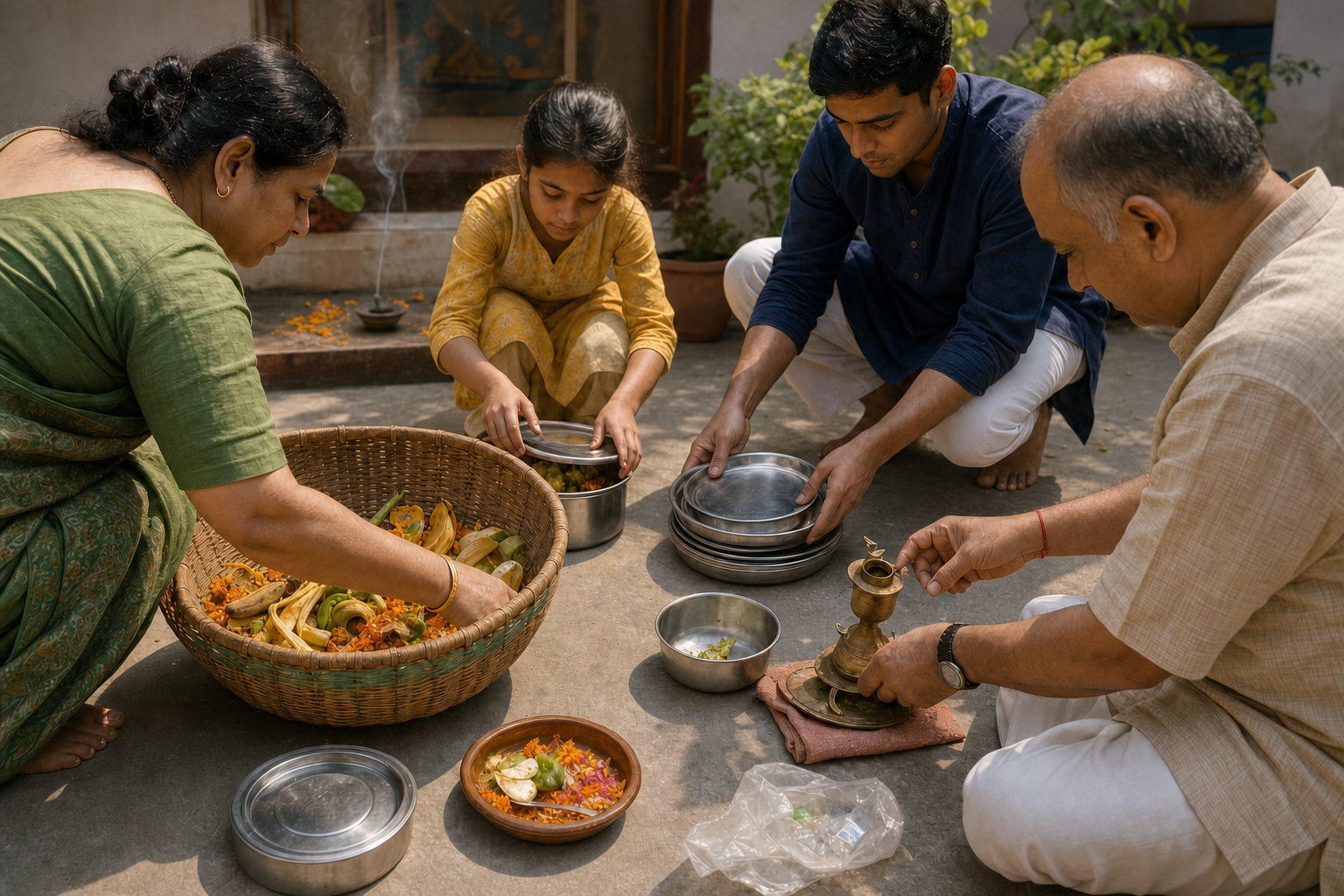
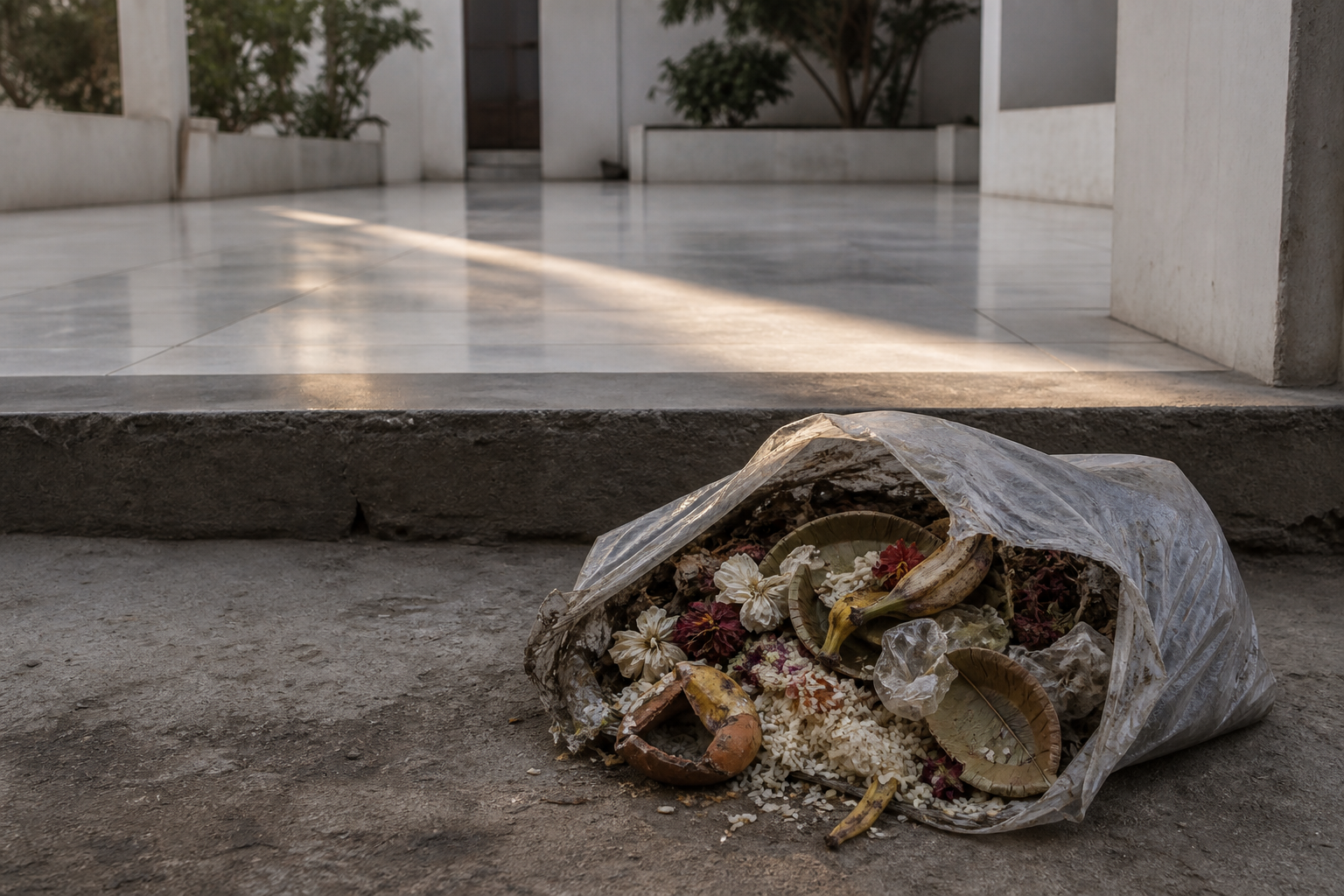
You have finished a pūjā, a family meal, or a temple gathering. The room looks orderly again, but flowers, food, leaf plates, plastic wrappers, and broken objects have all disappeared into one bag. The visible space is clean. The disorder has merely been moved somewhere else.
Dharmic waste ethics asks a more demanding question than “Which bin should this enter?” It asks why the material entered your life, whether its use caused avoidable harm, and which living or technical cycle can receive it next. Once you use that test, cleanliness becomes a discipline of right relationship rather than an exercise in hiding unwanted matter.
Waste appears when a relationship breaks
A fallen leaf on a forest floor is not rubbish. Fungi, small organisms, moisture, and soil transform it into nourishment. Food scraps can become compost or biogas inputs. A durable metal vessel can pass through generations of meals. Matter changes condition and ownership, but it need not lose all value.
The problem begins when we place the wrong material in the wrong place, mix streams that should remain separate, or produce something without arranging a credible next use. A useful Dharmic definition of waste is therefore not “matter we dislike.” Waste is matter whose onward relationship has been obstructed.
This distinction matters because the claim that Prakṛti is intrinsically pure is not permission to dump anything into a river, field, or fire. It places the failure squarely on human conduct. A river has powers of circulation and renewal, but those powers do not absolve the person who introduces contamination faster than a living system can process it. Nature’s resilience is a responsibility, not a disposal service.
The pañca-mahābhūtas—pṛthvī, jala, agni, vāyu, and ākāśa—offer a practical grammar for noticing where the consequences travel. An unwanted object does not vanish when it leaves your hand. It enters soil, water, fire, air, or the wider space occupied by other beings. The five elements are not a substitute for chemistry or ecological measurement. Their ethical value is that they make “away” impossible.
The Bhagavad Gītā 3.14 describes a chain in which beings depend on food, food on rain, rain on yajña, and yajña on rightly ordered action. You need not force this passage into the language of modern environmental science to use its central insight. Receiving creates an obligation to sustain the conditions from which you received. Yajña, understood as disciplined reciprocity, is the opposite of a one-way economy that extracts, consumes, and abandons.
Before discarding anything, follow the relationship through:
- Could the item, packaging, or excess quantity have been avoided before purchase?
- Can it remain useful through refilling, sharing, repair, or a new owner?
- If it is biological material, is there an actual composting, digestion, or soil-return route that can receive it without contamination?
- If it is a manufactured material, does a recycler, repairer, producer, or collection system genuinely accept it?
- If no safe onward path exists, what should you stop purchasing or redesign the next time?
That last question is the most important. A residual bag should not be treated as the end of the process. It is a record of design failures upstream.
Use four Dharmic virtues as a decision order
Dharmic values become useful when they change the order in which you decide. Begin with prevention, then preserve usefulness, then separate materials for a real recovery route. Disposal comes last. The familiar waste hierarchy—prevent, reduce, reuse, repair, remanufacture, recycle, recover, and only then discard—gives this ethical order a practical form.
Śauca: preserve the integrity of each flow
Śauca is more than a polished floor or a bag removed from sight. In waste practice, it means keeping food residues, reusable goods, dry recyclable materials, hazardous items, and true residual waste from contaminating one another. Mixing first and hoping to sort later turns recoverable material into a sanitation burden.
Put separation where the material first changes status. If food is scraped in the kitchen, keep the organics container there. If worship materials are removed beside the altar, provide a suitable container there rather than expecting someone to untangle flowers, foil, thread, food, and plastic later. The correct container at the point of use is more effective than a distant sign asking people to behave perfectly.
Śauca must not be distorted into a social ranking of the people who handle discarded materials. Moving a mixed, leaking bag out of your own view while exposing another person to it reverses the principle. Clean conduct protects the material flow, the surrounding ecosystem, and every human being who must handle what remains.
Aparigraha: stop waste before ownership begins
Aparigraha challenges the assumption that every convenience, festival, or expression of hospitality requires more objects. The strongest waste decision is often made before anything enters the house or temple.
At the point of purchase, ask whether you already own something that performs the same function, whether the item can be borrowed or shared, whether it is refillable or repairable, and whether an onward route exists after use. “Recyclable” printed on packaging is not an answer unless a collection and processing system available to you accepts it. A theoretical loop does not prevent a real pile of rubbish.
Aparigraha also corrects a common mistake in minimalism: clearing your shelves is not restraint if usable belongings are simply thrown away. First stop unnecessary inflow. Then repair, share, or transfer what still has value. The goal is not an empty-looking room but a lighter material claim on the world.
Ahimsa: count harm beyond your field of vision
Ahimsa widens the boundary of a decision. A disposable item may be convenient for the user while transferring pollution, dangerous handling, habitat loss, or an unusable residue to someone else. The fact that the harm occurs after collection does not remove it from the moral account.
This is why open burning of mixed waste is not a Dharmic use of agni. It moves the problem into air and ash while destroying materials that might have remained in circulation. Energy recovery can be a constrained fallback for appropriate residues within a controlled system, but it should never become an excuse to keep producing avoidable material.
Ahimsa also requires honesty about alternatives. A leaf plate can participate in a biological cycle when it is uncontaminated and reaches a suitable processing route. A reusable metal plate can remain in service for years when washing and return systems function. Neither option is virtuous merely because it carries a traditional or environmental label. Follow the object through its actual use and end route.
Dāna and sarbat da bhala: pass value, not burdens
Dāna can keep food, clothing, books, vessels, and tools in beneficial use, but donation must not become respectable-looking disposal. Give something because another person or institution wants it and can use it, not because you want relief from storing it.
In a kitchen, this means planning surplus sharing before food becomes unusable. Annadānam can join waste prevention with social care when quantities, timing, handling, and recipients are arranged in advance. Once food is no longer suitable to share, calling its transfer dāna does not make it safe or respectful.
The Sikh aspiration of sarbat da bhala—the welfare of all—tests whether a clean-up method improves the whole system or only the most visible part of it. “Pavan Guru, Pani Pita, Mata Dharat Mahat” places air, water, and Earth within a relationship of reverence. A solution that protects your courtyard by burdening another neighbourhood, river, or worker fails that wider test.
Buddhist dependent origination and Jain anekāntavāda sharpen the same discipline. Outcomes arise through connected conditions, and no single viewpoint reveals every consequence. When a proposed substitute looks obviously “green,” examine its production, repeated use, cleaning, transport, and end route before declaring victory. Humility here is practical: it helps you notice when a solution has only shifted the harm.
Reset household waste where it first enters

You do not need to reorganize your entire life in one burst. Start with the materials that repeatedly enter your residual bag, because those items reveal where purchasing and separation are failing. Keep the exercise tied to your real collection system rather than copying a sorting chart from somewhere else.
- Observe one normal collection cycle. Notice what you buy, what becomes surplus, what is mixed together, and which items have no known onward route. Do not change the record to make it look virtuous; you need an honest baseline.
- Confirm the outlets before creating the labels. Find out which dry materials your local collector accepts, where special items must go, whether organics can be composted or digested, and which reusable goods have a willing recipient.
- Create separate landing places. Keep unavoidable organics apart; keep accepted dry recyclables clean enough for the available system; set aside repairable or shareable objects; isolate materials requiring special handling; and leave only the genuinely unhandled remainder as residual waste.
- Move prevention to the shopping decision. Carry reusable vessels where they are practical, prefer refills when a reliable refill system exists, decline packaging you do not need, and avoid products whose end route you cannot identify.
- Review the residual stream before the next purchase. Look for recurring wrappers, broken low-quality objects, unused food, or so-called compostable items with no composting route. Choose one recurring failure and redesign how that item enters your household.
Food deserves early attention because it can move through several better relationships before becoming a residual problem. Plan meals around what is already present. Use edible parts fully. Share safe surplus while it is still useful. Send unavoidable organic residues to a well-managed composting or biogas route where one is genuinely available. Biogas can produce energy and nutrient-bearing slurry, but only a maintained system with a use for its outputs completes the loop.
Repair deserves its own place, not a vague promise. Keep items awaiting repair together and attach the next action: the person to call, the replacement part to obtain, or the date of the next repair opportunity. An indefinite repair pile is hoarding with a hopeful name. If an item cannot be repaired locally, let that fact guide the next purchase toward durability and repairability.
Water requires the same honesty. Washing residue down a drain does not make it disappear. Rainwater harvesting, carefully designed greywater reuse, constructed wetlands, and maintained tanks can restore useful hydrological relationships, but plumbing and treatment must match the intended use. Do not improvise a reuse system that exposes people, soil, or water bodies to contamination. At household scale, prevention begins by keeping oils, chemicals, solids, and mixed rubbish out of drainage in the first place.
You can also use the guṇas as a diagnosis of behaviour rather than as labels for people. Rajas appears in the hurried purchase made for novelty, display, or convenience. Tamas appears when the unwanted result is ignored, mixed, or pushed out of sight. Sattva appears in the pause that asks what is needed, how long it will serve, and where it will go next. The pause is small, but it sits at the point where most waste is still preventable.
Make temples and community kitchens model the ethic
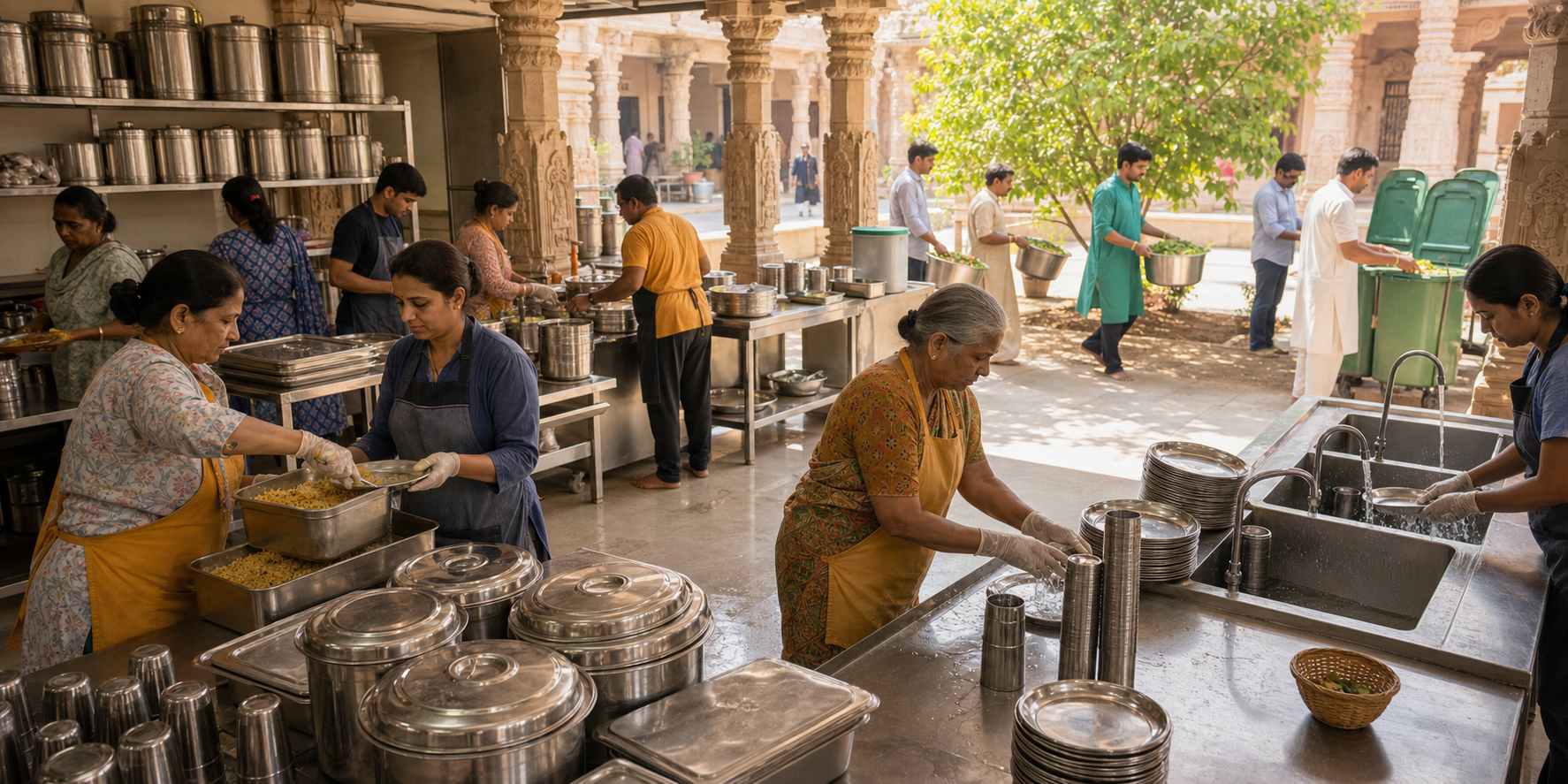
A temple, gurudwara, monastery, Jain institution, or community kitchen teaches through material practice as surely as through words. If sacredness is proclaimed inside while mixed refuse, wasted food, or contaminated water accumulates outside, the institution communicates a divided Dharma. The answer is not less hospitality or less celebration. It is better preparation for the flows those activities create.
Before an event, map each recurring material from entry to exit. The map can be simple:
| Decision point | Question to settle | Evidence that the route is real |
|---|---|---|
| Avoid | Can the service or ritual proceed without this item? | The unnecessary purchase is removed |
| Keep in use | Can it be refilled, washed, shared, or repaired? | A person and process are responsible for its return |
| Biological cycle | Can uncontaminated organic material be accepted? | A composting, digestion, or soil-return outlet is confirmed |
| Technical cycle | Will a recycler, repairer, or producer actually take it? | Acceptance requirements and collection are confirmed |
| Residual | Why does no safe loop exist? | The next procurement decision is changed |
Assign responsibility before people arrive. Reusable vessels need an inventory, a return point, washing capacity, and someone accountable for keeping the cycle intact. Organics need containers positioned where plates are cleared. Recyclables need examples showing what the actual collector accepts. Vendor packaging needs a take-back agreement or an identified local route. Without an owner for each flow, even well-intended signs become decoration.
During food service, use portioning that allows a person to return for more rather than loading every plate with an assumed quantity. Keep untouched surplus separate from plate scrapings. Arrange annadānam or another accepted sharing route while the food remains suitable. Once different food streams are mixed, fewer safe options remain.
Offerings require the same discernment. Organic flowers and leaves may have a biological route, while thread, foil, plastic, synthetic decoration, and other additions may not belong there. Devotional intent does not change the material properties of an object. Separate the components instead of placing the entire mixture into water or soil under a sacred label.
Temple tanks and community water bodies deserve especially careful stewardship. Rainwater capture, separate drainage, source-control of contamination, constructed wetlands, and responsible maintenance can support both ecology and cultural continuity. A neglected tank should not be treated as a convenient receiver for ritual residues. Its sacred status strengthens the duty to protect the water cycle.
After an event, record what was purchased, kept in circulation, shared, composted, recycled, and left as residual waste. The purpose is not to advertise a perfect “zero waste” performance. It is to find leakage. If the same cup, wrapper, decoration, or food category repeatedly becomes residual waste, procurement must change before the next gathering.
Larger institutions can make this discipline more rigorous. Material Flow Analysis tracks what enters, where it moves, and where value leaks out. Life Cycle Assessment helps compare options across their wider effects instead of judging only the disposal stage. Water-quality and biodiversity indicators test whether restoration is producing the intended result. Measurement does not replace Dharma; it keeps good intentions answerable to consequences.
Community action can then move beyond managing bins. Repair gatherings, seed libraries, decentralized composting, responsible biogas systems, rainwater harvesting, sacred-grove protection, agroforestry, and soil regeneration all rebuild relationships that a linear economy breaks. The strongest initiatives connect a clear ethical purpose to an accountable operator, a maintained process, and a useful destination for every output.
Public policy can reinforce the same order. Extended Producer Responsibility makes more sense when producers are rewarded for prevention, durable design, repairability, collection, and high-quality material recovery—not merely for financing a clean-up after difficult products have already been sold. Deposit-return systems, recycled-content requirements, transparent material reporting, and charges tied to residual disposal can create feedback where ordinary markets otherwise hide the cost.
Key takeaways
- Cleanliness is not displacement. If a mixed bag leaves your sight but burdens another person or ecosystem, śauca has not been achieved.
- Prevention comes before segregation. Use aparigraha at the purchasing stage, while unnecessary material can still be refused.
- A label is not a recovery route. “Recyclable” or “compostable” matters only when an available system accepts and processes the item.
- Keep biological and technical cycles distinct. Organics, durable reusables, accepted recyclables, special-handling materials, and residual waste need different destinations.
- Dāna passes usable value. Donation and food sharing require a willing recipient, suitable condition, and timely coordination.
- Measure the remainder. Repeated items in the residual stream tell a household, temple, business, or municipality what to stop buying or redesign.
Your next Dharmic environmental act need not be dramatic. Open the residual bag before it leaves. Choose the recurring item that should not be there. Then change the purchase, service arrangement, repair plan, or collection route that put it there.
At the next pūjā, meal, or community gathering, decide where each material will go before bringing it in. That reversal—from cleaning up afterward to preserving right relationships beforehand—is where waste management becomes waste ethics, and where ecological responsibility becomes lived Dharma.
References
