
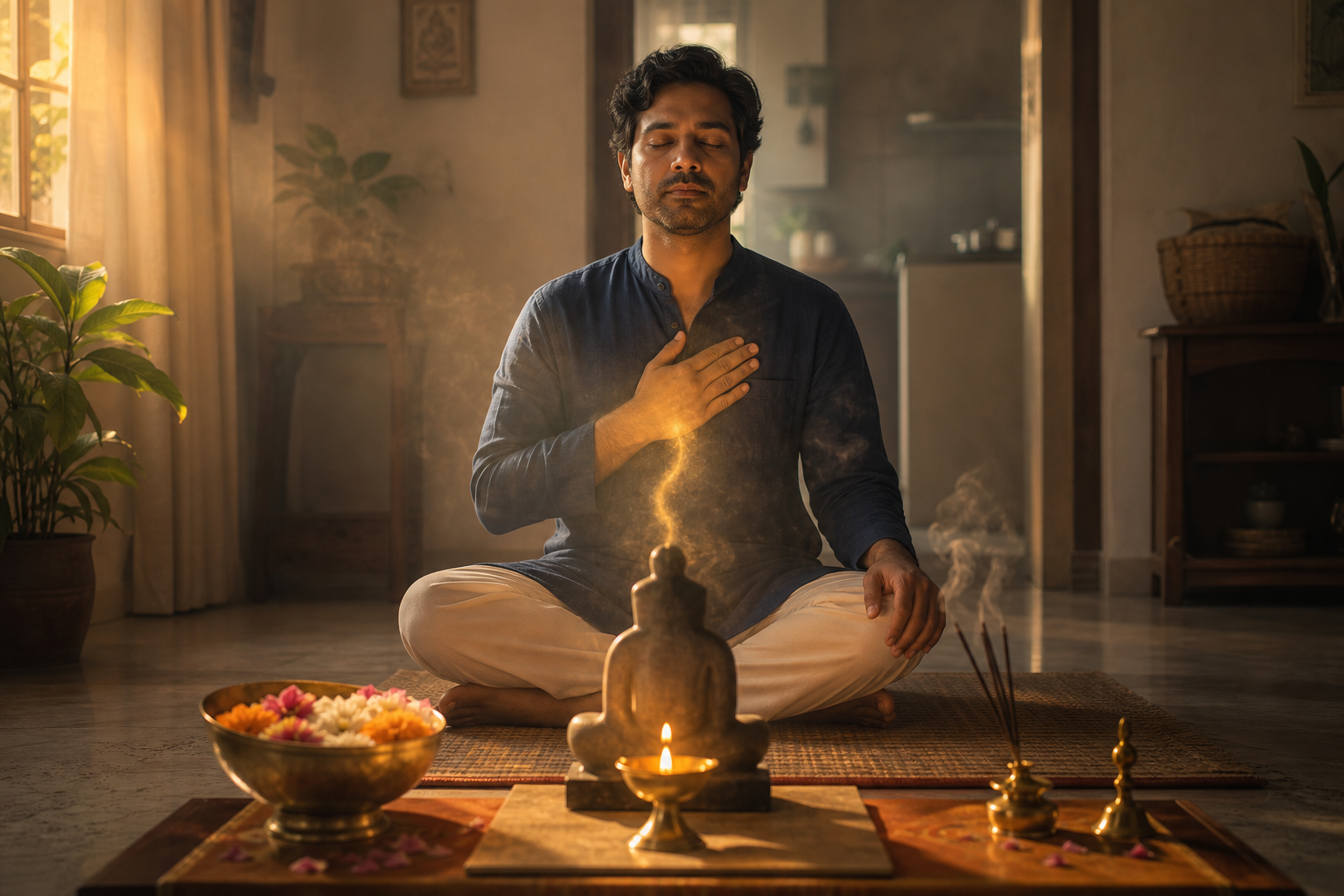
You can light the lamp, complete your mantra, and leave the altar with a quiet mind, only to lose that quiet in the next difficult conversation. That gap does not mean your puja has failed. It means the movement begun before the deity has not yet reached your reactions, motives, speech, and work.
Inner worship closes that gap. It does not require you to abandon the murti, mantra, temple, or inherited ritual. It asks you to discover what each outer act is meant to awaken within you, then carry that awakened attention into the part of the day where you usually forget the Divine.
The altar moves inward when the offering becomes personal

The difference between outer and inner worship is not a contest between false ritual and true spirituality. Outer worship gathers the senses around sacred sound, form, gesture, and time. It gives distracted attention a place to stand. Inner worship takes the next step: the offering becomes your desire, fear, pride, anger, inertia, possessiveness, and claim over the results of action. This is the movement from bahir-yajna to antar-yajna, from an external sacrifice to the consecration of the inner instrument itself.
This distinction matters because divine consciousness is not the same thing as whatever happens to be passing through your mind. A thought can be petty, fearful, or confused. Awareness is what allows you to see that movement without immediately becoming its servant. Inner worship begins when the movement is seen clearly and placed before the Divine instead of being defended as your identity.
In a Shaiva-Shakta contemplative language, Shiva signifies luminous consciousness and Shakti its self-aware power of manifestation. Their union offers a precise correction to two common mistakes. Stillness without energy becomes withdrawal, while energy without awareness becomes compulsion. Inner worship joins them: you remain aware, but that awareness must also become truthful speech, disciplined action, compassion, creativity, and service.
You can give every familiar element of puja an inner counterpart:
- The lamp becomes the will to see clearly, especially what the ego would prefer to hide.
- Mantra becomes disciplined remembrance and the purification of speech, not merely repetition completed at the altar.
- The murti or ishta becomes a living center of relationship, preventing contemplation from collapsing into vague self-absorption.
- The physical offering becomes the surrender of attachment, including attachment to recognition, control, and reward.
- Arati becomes the recognition that every capacity by which you worship already belongs to the Divine.
- The gesture of surrender becomes freedom from the claim that you alone are the doer.
If you contemplate Nataraja, the five divine acts offer another practical lens. Notice a thought arise as creation, continue as maintenance, and disappear as dissolution. Notice concealment when you mistake that temporary movement for your whole self. Notice grace when identification relaxes and clear awareness returns. The pancha-kritya of creation, preservation, dissolution, concealment, and grace can then be observed within an ordinary minute of consciousness, not only admired in sacred iconography.
Build one complete arc from puja to action
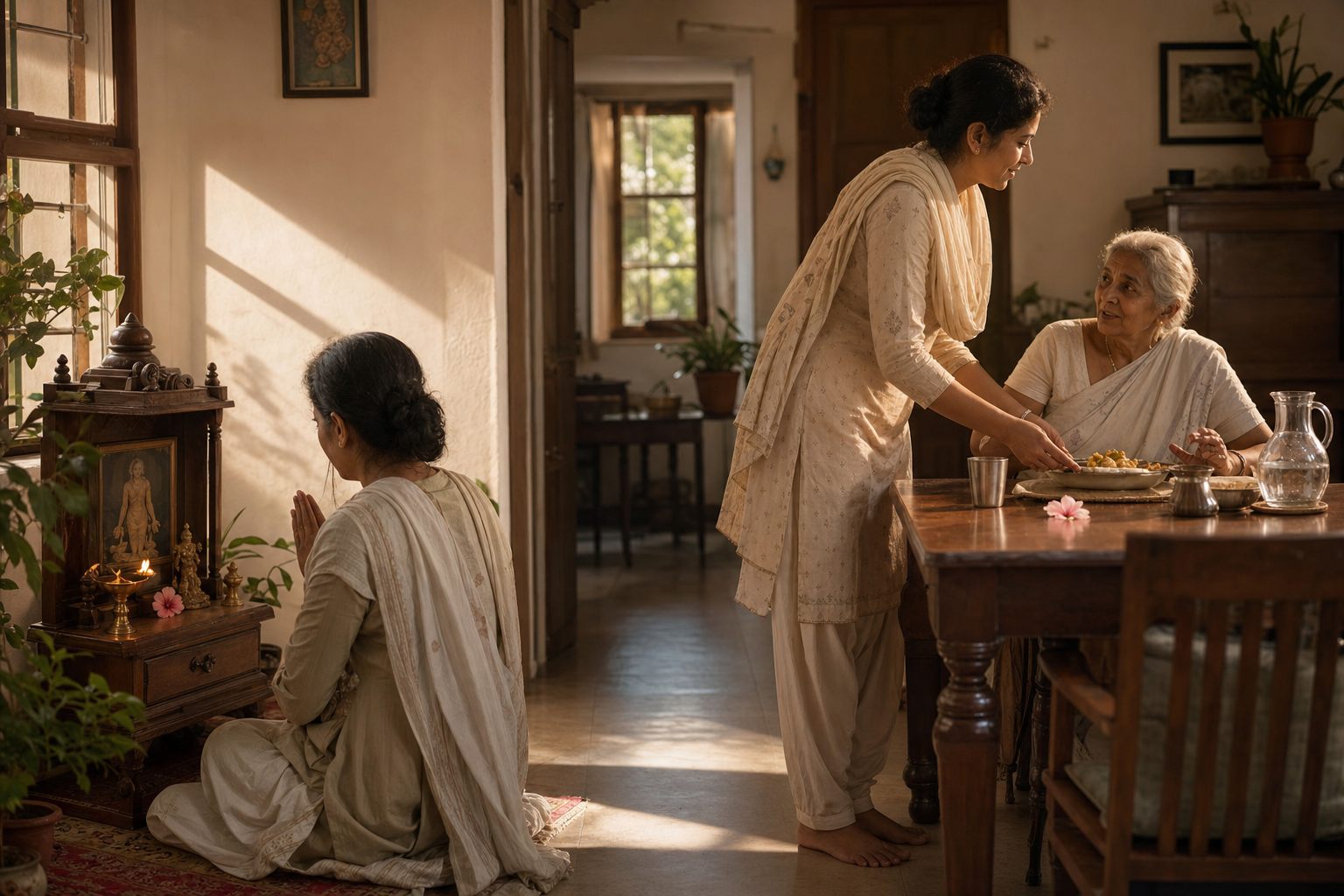
A useful daily practice should move through form, breath, sound, silence, and action. If it stops at a pleasant meditative state, it remains incomplete. Use the following sequence with the mantra, deity, and ritual discipline proper to your lineage.
- Establish a sankalpa. Before beginning, decide what the worship is for. A workable intention is to offer the day’s speech, reactions, work, and results to the Divine.
- Perform your familiar outer act attentively. Light the lamp, bow, make an offering, or sit in reverent silence. Do not add complexity merely to make the practice feel more serious. Use the form you can inhabit sincerely.
- Let the breath settle. If you have received a pranayama discipline, follow it as taught. Otherwise, breathe naturally and notice the movement of prana without forcing retention or trying to manufacture an unusual state.
- Repeat one mantra or Divine Name. Listen inwardly to each repetition. When attention wanders, return without irritation. The point is not speed or quantity here, but the gathering of speech, hearing, and attention into one movement.
- Let the words subside. Rest as the witness in the heart. Thoughts and sensations may continue, but you do not need to chase, suppress, or explain them. Allow each one to appear within awareness.
- Name one real offering for the day. Choose something specific: the need to win an argument, resentment toward a person, fear of a duty, craving for praise, or resistance to necessary work. General intentions rarely reach the place where habit is strongest.
- Consecrate the next action. Identify the duty immediately in front of you and do it without bargaining for a preferred result. This carries worship out of the sacred space before distraction has time to reclaim the mind.
This sequence brings Bhakti, Karma, Jnana, and Raja Yoga into one practice. Mantra and the ishta turn the heart toward the Divine. Witnessing separates awareness from automatic mental movement. Breath and attention reduce dispersion. Consecrated work prevents contemplation from becoming an escape from responsibility. The result is a living yajna in which knowledge, devotion, will, and action converge.
Carry the same arc into days when a full puja is not possible. Pause reverently, let the breath become unforced, repeat your mantra, offer the movement occupying the mind, and consecrate the next duty. The outer form may become shorter, but its essential functions should remain. Otherwise, reducing ritual can quietly become reducing remembrance.
Keep one more connection intact: let japa govern your later speech. If mantra is followed by gossip, needless cruelty, or habitual dishonesty, sound has not yet become vak-yajna. Before an important conversation, remember the mantra once and ask whether the words you are about to use belong on the same altar.
Use the inner fire when a reaction is already burning

Inner worship is easiest in silence and most necessary in conflict. Anger, jealousy, fear, and craving arrive with their own momentum. By the time you begin explaining them, the ego has often turned explanation into justification. The practical task is to meet the energy before it becomes speech or action.
Offering anger does not mean pretending that you are not angry. Suppression hides the movement, while indulgence hands it control. Antar-yajna does something more demanding: it exposes the energy, releases the ego’s claim over it, and redirects it toward a dharmic response.
- Pause the outward reaction. Do not send the message, deliver the accusation, or make the decision while the first surge is governing attention.
- Notice the raw movement before its story. Feel the agitation in the body, the change in breath, and the mind’s rush to build a case.
- Identify what the ego is protecting. It may be an image of being right, important, secure, admired, or beyond criticism.
- Place that claim in the inner Agni. You can inwardly offer the energy to the Divine and ask that it serve truth rather than self-protection.
- Use buddhi to select the response. Speak truthfully without needless injury, delay the conversation if clarity is absent, repair what you did wrong, or perform the duty you were trying to avoid.
- Release ownership of the result. Another person may still disagree, and a correct action may still be uncomfortable. Yajna is not a method for forcing the world to confirm your virtue.
Suppose someone criticizes you. One part of the criticism may be accurate while another part may be unfair. Inner worship does not require passive agreement with the unfair part. It asks you to separate the useful fact from wounded pride, acknowledge what is true, answer what is false without malice, and refuse to rehearse the insult for the rest of the day. In that moment, awareness has altered speech, discernment, and action. The worship has become real.
Use the five sheaths as a diagnostic, not a scoreboard
The pancha-kosha map can help you see where a reaction is being sustained. It is more useful as a practical diagnostic than as a ladder on which to declare yourself spiritually advanced.
- At the annamaya level, steady the body. Unclench what is needlessly tense, sit or stand with dignity, and stop feeding agitation through restless movement.
- At the pranamaya level, allow the breath and vital energy to become less erratic. Do not confuse intensity with spiritual power.
- At the manomaya level, notice the repeated story, imagined conversation, or emotionally charged label.
- At the vijnanamaya level, discriminate between fact, interpretation, egoic demand, and dharmic duty.
- At the anandamaya level, rest without trying to seize peace as an achievement. Ease deepens when the demand to possess an experience is also offered.
Working through these layers turns chitta-shuddhi into something observable. Body, energy, thought, discernment, and deeper repose begin to cooperate rather than pulling in different directions. You do not have to wait for a dramatic mystical event to know where the next act of purification belongs.
Measure transformation, not spiritual spectacle

Divine consciousness is not a permanently pleasant mood. Nor is every powerful sensation evidence of realization. Some yogic maps describe kundalini-Shakti rising through sushumna, the harmonizing of ida and pingala, devotional tenderness at anahata, and unitary awareness at sahasrara. These are lineage-shaped ways of interpreting subtle experience, not a scoreboard you need to force your life to match.
Look first for changes that survive beyond the period of worship:
- Your attention returns more readily after distraction.
- You recover from reactivity sooner and cause less damage before recovering.
- Your motives become easier to admit, even when they are unflattering.
- Forgiveness becomes less dependent on receiving a perfect apology, without requiring you to deny harm or abandon appropriate boundaries.
- You experience a quieter well-being that depends less completely on favorable circumstances.
- Ahimsa, truthfulness, non-covetousness, purity, and contentment feel less like external restrictions and more like the natural shape of a clarified mind.
- Your work becomes more useful to others because less energy is spent protecting an image of yourself.
These signs are more reliable than visions, bodily intensity, emotional sweetness, or the ability to speak fluently about non-duality. Rasa, wonder, tenderness, and tranquility can nourish practice, but the test comes when consciousness meets inconvenience.
Watch for the forms of ego that imitate inwardness
- I no longer need ritual. If lamp, mantra, temple, or murti still makes your attention steadier and your devotion more sincere, abandoning it may leave you with an abstract idea of inwardness. Let scaffolding become lighter only as remembrance becomes stable.
- Everything arising in me is divine. A non-dual vision of reality does not make every impulse wise or every desire dharmic. Manifestation must still be met with viveka.
- I felt bliss, so the work is complete. A state may pass without altering character. See what remains in your speech, conduct, and response to frustration.
- I made an offering, so I should receive the result. This turns yajna into a transaction and preserves the central claim of ego. Offer the demand for repayment as well.
- Inner worship excuses withdrawal from duty. Genuine consecration returns you to work, relationship, and lokasangraha with clearer motives. Avoidance decorated with spiritual language is still avoidance.
Inner worship also appears across Dharmic traditions without making their doctrines interchangeable. Buddhist bhavana and vipassana cultivate direct observation of mind. Jain samayik and pratikraman center equanimity and ethical purification. Sikh simran and Naam Japna gather consciousness around the Divine Name. These practices express a shared civilizational turn from mechanical performance toward transformed consciousness, while retaining different understandings of self, liberation, devotion, and ultimate reality.
If you are rooted in one tradition, practice its discipline accurately rather than constructing a mixture from attractive fragments. Unity in diversity becomes meaningful when it produces mutual reverence, not when it erases the distinctions that make each path intelligible.
Key takeaways
- Keep outer worship when it gathers your attention, but identify the inner movement each ritual act is training.
- Make the offering personal and specific: a fear, attachment, resentment, egoic claim, or resistance that is actually active today.
- Complete the movement from puja to breath, mantra, witnessing, and consecrated action.
- During conflict, offer the ego’s demand before choosing a truthful and non-harming response.
- Judge progress by attention, recovery from reactivity, transparent motives, ethical conduct, forgiveness, and useful work rather than by unusual experiences.
- Respect parallel inward disciplines across Hindu, Buddhist, Jain, and Sikh traditions without claiming that their doctrines are identical.
At your next worship, choose one movement you normally hide or defend and place it consciously before the Divine. Then carry that offering into the first difficult duty of the day. The inner altar becomes steady through this repeated passage from sacred form to clear awareness and from awareness to dharmic action.
References
- DharmaRenaissance Blog — Shiva–Shakti Raasa Leela: Unveiling the Cosmic Dance of Love, Consciousness, and Creation
- DharmaRenaissance Blog — Sri Aurobindo’s Inner Yajna: How Heart-Centered Worship Outshines Outer Rituals
