
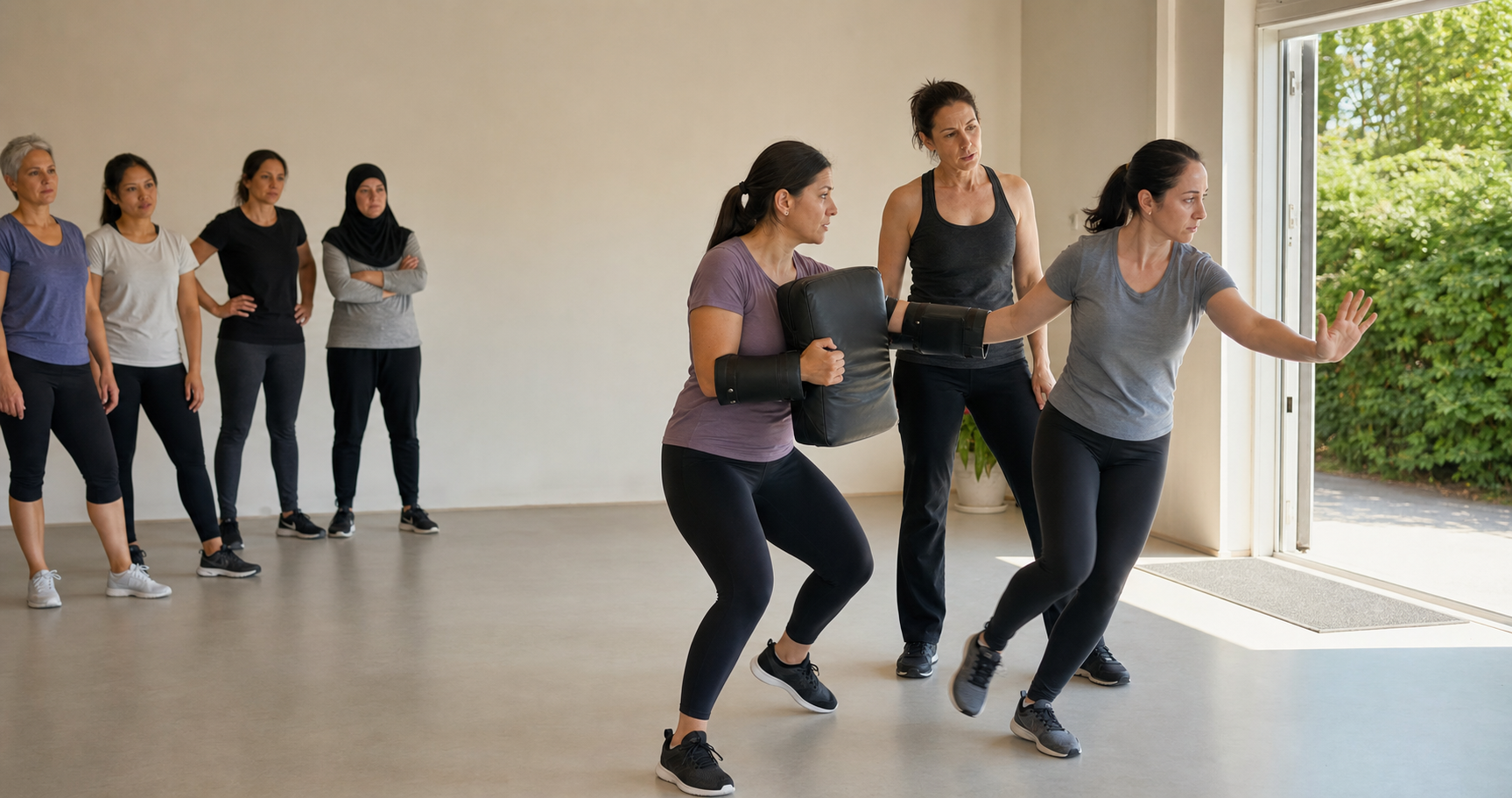
If you’re looking at a women’s self-defence class, the difficult part is not finding one. It is deciding whether the class will make you safer or merely make you feel forceful for an afternoon.
A sound course gives you a sequence you can recall under pressure: notice trouble early, move towards safety, set a clear boundary, summon help, use only the action needed to break contact when escape is otherwise impossible, and stop as soon as the immediate danger ends. Physical technique matters, but it sits inside that larger system.
The lawful aim is escape, not victory
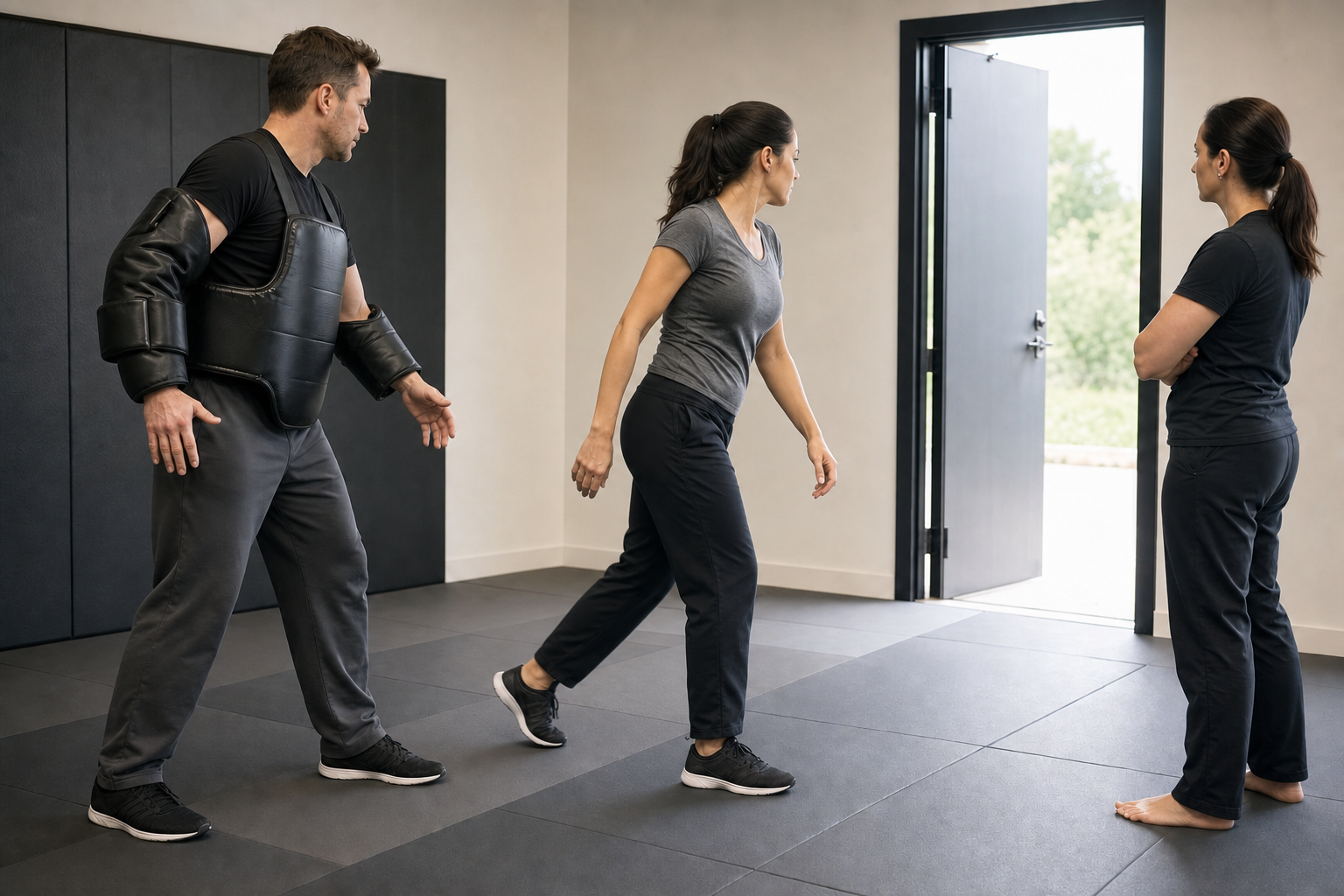
Self-defence is not a licence to punish someone who frightened, insulted, followed, touched, or attacked you. Its purpose is to protect life and dignity against an immediate threat. The practical questions are necessity, imminence, and proportionality: Is the danger happening or about to happen? Is defensive action needed to stop it? Does your response end when the danger ends?
This changes how you train. You are not preparing to win a contest, dominate an attacker, recover your pride, or chase someone who has withdrawn. You are preparing to create an opening and leave. A technique that keeps you entangled with an aggressor after an exit becomes available may be impressive in a demonstration but poorly suited to personal safety.
A useful decision sequence is:
- Notice: Observe the normal pattern of a place and anything that departs from it, without turning ordinary travel into constant fear.
- Reposition: Move towards visibility, other people, staff, security, an open business, or a usable exit.
- Set a boundary: Use short commands such as Stop, Stay back, or I don’t know you. Do not bury the boundary inside apologies or a long explanation.
- Delegate: Point to a specific person and tell that person what is needed, such as calling security or calling 112.
- Break contact: If an immediate threat makes physical action unavoidable, do only what is needed to create an escape opportunity.
- Withdraw: Leave rather than pursuing, retaliating, arguing, filming a confrontation at close range, or returning for possessions while danger remains.
This sequence is a memory aid, not a rigid legal test. Real incidents can move too quickly for every stage. If danger is immediate, you may have no safe opportunity to speak or summon help before acting. Conversely, annoyance, suspicion, or offensive speech alone does not automatically justify force. The exact legal assessment depends on the facts and belongs with qualified legal counsel.
Do not judge a legal module by how many section numbers you can repeat. The Mumbai programme used IPC Sections 96-106 to explain private defence in accessible terms, but a number remembered from a workshop is not personal legal advice and may not identify the statute or interpretation currently applicable to your circumstances. Ask the instructor to name the presently governing provisions, the jurisdiction covered, and when the legal material was last reviewed. Consult a qualified Indian lawyer when an actual incident creates legal exposure.
The same caution applies to pepper spray and other safety tools. A tool is not a substitute for awareness, distance, or escape. Before carrying anything, verify whether possession and use are lawful where you live and in places you regularly enter. Training should address access, wind direction, effective distance, accidental exposure, and immediate disengagement. Any instructor who presents a tool as permission to remain in a confrontation is teaching the wrong objective.
Inspect the class before trusting the techniques
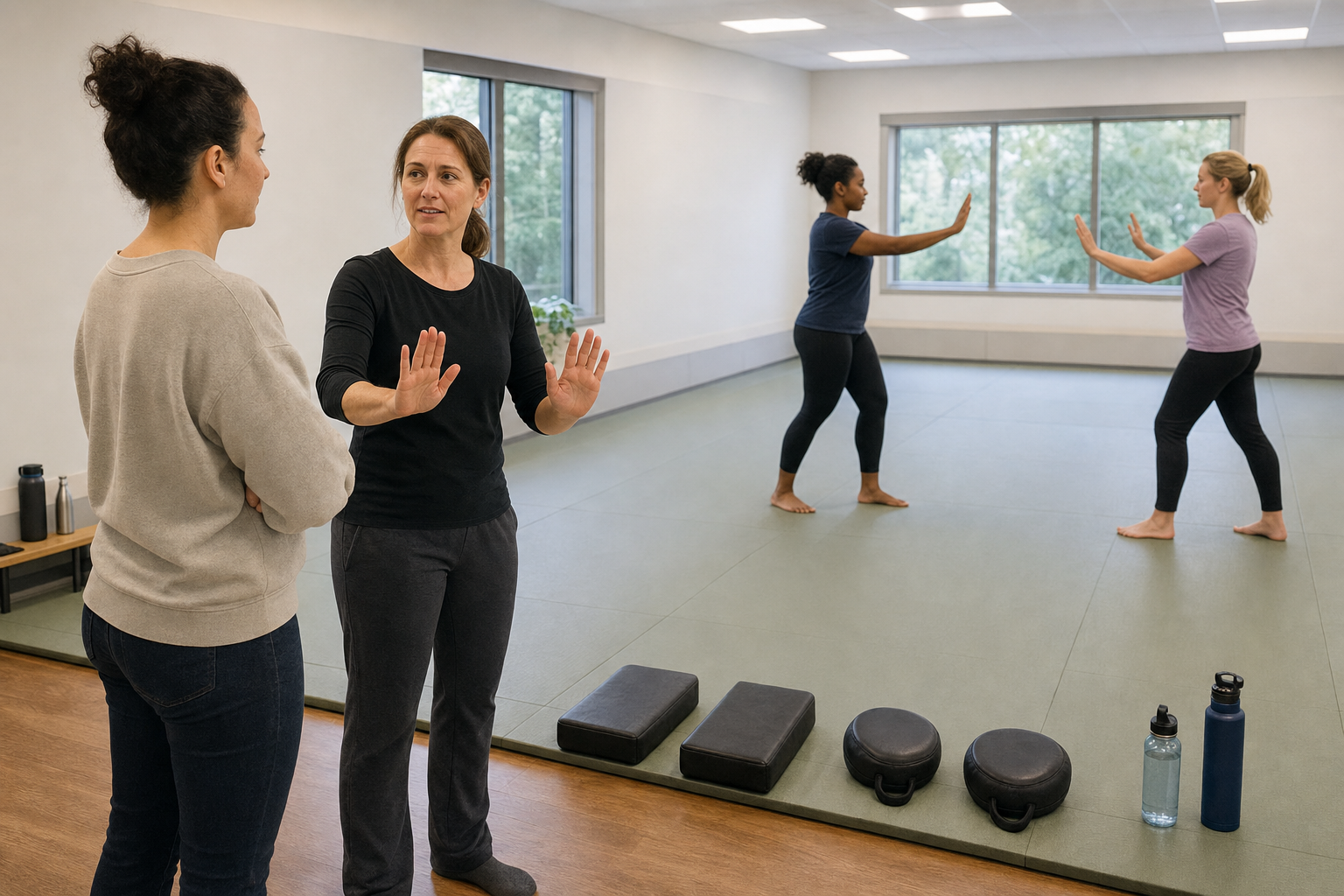
A beginner should not need athletic strength or an elaborate sequence of memorised movements. Under stress, fine details become harder to retrieve. A responsible curriculum therefore begins with posture, balance, movement, voice, and simple responses that can be adapted to different bodies.
Look for a class that includes:
- Awareness without hypervigilance. You should learn to notice exits, bottlenecks, unusual behaviour, and changes in distance while remaining calm enough to make decisions.
- Verbal boundary practice. Participants should say commands aloud, with a firm voice and clear body language, rather than merely discussing assertiveness.
- Protective positioning. A non-provocative fence uses open hands and balanced posture to preserve personal space while leaving you ready to move away.
- Simple escape-oriented movement. Training may cover common grips, hair grabs, attempts to pin, and returning safely from the ground to standing. Every drill should lead towards disengagement.
- Controlled stress. Scenarios should require you to observe, orient, decide, and act instead of performing a known sequence against a perfectly cooperative partner.
- A clear stopping rule. The drill should end when contact is broken and a safe route opens. Continuing to strike, restrain, or pursue should not be rewarded.
- Trauma-informed instruction. Fight, flight, and freeze are human stress responses, not moral grades. Participants should be able to pause, modify, or decline a drill without humiliation or pressure to disclose personal history.
- Incident follow-through. The syllabus should cover emergency contact, medical attention, preservation of relevant information, factual reporting, and post-incident support.
Be wary when an instructor glorifies retaliation, promises guaranteed safety, treats pain as proof of learning, turns beginners into sparring targets, or implies that a woman who freezes has failed. Also be cautious if most of the session is devoted to complex disarms or dramatic takedowns while awareness, exits, voice, and legal limits receive only a passing mention.
Physical drills require supervision because balance, joint position, partner resistance, and the training surface affect safety. An online explanation cannot reliably teach release mechanics. Do not practise full-force actions around the head, neck, or joints. If pregnancy, disability, an injury, or recovery from illness affects a movement, stop and seek individual advice from an appropriate healthcare professional and a trainer who can modify the exercise.
Before paying, ask the organiser these questions:
- Which current Indian legal provisions does the course teach, and who reviewed that material?
- Are students assessed on reaching safety, or only on completing techniques?
- How are contact drills introduced, supervised, and stopped?
- Can a participant observe, opt out, or request a modification without explaining why?
- Does the class address the settings participants actually use, including crowded transit, interchanges, ride-hailing, markets, lifts, parking areas, and last-mile travel?
- Is there a refresher or safe practice format after the initial session?
A martial artist may be skilled at movement without being qualified to give legal advice or trauma care. The organiser should be able to tell you who is responsible for each part of the curriculum. Honest limits are a sign of mature instruction.
Do not measure the course only by how confident you feel at the end. Confidence can rise after a dramatic demonstration even when recall under pressure remains weak. A better assessment asks what you actually noticed and chose during a scenario: Did you identify an exit? Use a clear command? move towards help? stop once escape became possible? Those behaviours show whether training is becoming usable.
Build a safety system around your ordinary journeys
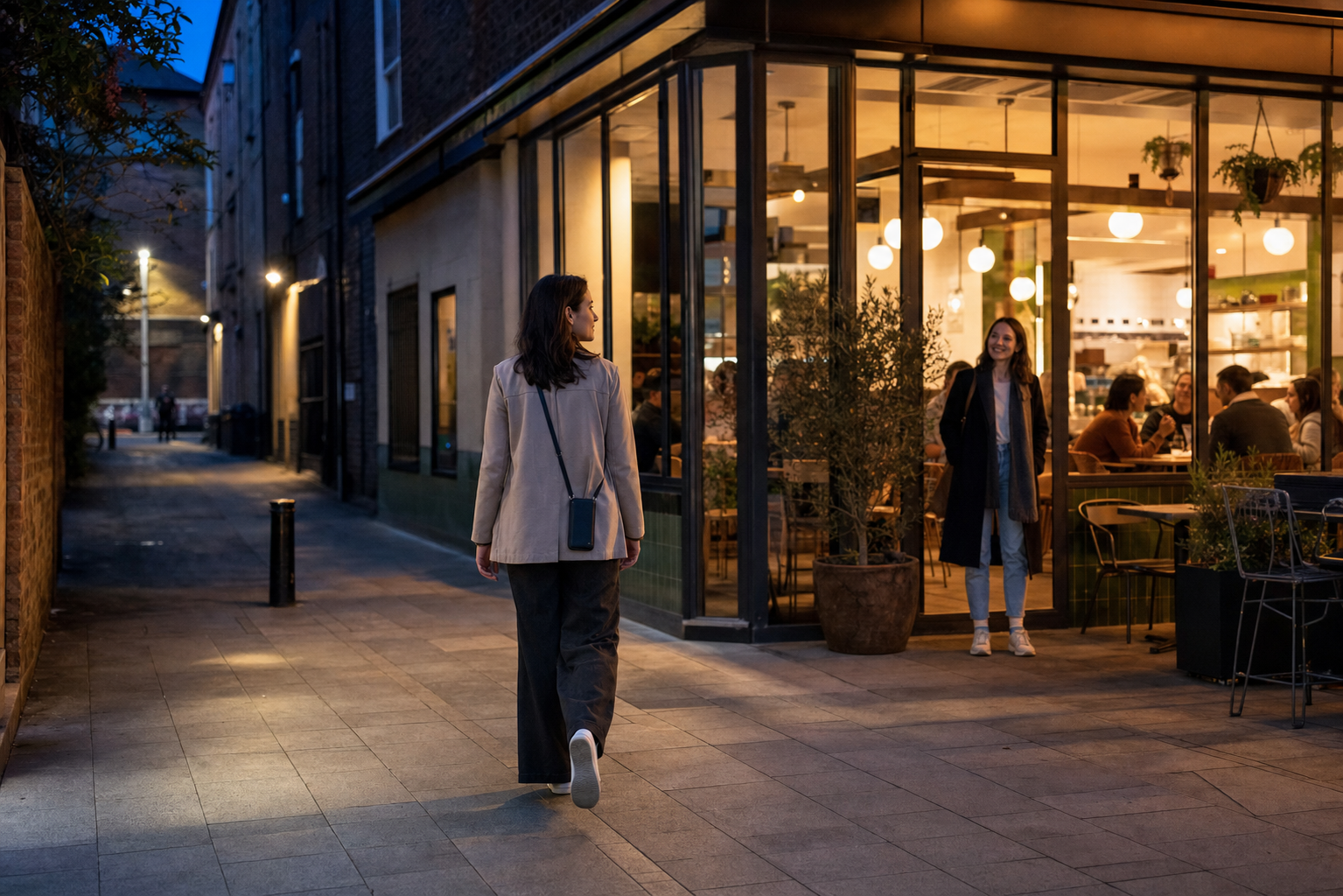
Personal safety improves when important decisions are made before adrenaline arrives. Start with the routes you already travel. You do not need to imagine every possible attack. You need defaults for the places where delay, isolation, crowding, or confusion regularly reduce your options.
For a regular commute, identify:
- usable exits and alternate routes rather than a single habitual path;
- bottlenecks where movement becomes difficult;
- staffed counters, security points, open shops, well-used platforms, or other places where help is more readily available;
- a trusted person who can receive a check-in without broadcasting your movements to a wider group;
- what that person should do if an expected check-in does not arrive;
- where you can move if a person is following, crowding, or attempting to isolate you.
When entering an unfamiliar space, make a brief awareness check: where did you enter, where else could you leave, who appears to work there, and where would you go if the nearest route were blocked? The aim is not to scan every face for danger. It is to avoid discovering your options for the first time during a crisis.
Crowded transport requires space management rather than theatrical confrontation. Preserve your balance, avoid letting luggage or a phone occupy both hands when conditions feel uncertain, and move before discomfort becomes entrapment. If someone repeatedly violates your space, a concise boundary and movement towards other passengers, staff, or an exit are generally more useful than trying to determine the person’s motive.
For ride-hailing, match the vehicle plate and driver identity before entering. Use live-location sharing selectively with a trusted contact, not as public proof of where you are. Decide in advance what a route discrepancy, identity mismatch, or unwanted stop will prompt you to do. Technology helps only when you have reviewed the controls before needing them.
Review the SOS feature on your own phone and learn how it behaves on that device. Test settings without placing a false emergency call. Make sure you know whether activation calls a service, alerts chosen contacts, shares location, records information, or performs some combination of those actions. Do not assume a feature is configured merely because its icon exists.
Use a repeatable 10-minute practice block
Long, occasional sessions can create familiarity without durable recall. Short 10-minute micro-drills make it easier to revisit the decisions that disappear under stress. Put the practice at a repeatable point in your routine and rotate through these elements:
- Settle: Use steady breathing to reduce unnecessary tension. The purpose is not to become perfectly calm but to recover enough control to notice and choose.
- Scan: In a familiar room or public setting, quietly identify exits, obstacles, staff, and places of visibility.
- Speak: Say your boundary commands aloud. Practise a firm volume and short wording without smiling, apologising, or entering a debate.
- Position: Rehearse balanced posture, the non-provocative fence, and movement towards an exit without crossing your feet or fixing your attention on only one person.
- Recall: Slowly repeat only physical movements already taught by a qualified instructor. Dry rehearsal is for retention, not for inventing techniques.
- Rehearse a decision: Picture a realistic setting and choose where you would move, what you would say, whom you would alert, and when physical contact would become a last resort.
Breathing deserves practice because stress can narrow attention and make speech difficult. It is not a shield against violence and should never delay escape or an emergency call. Its function is modest but valuable: helping you regain enough composure to act.
With a trusted training partner, vary the scenario so the answer is not always physical. Sometimes the correct response should be leaving. Sometimes it should be a boundary command, asking a bystander for help, or calling 112. Sometimes the scenario should stop because the danger has stopped. If every drill ends in striking, the training is rehearsing escalation rather than judgement.
Plan the first actions after an incident
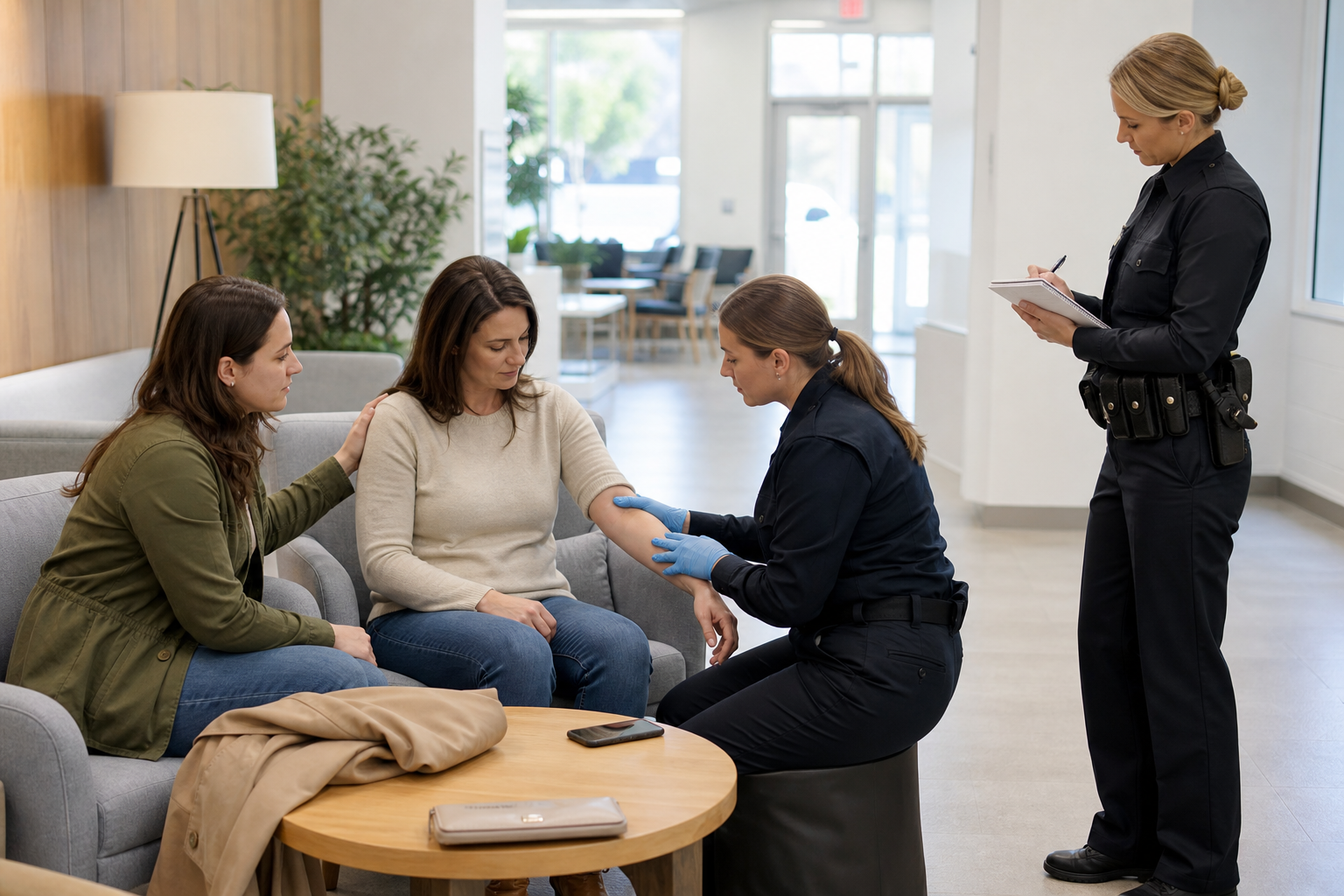
Reaching safety is not the end of the safety plan. Stress can disrupt memory and make simple tasks feel disordered, so decide the sequence before you need it.
- Reach a safer place. Create distance and move to people, staff, security, a locked space, or another location where the aggressor cannot easily regain contact.
- Call for help. In India, contact 112 when emergency assistance is required. Give your location early, then describe the immediate danger and the help needed as clearly as you can.
- Seek medical care when needed. Do not let embarrassment, uncertainty, or lack of visible injury prevent you from obtaining appropriate professional assessment.
- Contact a trusted person. Ask for a concrete form of support, such as accompaniment, transport, help reaching care, or presence while reporting.
- Preserve relevant information. Keep booking details, messages, call logs, photographs, recordings, and witness contact information in their original form where possible.
- Write a factual account. While memory is fresh, record the time, place, sequence, words or actions you directly observed, people present, identifying details, direction of travel, and any injuries or damage. Separate what you saw from what you inferred.
- Report through lawful channels. Give clear facts rather than filling gaps with guesses. Seek qualified legal help if the incident or your defensive action may be disputed.
Do not return to confront the person, arrange public retaliation, or circulate unverified accusations as a substitute for reporting. If requesting aid for another injured person can be done without putting you back in danger, contact the appropriate emergency service. Your first duty is to avoid renewing the threat.
Post-incident reactions differ. A person may feel agitated, numb, ashamed, angry, confused, or outwardly calm. None of those reactions proves courage or failure. Seek professional mental-health support when distress persists, disrupts ordinary functioning, or feels unmanageable. Self-defence training is not a substitute for trauma care.
Make community support practical
Women’s safety cannot rest entirely on individual alertness. A trusted commute contact, a buddy arrangement for late movement, and familiar safe points create options that no physical technique can provide. Community groups, workplaces, educational institutions, and dharmic organisations can also host local refreshers so participants discuss the routes and public spaces they actually use.
If you witness harassment or danger, do not assume direct confrontation is the only courageous response. Depending on what is safe, you can distract, delegate to staff or authorities, document appropriately, or offer support after the immediate event. Documentation should not come at the cost of summoning help, and it should not become public spectacle. Once safe, ask the targeted person what assistance they want rather than taking control of the situation away from them.
Shaurya is strongest when governed by restraint
For a dharmic reader, ahimsa should not be confused with helplessness, and self-protection should not be confused with vengeance. Hindu, Buddhist, Jain, and Sikh traditions are not identical in doctrine, but a useful shared ethical test remains available: does the action protect life and dignity, or does it continue harm after protection has become possible?
Shaurya, or valour, is the capacity to act when action is necessary. Karuna, or compassion, governs how that capacity is used. Together they reject both passive abandonment of a person in danger and aggressive punishment masquerading as defence. The disciplined defender creates safety, stops when the threat stops, and returns the aftermath to lawful institutions. Vigilantism fails that test.
Key takeaways
- Choose a class that treats awareness, boundaries, help-seeking, escape, and recovery as one system.
- Judge every physical technique by whether it helps you break contact and leave.
- Learn necessity, imminence, and proportionality in plain language, then verify which current law applies in your jurisdiction.
- Reject instruction that glorifies retaliation, shames freezing, promises guaranteed safety, or relies on complex beginner techniques.
- Use regular 10-minute practice to rehearse exits, commands, positioning, breathing, and decisions already taught safely.
- Prepare your phone, trusted-contact plan, commute safe points, emergency call, documentation, and post-incident support before a crisis.
- Let shaurya supply the courage to act and karuna supply the discipline to stop.
Before you enrol, send the organiser the curriculum questions above. Then review your usual route, your phone’s SOS settings, your boundary commands, and the person you would contact. That preparation will tell you more about your real safety system than any dramatic demonstration.
References
