
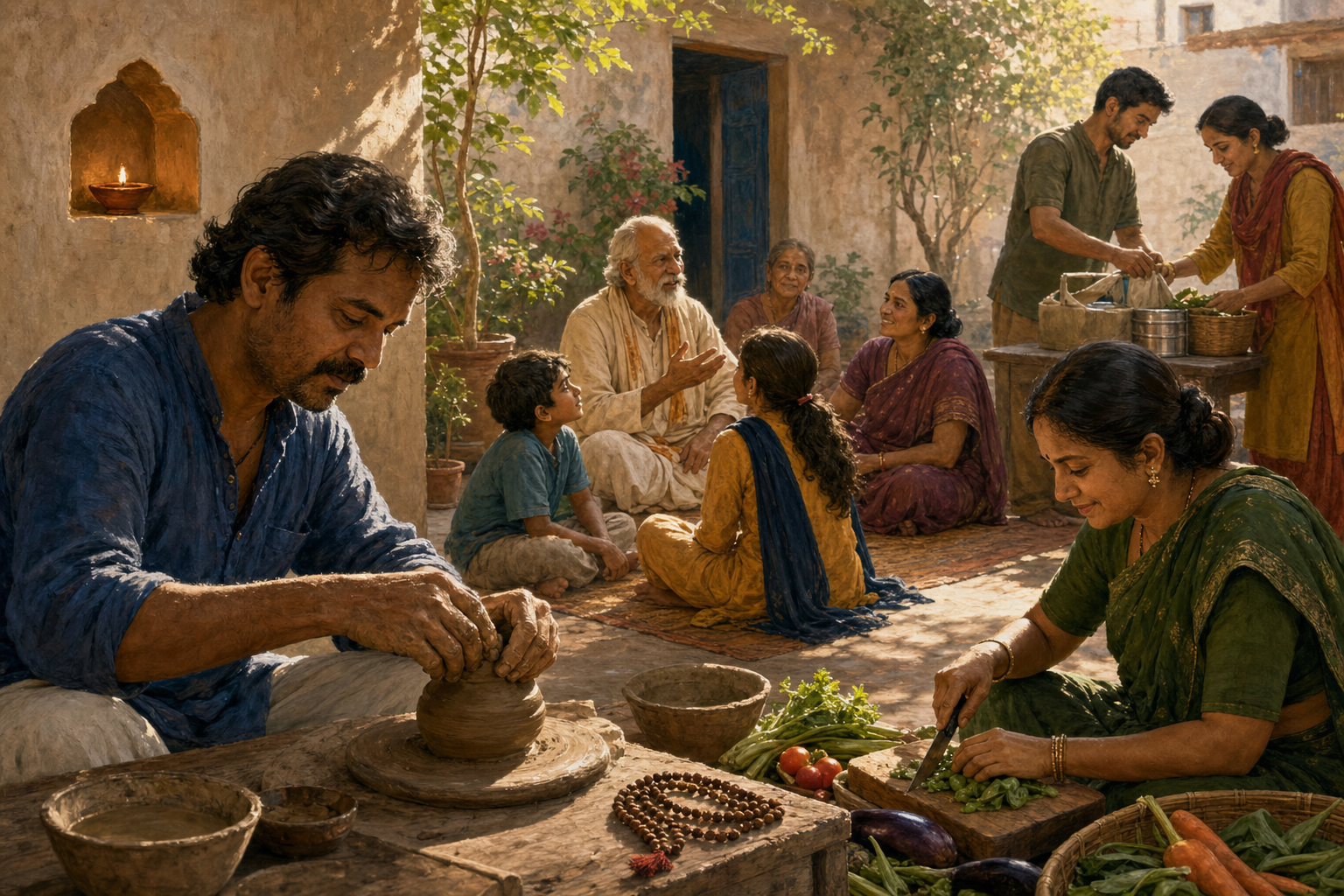
If your workday pushes prayer to the edges, the usual answer is to protect a little more private devotional time. That can help, but lived Bhakti asks a deeper question: can your work, the sacred stories you hear, and the people around you become parts of one discipline?
They can, provided each does a different job. Labor gives devotion a place to be practiced. Story gives remembrance content. Community keeps a sincere intention from fading into a private mood. When these three reinforce one another, Bhakti is no longer an activity you visit after ordinary life; it begins to shape how you earn, speak, remember, serve, and belong.
Let honest work carry remembrance

Sri Dhanasadha is remembered not as a scholar removed from village life but as an agrarian devotee who earned his livelihood behind a plough. His setting matters. The rhythms of cultivation, cattle care, uncertain rainfall, shared water, and seasonal harvest supplied the conditions in which his devotion matured.
A traditional description that he would not waste his time in farming can be badly misread. It does not make agriculture spiritually inferior, and it does not celebrate neglect of duty. The distinction is between work performed mechanically and work performed with remembrance, ethical care, and freedom from possessiveness. Dhanasadha did not abandon the field for Bhakti. He refused to let the field become a place where Bhakti disappeared.
This is Karma Yoga in a form you can recognize. The hands complete the necessary task. The mind returns to the Divine. The heart releases its demand to control every result. The Bhagavad Gita’s teaching on action becomes concrete here: skill, intention, and offering belong together. Poorly performed work does not become sacred merely because it is called an offering, and competent work is not yet Karma Yoga if deceit, vanity, or indifference governs it.
You can begin by choosing one kalyana-guna, one auspicious attribute of the Lord, before a substantial task. Compassion, truth, protection, and forbearance are practical objects of remembrance because each can become conduct. Kalyana-gunas are sometimes mistranslated as the Lord’s marriage qualities, but the term refers to auspicious divine attributes. That correction changes the practice: you are contemplating qualities that can refine how you act.
- Before beginning, name the quality you want the task to express. If the quality is truth, identify the conversation, record, estimate, or promise in which accuracy will matter.
- During repetitive work, return briefly to the Divine Name or to the chosen quality. Do not force continuous inner speech. The point is a dependable return whenever attention wanders into resentment, vanity, or anxiety.
- At the moment of friction, translate remembrance into behavior. Forbearance may mean answering without contempt. Compassion may mean noticing who is carrying an unfair burden. Protection may mean caring properly for a tool, animal, field, shared resource, or colleague.
- When the task is complete, offer the result without pretending that outcomes do not matter. Review errors, repair avoidable harm, and learn what needs improvement; then release the part you cannot command.
This practice should make you more reliable, not less attentive. If a task involves driving, machinery, hazardous materials, or another demand for full concentration, do not add audio or a complicated mental exercise. A brief silent remembrance before and after the task is enough. Bhakti does not require divided attention.
Nor does offering your labor mean sanctifying exploitation. Honest work offered to the Divine is incompatible with dishonesty, preventable danger, cruelty, and the deliberate misuse of another person’s dependence. Karma Yoga disciplines your participation in work; it does not turn adharma into duty simply because someone in authority demands compliance.
Dhanasadha’s agrarian setting adds another correction. Work is rarely as individual as modern language makes it sound. A field depends on soil, water, animals, tools, inherited knowledge, neighbors, and seasons. Caring for those relationships is part of the offering. Repairing a bund, tending a tired animal, conserving a scarce resource, or sharing food with another worker can express Bhakti as surely as an inward recollection.
Give remembrance a story, not just a slogan
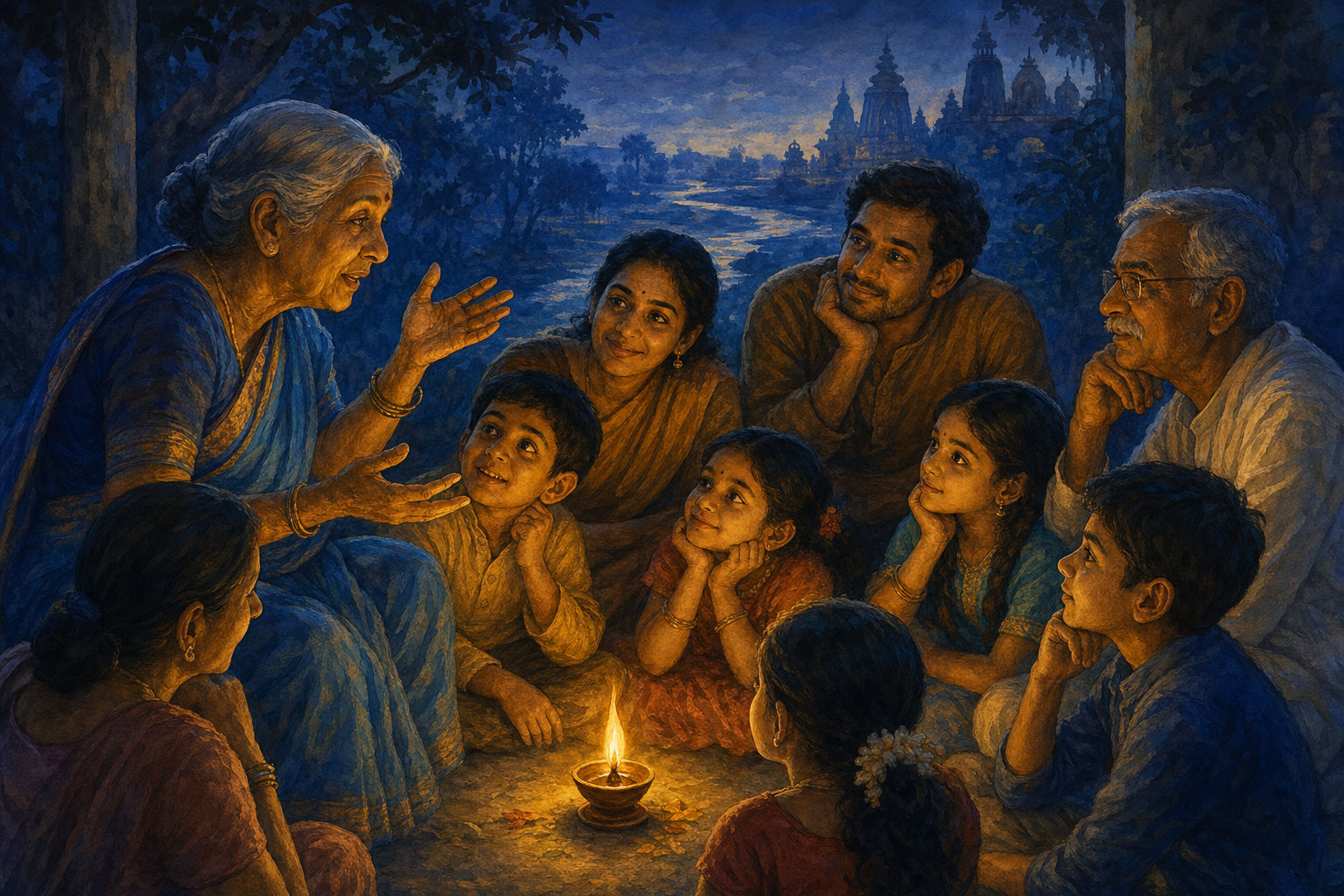
Remembrance needs content. Repeating the word compassion is thinner than hearing how compassion acts under pressure, what it costs, and whom it protects. Lila gives divine qualities movement, voice, tension, and consequence. It allows a listener to contemplate not only an abstract virtue but a scene that can be recalled when a similar moral pressure enters daily life.
Uddhava Chitguna survives in the memory of Tharoor as a pilgrim who worshipped Perumal and enacted the Lord’s pastimes at night for the community. Formal documentary traces may be limited, so the responsible description is not a falsely complete biography. The durable fact is the shape of the remembrance: pilgrimage led to temple worship, worship opened into performance, and performance gathered residents into shared devotion.
Harikatha, Upanyasa, Bhagavata Mela nataka, Krishnattam, and Bhajana Sampradaya do not all have identical forms. They nevertheless show how narrative, music, gesture, explanation, and participation can carry theology beyond a written page. In such settings, rasa is not decorative emotion added to doctrine. Sacred story trains attention and feeling so that the listener learns to delight in what is truthful, compassionate, protective, and worthy of remembrance.
You do not need to imitate a professional performance tradition to restore story to a household or satsanga. You do need a structure that protects the story from becoming either a lecture or casual entertainment.
- Choose one bounded episode from the Ramayana, Bhagavata Purana, or the tradition your gathering actually practices. A complete scene is easier to remember than a rushed survey of many episodes.
- Tell listeners what kind of account they are hearing. Distinguish a scriptural episode from a temple’s sthala-varalaru, a family’s oral memory, a saint’s traditional life, and your own interpretation.
- Preserve the sequence of the scene: the situation, the pressure, the choice, and its consequence. Do not extract the moral so early that the characters become labels.
- Where appropriate, include a refrain, verse, gesture, or call-and-response element. Participation turns passive hearing into shared recollection, but it should serve the narrative rather than overwhelm it.
- Ask a question that returns the story to conduct: Which quality became visible here? Where will that quality be difficult to practice in our work or home?
- Close with a specific act of seva. The act may be modest, but it should have a recipient, a responsible person, and a clear next step.
Night-time narration has a practical logic in many Vaishnava communities. Work has slowed, temple worship has created a natural gathering point, and quieter hours support listening. Janmashtami vigils, Ekadashi kirtans, and observances during Margazhi make this relationship between sacred time and shared attention especially visible. Your own gathering need not reproduce every inherited detail, but it should protect a period in which nobody is simultaneously rushing through another obligation.
Accuracy also belongs to devotion. Oral memory carries the identity and affection of a community, but it should not be presented as an inscription merely to make it sound authoritative. When preserving a local account, record its place, language, narrator, and context. Keep editorial explanations separate from the remembered narration. Where possible, compare oral histories with inscriptions, temple kaifiyat, sthala-varalaru, and musical repertoires preserved by bhajana mandalis. Annotated recordings and careful transliteration can help younger listeners inherit a tradition without obscuring where each detail came from.
Build satsanga as a structure of mutual care

A story heard once can move you. A community that returns to sacred story can reshape your habits. This is why satsanga is more than pleasant company. It supplies repetition, encouragement, and correction. Other devotees notice when eloquent ideals fail to become truthful speech, dependable work, or compassionate service. They also help carry a practice when individual enthusiasm weakens.
The temple naturally gathers these functions. Agama-guided cycles such as abhisheka, alankara, archana, naivedya, and deepa aradhana order the day around worship. Utsava-murtis bring sacred presence into procession and public space. Dusk then becomes a meeting point for darshana, song, narration, prasada, and service. The result is not merely an audience assembled for religious content. It is a community learning to share time and responsibility.
If you are trying to form a satsanga, begin with a pattern small enough to repeat. Gather at a dependable point in the week or devotional calendar. Open with a familiar invocation, hear one coherent episode or teaching, leave room for reflective participation, and end by assigning the next act of service. Regularity matters more than trying to make every gathering elaborate.
Rotate visible and invisible duties. One person may narrate, another lead the refrain, another welcome newcomers, another prepare or distribute prasada, and another attend to the room after everyone leaves. Rotation prevents the gathering from confusing Bhakti with the charisma of one performer. It also teaches that cleaning, cooking, listening, teaching, and organizing are connected forms of seva.
Keep the threshold of participation low. A person should be able to arrive, listen, and learn before being expected to know every response or pronunciation. Explain enough context for younger people and newcomers to follow the episode, without turning the gathering into an academic seminar. If no temple or established bhajana mandali is accessible, a household circle can still preserve the essential pattern of attentive hearing, shared remembrance, and service.
The test comes after the singing ends. Traditional devotional gatherings often flow into prasada distribution, anna dana, temple upkeep, and other forms of volunteer service. These acts matter because they prevent community feeling from becoming self-enclosed. Before the group disperses, ask what care is actually needed: Is someone ill or isolated? Does an elder need transport? Is a shared space being neglected? Is food being prepared without enough help? A named need is more likely to receive seva than a general appeal to be compassionate.
Do not measure success only by attendance, musical polish, or the emotional height of an evening. Look for quieter evidence: promises are kept, disagreements lose some of their cruelty, shared property is treated carefully, newcomers are not humiliated, and service does not always fall on the same few people. Bhakti-rasa should deepen ethical attention. If strong devotional feeling repeatedly leaves conduct untouched, the gathering needs reflection as much as it needs another performance.
Recognize shared dharmic practice without erasing difference
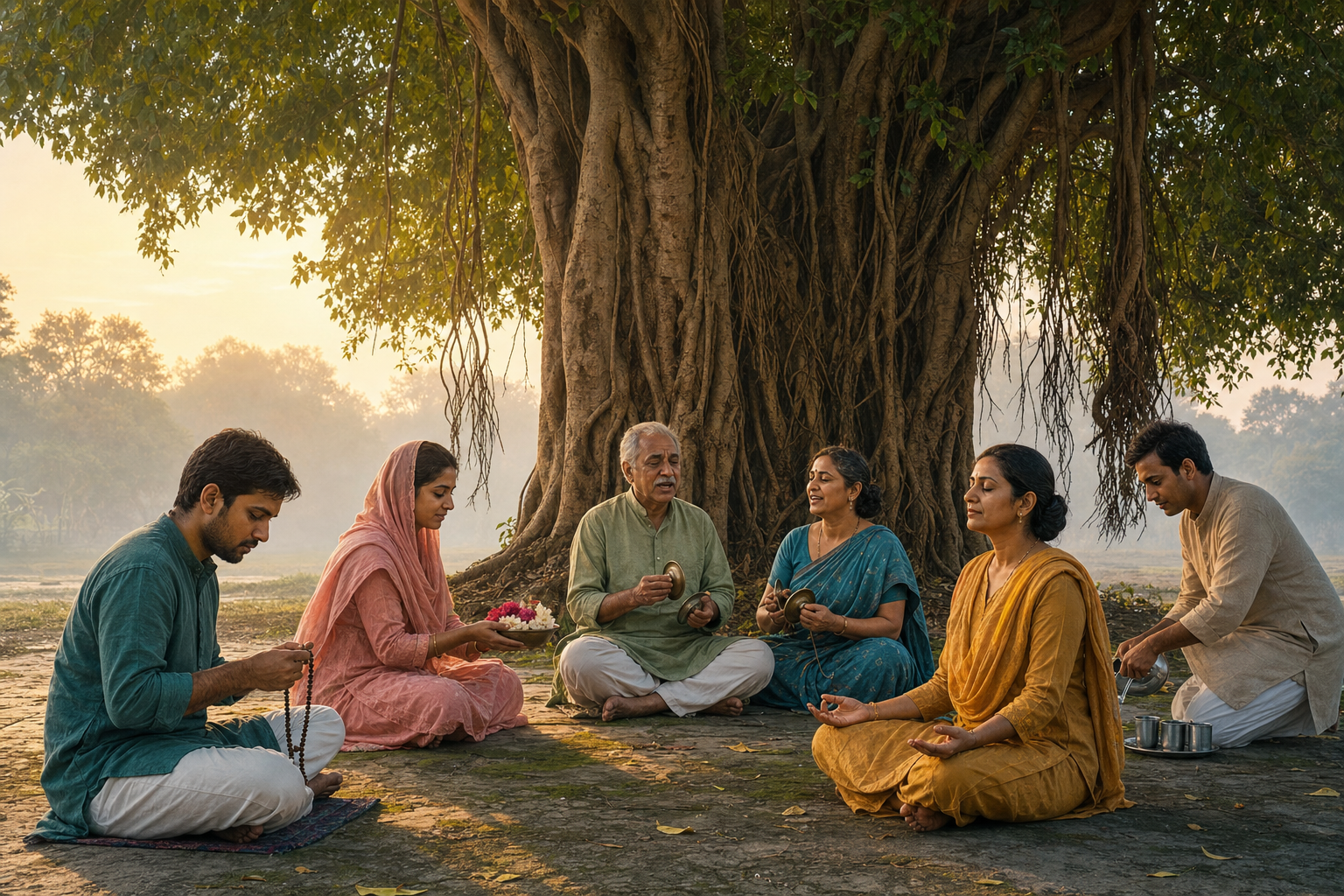
The relationship among work, remembrance, and community is not confined to one Hindu biography or one Vaishnava setting. Hindu Karma Yoga joins rightful action to offering and non-attachment. Sikh practice brings righteous earning through Kirat Karni into relationship with Naam Simran and sangat. Buddhist Right Livelihood places ethical earning within a disciplined path that includes mindful attention. Jain aparigraha and ahimsa restrain acquisition through non-possessiveness and non-harm.
Shared sacred narration appears in distinct forms as well: Hindu Harikatha and lila performance, Buddhist paritta and Jataka recitation, Jain stavan and Kalpa Sutra readings during Paryushana, and Sikh kirtan centered on shabad. These are not interchangeable theologies. Each tradition understands ultimate reality, bondage, liberation, authority, and devotional practice in its own way. The convergence lies in what disciplined hearing and participation can do: transmit ethical memory, order attention, and turn belonging toward service.
If you convene a broader dharmic gathering, resist the urge to prove unity by renaming every practice as the same thing. Let each tradition answer in its own vocabulary: What makes earning righteous? What protects remembrance during daily labor? How does sacred recitation form character? What service does the community owe its members and neighbors? Parallel answers reveal kinship more honestly than flattened claims of sameness.
This distinction also strengthens Hindu self-understanding. A confident account of Bhakti can affirm the particularity of Perumal worship, lila, darshana, seva, and the Divine Name while recognizing related dharmic disciplines elsewhere. Respect does not require dilution. It requires listening closely enough to know both the shared ethical grammar and the theological boundaries.
Key takeaways for practicing lived Bhakti
- Choose one kalyana-guna before an ordinary task, then identify the exact behavior through which that quality can enter your work.
- Use brief smarana during natural pauses or repetition, but protect full attention wherever divided concentration would be unsafe.
- Receive one lila through careful hearing and retell it faithfully, distinguishing scripture, local tradition, oral memory, and personal interpretation.
- Make satsanga repeatable and participatory. Include the people who narrate, listen, cook, clean, welcome, document, and serve.
- End devotional gathering in concrete seva, with a real need and a responsible person rather than a vague promise of future kindness.
- Judge the practice by its fruit in conduct: truthfulness, forbearance, compassion, stewardship, reliability, and reduced possessiveness.
Start with the next task already in front of you. Name the divine quality it should express. At the next satsanga, hear one story closely enough to carry it back into that task. Then help the gathering turn its shared remembrance into one act of care. That small circuit – labor, story, community, and renewed labor – is where Bhakti becomes lived.
References
- DharmaRenaissance Blog – Sri Dhanasadha and the Plough: A Powerful Bhakti Portrait of Humble Labor in Tamil Village Life
- DharmaRenaissance Blog – Uddhava Chitguna of Tharoor: How Bhakti and Perumal Worship Nurtured Community Spirit
