
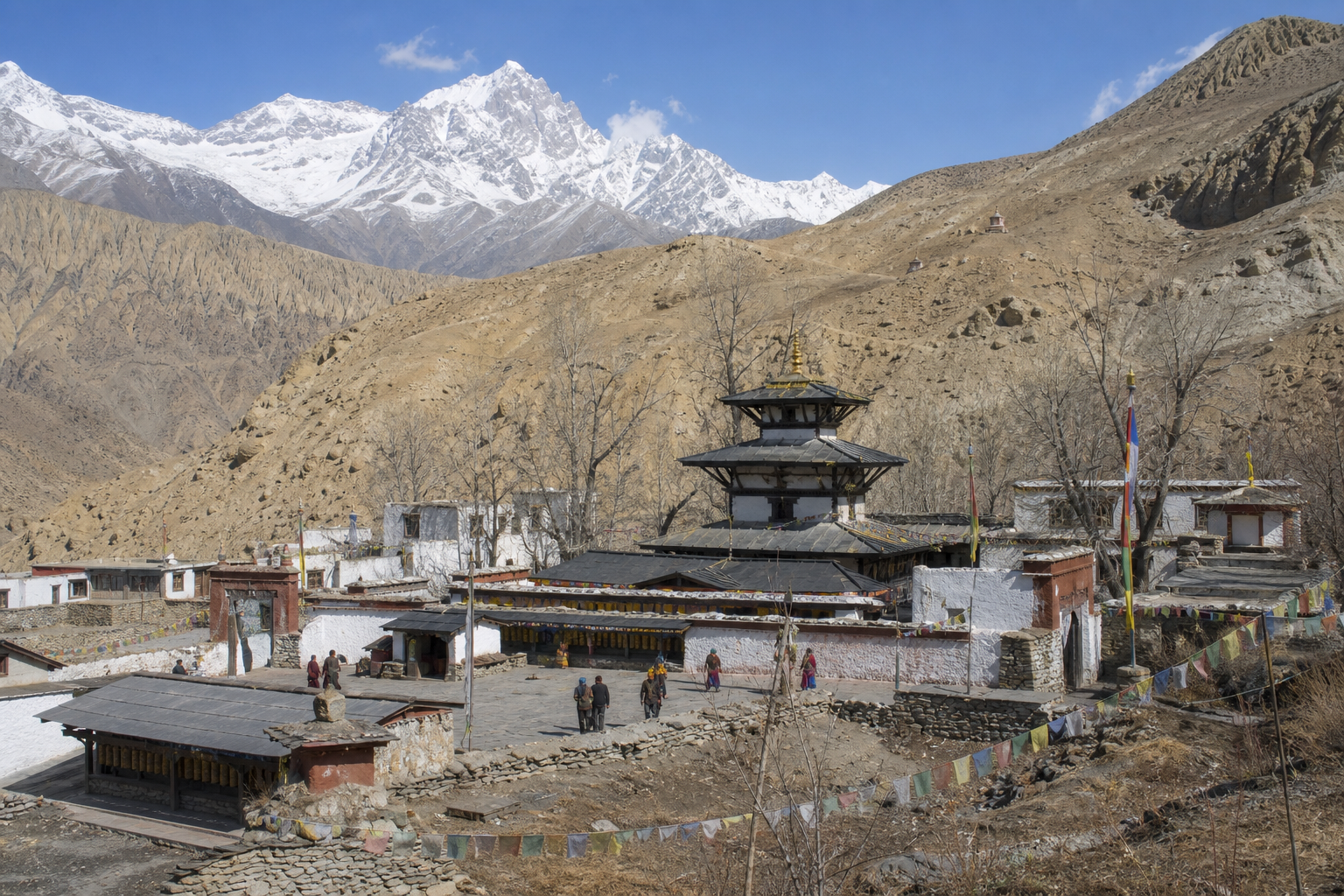
If you are approaching Muktinath and wondering whether it is primarily a Hindu temple or a Buddhist sanctuary, you are beginning with the wrong test. You do not have to decide which tradition owns the place before you can understand it. Ask instead: what does each tradition teach you to recognize, and how should that recognition shape your conduct?
At roughly 3,700 metres in Nepal’s Mustang district, Muktinath brings Vaishnava, Shakta, Shaiva and Buddhist sacred worlds into one Himalayan precinct. Reading those worlds carefully will help you experience more than a collection of shrines. It will show you how Dharmic traditions can inhabit a shared landscape without surrendering their particular names, practices or teachings.
Begin with several sacred maps, not one religious label
A Hindu pilgrim can approach Muktinath through Sri Mukti-Narayana, the form of Vishnu worshipped at a shrine counted among the 108 Divya Desams. The same landscape is associated with Gandaki Chandi, identified in widely circulated Shakta traditions as the Shakti Pitha where Sati’s right cheek fell. Chakrapani Bhairava stands within this sacred geography as Devi’s guardian.
A Buddhist pilgrim knows the sanctuary as Chumig Gyatsa. Its sacred memory includes dakinis and narratives associated with Padmasambhava. Prayer wheels, butter lamps and Tibetan ritual forms therefore belong to the place as living practices, not as picturesque additions to a supposedly Hindu setting. These Hindu and Buddhist identifications coexist within the Kali Gandaki landscape.
This does not make the traditions interchangeable. Mukti-Narayana is not simply a Buddhist figure under another name, and Chumig Gyatsa is not merely a Tibetan translation of a Vaishnava temple. Each sacred map carries its own lineage, vocabulary and ritual discipline. The important fact is that the maps overlap geographically without having to become identical doctrinally.
You should apply the same care to the Shakti Pitha identification. Lists of Shakti Pithas vary among regions, manuscripts and later sacred-geography traditions. Gandaki Chandi’s association with Sati’s cheek is therefore best understood as a living Shakta attribution sustained by particular traditions, not as a claim that every textual enumeration is uniform. Respecting a tradition does not require concealing its internal variation.
This distinction gives you a reliable way to speak about Muktinath. Call it a shared sacred precinct, but name the tradition behind each feature. That is more accurate than reducing everything to religious harmony, and more faithful than assigning the entire landscape to only one community.
Read the meeting of traditions through water, fire and ritual
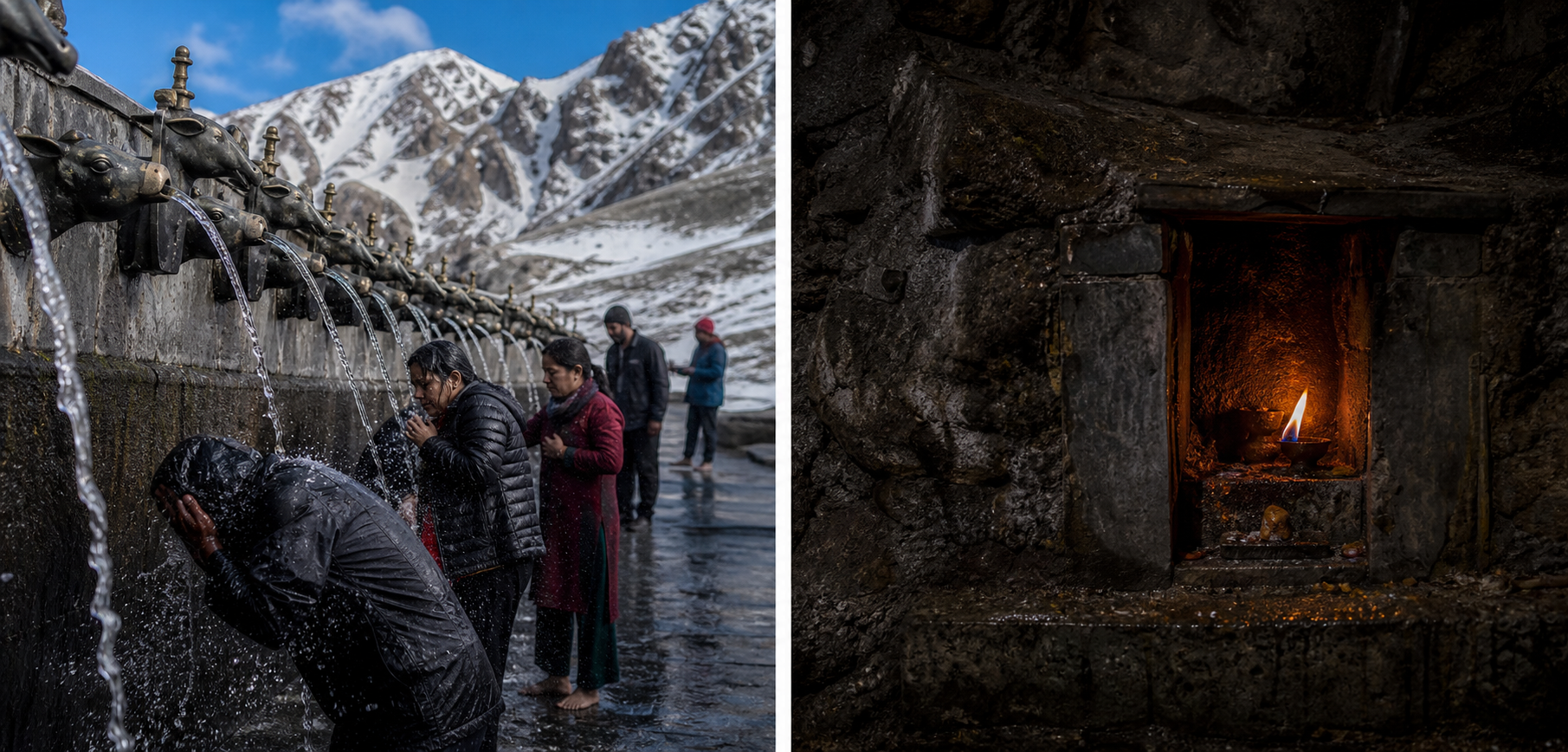
Muktinath’s religious intersection becomes clearest when you stop looking only for doctrinal statements and pay attention to ritual action. Conch calls and Sanskrit mantras inhabit the same mountain atmosphere as turning prayer wheels and Buddhist butter lamps. These practices do not need to be blended into a new ceremony. Their proximity is itself the lesson.
The Muktidhara presents the most visible Hindu ritual pattern: 108 spouts carry cold glacial water used for purificatory bathing. Nearby, Jwala Mai shelters a natural flame. Water and fire, ap and agni, are therefore encountered together rather than contemplated only as abstractions.
There are two mistakes to avoid here. The first is treating the spouts and flame as unusual tourist attractions. That strips ritual elements from the disciplines through which pilgrims understand them. The second is claiming that their coexistence proves every Hindu and Buddhist teaching to be the same. Shared reverence for a place can be profound without erasing real differences in theology.
Use a simple three-part method as you move through the precinct:
- Name the feature. Is it a Vaishnava image, a Shakta sacred location, a guardian shrine, a Buddhist prayer wheel or an elemental manifestation?
- Notice the action around it. Watch whether people offer light, recite a mantra, perform snana, make parikrama or pause in contemplation.
- Learn before participating. Follow the instructions of temple or monastic custodians instead of assuming that one familiar custom applies everywhere.
This method prevents two opposite failures: standing so far outside the tradition that everything becomes spectacle, or entering so casually that reverence turns into appropriation. You can participate sincerely while still admitting what you do not yet know.
Chakrapani Bhairava explains unity without sameness

Chakrapani Bhairava is the theological hinge that helps make sense of Muktinath. Chakrapani, the bearer of the chakra, is a familiar name of Vishnu. Bhairava belongs to the Shaiva world and serves here as the guardian associated with the Shakta presence of Gandaki Chandi. One name consequently touches Vaishnava, Shaiva and Shakta vocabularies without dissolving any of them.
Bhairava’s fierce appearance can mislead a visitor who equates compassion only with gentleness. As kshetrapala, he protects the sacred boundary, stabilizes the shrine and upholds its moral order. Fierceness is functional: it guards the conditions in which worship, compassion and the search for liberation can proceed.
That protective role has an ethical consequence. Truth, non-injury and service are not optional sentiments added after ritual. They express the order that the guardian defends. A pilgrim who offers a lamp but exploits local people, disregards another lineage or damages the river has missed the force of Bhairava’s presence.
The Kali Gandaki gives the name Chakrapani another layer of resonance. The river is associated with shalagrama-shilas, ammonite fossils revered as manifestations of Vishnu. Their natural spiral evokes the chakra. In a valley marked by this Vaishnava presence, a guardian called Chakrapani Bhairava becomes an intelligible bridge rather than a contradiction.
This is the form of unity Muktinath actually supports. It is not the claim that all names mean exactly the same thing. It is the recognition that distinct forms can serve a shared Dharmic horizon: guarding sacred order, cultivating compassion, restraining harmful conduct and orienting life toward mukti.
Make your pilgrimage respectful, unhurried and non-extractive
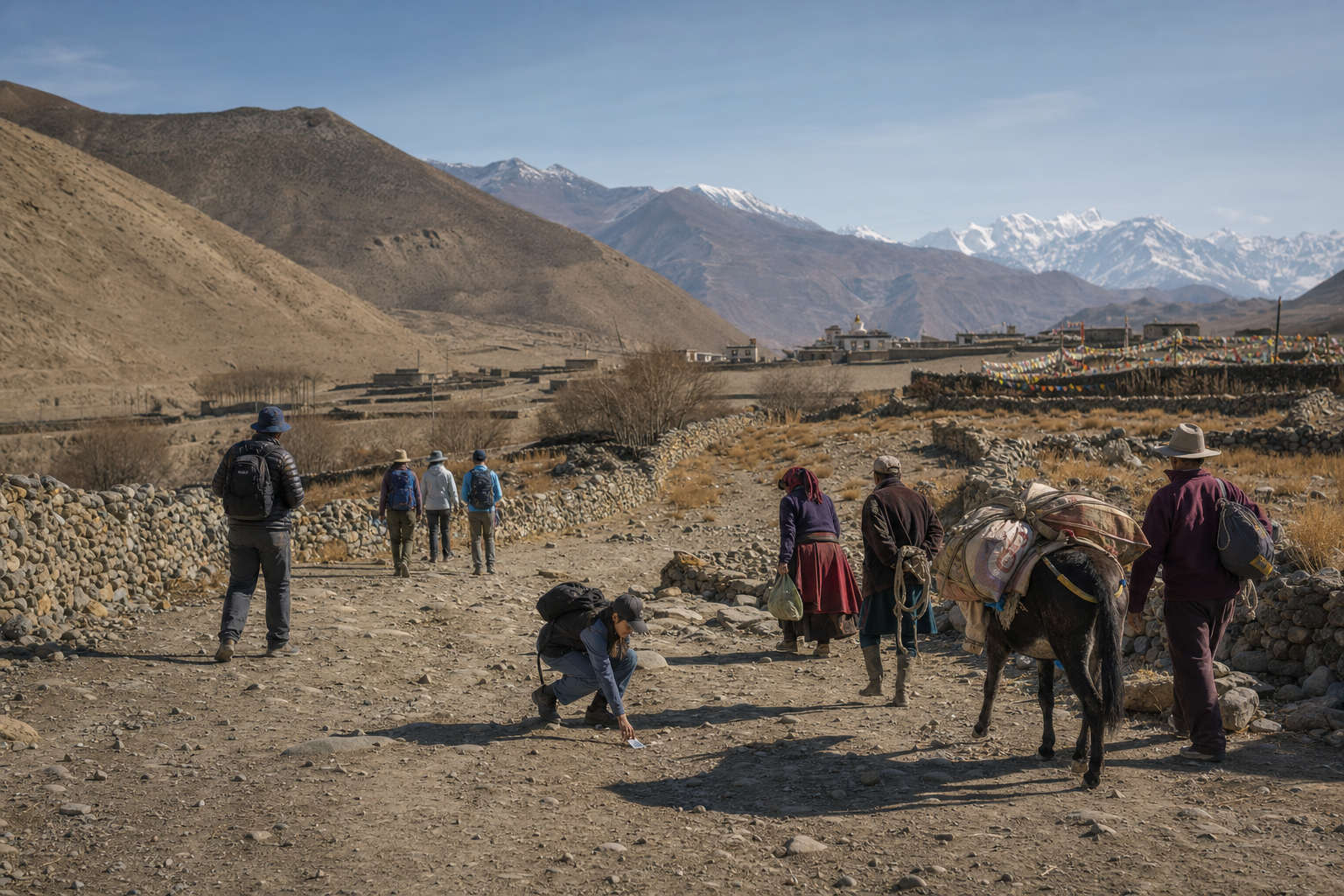
Muktinath’s intersection of traditions asks something practical from you. Respect is not achieved by admiring pluralism from a distance. It appears in how you cross a threshold, receive guidance, handle sacred objects and respond to the mountain environment.
- Plan for the altitude before planning your ritual schedule. The precinct stands at roughly 3,700 metres. Give yourself time, wear layers and keep your pace unhurried. Do not turn bathing, climbing or completing a sequence quickly into a test of devotion. If you become unwell, stop and seek local assistance rather than pressing on for ritual reasons.
- Confirm the route and current conditions locally. Access generally runs from Pokhara to Jomsom by road or, where available, by air, then onward to Ranipauwa before the final ascent. Late spring through early autumn is commonly favoured, but transport and mountain conditions should be checked before departure.
- Ask which sacred space you are entering. Temple authorities and local monasteries can tell you which practices are appropriate. A shared precinct does not mean that every gesture belongs in every shrine.
- Respect the guardian before improvising an offering. Salutations to Chakrapani Bhairava commonly precede approach to Devi and Narayana. Locally guided offerings may include a mustard-oil lamp, red flowers, akshata, black sesame or bilva where available. Receive the local sequence rather than assembling one from fragments learned elsewhere.
- Approach the Muktidhara as a rite, not an endurance display. Its 108 streams carry intensely cold water. If you undertake snana, do so within your physical capacity and under local guidance. You can show reverence without treating completion of every external act as compulsory.
- Leave shalagrama-shilas where they belong. Do not extract stones from the Kali Gandaki or support their commercialization. Honour local regulations and receive a stone only as prasad where that is customary. Restraint protects both the river ecology and the Vaishnava heritage rooted in it.
Move slowly enough to notice when the ritual language changes. A conch, a mantra, a prayer wheel and a butter lamp may share one soundscape, but each deserves to be encountered on its own terms. Silence is often a better response than performing a practice you have not been taught.
The journey itself reinforces this discipline. Pokhara, Jomsom, Kagbeni, Ranipauwa and the wider Mustang corridor belong to a long Himalayan zone of movement among Sanskritic, Newar, Tibetan, Thakali and local Mustang cultures. What you see at Muktinath is therefore not a modern display assembled to advertise tolerance. It is a sacred landscape shaped by sustained contact among communities, languages and ritual traditions.
Key takeaways for understanding Muktinath
- Muktinath is simultaneously approached as the Vaishnava shrine of Mukti-Narayana, the Shakta sacred geography of Gandaki Chandi and the Buddhist sanctuary of Chumig Gyatsa.
- Shared geography does not make the traditions interchangeable. Name each shrine, practice and narrative within its own lineage.
- Chakrapani Bhairava links Vaishnava, Shaiva and Shakta vocabularies through a protective office centred on sacred and ethical order.
- The 108 waters of the Muktidhara and the flame at Jwala Mai make elemental balance visible, but they should be approached as sacred manifestations rather than attractions.
- Respectful pilgrimage means following local guidance, pacing yourself at altitude and refusing extractive treatment of shalagrama-shilas or the Kali Gandaki.
Before leaving for Muktinath, make three commitments: give your body time at altitude, let each community’s custodians guide your conduct, and take nothing from the river. Once there, pause long enough to identify each sacred form before trying to interpret the whole. That small discipline will let Muktinath teach unity without asking you to mistake it for uniformity.
References
