

If you have tried to fit Brahman, Prakriti, the Trimurti, the tattvas, and the yugas into one creation story, the contradictions can seem immediate. Is Brahman creating the universe? Does Prakriti evolve it? Are Brahma, Vishnu, and Shiva separate agents? Is the world a real transformation or an appearance?
The confusion lifts once you stop demanding that every concept answer the same question. Hindu cosmology offers several disciplined maps of reality, each drawn for a particular philosophical and spiritual purpose. This guide will help you identify the level and school you are looking at, follow the movement from subtle potential to manifest experience, and use that movement in your own sadhana.
Begin by separating the ground of reality from its unfolding
The first distinction is between reality as the ultimate ground and reality as an ordered manifestation. In Vedanta, nirguna Brahman points to the absolute without limiting attributes, while saguna Brahman is that same Reality approached through intelligible qualities and forms. The distinction does not divide Brahman into two beings. It distinguishes two ways in which finite understanding relates to what cannot be contained by thought.
This is why the Upanishadic language can move in two directions. Neti, neti removes every attempted limitation: not this, not this. Sarvam khalvidam brahma affirms that all this is Brahman. One protects transcendence; the other protects immanence. If you keep only the first, the manifest world can appear spiritually irrelevant. If you keep only the second, Brahman can be reduced to the collection of visible things. Hindu cosmology holds both movements together.
A second distinction becomes necessary when you turn to Samkhya. Purusha is witness-consciousness; Prakriti is primordial nature, the source of material, sensory, and mental modifications. Prakriti is not merely physical matter, because mind, individuation, and intelligence also belong to its domain. Purusha does not become one more product within the sequence. It is the conscious principle before which the sequence becomes manifest.
A third distinction separates a cosmic function from the divine form that makes it contemplatively accessible. Creation, preservation, and dissolution are processes. Brahma, Vishnu, and Shiva render those processes approachable through theology, devotion, narrative, and iconography. A deity cannot be reduced to an abstract mechanism, but neither should the symbolism be mistaken for three rival gods competing over one universe.
When you meet a cosmological passage, ask three questions before interpreting it: What is treated as the ultimate ground? What is undergoing change? Is the language metaphysical, devotional, psychological, or physical? Those questions prevent most apparent contradictions before they begin.
Follow the Samkhya sequence from potential to experience
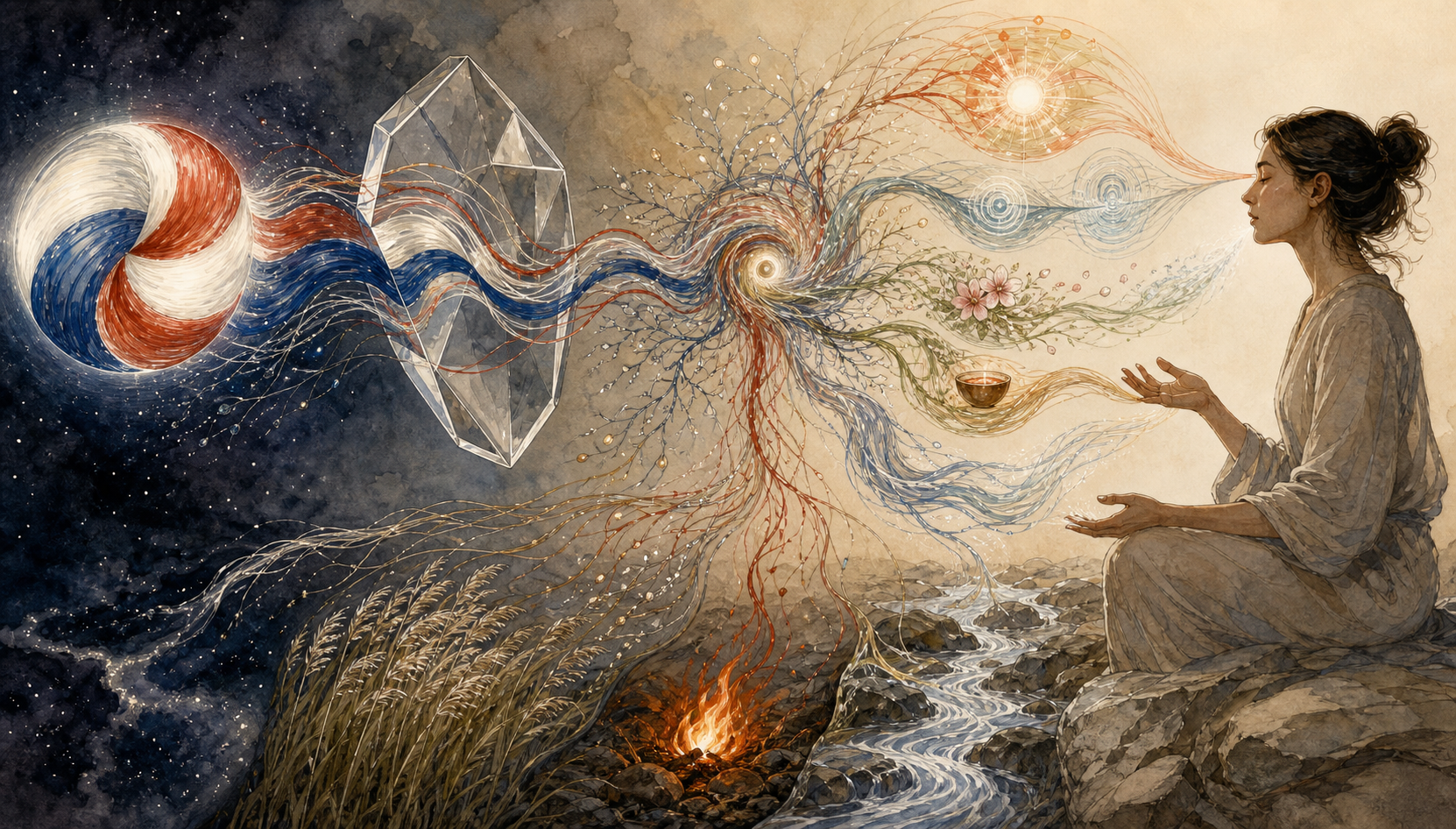
Samkhya gives one of the clearest Hindu accounts of how an unmanifest condition becomes a structured cosmos. It does not describe creation from nothing. Its central logic is parinama: an effect emerges through the transformation of a cause in which its potential is already present.
The sequence begins with Prakriti in an unmanifest equilibrium of three gunas. Sattva is associated with luminosity, intelligibility, and balance; rajas with activity and propulsion; tamas with inertia, density, and concealment. These are not three substances, and they are not a scale from morally good to morally bad. They are interdependent tendencies whose changing proportions make manifestation possible.
- Prakriti rests in equilibrium. Its possibilities remain unexpressed while the gunas are balanced.
- The proximity of Purusha disturbs that equilibrium. Purusha remains the witness; the modifications occur within Prakriti.
- Mahat emerges. Also called cosmic buddhi, mahat is determinative intelligence: the capacity for order, discernment, and intelligibility. It is not an enormous personality thinking private thoughts.
- Ahamkara differentiates experience. This principle of individuation produces the standpoint through which experience becomes mine rather than merely present. Ordinary vanity is one expression of it, not its full philosophical meaning.
- The differentiated streams produce the instruments of experience. The sattvika mode yields manas and the cognitive and active faculties. Rajas supplies motion and energy. The tamasika mode yields the subtle sensory potentials called tanmatras.
- The subtle potentials become gross elements. The tanmatras develop into akasha, vayu, agni, ap, and prithvi: space or ether, air, fire, water, and earth.
The five gross elements should not be read as an early version of the modern periodic table. They classify pervasive modes of embodied manifestation: accommodation, movement, transformation, cohesion, and solidity. Likewise, a tanmatra is not a tiny particle hidden behind a visible object. It is a subtle potential corresponding to sound, touch, form, taste, or smell before these appear as fully embodied qualities.
This movement is sometimes described through Mahatparinama, the unfolding from subtle determinants into gross, experienceable reality. The important word is not merely great but transformation. The world is intelligible because its visible forms do not appear as disconnected accidents; they emerge through an ordered causal sequence.
You can observe a modest version of this sequence without pretending that your psychology proves a cosmic doctrine. An impression becomes an intention. Intention organizes attention. Attention guides speech and action. Repeated action leaves dispositions that influence the next decision. The visible act is the late, gross stage of a process that began more subtly.
That gives you a practical diagnostic rule: when an action keeps producing an unwanted result, do not look only at its final physical form. Trace it backward through speech, attention, identification, intention, and impression. The earlier you recognize the movement, the more room you have to redirect it.
Let the Trimurti and cosmic time teach you how processes move
The Trimurti presents the universe through three inseparable functions: srishti, manifestation or creation; sthiti, preservation and continuity; and samhara, dissolution or withdrawal. Brahma, Vishnu, and Shiva make these functions available to devotion and contemplation. The point is not that one god constructs what another reluctantly maintains until a third destroys it. All three movements belong to one cosmic order.
The gunas provide a related functional vocabulary. Brahma’s creative movement is often associated with rajas, Vishnu’s preserving equilibrium with sattva, and Shiva’s dissolving and transformative power with tamas. Do not turn this correspondence into a moral ranking. A world with creation but no continuity could not develop. A world with preservation but no dissolution would become incapable of renewal. Dissolution is not evil merely because a cherished form comes to an end.
This is also why Hindu cosmology imagines time cyclically. Manifestation, duration, withdrawal, and renewed manifestation occur across scales far larger than an individual life. The Purānic framework uses exact nested periods to dislodge the assumption that human history is the measure of reality:
| Cosmic measure | Composition or duration | What to notice |
|---|---|---|
| Mahāyuga | Four yugas totaling 4.32 million human years | A complete civilizational cycle includes differing conditions of dharma. |
| Manvantara | Seventy-one mahāyugas | Many complete yuga cycles fit within a larger governing period. |
| Kalpa, or day of Brahmā | Fourteen manvantaras, with transitional intervals, totaling 4.32 billion human years | Cosmic manifestation is framed on a scale far beyond recorded history. |
| Night of Brahmā | Equal in duration to the day | Manifestation alternates with withdrawal rather than moving toward a single final stopping point. |
| Year of Brahmā | Three hundred and sixty day-night cycles | Even a cosmic day belongs to a still greater rhythm. |
| Lifespan of Brahmā | One hundred such years, approximately 311.04 trillion human years | Brahmā and the manifest cosmos remain within time; Brahman is not bounded by it. |
These measures should be interpreted within their own cosmological framework. Treating them as disposable fantasy misses their disciplined scaling of time. Treating them as if they were simply interchangeable with the categories of modern astrophysics also misses the point. Their immediate contemplative force is clear: beginnings and endings that look absolute from a human standpoint belong to larger rhythms of manifestation and repose.
Sacred images turn that rhythm into something you can see. Shiva Nataraja holds the drum of emergence and the fire of dissolution within one dance; the gesture of fearlessness and the raised foot show that liberation is possible amid change. Vishnu reclining upon Ananta depicts ordered manifestation arising from inexhaustible stillness. His discus evokes the wheel of time and the power that restores order; the lotus shows purity without withdrawal from becoming. Brahma’s four faces associate creative intelligence with the articulation of sacred knowledge.
When you encounter this iconography in a murti or temple, read the attributes as verbs before treating them as ornaments. Ask what is arising, what is being sustained, what must be released, and what remains untouched through the change. The image then becomes a method of attention rather than a catalogue of objects.
Keep the schools distinct when they explain what changes
Hindu philosophy does not offer one compulsory account of manifestation. Its schools agree that reality is ordered and that liberation requires correct discernment, but they do not always agree about what transforms, whether an effect already exists in its cause, or how the world relates to the ultimate. You gain clarity by locating a claim within its darshana instead of assembling isolated Sanskrit terms into a single hybrid system.
- Samkhya: Prakriti really transforms. Its effects emerge from latent causal potential, while Purusha remains the witnessing consciousness. Liberation depends on discerning that the modifications belong to Prakriti, not to Purusha.
- Nyaya-Vaisheshika: Gross objects arise through lawful combinations of subtle constituents, including indivisible paramanus. Its arambhavada treats the effect as a new beginning rather than merely a previously existing form becoming visible. Substance, quality, motion, universality, particularity, inherence, and later absence provide a categorical analysis of what exists.
- Advaita Vedanta: Brahman does not undergo an actual modification into a second reality. Vivarta describes apparent transformation upon the nondual substratum. The world of ordinary experience is not dismissed as a nonexistent nothing; the central question is whether it possesses independent, ultimate reality.
- Vishishtadvaita: Manifestation is real and belongs within the unity of Brahman, understood with infinite auspicious attributes. Unity therefore does not require the erasure of real differentiation.
- Dvaita: God, souls, and the world are genuinely distinct, although all cosmic processes remain under divine sovereignty. Difference is not merely an error awaiting nondual correction.
- Achintya Bhedabheda: Reality involves simultaneous difference and non-difference whose full relation exceeds ordinary conceptual capture.
- Yoga: Cosmology becomes directly practical through transformations of citta. Nirodha-parinama concerns the movement toward stilling, samadhi-parinama the movement toward integration, and ekagrata-parinama the stabilization of one-pointed attention. Abhyasa and vairagya make these transformations trainable rather than accidental.
A common mistake is to ask which statement wins before noticing that the statements preserve different commitments. Samkhya asks how experience evolves when consciousness and nature are distinct. Advaita asks how multiplicity can appear without dividing nondual Brahman. Nyaya-Vaisheshika analyzes real entities, causes, and valid inference. A devotional Vedanta asks how real dependence, difference, and divine sovereignty fit together. Before accepting or rejecting a claim, identify the problem it was designed to solve.
Shared Dharmic grammar does not erase doctrinal difference
Related Dharmic traditions also examine the passage from subtle conditions to manifest experience, but they do not thereby teach identical metaphysics. Buddhism explains conditioned emergence through dependent origination and, in some analyses, momentary events without affirming a permanent atman. Jain philosophy understands transformation through substance, quality, and changing mode, while preserving the identity of substances and explaining bondage through karmic matter. Sikh thought holds nirgun and sargun together under Hukam, with the formless Divine manifest throughout ordered existence.
The responsible comparison is therefore structural, not reductive. You can notice a shared concern with lawful emergence, ethical causation, and liberation while preserving disagreements about self, substance, God, and ultimate reality. Compare the questions each tradition asks and the disciplines each answer supports; do not declare every technical term another name for Brahman.
Bring the cosmology into one decision before mapping the universe
A cosmology becomes spiritually useful when it changes what you notice before you act. Choose one recurring decision rather than trying to contemplate the entire chain of manifestation at once. It might concern a duty you keep postponing, a commitment you are sustaining without discernment, or a habit whose proper season has ended.
- Name the visible outcome. Describe the action or omission without turning it into a judgment about your whole identity.
- Trace the subtle chain backward. What speech, mental selection, identification, intention, or impression preceded the outcome?
- Identify the dominant tendency. Is clarity present but inactive, is activity outrunning discernment, or is inertia concealing what you already understand? Use sattva, rajas, and tamas diagnostically, not as labels of personal worth.
- Choose the needed cosmic function. Begin what dharma requires, sustain what remains worthy, or release what has completed its work.
- Intervene at the earliest stage you can actually observe. Redirecting an intention is usually more fundamental than repeatedly repairing its later consequences.
- Watch the new result without claiming it as a fixed self. In the Samkhya-Yoga frame, the modification belongs to citta and Prakriti. The witness is known by discernment, not manufactured through another mental performance.
This exercise also corrects a sentimental misuse of the Trimurti. Starting is not always brave; it can be restless proliferation. Sustaining is not always loyal; it can preserve adharma or attachment. Ending is not always destructive; it can clear the conditions for truthful action. Dharma, viveka, and attention determine which function is needed.
Practice works in the subtle-to-gross direction. Repeated attention changes the pattern of citta; the altered pattern changes what you notice; what you notice changes the choices available to you; and those choices become speech and embodied action. This is why abhyasa, dispassion, breath, and focused observation matter within the unfolding of lived experience. They work upstream of conduct without making conduct optional.
Key takeaways
- Do not force Brahman, Prakriti, the Trimurti, and the tattvas into one undifferentiated creation narrative; first identify the philosophical level and school.
- In Samkhya, the subtle-to-gross sequence belongs to Prakriti, while Purusha remains witness-consciousness.
- Mahat is determinative cosmic intelligence, ahamkara is individuation, and the tanmatras are subtle sensory potentials rather than physical particles.
- Creation, preservation, and dissolution are mutually necessary functions, not a moral contest between three deities.
- Purānic cosmic periods place human events within recurring scales of manifestation and withdrawal; they should not be casually equated with modern scientific categories.
- The practical use of cosmology is to notice subtle causes early enough to begin, sustain, or release an action in accordance with dharma.
The next time you meet a Hindu cosmological claim, write its main terms under three headings: ground, process, and manifest form. Mark the darshana to which the claim belongs. Then ask which movement it places before you now: clearer creation, steadier preservation, or timely release. That small discipline turns a bewildering collection of cosmic images into a precise way of reading reality and participating in it responsibly.


References
- DharmaRenaissance Blog — Decoding the Trimurti and Time: Brahma, Vishnu, Shiva as One Timeless Consciousness
- DharmaRenaissance Blog — Mahatparinama Unveiled: The Transformative Journey from Subtle to Manifest Reality in Hindu Philosophy