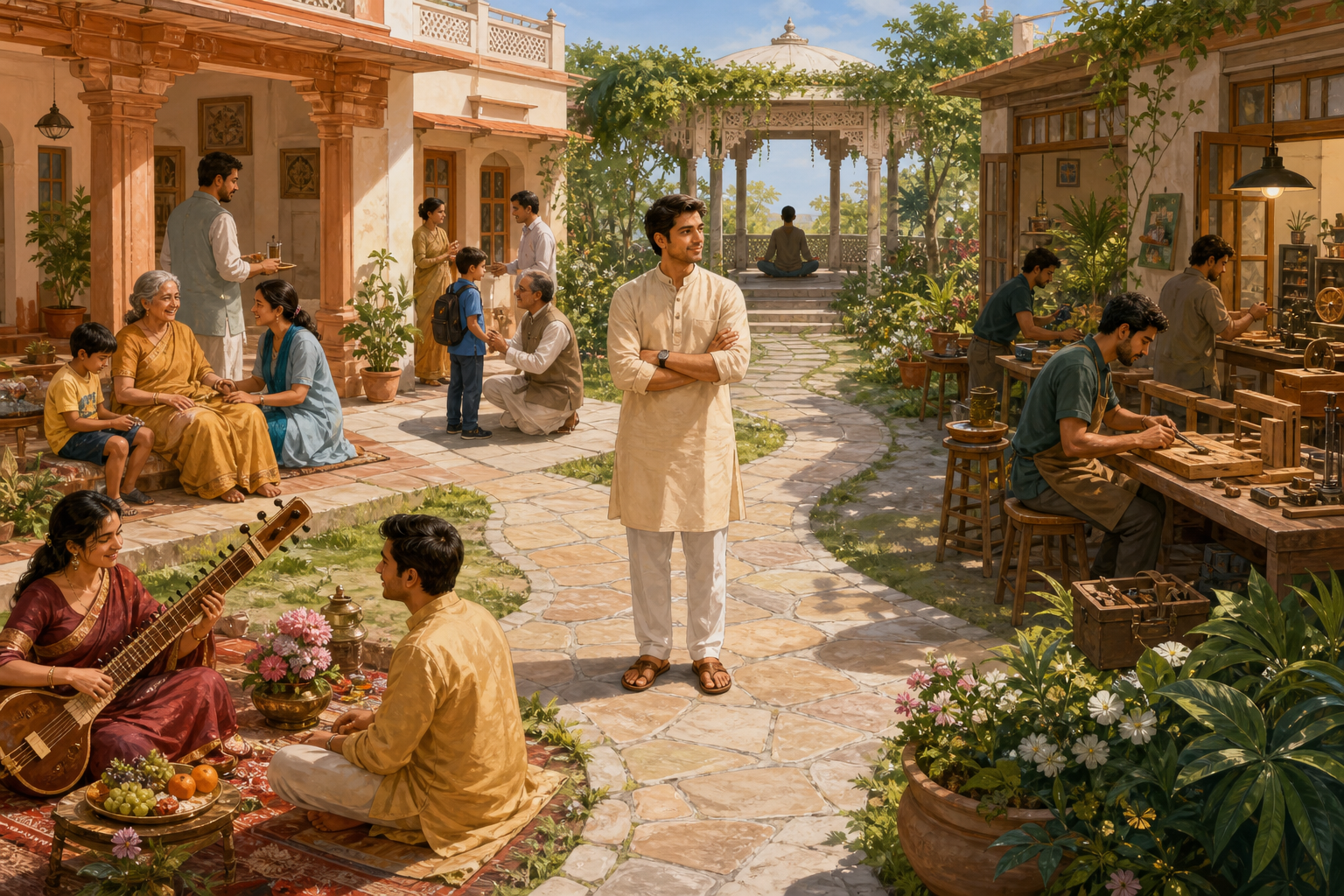
You do not have to choose between renouncing modern life and letting consumption define it. A Hindu can pursue education, technology, comfort, enterprise and wealth without accepting the belief that more consumption is the measure of a better life.
The decisive question is not whether you own things. It is whether you command your possessions and desires, or whether they quietly command your time, relationships, duties and sense of worth. Hindu civilisation gives you a practical way to make that distinction.
The real choice is mastery or imitation
Western materialism should not be confused with everything produced in the West, nor attributed to every Western person. Here it means a particular ideal: human progress measured chiefly by expanding wants, increasing consumption and gaining control over the external world. That ideal can travel through advertising, education, social prestige and institutional habits without ever announcing itself as a philosophy.
Material achievement has real value. Mechanical invention, productive enterprise and accumulated wealth can improve human life. Indeed, the multiplication of wants in the modern West developed alongside wealth and mechanical invention. The danger begins when a society copies the appetite but not the capability that made the consumption sustainable.
This distinction matters especially for Bharat. Importing a taste for expensive goods does not automatically create the knowledge, discipline, industry or capital needed to produce them. When luxury spreads before wealth, mechanical talent and industrial qualities have been developed, visible consumption can conceal economic and civilisational weakness.
The household version is easy to recognise. A purchase may imitate the lifestyle of a richer social group while adding no productive ability, no durable utility and no inner contentment. The national version follows the same pattern: imported status symbols expand faster than domestic skill, craftsmanship and invention.
The Dharmic response is therefore selective, not reactionary. Adopt a machine that increases capability. Learn a method that improves accuracy. Build an institution that disciplines power. But do not assume that the wants attached to those achievements must also be imported. A civilisation can accept a tool without accepting the toolmaker’s hierarchy of values.
Key takeaways
- Hindu civilisation does not reject wealth or pleasure; it refuses to make either one sovereign.
- Judge modern habits by the capabilities they build, the duties they serve and the dependencies they create.
- Productive strength should precede conspicuous consumption, both in a household and in a nation.
- Protecting rights and fulfilling duties are complementary responsibilities, not rival political slogans.
- Simplicity is not forced poverty. It is the ability to decide what is enough.
Use the purusharthas as a decision framework
Hindu traditions are diverse, but the four purusharthas provide a widely shared grammar for human aspiration: dharma, artha, kama and moksha. Their importance lies not merely in naming four goals. They prevent one goal from swallowing the rest.
Artha gives material security, competence and the means to act. Kama gives legitimate enjoyment, affection and aesthetic pleasure. Dharma orders both through responsibility, right conduct and attention to consequences. Moksha keeps the whole arrangement from becoming a prison of possession and identity.
This is why a Hindu view of civilisation cannot be reduced to hostility toward money. The grihastha needs material resources to sustain dependants, practise hospitality, support worship, give to worthy causes and maintain social institutions. Deliberately creating wealth can be a Dharmic act. Making wealth the final judge of human value cannot.
When you face a purchase, career choice or lifestyle change, ask four questions:
- Dharma: Which responsibility will this help you fulfil, and which responsibility might it make easier to neglect?
- Artha: Does it strengthen your capacity to earn, produce, maintain and remain resilient, or does it merely advertise prosperity?
- Kama: Is the pleasure proportionate and consciously chosen, or must it be repeated and intensified to remain satisfying?
- Moksha: Can you use or enjoy it without making it part of your identity? If it disappeared, would your inner balance disappear with it?
The four questions reveal conflicts that price alone cannot show. A better-paid role may increase artha while violating dharma if it requires deception. A celebration may honour both dharma and kama, yet damage artha if it is organised mainly to compete with another family. A convenient device may genuinely save effort, but fail the moksha test when every idle moment becomes dependence on stimulation.
Dharma also prevents a common mistake in civilisational debate. The language of duty must not be used to excuse domination or deny legitimate rights. Yet rights become difficult to sustain when nobody accepts the duties required to honour them. The modern emphasis on rights can cause us to lose sight of the older idea of human duties. The corrective is balance: claim your rightful protection, and ask what you owe to family, neighbour, institution, community and future generations.
Notice where materialism enters ordinary life
Materialism rarely arrives as a formal declaration that matter is all that exists. It enters through repeated decisions that make display more important than usefulness, appetite more authoritative than restraint, and personal preference more binding than obligation. You can detect it before it hardens into habit.
Mimicry outruns capability
A healthy material advance leaves you more capable. You can produce something, repair something, understand something or serve someone better than before. Mimicry leaves you with the appearance of advancement while the underlying ability remains elsewhere.
Before an upgrade, ask what new capacity it creates. Include maintenance, replacement and dependence on outside expertise in the answer. If the honest benefit is mainly that the object signals membership in a fashionable class, call it a status purchase. You may still choose it, but you will no longer mistake it for development.
Status disguises itself as progress
Many desires survive because other people can see them. Remove the audience in your imagination. If nobody knew the brand, price, address, title or destination, would you still want the same thing? A sharp fall in desire does not prove that the choice is wrong, but it exposes the part purchased for recognition rather than use.
Apply the same test to social reform. Western approval does not make a practice just, and Western disapproval does not make it unjust. Earlier reformers were warned against discarding customs merely because they failed to fit a Western social mould. Examine the purpose, consequences and Dharmic legitimacy of a custom. Reform what violates dignity or duty, preserve what carries wisdom, and adapt what can continue through a changed form.
Comfort begins consuming the life it was meant to improve
A comfort should release capacity for worthwhile living. It becomes materialistic when it repeatedly takes back more attention, money, time or self-command than it gives. The warning sign is not enjoyment itself. It is the expansion of sensual life alongside a contraction of ethical and spiritual life.
Look at what is displaced. Is family presence shortened to fund a display? Is worship rushed because entertainment has no stopping point? Is study abandoned because quiet now feels intolerable? Is generosity postponed while every rise in income immediately becomes a rise in lifestyle? The displaced practice tells you the true cost.
Choice loses its connection to obligation
Personal choice matters, but it is not self-justifying. A decision can be legal, affordable and fashionable while still transferring its burden to a spouse, parent, child, colleague or community. Materialism narrows the calculation to what you can acquire. Dharma widens it to include who must carry the consequence.
For any major change, identify the people who will absorb its hidden work. Ask whether they consent, whether the burden is fairly shared and whether you would accept the same arrangement with the roles reversed. This converts duty from an abstract virtue into a visible test.
Run a Dharmic audit of your consumption
You do not need to condemn every luxury or withdraw from modern society. You need a repeatable process that separates material support from material servitude. Use this audit for recurring expenses, major purchases, career-driven lifestyle changes and family expectations around display.
- Name the desire plainly. Avoid the language of necessity unless the item is genuinely necessary. Distinguish shelter from prestige, reliable transport from display, hospitality from competition, and recreation from compulsive stimulation.
- Classify its purpose. Place it under foundation, productive capability, wholesome enjoyment or status display. Mixed motives are normal; identify the dominant one instead of forcing a flattering answer.
- Attach it to a duty. Complete the sentence: This helps us fulfil our responsibility to whom, and how? If no clear answer exists, evaluate it as private pleasure rather than disguising it as family welfare or progress.
- Count the whole cost. Include not only the purchase price but maintenance, attention, storage, learning, social obligations and the future work needed to sustain it. A cheap appetite repeated without limit may cost more life than an expensive durable tool.
- Build the base before the display. Put competence, productive assets, education, repairability and resilience ahead of visible consumption. At a civilisational scale, this means cultivating makers and technical talent rather than celebrating access to imported luxury as proof of national advancement.
- Set the boundary before desire argues back. Decide what enough means while calm. A boundary made during the excitement of acquisition usually moves. A boundary connected to a duty is harder to manipulate.
- Give restraint a positive destination. Redirect the money, time or attention you release toward learning, seva, worship, family presence, craftsmanship, generosity or the creation of something useful. Renunciation becomes durable when it serves a higher good rather than leaving an empty space.
The audit is not a purity test. A beautiful object may nourish kama without causing harm. A costly professional tool may strengthen artha. A generous family ceremony may serve dharma, kama and community at once. The purpose is to see the order among your goals, not to make deprivation itself sacred.
You should also audit non-financial consumption. Attention is consumed by novelty, approval and constant comparison just as money is consumed by goods. A practice that costs nothing can still make you restless, vain or unavailable to the people who depend on you. If it cannot be stopped without agitation, treat that loss of freedom as part of its price.
Modernise from a Hindu centre
A confident Hindu civilisation does not prove its confidence by rejecting everything foreign. Nor does it prove its modernity by treating inherited categories as embarrassments. It receives, examines, adapts and sometimes refuses. The centre of judgement remains Dharmic.
That orientation produces concrete priorities. Education should join technical competence with civilisational literacy, so that a student can use modern knowledge without assuming that history began with modern Western categories. Economic aspiration should honour invention, production, maintenance and skilled work, not only consumption. Families should explain the purpose of customs instead of demanding empty conformity. Public life should speak of rights together with the duties that keep rights real.
This approach also distinguishes living tradition from fossilised habit. Age alone cannot justify a practice. The right questions are whether it protects dignity, disciplines desire, distributes responsibility fairly, sustains continuity and remains open to correction from within Dharma. A custom that fails those tests needs reform. But imitation is not reform merely because the imitated society is wealthy.
Simplicity is central because it gives a person and a civilisation room to choose. The linked virtues of benevolence, humility and economy in living are not decorative moral advice. Benevolence directs surplus toward others. Humility weakens the need to display rank. Simplicity limits the number of appetites that can bargain away your freedom.
At your next household decision, choose one recurring desire and put it through the four purushartha questions. Keep it if it strengthens a worthy life. Limit it if its benefit is real but its appetite has no boundary. Leave it if it demands the sacrifice of duty, productive strength or inner freedom. That small act of discrimination is how modern life becomes Hindu in direction rather than merely Hindu in appearance.