
If you are trying to decide whether to worship on March 29, break a fast on March 30, or reserve Monday evening for Pradosh, do not force all three decisions into a single civil date. Chaitra Dwadashi 2026 crosses the midnight-based calendar in a way that makes a location-specific Panchang essential.
The practical approach is to treat the occasion as three linked appointments: Vamana Dwadashi worship, any Ekadashi Parana assigned to the following morning, and Som Pradosh after Trayodashi takes over. Once you separate those observances, the schedule becomes much easier to follow.
Why Chaitra Dwadashi touches two civil dates in 2026
A tithi is not a fixed 24-hour day beginning at midnight. It changes when the angular distance between the Sun and Moon crosses the next 12-degree boundary. Dwadashi occupies approximately 132 to 144 degrees of Sun-Moon separation; Trayodashi begins when the upper boundary is crossed. This is why a tithi can begin on one civil date and finish soon after sunrise on another.
For 2026, March 29 provides the clearest Vamana Dwadashi observance date in most Panchangs. Dwadashi nevertheless remains relevant into the next morning: the working Indian timing places the transition from Shukla Dwadashi to Shukla Trayodashi at 07:20 AM IST on March 30. That evening, Trayodashi prevails at sunset, making Monday, March 30 suitable for Som Pradosh.
| Decision | Working date or window | What you must verify locally |
|---|---|---|
| Vamana Dwadashi vrata | March 29, 2026, in most Panchangs | The date recognized by your regional calendar, temple, or parampara |
| Ekadashi Parana | After local sunrise and after Hari Vasara, while Dwadashi remains, where your calendar assigns Parana to March 30 | Sunrise, Hari Vasara end, Dwadashi end, and the temple’s stated Parana interval |
| Som Pradosh | Evening of March 30, when Trayodashi prevails at sunset | Local sunset and the corresponding Pradosha kala |
This is not a contradiction between two dates. A named vrata may be assigned through sunrise rules, a specified puja period, and the practice of a particular lineage. A tithi boundary answers a different question: which lunar day is operating at a precise moment. Use the vrata date for your sankalpa, and use the clock boundary for time-sensitive acts such as Parana.
Amanta and Purnimanta calendars may also differ in how they name or organize the lunar month. Do not move an observance merely because another app displays a different month label. Follow one coherent regional system or the calendar used by your temple. The lunar geometry is shared even where nomenclature and ritual assignment vary.
Make a city-specific Panchang card before the vrata

The 07:20 AM IST transition is a useful planning marker, but it is not a universal deadline. Longitude, latitude, local sunrise, and the calendrical model can produce small but consequential differences. If your Parana window is short, even a modest variation matters.
- Enter the city where you will actually observe. Do not use the timing for your ancestral hometown, a distant Indian metropolis, or the default city in an app if you live elsewhere.
- Write down local sunrise and sunset. These anchor Parana, Pradosha kala, Abhijit Muhurat, Rahu Kaal, and daytime Choghadiya.
- Record the Dwadashi end time. Keep the date, time zone, and calendrical system attached to the number so it is not copied out of context.
- Record Hari Vasara end separately. Ekadashi Parana should occur after Hari Vasara has passed and within the permitted Dwadashi interval. A Dwadashi end time alone is not a complete Parana instruction.
- Mark the local Pradosha kala. For March 30, use the roughly 72-minute worship period around your local sunset rather than an evening time copied from another city.
- Add secondary muhurtas only if you need them. Nakshatra, Moon Rashi, Yoga, Karana, Rahu Kaal, Yamaganda, Gulikai, and Choghadiya can refine a plan, but they should all come from the same local Panchang.
You can calculate Abhijit Muhurat from local daylight when a trustworthy listing is unavailable. Find the midpoint between sunrise and sunset, then take approximately 24 minutes on either side, producing a total interval of about 48 minutes. Use it for prayer, study, or an important beginning when another suitable window is difficult to find.
Rahu Kaal and related daytime intervals must also be scaled to the actual length of daylight. Divide the period from sunrise to sunset into eight equal segments. On Monday, Rahu Kaal occupies the second segment. A generic chart based on a nominal 6:00 AM sunrise and 6:00 PM sunset will be wrong whenever your real daylight differs from that template.
Choghadiya applies the same local principle by dividing daylight and nighttime into eight parts each. Shubh, Labh, and Amrit are commonly preferred; Char is generally workable for travel or movement; Rog, Kaal, and Udveg are usually avoided for a new beginning. These labels are planning aids, not substitutes for the tithi and sunrise rules governing the vrata itself.
Nakshatra, Moon Rashi, Yoga, and Karana depend on exact solar and lunar positions. Drik calculations and calendars using traditional parameters such as Surya Siddhanta may not produce identical transition times. If a family rite depends on one of these limbs, take every value from the calendar accepted by the officiating priest or temple instead of combining convenient times from several apps.
A workable Vamana Dwadashi observance at home
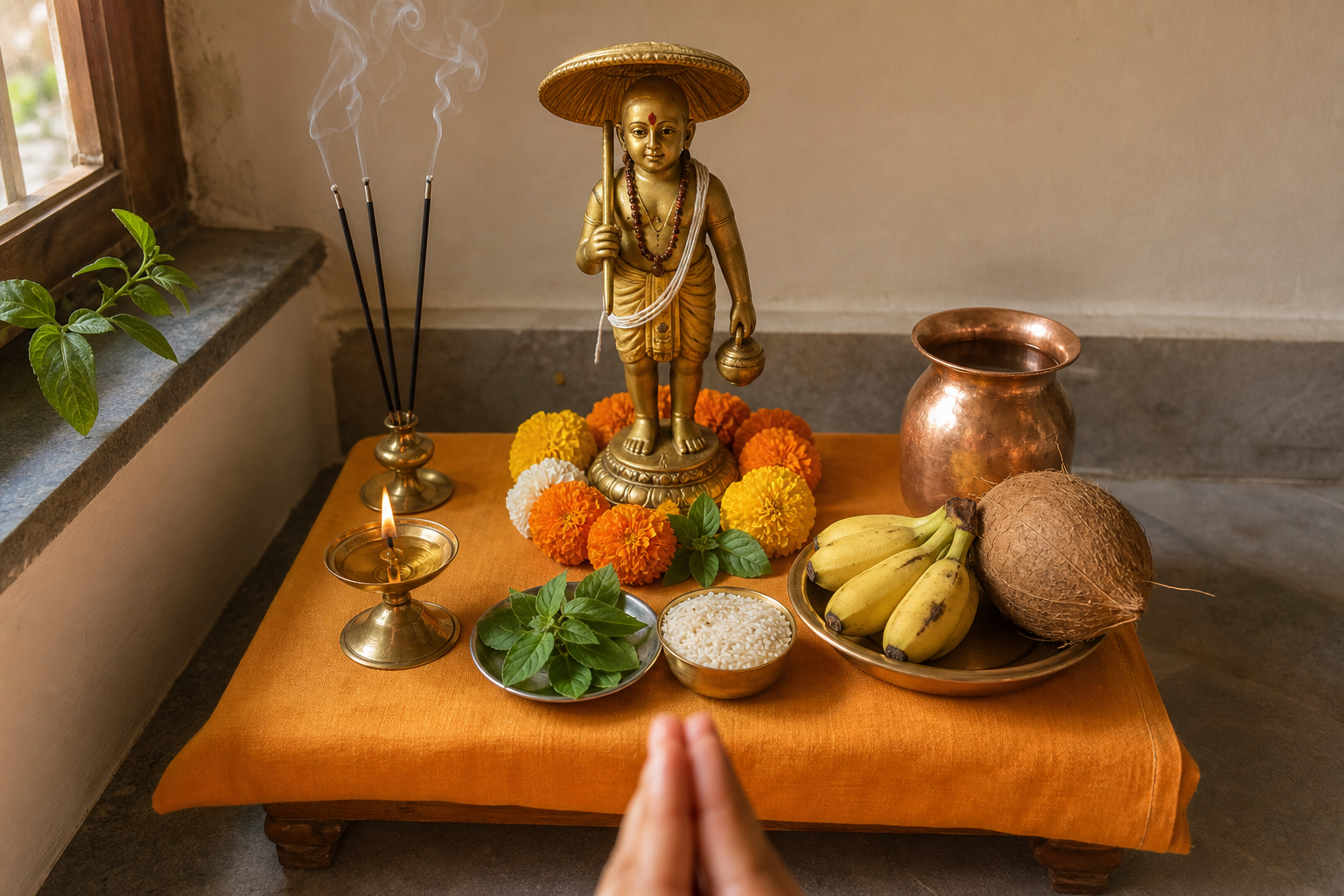
Vamana Dwadashi in Chaitra is a vrata centered on Lord Vamana, Vishnu’s fifth avatara, and on the restoration of right measure. It should not be confused with Vamana Jayanti, which many traditions observe on Bhadrapada Shukla Dwadashi as the avatara’s appearance day. If your intention is the Chaitra vrata discussed here, use the March 29 observance recognized by your local calendar.
- Begin with snana and sankalpa. State the vrata you are undertaking and remember Lord Vamana. Keep the intention concrete: humility, truthfulness, restraint, or responsible use of what has been entrusted to you.
- Prepare a simple altar. Use a clean cloth, a kalasha containing sanctified water, and tulasi where available. Worship an image of Vamana or Vishnu, or a Saligrama if that is already part of your authorized household practice.
- Offer a restrained puja. A simple abhisheka may be followed by deepa, dhupa, and sattvic naivedya. Completeness matters more than ritual display.
- Choose one recitation you can finish attentively. Suitable choices include Vishnu Sahasranama, Purusha Sukta, a Vamana-stuti, or japa of “Om Namo Narayanaya” or “Om Vamanaya Namah.” Avoid assembling a long programme that leaves you rushing through every part.
- Match the fast to your actual capacity. Depending on health and parampara, the vrata may involve complete upavasa, fruit and water, or a simple sattvic meal after worship. Elderly, pregnant, or nursing devotees, and anyone managing a medical condition, should not turn strict fasting into a health risk; adapt it with appropriate family, spiritual, and medical guidance.
- Make dana part of the observance. Grain, clothing, annadana, support for a community kitchen, or respectful feeding of animals turns the vrata’s call for self-limitation into practical generosity.
- Conclude according to your local schedule. Do not guess the fast-breaking time from the civil date alone. Use the Parana instruction issued by the temple or Panchang whose observance date you followed.
The Vamana-Mahabali account in Srimad Bhagavatham, Canto 8, gives the day its moral center. Vamana does not answer expansion with uncontrolled destruction. His three strides restore proportion while exposing the spiritual cost of pride, possession, and power without limits. Your most useful offering may therefore be a promise you will actually keep: release something you are hoarding, fulfil an overdue obligation, or place a limit on one form of excess.
This ethic also opens a natural conversation across Dharmic traditions. Hindu restraint and dana meet the Buddhist middle path, Jain aparigraha, and the Sikh disciplines of seva and nimrata without erasing the distinct theology of any tradition. A family can use the day to teach that humility is not passivity. It is the discipline that keeps ability, wealth, and authority answerable to dharma.
Keep morning Parana and evening Som Pradosh distinct
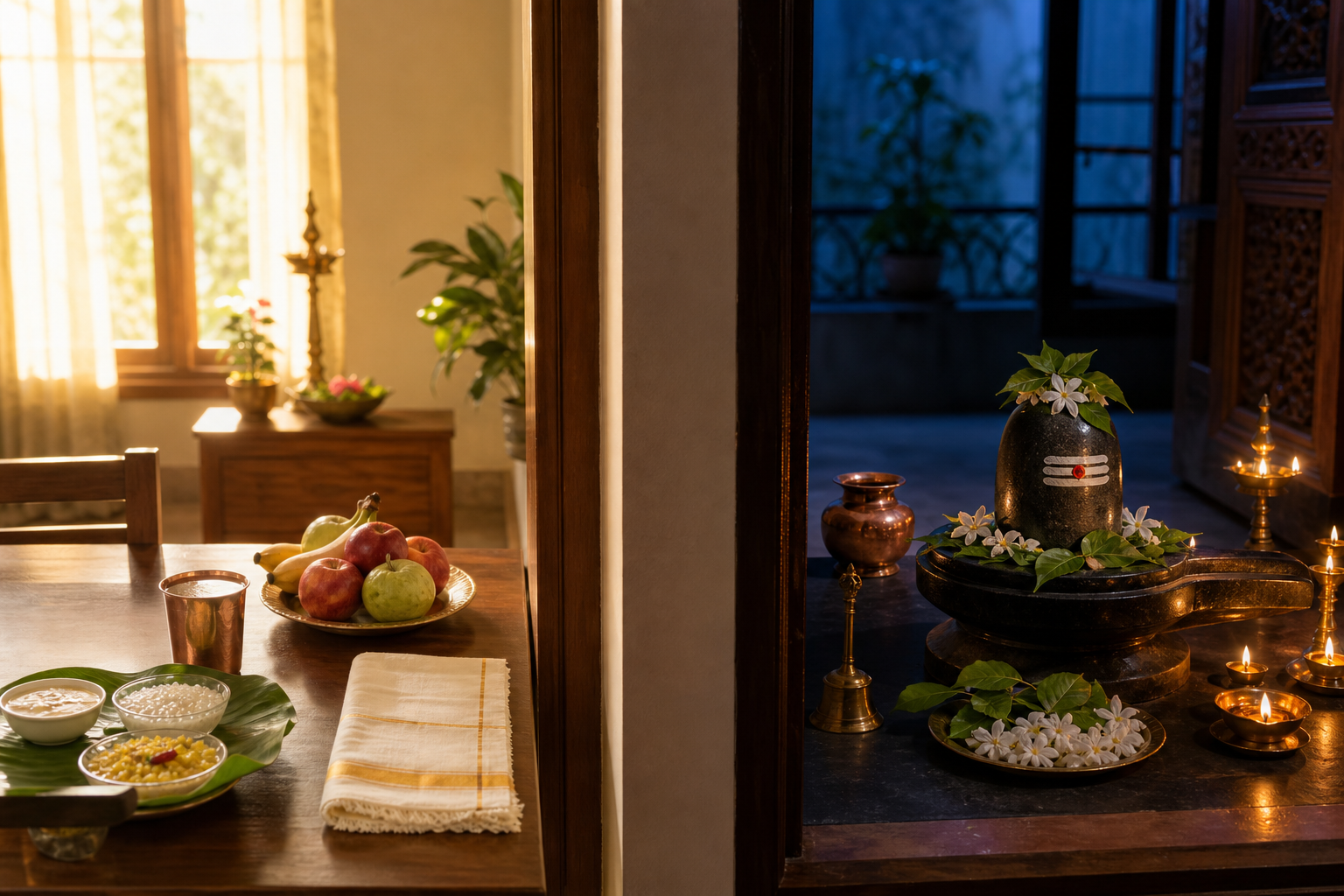
Morning: complete Parana within the permitted interval
If your regional Ekadashi schedule assigns Parana to March 30, prepare the meal and puja materials the previous night. The Dwadashi interval ending at 07:20 AM IST leaves little margin in the working Indian schedule. Waiting until after sunrise to cook, locate the correct time, or ask which ingredients are permitted can consume the available window.
First confirm that local sunrise has occurred. Then confirm that Hari Vasara has ended. Complete Parana before the locally calculated end of Dwadashi. If sunrise and the tithi boundary leave no clear interval in your location, do not improvise from the 07:20 figure; follow the ruling of your temple, guru, or authoritative regional Panchang.
Keep the meal simple and sattvic. The purpose is to conclude the vow correctly and gratefully, not to replace restraint with a hurried feast. Preparing water, permitted food, serving vessels, and any intended offering in advance lets you act calmly when the window opens.
Evening: worship Shiva during local Pradosha kala
After Dwadashi ends, Trayodashi governs the rest of March 30 in the working Panchang. Because Trayodashi prevails at sunset and the civil weekday is Monday, the evening carries Som Pradosh. Center the worship on the local Pradosha kala rather than treating the entire evening as equally timed.
A household observance can remain concise: bathe or wash before worship, light deepas, offer water or perform Shiva abhisheka according to family practice, recite a Shiva stotra or mantra, and offer naivedya. If you attend a temple, its announced abhisheka and aarti schedule should take precedence over a general calculation.
The Vaishnava discipline associated with Dwadashi and the Shaiva worship of Som Pradosh need not be collapsed into one ritual. Let each retain its own sankalpa and timing. Completing a vow in the morning and turning toward Shiva in the evening expresses a familiar Dharmic unity: fidelity to distinct forms of worship without treating them as rivals.
Quick answers before you set the alarm
Is Chaitra Dwadashi on March 29 or March 30 in 2026?
Use March 29 for Vamana Dwadashi vrata in most Panchangs. Dwadashi continues into March 30 in the working IST calculation, ending at 07:20 AM before Trayodashi begins. The named observance date and the precise tithi boundary answer different ritual questions.
Can you use 07:20 AM wherever you live?
No. It is an IST timing subject to regional and calendrical variation. Use your actual city and the same Panchang tradition that supplied your vrata or Ekadashi date. This is especially important when calculating a short Parana window.
Which timing determines Som Pradosh?
Trayodashi must prevail at sunset, and worship is centered on the local Pradosha kala around sunset. March 30 meets that condition in the working 2026 schedule and falls on Monday, giving Som Pradosh.
Do you need every Panchang limb before beginning?
For the decisions covered here, establish the vrata date, local sunrise, Dwadashi end, Hari Vasara end, local sunset, and Pradosha kala first. Nakshatra, Rashi, Yoga, Karana, Choghadiya, and avoidance periods can refine other activities, but collecting them should not make you miss the time-sensitive observance.
Before March 29, put these timings on one card and place the necessary puja and Parana materials together. If your city’s schedule differs from the general plan, let the local Panchang or temple timetable decide. Precision should protect the sankalpa, leaving your attention free for worship, dana, and the restraint that gives Dwadashi its meaning.
References
- DharmaRenaissance Blog — March 30, 2026 Panchang: Shukla Dwadashi to Trayodashi, Som Pradosh, Auspicious Timings
- DharmaRenaissance Blog — Vamana Dwadashi 2026: Auspicious Date, Puja Vidhi, Fasting Guide, and Dharmic Significance