

You may have come to Laghima through accounts of yogis becoming weightless or rising from the ground. The practical question, however, is not whether you can force the body to defy gravity. It is whether your sadhana is making you less governed by tension, inertia, clutter, resentment, and the need to appear spiritually exceptional.
That distinction lets you approach Laghima with reverence and discernment. You do not have to dismiss the traditional siddhi, but you also do not have to turn an extraordinary claim into a personal experiment. Begin with what you can actually notice: easier posture, quieter breathing, clearer attention, less grasping, and more freedom in the moment before you react.
The first decision: spectacle or sadhana?
The Sanskrit word laghu carries the senses of light, subtle, agile, and easy to move. Laghima is classically counted among the eight siddhis: anima, mahima, garima, laghima, prapti, prakamya, ishitva, and vashitva. In its most extraordinary reading, Laghima is the capacity to make the body exceedingly light. In disciplined practice, it also names a progressive refinement of the whole body-mind field.
The two meanings should neither be carelessly collapsed nor forced into opposition. Traditional descriptions can retain their metaphysical meaning while you work with the accessible dimensions of lightness. A subjective feeling of buoyancy after pranayama is not proof that your physical mass has changed. Nor does a modern account of breathing, posture, balance, and bodily perception exhaust what a siddhi means within Hindu metaphysics.
The Yoga Sutra does not present the same eightfold list in that form. It describes related vibhutis arising through samyama, the integration of dharana, dhyana, and samadhi. Mastery of udana vayu is associated with ascent and unusual lightness. This setting matters: the power belongs within concentrated inner discipline, not within a stunt, a shortcut, or a test performed to satisfy curiosity.
You can therefore separate three questions that are often confused:
- What does the tradition permit? It preserves accounts of extraordinary yogic capacities.
- What can you responsibly verify in ordinary practice? You can observe changes in effort, breath, movement, attention, attachment, and conduct.
- What is worth pursuing? The lightness that reduces ego and increases freedom is spiritually useful whether or not anything unusual occurs.
This gives you a firm boundary. Do not jump from heights, restrict breathing, fast aggressively, or force advanced techniques in an attempt to prove Laghima. Such acts test the body, not realization. If an experience is genuine, it does not need reckless confirmation.
Yogic lightness rises from a stable foundation
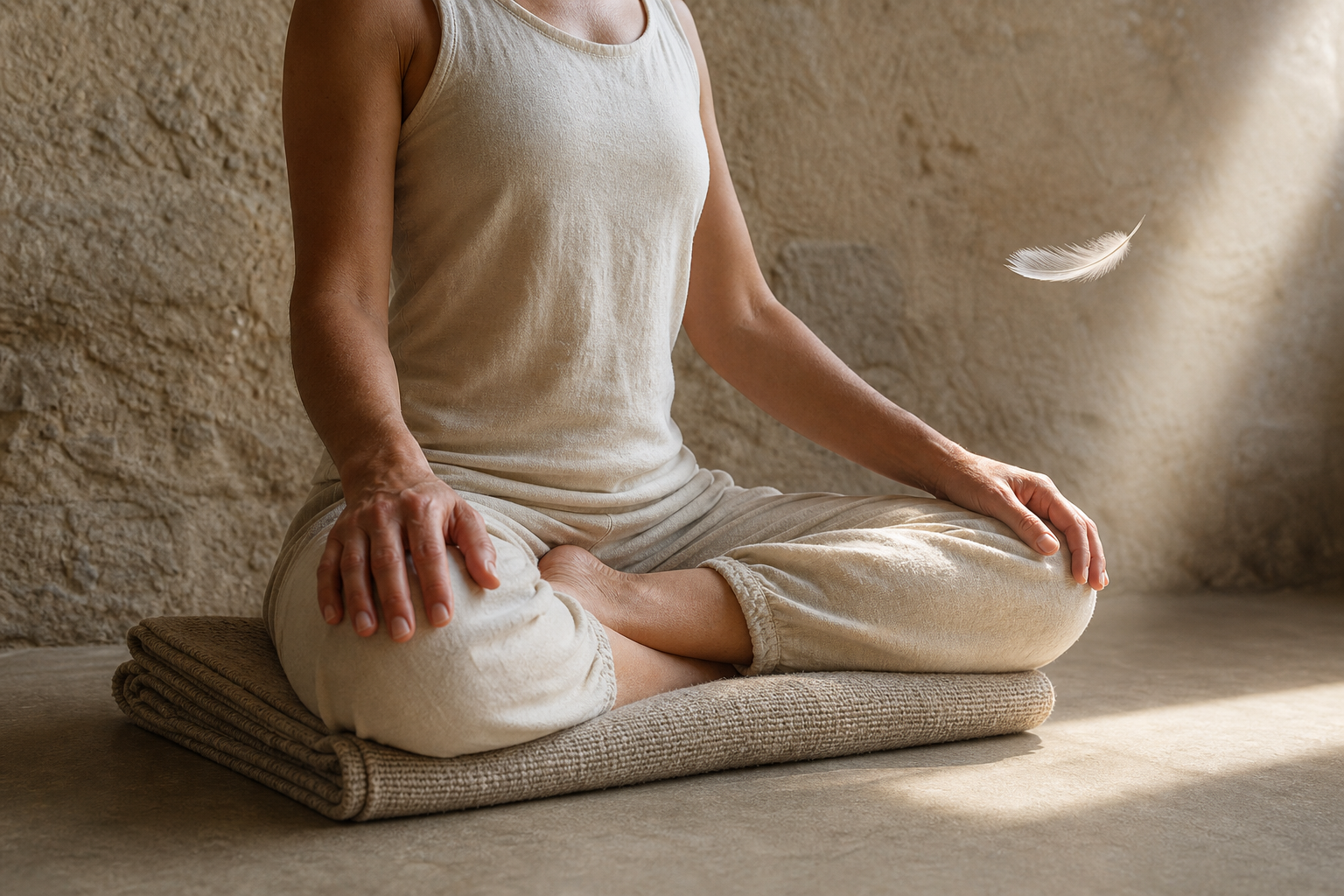
Yoga names five principal pranic currents: prana, apana, samana, udana, and vyana. Udana is the current most closely connected with ascent, speech, expression, and the felt lift through the upper body. Yet udana does not become healthy by overpowering everything that moves downward. It must remain in relationship with apana, the grounding current.
This corrects a common mistake. Upward sensation is not automatically spiritual progress. If you feel airy but cannot sense your feet, agitated rather than clear, or fascinated by the sensation rather than present to reality, you may have produced imbalance rather than Laghima. Authentic lightness does not make you vague. It makes you more available.
The gunas offer another diagnostic. Tamas becomes heaviness as inertia, dullness, and avoidance. Rajas produces another kind of burden through restless striving, overactivity, and compulsive thought. Sattva brings luminosity, balance, and intelligibility. The aim is not to hate everything heavy or to chase a permanently elevated mood. It is to reduce tamasic obstruction and rajasic agitation so that sattvic clarity can prevail.
Try a simple grounding test whenever a practice gives you a strong feeling of uplift. Can you still feel the contact of your feet or seat? Is your breathing quiet? Can you orient to the room without irritation? Can you answer an ordinary question plainly? If not, return to natural breathing and physical contact with the ground. The ability to come back matters as much as the ability to rise.
Ethical practice supplies the deeper foundation. Ahimsa lightens the aggression you otherwise have to carry. Satya removes the burden of maintaining falsehood. Asteya reduces covetous comparison. Brahmacharya gathers energy that would be scattered through compulsion. Aparigraha loosens the reflex to hold, accumulate, and defend. The niyamas further refine the practitioner through purity, contentment, disciplined effort, self-inquiry, and devotion.
These are not ceremonial preliminaries to be discarded once pranayama becomes interesting. They reveal whether the practice is actually working. A buoyant meditation followed by harsh speech is not mature lightness. The unresolved reaction is the heavier fact.
A safe practice for experiencing lightness without strain
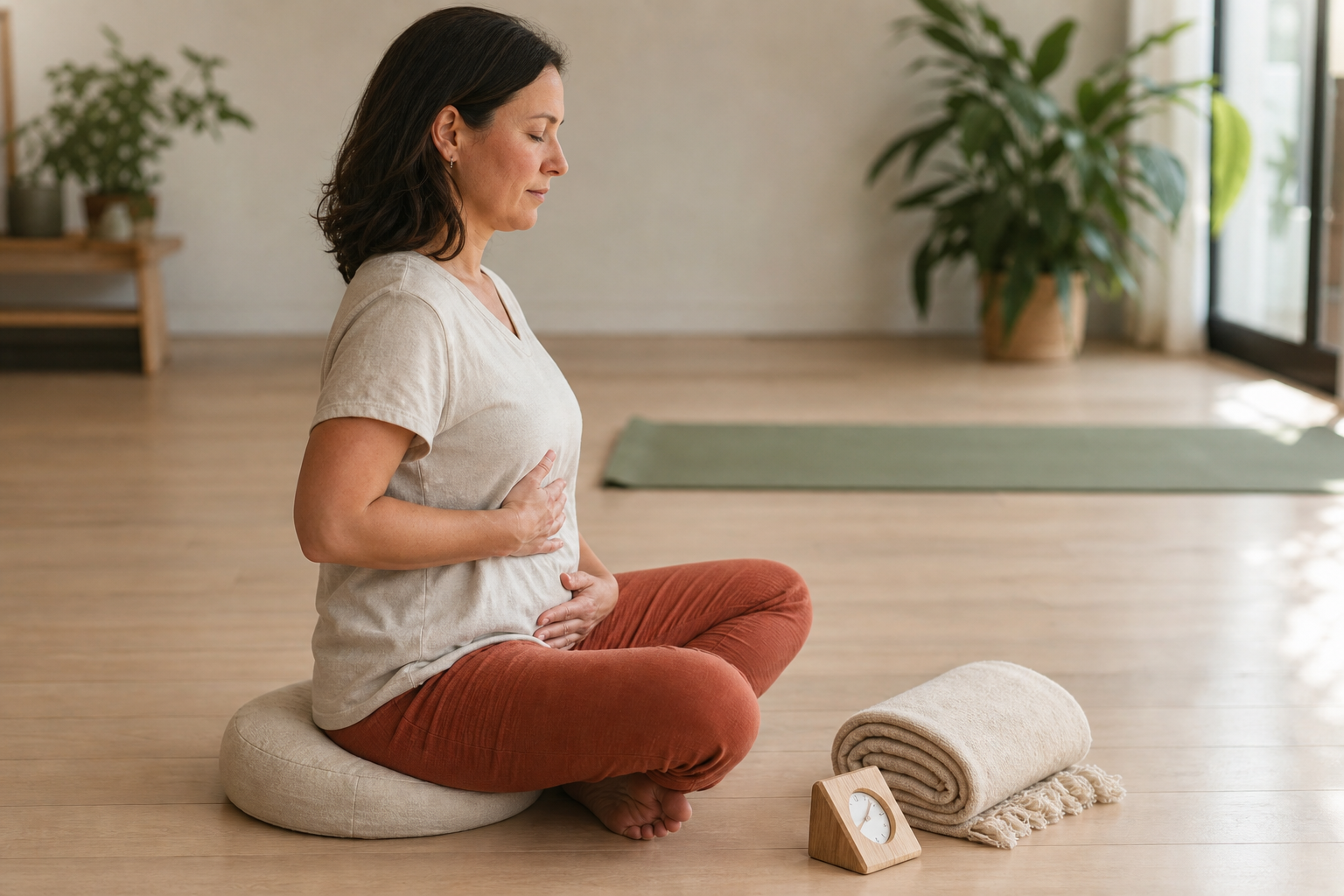
The following sequence works with posture, unforced breathing, and spacious attention. It deliberately excludes breath retention, forceful bandhas, advanced mudras, and attempts at levitation. Its purpose is to help you recognize the ordinary experiential signature of Laghima while remaining grounded.
Begin with weight rather than trying to escape it
- Stand in Tadasana with the feet placed steadily. Notice the heel, the base of the great toe, and the outer forefoot. Let the knees remain responsive rather than rigid.
- Allow the crown of the head to rise while the soles continue to descend. Do not lift the chin or pull the shoulders back. Think of length, not military stiffness.
- Soften the jaw, tongue, eyes, shoulders, hands, and lower abdomen. Release only effort that is unnecessary; do not collapse the spine.
- Observe whether the body now feels both supported and easier to carry. That simultaneous grounding and lift is more relevant than an exotic sensation.
If standing is uncomfortable, use the same principles while seated in a stable chair: feet supported, spine naturally long, jaw soft, and hands at rest. Persistent pain, unexplained weakness, or unusual fatigue should not be spiritualized as blocked prana. A qualified health professional can assess physical symptoms that need medical attention.
Choose one gentle breathing method
First let the breath settle by itself. Then allow the exhalation to become slightly longer and smoother than the inhalation, but only while both remain comfortable. Do not maximize the exhale. The relevant sign is reduced effort, not an impressive duration.
You can continue with either Nadi Shodhana or Bhramari:
- For gentle Nadi Shodhana, close the right nostril lightly and inhale through the left. Change sides and exhale through the right; inhale through the right, change sides, and exhale through the left. Keep the breath at an ordinary, unforced volume and omit retention.
- For Bhramari, inhale naturally and make a soft, steady humming sound on the exhale. Let the vibration spread through the face and chest without pushing for volume.
Continue only while the breath remains smooth. If the exhale becomes rough, the next inhale feels urgent, or you become dizzy or panicky, stop the technique and return to normal breathing. Chest pain, fainting, or unusual breathlessness requires prompt medical attention, not perseverance in pranayama.
Let attention become spacious without leaving the body
After the breathing practice, rest attention in akasha, the quality of space. Notice the room around the body, the space above the head, the openness across the chest, and the small intervals between thoughts. Do not squeeze attention into the crown or manufacture an upward rush. Spaciousness should include the feet, the seat, and the breath.
End by pressing the feet or seat gently into their support, opening the eyes fully, and looking around the room. Then stand or walk normally. This closing step teaches the nervous system that clarity and ordinary embodiment belong together.
Kumbhaka, uddiyana bandha, jalandhara bandha, and khechari-related methods belong to more specialized training. Their pressures and effects should be learned from a competent teacher who can assess readiness and correct technique. Breath hunger, forceful abdominal locking, or manipulation of the tongue and throat is not a sensible self-directed route to Laghima.
Carry less into meals, speech, possessions, and service

Ayurveda uses laghu and guru as practical qualities of lightness and heaviness. This does not mean that light food is morally pure and nourishing heaviness is bad. It means that food, quantity, timing, digestive capacity, and present need affect how much work the body must do. If meditation repeatedly becomes dull after a large or poorly timed meal, change the load instead of blaming your concentration.
Start with observation rather than an aggressive fast. Notice which meals leave you comfortably nourished and able to sit without torpor, reflux, or agitation. Prefer digestible food and timely eating when appropriate to your constitution and health. Fasting is not required for this practice and can be harmful in some circumstances; anyone with a medical condition or a history of disordered eating should seek individualized professional guidance rather than adopting a generic restriction.
The same lightening principle applies outside diet. Choose one form of load that you repeatedly carry and make one concrete change:
- If the load is cognitive, remove one recurring stream of noise before meditation rather than trying to overpower its after-effects.
- If the load is relational, prepare one truthful sentence that does not carry an extra barb. Light speech is not evasive speech; it communicates without adding avoidable injury.
- If the load is material, release an object you keep only from fear, status, or habit. Use the moment to observe the grasping response rather than merely tidying a room.
- If the load is moral, acknowledge a specific harm, repair what can be repaired, and resolve not to repeat it. An unexamined conscience can remain heavy even when the breath feels refined.
- If the load is social importance, perform a useful act of service that brings no display or special recognition.
The Dharmic traditions preserve different metaphysical commitments, so their teachings should not be flattened into one system. They nevertheless offer a strikingly consistent test for spiritual lightness. Buddhist analysis speaks of kaya-lahuta and citta-lahuta, wholesome lightness of body and mind associated with collectedness. Jain discipline places aparigraha at the center of releasing material and mental accumulation, while practices such as pratikraman clear remorse through review and correction. Sikh wisdom warns against becoming captivated by ridhi-sidhi; remembrance of Naam, humility, and seva matter more than occult display.
For you, the shared diagnostic is direct. Does the practice reduce self-importance? Does it free attention for truth and service? Can you release a possession, an insult, a defensive story, or the wish to be admired? If your interest in Laghima makes you feel superior, it has added weight under a spiritual name.
Key takeaways: what genuine progress looks like
- Laghima belongs to the classical siddhi tradition, but an everyday feeling of buoyancy is not proof of levitation or reduced physical mass.
- Healthy uplift balances udana with grounding. You should become clearer and more present, not unsteady, agitated, or detached from ordinary responsibilities.
- A safe starting point combines axial length, relaxed unnecessary effort, smooth breathing, a comfortably extended exhale, and attention to spaciousness.
- Nadi Shodhana without retention and gentle Bhramari can support the practice. Strain, air hunger, dizziness, or panic means you should stop and return to natural breathing.
- Advanced kumbhaka, bandhas, and khechari-related methods require competent guidance. They are not shortcuts and should not be used to test extraordinary claims.
- The strongest evidence of progress appears in conduct: less reactivity, less grasping, cleaner speech, easier repair after harm, and greater willingness to serve.
At your next sitting, make just one experiment: let the body be fully supported while the spine rises without strain. Then look for the result later, in the first difficult exchange or inconvenient task of the day. If you find a little more space before reaction and use it wisely, you are already working with the part of Laghima that can transform a life.