

Your calendar may show Chaitra Purnima on Wednesday, April 1, and a Hindu New Year on April 14. Both dates are correct. They are not competing claims about when the year begins: the first marks the culmination of a lunar fortnight, while the second is anchored to the Sun’s entry into Mesha.
The most useful way to observe them is as two connected checkpoints. Let Chaitra Purnima close what has run its course. Then use the following thirteen days to prepare for a deliberate solar New Year sankalpa rather than making hurried resolutions on festival morning.
Two dates are tracking two different celestial clocks
A tithi measures the changing angular relationship between the Sun and Moon. A Sankranti marks the Sun’s passage into a new sidereal rashi. Because the lunar and solar calculations answer different questions, Chaitra Purnima and Mesha Sankranti do not need to occur on adjacent days.
| Date in 2026 | Calendar marker | What it means | How to use it |
|---|---|---|---|
| April 1 | Chaturdashi gives way to Purnima | The bright lunar fortnight reaches fullness | Complete vrata, worship, dana, reflection and unfinished duties |
| April 14 | Mesha Sankranti | The Sun enters sidereal Mesha and the first solar month begins in Sauramana traditions | Make the New Year sankalpa, hear the Panchangam and begin the household’s regional observance |
The monthly label also depends on the calendar convention your family follows. In the Purnimanta system common in North India, the April 1 full moon concludes Chaitra. In the Amanta system used across much of western and southern India, the full moon occurs within Chaitra rather than ending it. This is a difference in the placement of the month boundary, not a disagreement about the full moon itself.
There is another distinction worth keeping clear: Chaitra Purnima is not Chandramana Ugadi. The lunar New Year observed in parts of Karnataka, Andhra Pradesh and Telangana begins on Chaitra Shukla Pratipada. The April 14 observance is Sauramana Ugadi, determined by Mesha Sankranti and the solar reckoning. Calling all three occasions simply Ugadi hides the very calendar logic that gives each one its meaning.
Plan your April 1 observance from a city Panchang
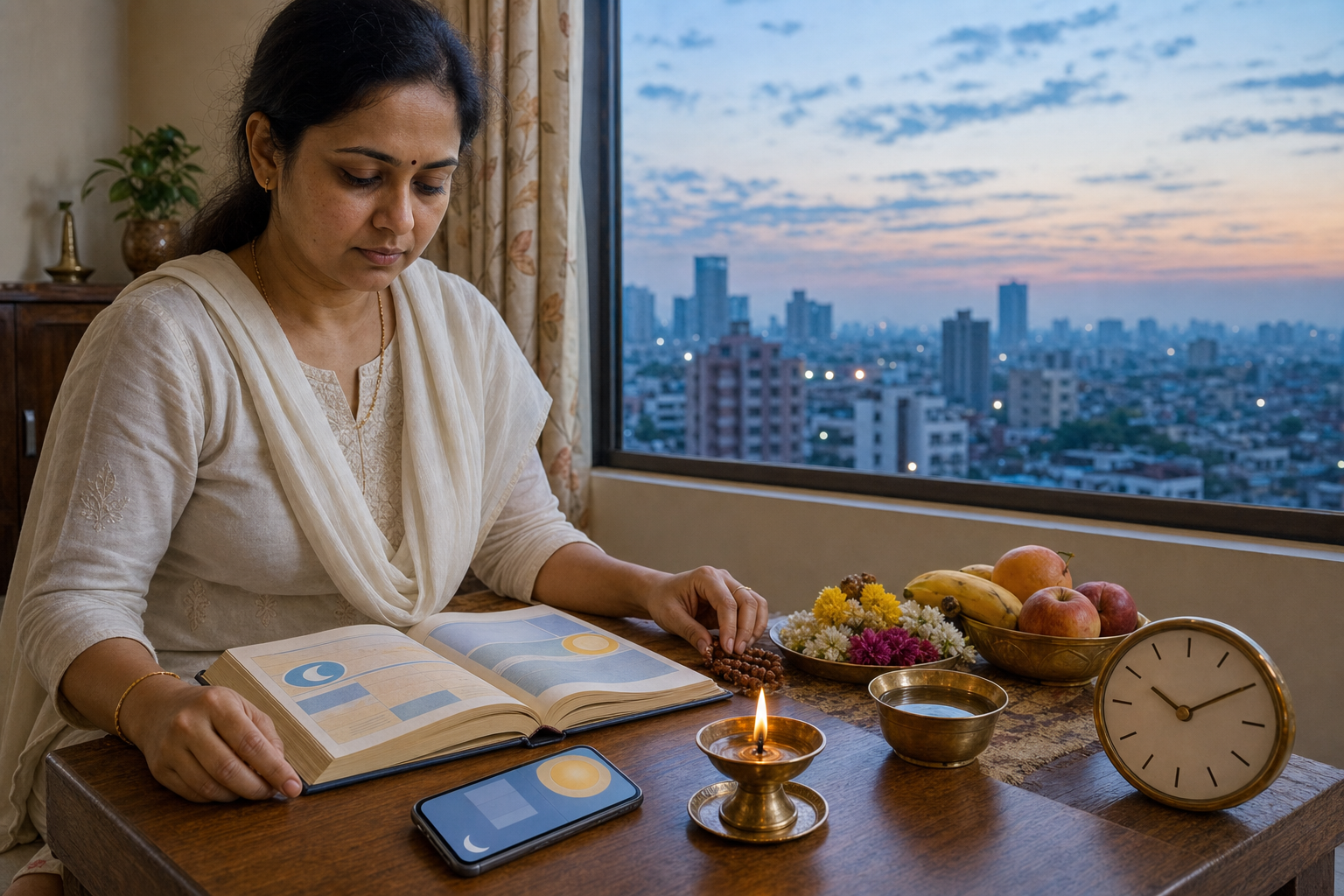
Across much of Bharat, Shukla Chaturdashi is expected to continue until about 6:15 AM on April 1, after which Purnima prevails for the rest of the civil day. That time is a broad reference, not a universal ritual deadline. Longitude, latitude and the computational tradition of an almanac can move a tithi boundary by several minutes. When a vrata or temple rite depends on the tithi at dawn, your city-based Panchang should govern.
- Choose one trusted Panchang calculated for your city. Do not average the times from almanacs prepared for different locations.
- Write down sunrise, the Chaturdashi-to-Purnima transition, moonrise, Nakshatra and the Moon’s Rashi for the actual time of your puja. Around this full moon, an almanac may record Chitra Nakshatra and a movement from late Kanya into early Tula, so copy the local entry rather than relying on memory.
- Decide which inherited observance you are following. Satyanarayan Puja is widely performed on Chaitra Purnima, while several regional traditions celebrate Hanuman Jayanti. Follow your family’s sampradaya or temple calendar rather than treating every regional custom as mandatory.
- Make the vrata sankalpa before beginning the discipline. Keep it specific: name the vrata, the purpose of the worship and the dana you will offer. Grains, ghee and clothing are customary forms of giving associated with the day.
- Reserve the evening for completion. Moonrise is ordinarily near local sunset on Purnima, allowing Chandra darshan after twilight. A lamp, an offering of water, japa and quiet recitation can form a complete household observance when an elaborate puja is not practical.
- If you fast, conclude it according to the vrata method followed in your home. Complete the sankalpa and worship first; do not infer a breaking time from the date alone when your tradition requires a particular tithi or moonrise condition.
Use muhurat rules without turning the day into a maze
Rahu Kalam does not make every minute within it spiritually unusable. It is ordinarily avoided for the first step of a new undertaking, such as beginning a journey, opening a business or making a major purchase. On a Wednesday it occupies the fifth eighth of the daylight interval. If daylight were exactly 6:00 AM to 6:00 PM, that would produce a notional window of noon to 1:30 PM; April 1 timings must instead be calculated from the actual local sunrise and sunset.
Abhijit Muhurat is centered on true local solar noon and extends approximately twenty-four minutes on either side. It may be used when another suitable muhurat is unavailable, but marriage and upanayana are commonly excluded from that rule. Clock noon is not necessarily true solar noon, so a generic 12:00 PM entry is not precise enough for a consequential samskara. Yoga and Karana can also change within the civil day; rites near a boundary need the local combination of tithi, Nakshatra, Yoga and Karana.
For ordinary Purnima worship, begin with the observance itself rather than anxiety about every calendrical blemish. A family already engaged in japa, puja, dana or contemplation is not starting a commercial venture. Apply each timing rule to the kind of action it was intended to govern.
Use the thirteen-day interval as a dharmic year-end
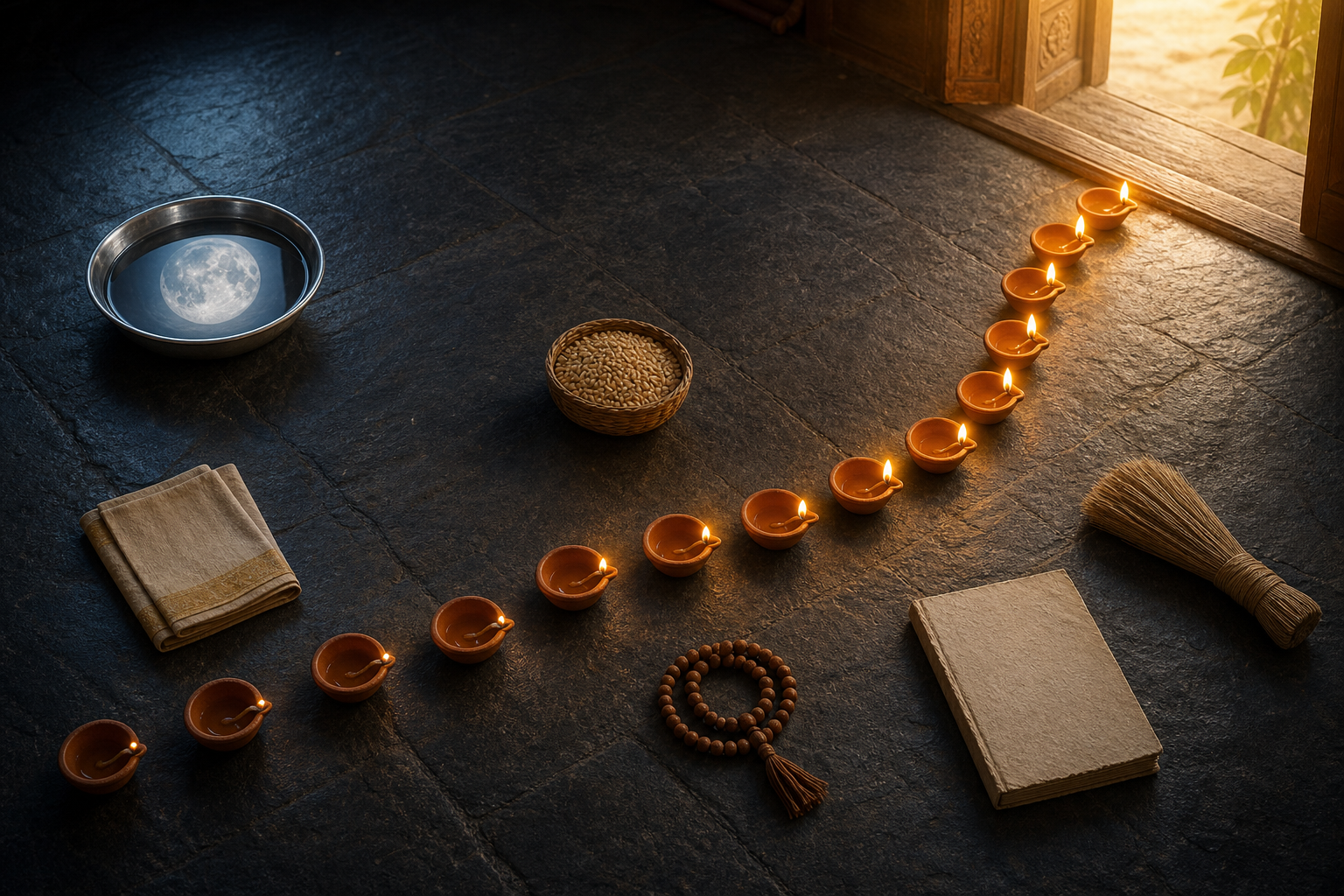
The space between April 1 and April 14 gives you something a single New Year’s morning cannot: time to convert reflection into preparation. Treat Purnima as the closing balance and Mesha Sankranti as the opening entry.
- On April 1, name one duty that should not be carried silently into the next cycle. Complete it if you can. If another person is affected, communicate a concrete next step instead of making a private resolution.
- During the first few days, reconcile household obligations and accounts. Note unpaid dues, borrowed objects, promised help and charitable commitments. A clean ledger is more useful than a vague wish for prosperity.
- Clear and prepare the puja space. Check lamps, oil, wicks, incense, vessels and the items required by your regional New Year custom. This prevents festival morning from becoming a search for supplies.
- Ask an elder or temple which regional convention your household follows, especially if your family now lives outside its ancestral region. Confirm whether community worship follows the exact Sankranti, a sunrise rule or a publicly scheduled festival day.
- Before April 14, write one New Year sankalpa and its first visible action. A promise to study becomes a chosen text and a regular study period. A promise of seva becomes a named recipient, place or household duty.
Test the sankalpa against the four purusharthas
A resolution is easier to trust when it does not enlarge one part of life by damaging another. Use four questions before accepting yours:
- Dharma: Which real duty will this help you perform more faithfully?
- Artha: Is the required prosperity or material support being pursued honestly and within your means?
- Kama: Does the desire support a harmonious life, or merely add appetite and comparison?
- Moksha: Will the commitment leave room for silence, study, japa, meditation or freedom from an unhelpful attachment?
You do not need four separate resolutions. One well-formed commitment can respect all four aims. For example, a disciplined study plan may serve family responsibility, require only modest resources, satisfy the desire to learn and deepen spiritual understanding.
Recognize shared rhythms without erasing distinctions
Full-moon discipline reaches beyond one Hindu observance. Buddhist communities intensify sila and meditation on Uposatha; Jain practice may include vrata, pratikraman and self-examination. Sikh practice is not governed by lunar tithis, although seva, simran and kirtan may coincide with community gatherings. The honest point of unity is a recurring commitment to restraint, remembrance and service, not a claim that all traditions use one calendar or perform one rite.
Observe April 14 through your regional solar tradition
Sauramana Ugadi 2026 falls on April 14, when the Sun enters sidereal Aries, or Mesha. This is why the date does not coincide with the March equinox of the tropical zodiac. Sidereal calculation applies an ayanamsha, and small differences in the chosen ayanamsha or ephemeris can alter the recorded ingress time. The festival date is broadly shared, but the exact Sankranti and Punya Kala still belong to the regional Panchang.
Punya Kala is the auspicious interval associated with the ingress for snana, dana, japa and vrata. Because the astronomical ingress can occur before or after sunrise, a temple may apply a sunrise-based rule when assigning public worship. Confirm the local schedule instead of assuming that midnight begins the religious New Year.
- Before the festival, record the exact Sankranti, Punya Kala, sunrise and temple schedule from the same regional almanac.
- Bathe at the locally prescribed time or near sunrise, then offer prayer to Surya and your Ishta Devata.
- Perform dana suitable to your means and region. Choose something useful enough to be an act of service, not merely an item placed beside the altar.
- Hear or read the Panchangam. Pay attention to the year’s calendrical framework, but turn prediction into responsibility: ask what the coming cycle requires from your household.
- State the sankalpa prepared during the preceding thirteen days and perform its first action that day.
- Join the regional celebration through temple darshan, seva, kirtan, a family meal or a community gathering. The household rite and public festival can support each other without having identical timings.
Keep the local form instead of assembling a generic festival
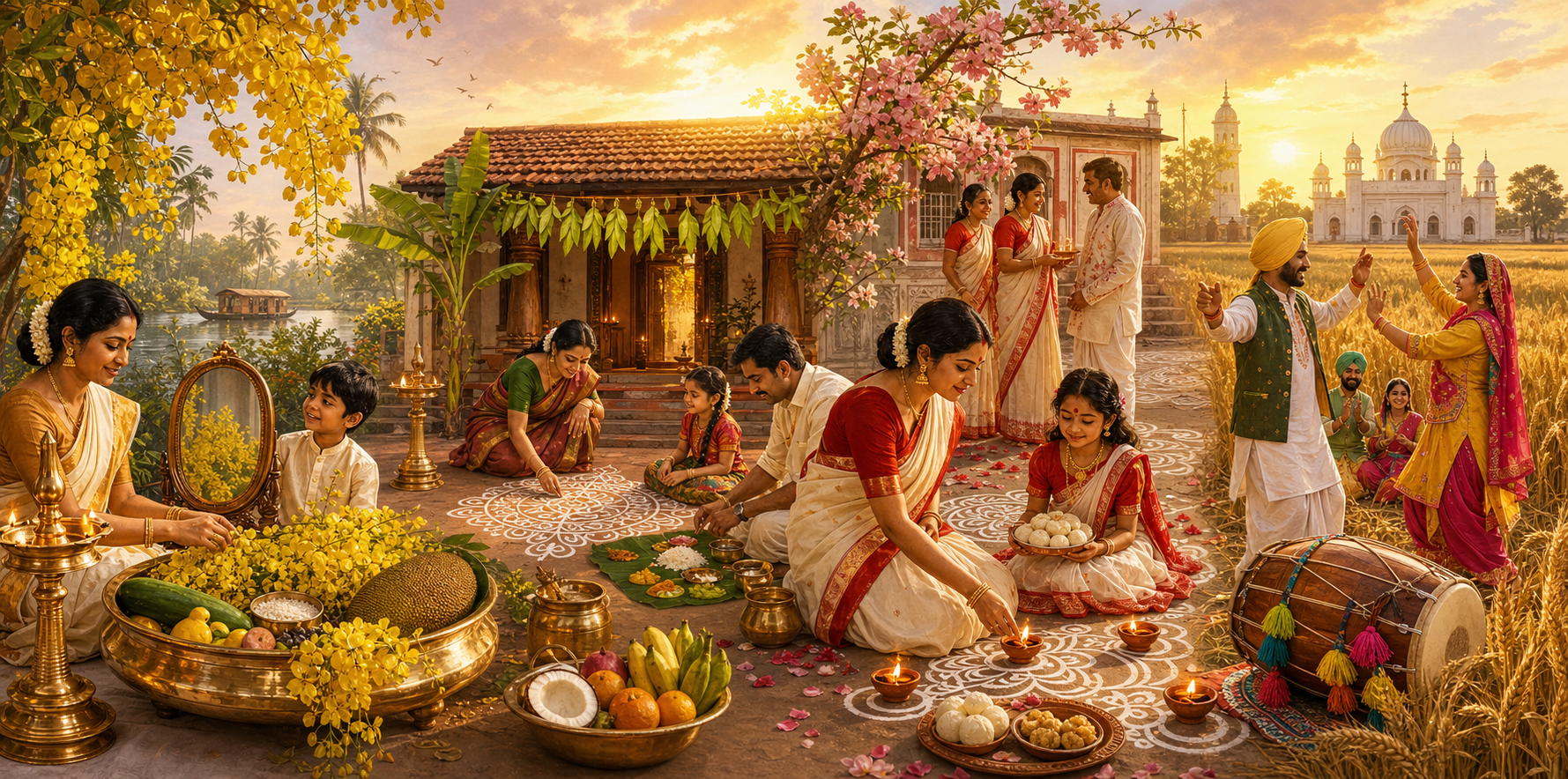
The same solar threshold has developed distinct forms across Bharat. Choose the form carried by your family and region; learning about neighboring traditions should deepen respect, not turn sacred customs into interchangeable decorations.
- In Tamil tradition, Puthandu or Varusha Pirappu may include kolam, mango-leaf thoranam, lamps, temple darshan, Panchanga vasanam and maangai pachadi. Its combination of tastes gives the household a concrete reminder that the coming year will not contain sweetness alone.
- In Kerala, Vishu centers on the Vishu Kani viewed at Brahma Muhurta. The arrangement may include kani konna blossoms, a nilavilakku, grains, fruit, gold, a mirror and sacred texts, followed by gifts from elders and a festive meal.
- In Odisha, Pana Sankranti or Maha Vishuba Sankranti emphasizes bathing, charity and pana, often prepared as a cooling jaggery-based drink with bael and other aromatics.
- Across Punjab and parts of North India, Vaisakhi joins the solar and harvest season with gurdwara worship, kirtan, seva, processions and collective meals. Its Sikh significance also recalls the formal inauguration of the Khalsa in 1699.
- In Bengal, Pohela Boishakh includes cultural observance and the opening of new ledgers, or haal khata. Assam welcomes the agricultural season through Rongali or Bohag Bihu. These are related by the solar turn without becoming the same festival.
The mid-April New Year cluster also reaches Nepal and Sri Lanka, while Songkran in Thailand, Thingyan in Myanmar, Pi Mai in Laos and Chol Chnam Thmey in Cambodia occupy the same seasonal horizon. This civilizational breadth is best understood as kinship expressed through local histories. It should not be flattened into a claim that every community follows an identical doctrine, calculation or ritual sequence.
Key takeaways for your 2026 observance
- Mark April 1 as lunar culmination and April 14 as solar renewal; you do not need to choose between them.
- Use a city-specific Panchang whenever a tithi, Sankranti, Punya Kala, moonrise or muhurat boundary affects your rite.
- Do not mistake Purnimanta and Amanta month labels for conflicting full-moon dates.
- Apply Rahu Kalam chiefly to the start of new undertakings; do not let a generic interval displace the day’s central worship.
- Use the thirteen-day gap to settle obligations, prepare the altar, confirm the regional convention and give your sankalpa a first action.
- Practice dharmic unity through mutual recognition and seva while preserving the names, histories and disciplines of each tradition.
Before you close your calendar, make two entries now. Under April 1, write the duty, vrata or act of giving you will complete. Under April 14, write the New Year sankalpa and the first action that will make it real. Then add the four local timings you still need to verify: sunrise, the Purnima boundary, Sankranti and Punya Kala.
References
- DharmaRenaissance Blog — April 1, 2026 Panchang: Shukla Chaturdashi to Chaitra Purnima, Nakshatra, Rashi & Muhurat
- DharmaRenaissance Blog — April 14 Sauramana Ugadi 2026: Mesha Sankranti, Tamil Puthandu, and Solar New Year Guide