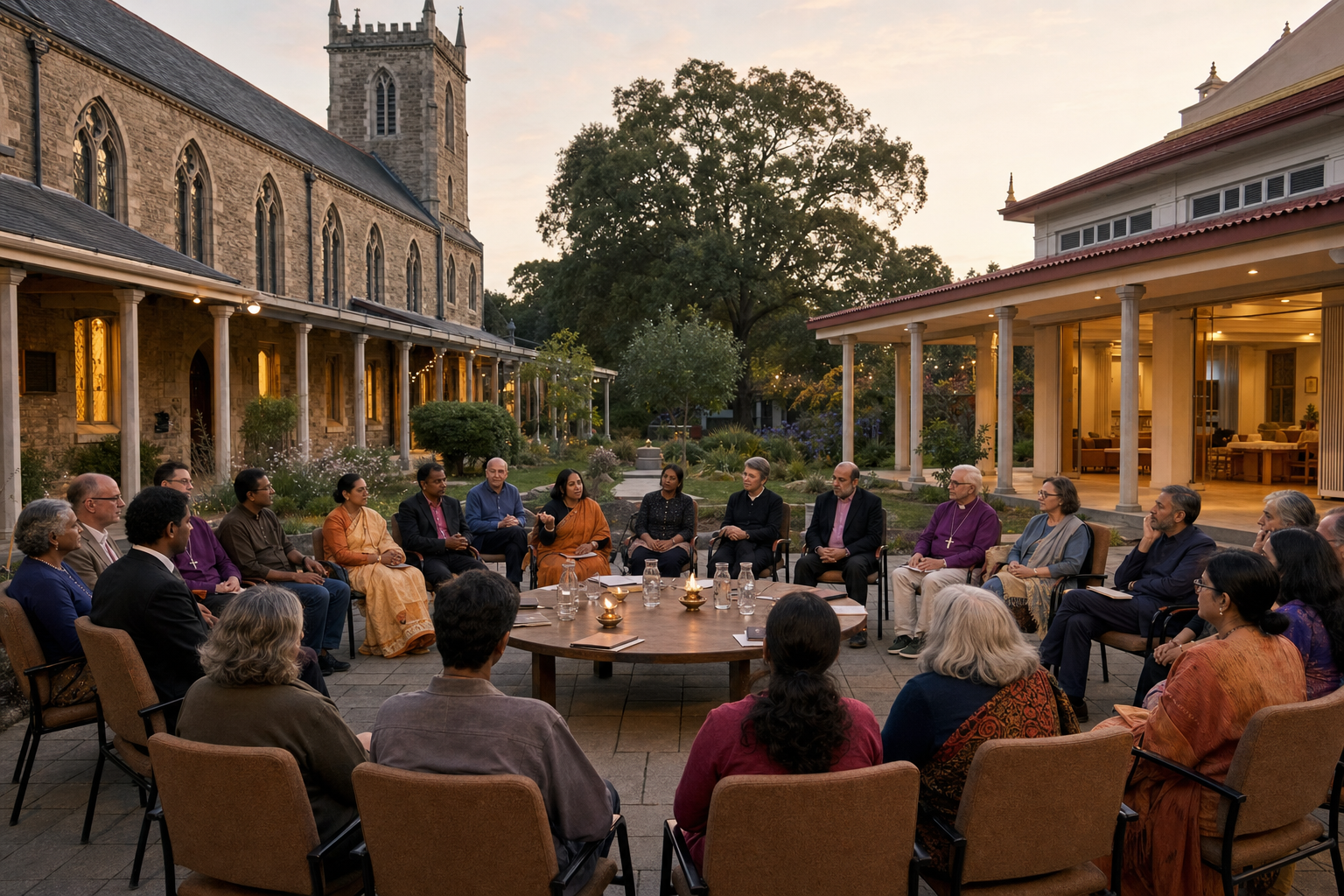
If you saw Canterbury’s historic installation and wondered whether it represented continuity, rupture, or a carefully staged compromise, don’t settle for any of those labels too quickly. The more useful question is whether inherited authority can accommodate reform without turning unity into a demand for silence.
On 25 March 2026, Dame Sarah Mullally became the first woman installed on the Chair of St Augustine. The occasion matters beyond Anglicanism because it puts three difficult tasks in the same frame: preserving a lineage, changing who may embody its authority, and holding together people who do not interpret that change in the same way.
Why the Chair of St Augustine is more than a ceremonial seat
An installation is not simply a celebration of the person receiving an office. In Christian ecclesiology, a cathedra is the principal symbol of a bishop’s pastoral and teaching authority. The Chair of St Augustine recalls the mission of Augustine, sent in 597 CE, and the establishment of Canterbury as a foundational centre of English Christianity.
Seating a leader there expresses jurisdiction, stewardship and responsibility. It connects a living officeholder to an inherited institution. That is why the event cannot be understood merely as a modern statement about representation. It placed a woman inside one of the tradition’s most important structures of continuity.
The change also did not arrive in a single leap. The Church of England opened its episcopate to women in 2014; the Canterbury installation followed that institutional pathway. Whether someone approves of the outcome or not, the sequence matters. Durable religious reform normally has to pass through the tradition’s recognised forms of interpretation, law, worship and communal deliberation.
When you assess a religious leadership change, ask three questions in this order:
- What does the office actually carry? Identify its teaching, pastoral and institutional duties before judging the symbolism.
- What has been retained? Look for continuity in worship, doctrine, succession, discipline and accountability rather than relying on the age of a building or title.
- What changed, and through which process? Distinguish an authorised reform from a gesture that has not altered the institution’s rules or practice.
This prevents two opposite mistakes. One is to treat every reform as proof that tradition has been abandoned. The other is to assume that placing a new kind of leader in an old office automatically resolves the deeper theological dispute. Neither conclusion follows from the ceremony alone.
Unity needs a clearer meaning than public agreement
The word unity often hides three different conditions:
- Institutional continuity: communities remain connected through inherited offices, councils, worship or forms of recognition.
- Doctrinal concord: communities agree on the teaching at issue and on the authority used to decide it.
- Cooperative solidarity: communities work together despite disagreements they have not settled.
These conditions can overlap, but they are not interchangeable. An installation may visibly strengthen institutional continuity. It may also create opportunities for cooperation. It does not, by itself, demonstrate universal doctrinal concord.
That distinction is especially important in an Anglican Communion spanning tens of millions of adherents worldwide. A global religious family contains different histories, social settings and judgements about authority. The appearance of harmony during one service cannot tell you how every part of that family understands the change.
When an Anglican or interfaith leader calls for unity, listen for the object of that call. Is the leader asking for agreement on doctrine, continued participation in a shared institution, civil respect, or cooperation in service? If the object remains unstated, unity can become a way of placing the burden on dissenters while leaving the actual disagreement untouched.
A more credible appeal answers three questions plainly: What remains disputed? What must be held in common for the relationship to continue? What can be done together without pretending that the dispute has disappeared? Leadership earns trust by making those boundaries visible.
The Dharmic expression Vasudhaiva Kutumbakam, the world as one family, helps here when it is read with care. A family is not a collection of identical persons. Relationship creates duties of dignity, hospitality and restraint; it does not require every member to hold the same convictions. Unity in diversity becomes meaningful when difference is protected from both hostility and erasure.
A Dharmic lens should compare methods, not collapse doctrines
Comparative religion becomes careless when a resemblance is treated as an equivalence. Christian apostolic office, Hindu understandings of Shakti, Buddhist ordination lineage, Jain renunciation and Sikh seva arise from distinct teachings. None should be used as a substitute vocabulary for another.
The sound comparison concerns method: how does a tradition recognise spiritual authority, preserve discipline, interpret precedent and respond when inherited institutions meet a new demand? That question reveals useful parallels without pretending that the theological answers are the same.
| Dharmic setting | Concrete point of reference | Leadership question it raises |
|---|---|---|
| Hindu traditions | The recognition of Shakti, women saints and scholars such as Akka Mahadevi, and contemporary women serving as gurus and teachers. | Does an institution recognise spiritual attainment and teaching competence when they appear outside an older social expectation? |
| Buddhist traditions | The bhikkhuni lineage beginning with Mahapajapati Gotami and modern efforts to strengthen women’s ordination and monastic education. | Can reform be argued through inherited discipline, lineage and communal counsel rather than detached from them? |
| Jain traditions | The major place of women ascetics, including large Shvetambara communities of sadhvis, alongside distinctive Digambara norms. | Can differences between schools remain explicit while renunciation, learning and ethical discipline continue to command respect? |
| Sikh tradition | Spiritual equality expressed through figures such as Mata Khivi and Mai Bhago, as well as women’s participation in kirtan, seva and institutional life. | Is an affirmed equality made visible through responsibility, worship and service? |
This comparison gives you a disciplined way to appreciate the Canterbury milestone without importing Anglican categories into Dharmic institutions. A Hindu does not need to turn Shakti into a Christian argument for episcopal ordination. An Anglican does not need to reinterpret Sikh equality as Anglican ecclesiology. Each community can instead examine whether its stated principles are honestly reflected in who teaches, serves and bears responsibility.
The same discipline also prevents selective comparison. Citing a revered woman from the past is not enough if present institutions give women no meaningful voice. Conversely, a contemporary appointment does not prove that every question about authority, discipline or community consent has been answered. Test the institution’s practice, not only its preferred example.
Turn a symbolic milestone into trustworthy local practice
A ceremony at Canterbury can become a productive interfaith moment, but only if local leaders move from admiration to a precise conversation. Broad panels on women, religion and unity often produce agreeable statements because the question is too large. A narrower format produces more candour and more usable learning.
If you organise a temple programme, gurdwara discussion, university forum or interfaith council, use this sequence:
- Choose one institutional question. Ask how each tradition recognises teaching authority, or how it distinguishes doctrine from local custom. Do not ask participants to explain the entire status of women in their religion.
- Require both continuity and change. Ask each representative to name one inherited principle that remains binding and one practice that has changed. Then ask what authorised the change.
- Separate description from endorsement. Participants should be able to explain another community’s practice accurately without being expected to adopt its theology.
- Name the unresolved boundary. Give speakers room to state where cooperation is possible and where conviction prevents agreement. Civility becomes stronger when it does not depend on concealment.
- End with one owned action. Choose a defined educational session or community-service activity, assign responsibility and set a follow-up date. Otherwise, unity remains the theme of an event rather than a habit of the community.
Key takeaways
- Authority test: understand the duties and limits of the office before reacting to the identity of its holder.
- Continuity test: look for inherited teachings and forms that still govern the institution, not merely historic scenery.
- Legitimacy test: ask whether reform passed through a process the community recognises as authoritative.
- Honesty test: never use unity as a synonym for doctrinal agreement when genuine disagreement remains.
- Fruit test: judge inclusive leadership by whether it creates durable responsibility, clearer dialogue and compassionate service.
Applied to Canterbury, these tests keep both celebration and criticism proportionate. Dame Sarah Mullally’s installation is historically significant because an inherited office is now embodied in a way it had never been before. Its longer significance will depend on how Anglican leadership carries authority, addresses disagreement and converts a call to unity into relationships capable of surviving candour.
For your next interfaith gathering, replace the unqualified word unity with the actual aim: shared study, respectful disagreement or cooperative service. Choose one, state its boundaries and give someone responsibility for the next step. That small act of precision will do more for harmony than another declaration that everyone is already one.