
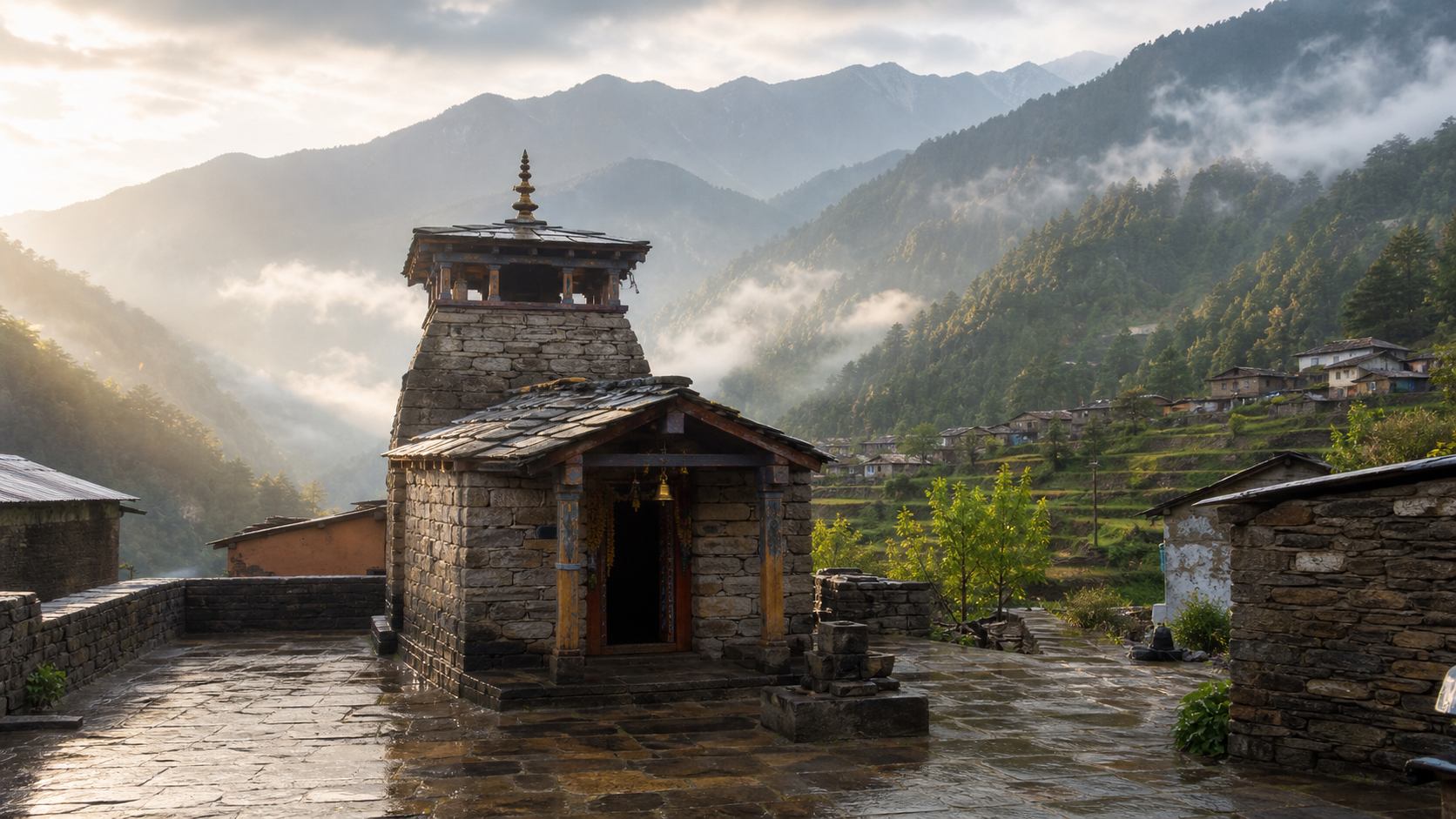
If you are deciding whether Dhyan Badri deserves a place in your Uttarakhand pilgrimage, the answer depends on what you seek. This is not a large temple built around spectacle. It is a quiet Vishnu shrine where the journey, the Himalayan setting and a few undistracted minutes before the sanctum belong to the same practice.
The temple is especially worthwhile when you want to understand the Sapta Badri tradition beyond Badrinath, combine Vaishnava and Shaiva pilgrimage in one valley, or make meditation part of your yatra rather than an activity postponed until you return home. Here is how to approach Dhyan Badri with enough context to recognise what matters and enough practical preparation to avoid turning a contemplative visit into a hurried stop.
Why Dhyan Badri is different from a Badrinath visit
Dhyan Badri stands in the Urgam Valley of Chamoli district, Uttarakhand, at approximately 2,135 metres above sea level. Its scale is modest: a compact stone sanctum, a restrained hill-temple form, a simple gathering space and architectural elements adapted to the mountain climate. The absence of monumentality is not a deficiency to look past. It helps define the kind of darshan available here.
The name gives you the interpretive key. Dhyana is sustained, one-pointed attention. Badri recalls Badrikashrama, the Himalayan sacred landscape associated with Vishnu’s tapas and with badari, or jujube, trees. Put together, the name asks you to approach Vishnu through collected attention. You have missed something essential if you photograph the exterior, enter for a moment and leave without allowing the mind to settle.
Local tradition connects the place with Urvarishi, a seeker whose austerities in the valley culminated in the darshan of Lord Vishnu. The exact textual attribution is not uniform across regional accounts, so the tradition should not be turned into a falsely precise historical claim. Its enduring meaning is clear, however: sustained sadhana prepares the seeker to receive what distraction conceals.
That gives you a practical way to judge whether this temple belongs in your itinerary. Visit if you can protect some unhurried time for silence. If your schedule allows only a rapid series of temple check-ins, reduce the number of stops instead of reducing every darshan to a few minutes.
Plan the route around Helang, Urgam and mountain conditions
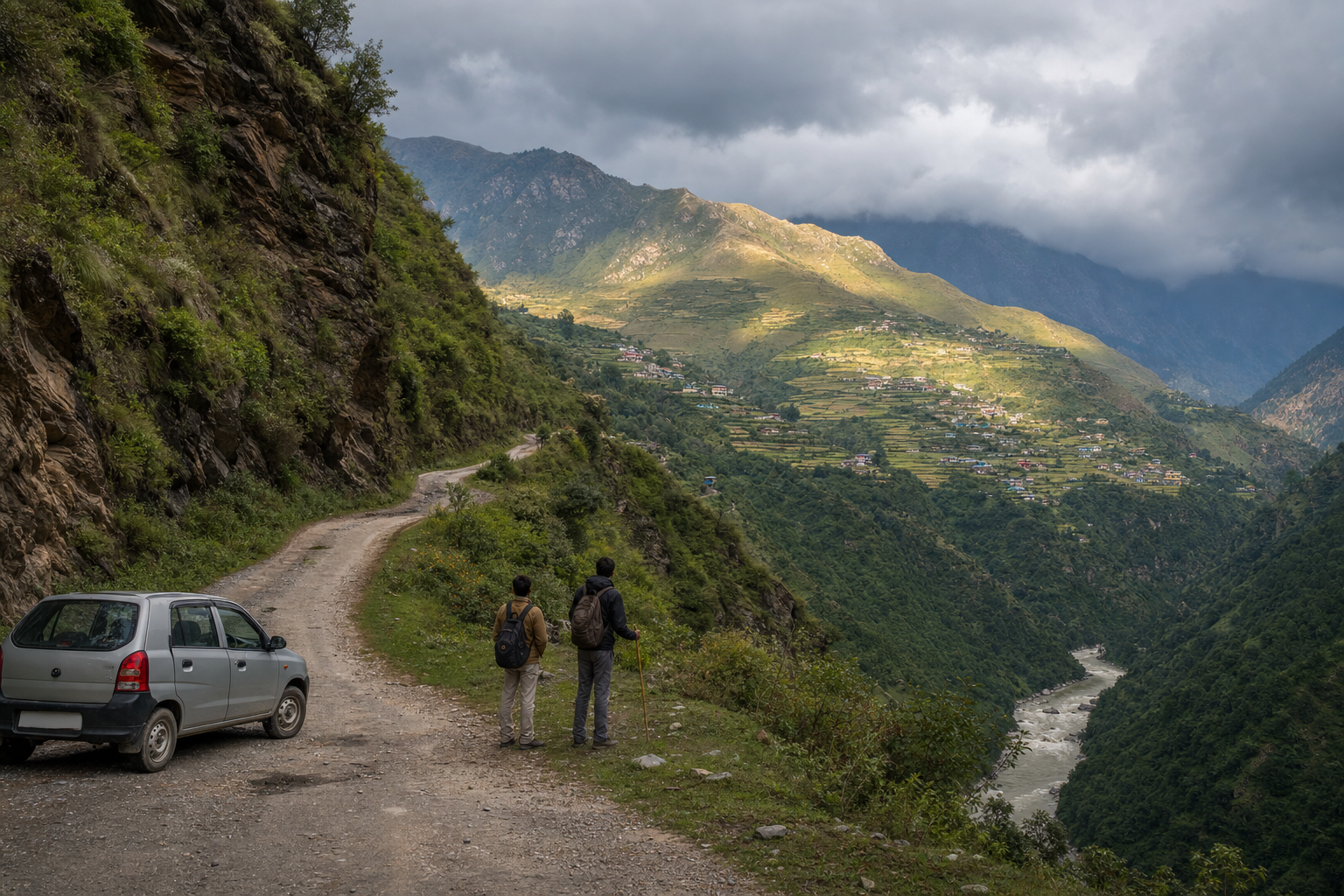
The usual approach follows the Rishikesh-Badrinath highway towards Joshimath and leaves the main route at Helang for the Urgam Valley road. From Urgam village, the temple is reached by a short local path. Shared jeeps and public transport may serve the Helang-Urgam segment seasonally, but availability should not be treated as a fixed urban timetable.
- Confirm the Helang-Urgam road before departure. Ask a village contact, accommodation provider or relevant district information channel about current access. This matters particularly after rain, when Himalayan roads may be affected by landslides.
- Verify temple timings locally. The shrine retains a village-centred devotional life, and the available material does not support publishing a permanent opening schedule. Do not build a tightly timed day around an unverified hour.
- Leave margin for the last stretch. A short path can still take longer when you are walking slowly, carrying luggage or adjusting to elevation. Treat the walk as part of the pilgrimage rather than as transit to be rushed.
- Carry layers and water. Conditions can change in the mountains, while gradual ascent and hydration remain sensible even at the temple’s moderate Himalayan elevation.
- Keep a second plan for adverse weather. If road conditions deteriorate, postpone the valley excursion rather than press on merely to preserve an itinerary.
The most favourable travel periods are generally late April through June and September through November. The monsoon requires additional caution because of landslide risk. Winter snow can restrict local movement. These are planning windows, not guarantees of access; a seasonal recommendation never replaces a current road check.
Dhyan Badri also pairs naturally with Kalpeshwar, the nearby Panch Kedar shrine. This is more than a convenient way to use a day in the valley. It lets you encounter Vishnu and Shiva within the same Himalayan sacred geography. Allow the pairing to deepen the journey; do not convert it into a race between two names on a list.
Use the temple’s quiet as a simple dhyana practice
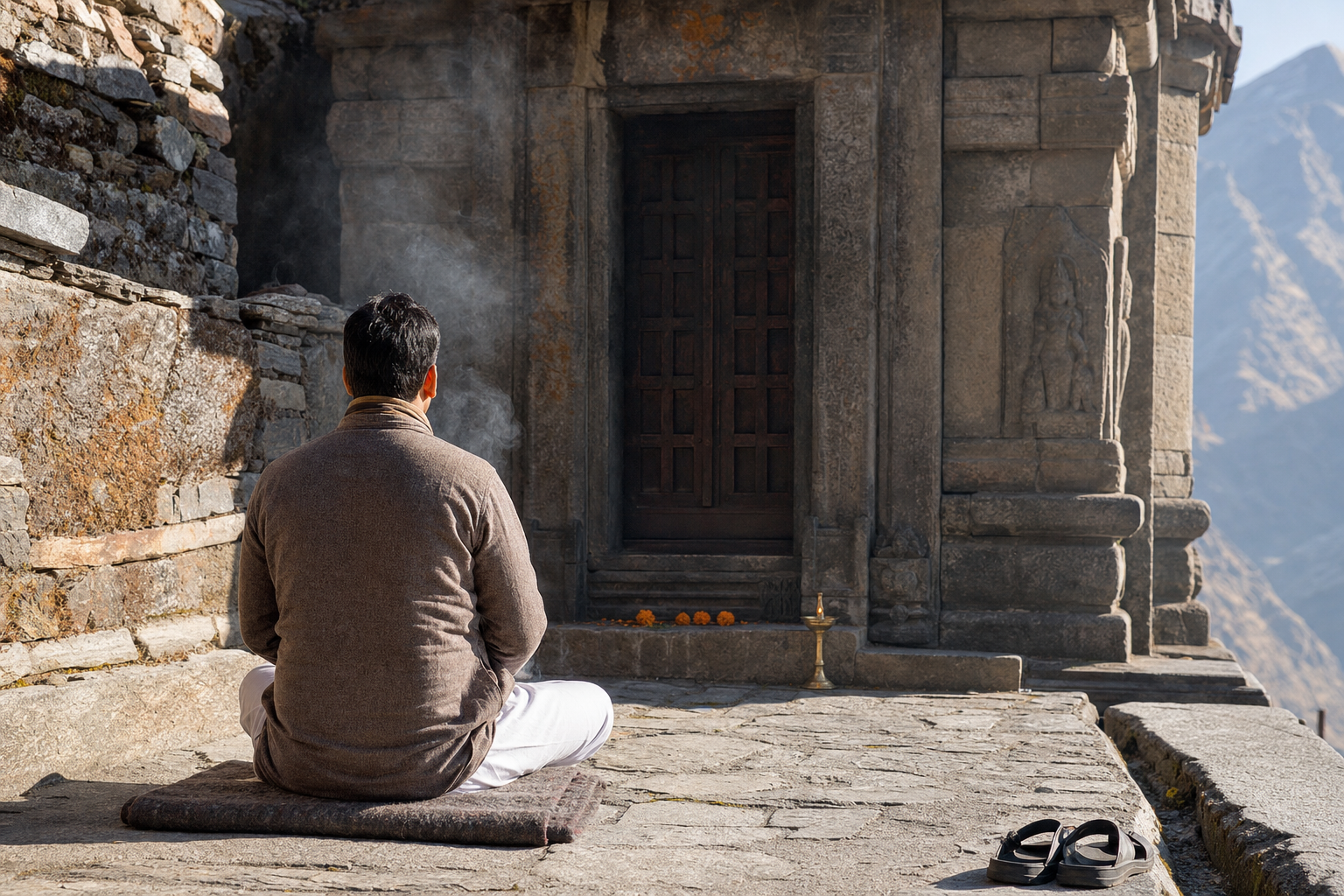
You do not need an elaborate meditation system to respond appropriately to Dhyan Badri. A short sequence of breath, withdrawal from distraction, nama-japa and silent attention is enough. The aim is not to produce a dramatic experience. It is to become present enough that darshan is more than visual registration.
- Pause before entering. Let your breathing become even without forcing it. A few quiet breaths mark the change from travel mode to worship.
- Reduce sensory demands. Put away the phone, stop planning the next destination and allow the sounds and cool stone of the precinct to remain in the background.
- Choose one Vishnu nama. Repeat it silently for a few rounds. Consistency matters more here than quantity; changing words every few moments gives the mind another form of movement.
- Receive darshan without searching for an effect. Rest your attention gently towards the sanctum. If the mind wanders, return to the nama rather than becoming irritated with yourself.
- Sit quietly after the formal moment. Do not reach immediately for the camera or itinerary. Give the experience a little space before re-entering conversation.
This progression resembles a familiar yogic movement: settle the breath, soften the pull of the senses, collect attention on one support and remain steady. It also clarifies what dhyana does not mean. It is neither blankness nor an attempt to force mystical emotion. It is disciplined continuity of attention.
The shrine’s contemplative emphasis has a wider Dharmic resonance. Hindu dhyana, Buddhist bhavana, Jain samayik and Sikh simran are not interchangeable doctrines, and their differences should be respected. Yet each tradition recognises that trained attention changes how a person sees, chooses and acts. Dhyan Badri expresses that civilisational priority in a distinctly Vaishnava and Himalayan form.
Place the shrine correctly within Sapta Badri
Dhyan Badri is generally counted among the Sapta Badri, the seven Himalayan manifestations or sacred seats of Vishnu. A commonly given enumeration includes Badrinath, Adi Badri, Bhavishya Badri, Vriddha Badri, Yogadhyan Badri, Ardha Badri and Dhyan Badri. Regional lists can vary, with Narsingh sometimes appearing in place of one member. That variation is a reason to ask which local convention is being followed, not a reason to dismiss the tradition.
The circuit teaches something that a single monumental destination cannot. Sacred presence is distributed across valleys, villages and elevations. Vishnu is encountered through multiple devotional accents rather than confined to one building. Dhyan Badri contributes the contemplative accent: the deity is approached in a meditative or yogic mode, and the pilgrim is invited to become inwardly quieter.
Do not collapse Dhyan Badri and Yogadhyan Badri into one location simply because their names and contemplative associations resemble each other. They are distinct shrines. If you are mapping a wider journey, Dhyan Badri lies in Urgam Valley, while Yogadhyan Badri is associated with the Pandukeshwar area. Vriddha Badri, Adi Badri, Bhavishya Badri and Badrinath likewise require a route planned across the broader Garhwal region rather than as one compact walking circuit.
The temple’s historical value also calls for precision. The wider Badrikashrama tradition has deep roots in Puranic memory, and the Himalayan Badri shrines developed through layered periods of worship, renewal and custodianship. Dhyan Badri itself does not come with a securely established public epigraphic date in the available record. Its stone architecture, village memories and continuing worship support a living heritage claim; they do not justify inventing an exact construction century.
This distinction matters for anyone writing, guiding or posting about the temple. Say that the shrine belongs to an old and layered Himalayan Vaishnava tradition. Present Urvarishi as local sacred memory. Avoid attaching an unsupported date, dynasty or rigid scriptural citation merely to make the description sound authoritative.
Behave as a guest of a living village shrine
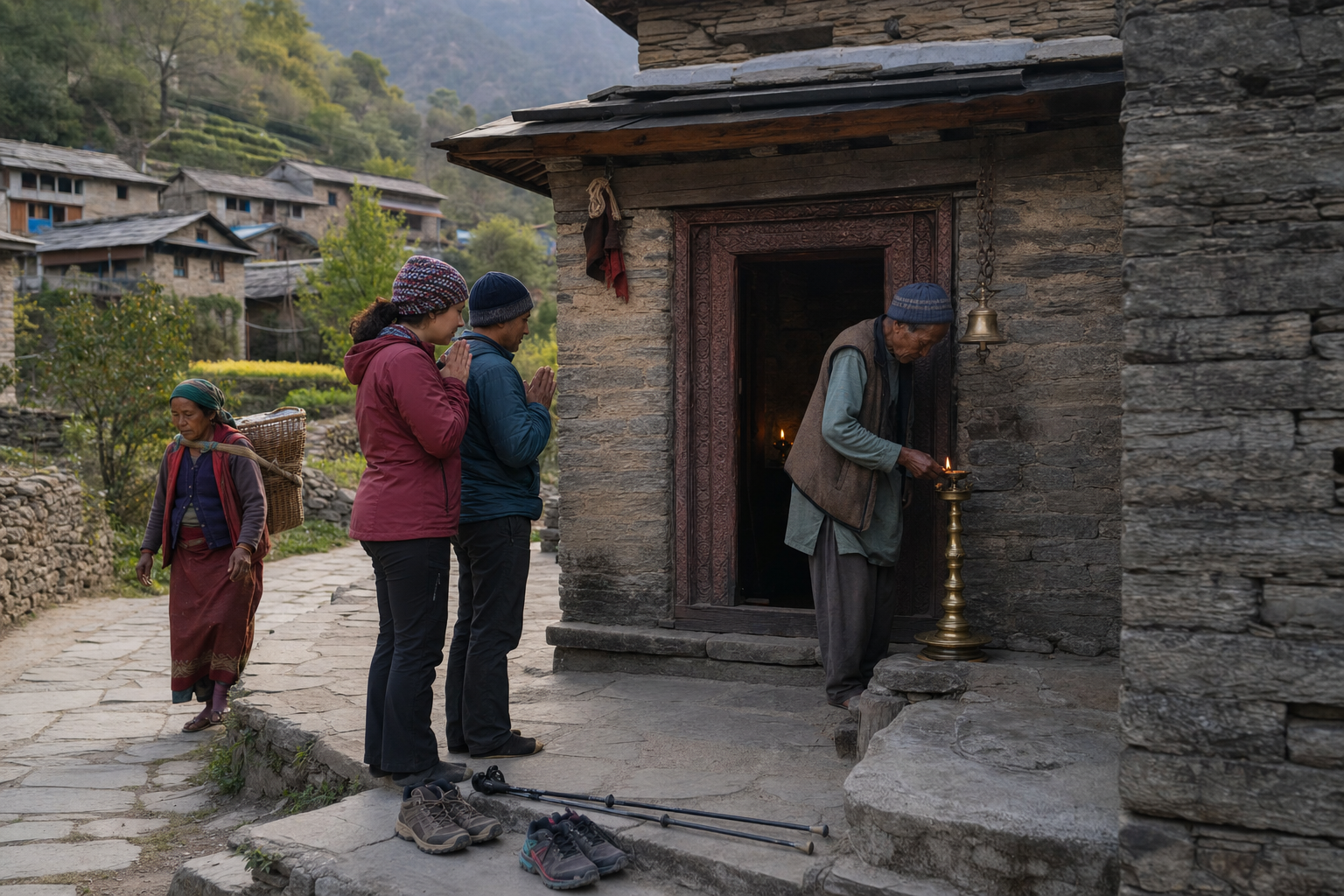
Dhyan Badri is not an abandoned monument preserved only for visitors. Its worship remains tied to the surrounding community. The appropriate question is therefore not only, “What can I see?” but also, “How can I visit without weakening the conditions that keep this place sacred and habitable?”
- Ask before photographing the sanctum, murti, priest or worshippers. A camera-friendly exterior does not imply unrestricted photography inside a sacred space.
- Carry your waste back out. Avoid bringing unnecessary single-use plastic into the valley, and do not assume a small settlement can absorb a visitor’s packaging.
- Use local services where they are available. Homestays, small eateries and local guides keep more of the pilgrimage economy within the community that sustains the route and shrine.
- Follow local ritual direction without demanding uniformity. Village practice may not mirror the procedure you know from a larger temple. Ask respectfully rather than treating difference as error.
- Keep sound low. Loud playback, group chatter and repeated photo direction work against the contemplative character that brought you to Dhyan Badri.
- Do not turn stonework or votive objects into props. What appears visually modest may carry ritual meaning that is not obvious to an outsider.
The same restraint should shape what you publish after the visit. Distinguish observation from tradition and tradition from dated history. If a priest or resident offers a local account, preserve its status as local memory rather than converting it into an absolute claim for every Sapta Badri community.
Key takeaways for your Dhyan Badri visit
- Turn from the Rishikesh-Badrinath route at Helang for Urgam Valley, then approach the temple by the local path from Urgam village.
- Prefer late April to June or September to November, while checking current road access, weather and temple timings before committing to the journey.
- Combine Dhyan Badri with nearby Kalpeshwar when conditions permit, but leave enough time for both visits to remain acts of worship rather than itinerary collection.
- Protect a period of silence for breath-settling, Vishnu nama-japa and steady darshan; contemplation is central to the shrine’s identity.
- Treat claims about Urvarishi, the temple’s age and the exact Sapta Badri list with the precision their varying local traditions require.
- Minimise plastic, seek permission for photography and support village-based services so your pilgrimage contributes to the valley rather than burdening it.
Make one decision before you set out: choose what you will leave out of the itinerary so that Dhyan Badri has room to work on your attention. Confirm the road and worship timings, travel lightly, and arrive prepared to be still.