
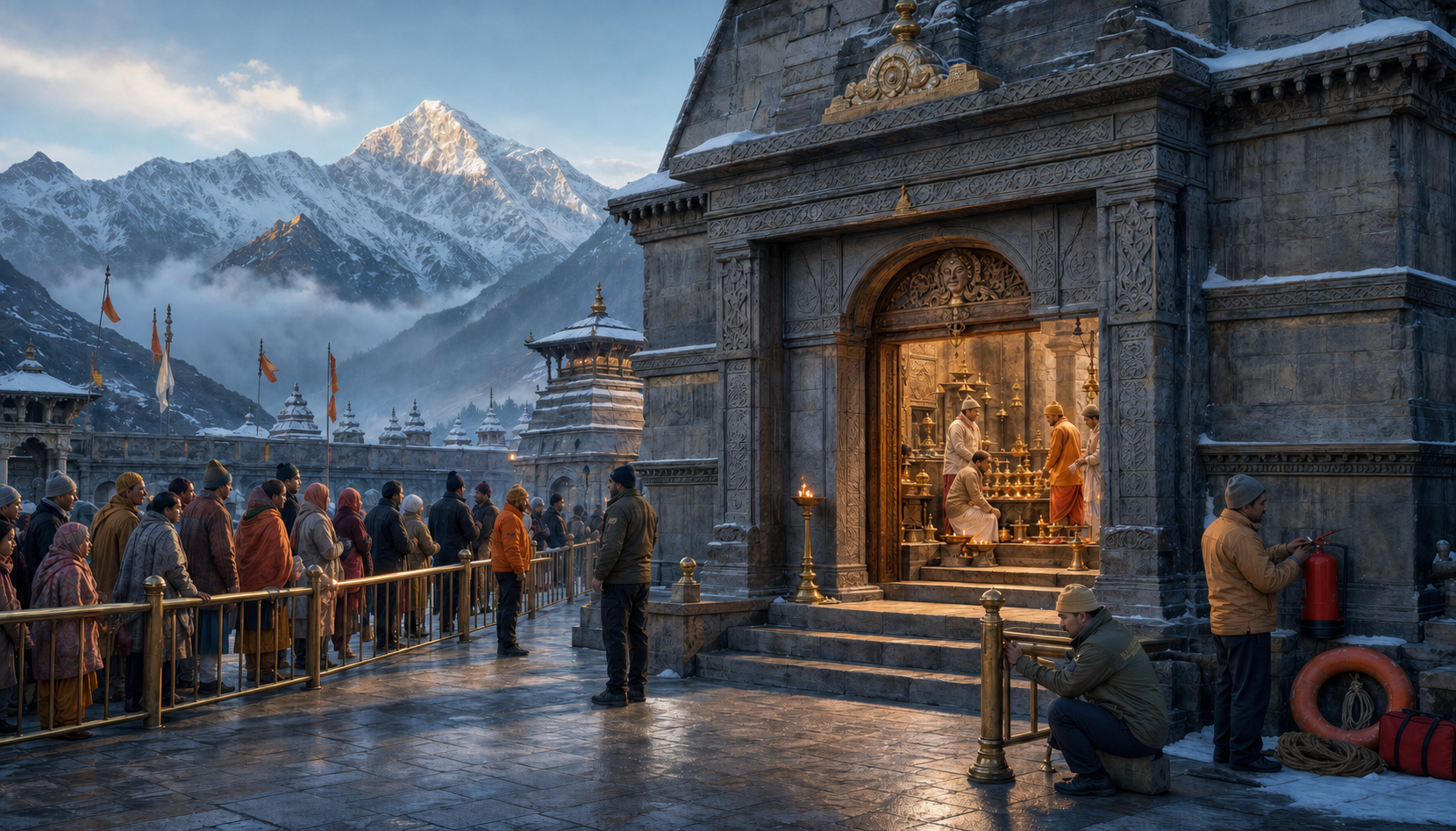
You may support strict mandir maryada and still be uneasy with identity checks at a shrine door. That is not a contradiction. The question is whether a proposed rule protects worship, keeps pilgrims safe, or merely turns a sacred boundary into a social test.
As Char Dham Yatra 2026 approaches, the Gangotri Temple Committee is reported to be considering Panchgavya in the shuddhikaran associated with seasonal reopening. That ritual question has become entangled with a wider argument about who may enter, how close anyone may approach the garbhagriha, and what conduct the shrine may require. You can judge these proposals more clearly by separating ritual authority, pilgrim access, and public administration.
Start by separating rite, access, and administration
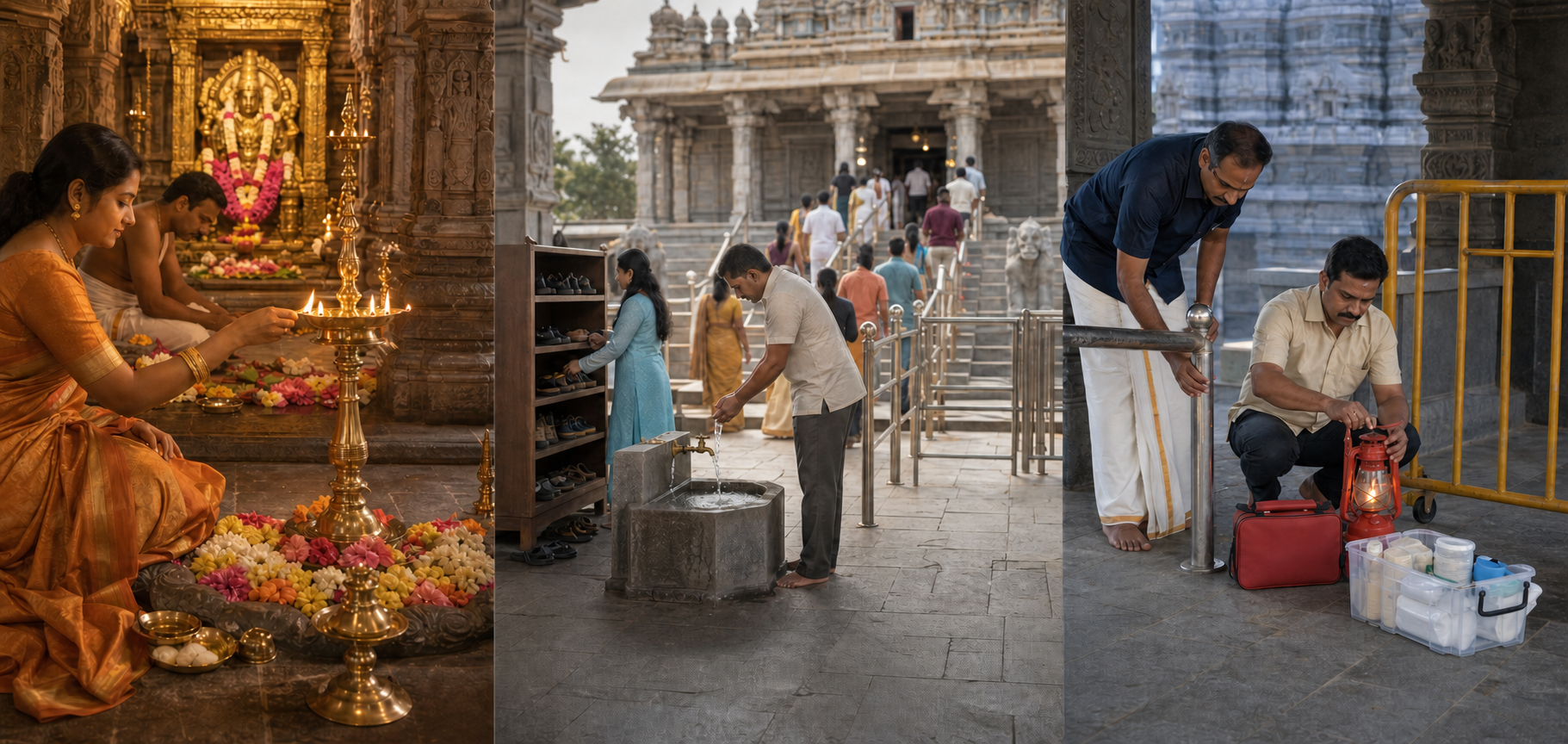
The fastest way to test any Char Dham proposal is to ask exactly what it regulates. Three different kinds of governance are involved:
- Ritual governance determines which rites are performed, by whom, with which materials, and at what point in the temple calendar.
- Access governance determines where pilgrims may stand, which devotional acts they may join, and which areas remain reserved for authorized sevayats.
- Administrative governance covers registration, queues, crowd density, emergency procedures, accessibility, waste, photography, and enforcement.
This distinction prevents two common mistakes. First, Panchgavya used for kshetra-shuddhi does not by itself create a requirement that every visitor consume, receive, or personally handle it. A rite that sanctifies the temple precinct is not automatically a test of an individual pilgrim. If personal participation is proposed, that must be stated and justified separately.
Second, a dress or conduct code does not logically require identity screening. Modest clothing, silence, queue discipline, restrictions on photography, and prohibitions on intoxicants regulate actions that can be observed. A person’s name or presumed religious identity does not tell the committee whether that person will respect mandir maryada.
Gangotri’s ritual calendar also supplies the proper context. During the winter closure, the utsava murti is associated with the protected winter seat at Mukhba. Its return around Akshaya Tritiya belongs to a liturgical sequence that can include purnahuti, kumbhabhisheka, and kshetra-shuddhi. Panchgavya fits within that established ritual logic when authorized priests use it for a defined sacred purpose. The committee should govern that rite as a rite, not allow it to become a vague symbol in an unrelated entry dispute.
Protect Panchgavya by governing it as a sacred material
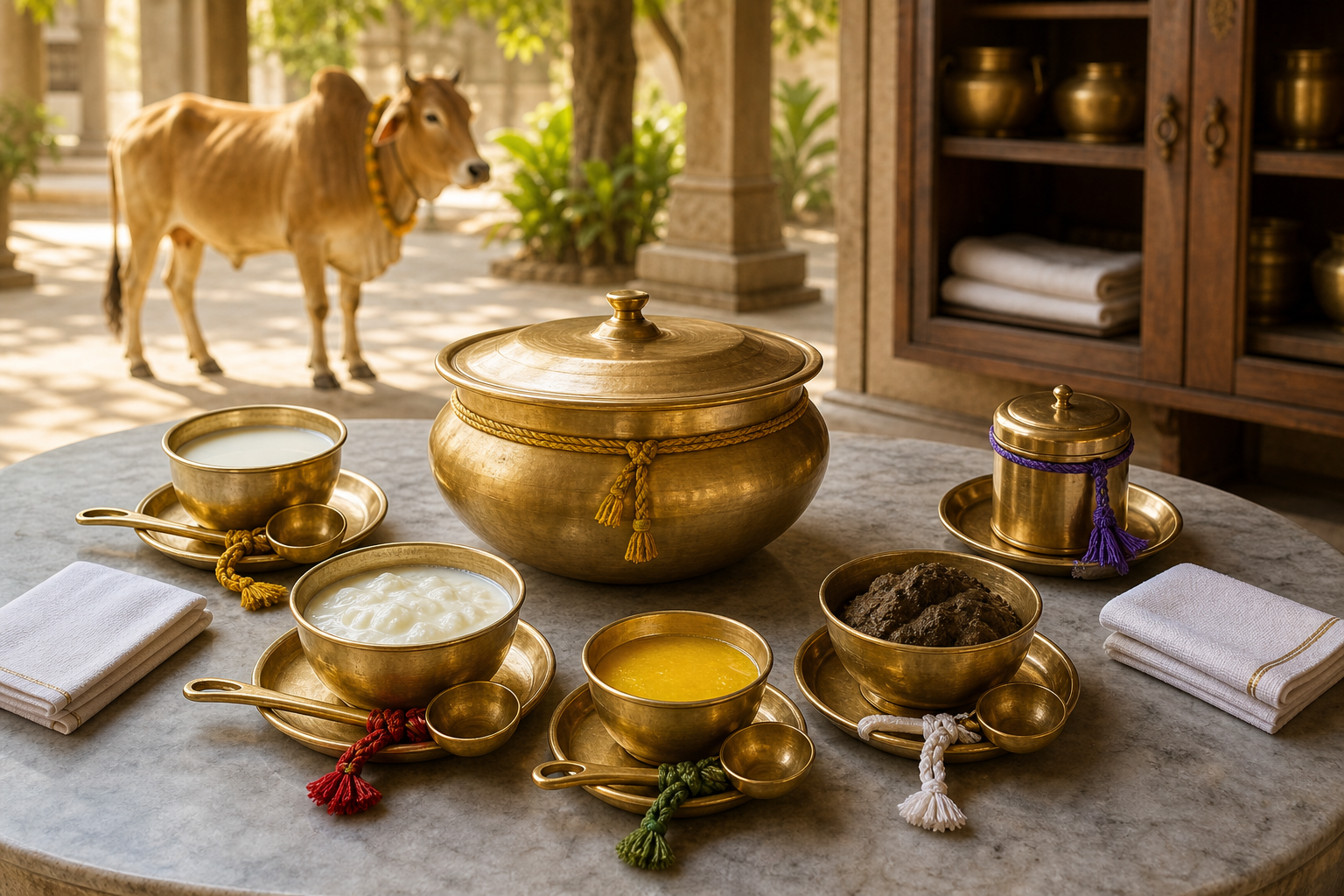
Panchgavya traditionally combines milk, curd, ghee, gomutra, and gomaya. Within temple practice, its primary significance is ritual and symbolic. It connects purification with go-seva, the agrarian foundations of Hindu life, and an ethic of responsible care. Emerging laboratory work on individual components does not establish broad therapeutic claims, so a temple should not defend the rite by presenting it as medicine. Its Dharmic legitimacy does not depend on a modern health claim.
A written standard operating procedure would strengthen, not bureaucratize, the ritual. It should settle six practical questions before reopening:
- Authority: Name the priests or ritual office empowered to approve the preparation, perform the rite, and resolve questions of paddhati.
- Scope: State the date, location, purpose, and boundaries of the shuddhikaran. Make clear whether it concerns the kshetra, ritual vessels, the sanctum approach, or another defined element.
- Sourcing: Prefer traceable partnerships with local gaushalas that follow humane care. Record the origin of each component rather than treating procurement as an invisible commercial step.
- Handling: Assign trained handlers, clean vessels, protected storage, and measured quantities appropriate to the rite. Sacred material deserves disciplined preparation.
- Ecology: Prevent leftover material or ritual runoff from entering the Ganga or nearby drainage. In a fragile glacial river system, careless disposal would contradict the reverence the rite is meant to express.
- Communication: Publish a short explanation of the ritual purpose, sourcing, hygiene, and disposal method. If non-dairy participation is not essential to the rite, provide a water-only viewing or symbolic participation option for pilgrims whose Jain, Buddhist, Sikh, or personal commitments make that preferable.
The committee should complete a pre-opening checklist and publish a brief post-ritual note confirming that the approved procedure was followed. Traceability, limited quantities, hygienic handling, ecological disposal, and public summaries turn a contentious proposal into an accountable sacred practice. Documentation also prevents rumor from defining the rite for people who have never seen it performed.
Use sacred-function zones instead of identity checkpoints

A Hindu temple is not an undifferentiated public hall. Different spaces carry different ritual functions, and the garbhagriha is not governed like the outer approach. The sound principle is therefore not that every person must enter every space. It is that every boundary should correspond to a sacred or operational function.
| Zone | Who may enter | Purpose | Appropriate rule |
|---|---|---|---|
| General darshan zone | All visitors who observe the published code | Darshan, reverence, and orderly pilgrimage | Uniform rules for attire, silence, queues, photography, intoxicants, and waste |
| Near devotional zone | Pilgrims joining the rites conducted there and accepting the associated maryada | Focused participation in Sanatana Dharma worship | Conduct-based entry, limited capacity, and clear instructions before the threshold |
| Priestly core | Authorized sevayats during defined ritual periods | Mantra, arcana, preparation, and service to the deity | Role-based restriction tied to priestly duty and ritual timing |
This concentric model preserves the distinctiveness of the Hindu shrine without pretending that sacred order requires a broad identity ban. It also gives administrators an enforceable standard. Staff can verify a ticket, observe conduct, control capacity, or confirm authorization to perform seva. They cannot reliably infer inward belief from a surname, appearance, nationality, or declaration made under pressure.
Before creating any additional boundary, a committee should answer four questions in writing:
- Which sacred action or safety requirement exists inside this boundary?
- How would unrestricted presence interfere with that action or requirement?
- Is this the smallest restriction capable of protecting it?
- Can the rule be explained and enforced consistently, without discretionary humiliation?
The constitutional frame makes such precision important. Article 25 protects freedom of conscience and religious practice, while Article 26 recognizes denominational authority over religious affairs; both operate subject to public order, morality, and health. The Shirur Mutt decision of 1954 and Sri Venkataramana Devaru decision of 1958 form part of the jurisprudence balancing religious autonomy and access. For a public, state-facilitated pilgrimage corridor, conduct-based rules and proportionate zoning offer a more defensible balance than a sweeping identity test.
That is a governance principle, not a legal ruling on a particular notification. Any proposed restriction should be reviewed against the shrine’s governing statute, the precise rule, and current case law before enforcement. Copying the entry regime of another temple is not a substitute. Jagannath Puri, for example, has its own legal and religious history; its legacy restrictions cannot simply be transplanted to Char Dham.
Publish one rulebook for sanctity, safety, and accountability

Maryada loses authority when a pilgrim encounters it for the first time through a shouted instruction at the end of a long queue. The code should reach you before departure, appear during registration, and be repeated at the temple approach. It should say what is required, why it matters, which zone the rule governs, and what happens if someone refuses to comply.
The operational stakes are substantial. Annual Char Dham footfall has exceeded five million, while the memory of the 2013 disaster keeps emergency readiness central to mountain governance. A policy that debates identity but neglects crowd density, timed movement, weather exposure, queue discipline, or evacuation has confused a visible controversy with the larger duty of care.
- Before the season: The Gangotri and Yamunotri committees, the Badri-Kedar Temple Committee for Badrinath and Kedarnath, local panchayats, tourism authorities, disaster professionals, and priestly representatives should agree on common baseline rules. Site-specific ritual differences can then be stated as additions, not hidden exceptions.
- At registration: Use staggered time slots where needed, show the code in relevant languages, and require pilgrims to acknowledge safety and conduct instructions. A QR-linked briefing can explain the shrine’s ethos, the glacial environment, and the reason for each restriction.
- At the approach: Display a zone map before the queue narrows. State requirements concerning modest clothing, leather, tobacco, alcohol, photography, silence, and personal waste while the pilgrim can still correct a problem calmly.
- Inside the complex: Deploy trained Seva Mitras to guide queues, translate instructions, and assist elders, women, and persons with disabilities. Priests should control ritual thresholds; safety staff should control crowd movement. The two roles should cooperate without becoming interchangeable.
- After the season: Publish a concise account of crowd incidents, accessibility failures, ecological compliance, and complaints about enforcement. Rules that repeatedly create confusion should be clarified before the next opening.
Enforcement should also be graduated. Begin with a clear explanation and an opportunity to correct the conduct. Restrict access to the affected zone when a person refuses or creates a genuine ritual or safety disruption. Record serious incidents and provide a channel for complaints. Immediate exclusion may be necessary when there is intoxication, violence, deliberate desecration, or dangerous crowd behavior, but routine misunderstandings should not be treated as proof of hostility to Dharma.
Consultation matters because each participant sees a different failure mode. Priests know where ritual choreography can be disturbed. Disaster personnel know where congestion becomes dangerous. Local communities understand the mountain’s seasonal limits. Gaushalas can identify responsible Panchgavya sourcing. Hindu, Buddhist, Jain, and Sikh representatives can reveal where wording intended to defend sanctity will instead be heard as needless rejection. Consultation does not transfer ritual authority away from the temple; it gives that authority the information required to govern well.
Key takeaways for your next decision or yatra
- If you are a yatri: Do not treat circulating proposals as final policy. Confirm the applicable registration and entry instructions with the responsible temple authority before departure. Carry warm, modest clothing; avoid leather, tobacco, alcohol, and intrusive photography; keep silence near the sanctum; and take your waste back down.
- If you defend mandir maryada: Ask for rules tied to ritual function. A clearly protected priestly core is stronger than a vague identity ban because its boundary has a sacred purpose that can be explained.
- If you question Panchgavya use: Separate objections to sourcing, hygiene, disposal, or compulsory personal participation from rejection of kshetra-shuddhi itself. Each concern needs a different answer.
- If you serve on a temple committee: Publish the ritual protocol, zone map, conduct code, enforcement process, and ecological safeguards before opening day.
- If you administer the corridor: Measure success through safe movement, consistent enforcement, accessibility, ecological compliance, and the uninterrupted performance of worship, not through the number of people screened by identity.
- If you shape policy: Obtain shrine-specific legal review. Articles 25 and 26, denominational rights, public access, health, and public order must be applied to the actual institution and the exact restriction proposed.
Before supporting or opposing a new Char Dham restriction, ask to see four things: its written sacred purpose, the map of the space it governs, the uniform conduct standard, and the safety and ecological procedure behind it. If those answers are missing, the policy is not ready. Char Dham can be unmistakably Hindu, disciplined in worship, welcoming to respectful pilgrims, and professionally governed at the same time.