
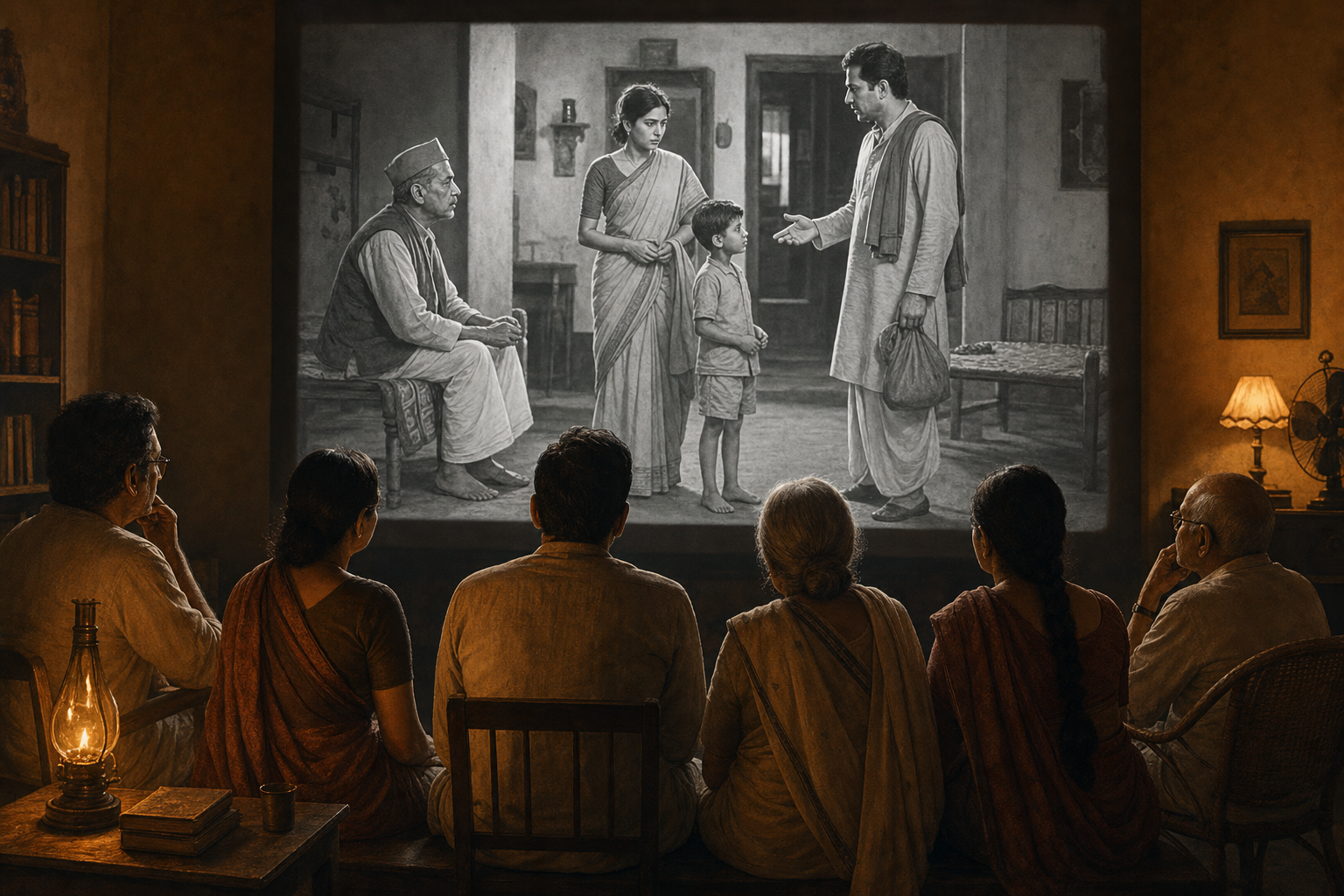
You have an old Hindi social drama ready for a family screening, a classroom, or an interfaith gathering. The real challenge is not deciding which character behaved well. It is learning how to discuss duty, compassion, restraint, and service without turning them into interchangeable words for being nice.
A careful viewing can do more. It can show you where Dharmic traditions genuinely meet, where they ask different questions, and where a film’s appeal to family harmony may conceal an unequal burden. The method below gives you a practical way to conduct that viewing.
Begin with the pressure point, not the moral label
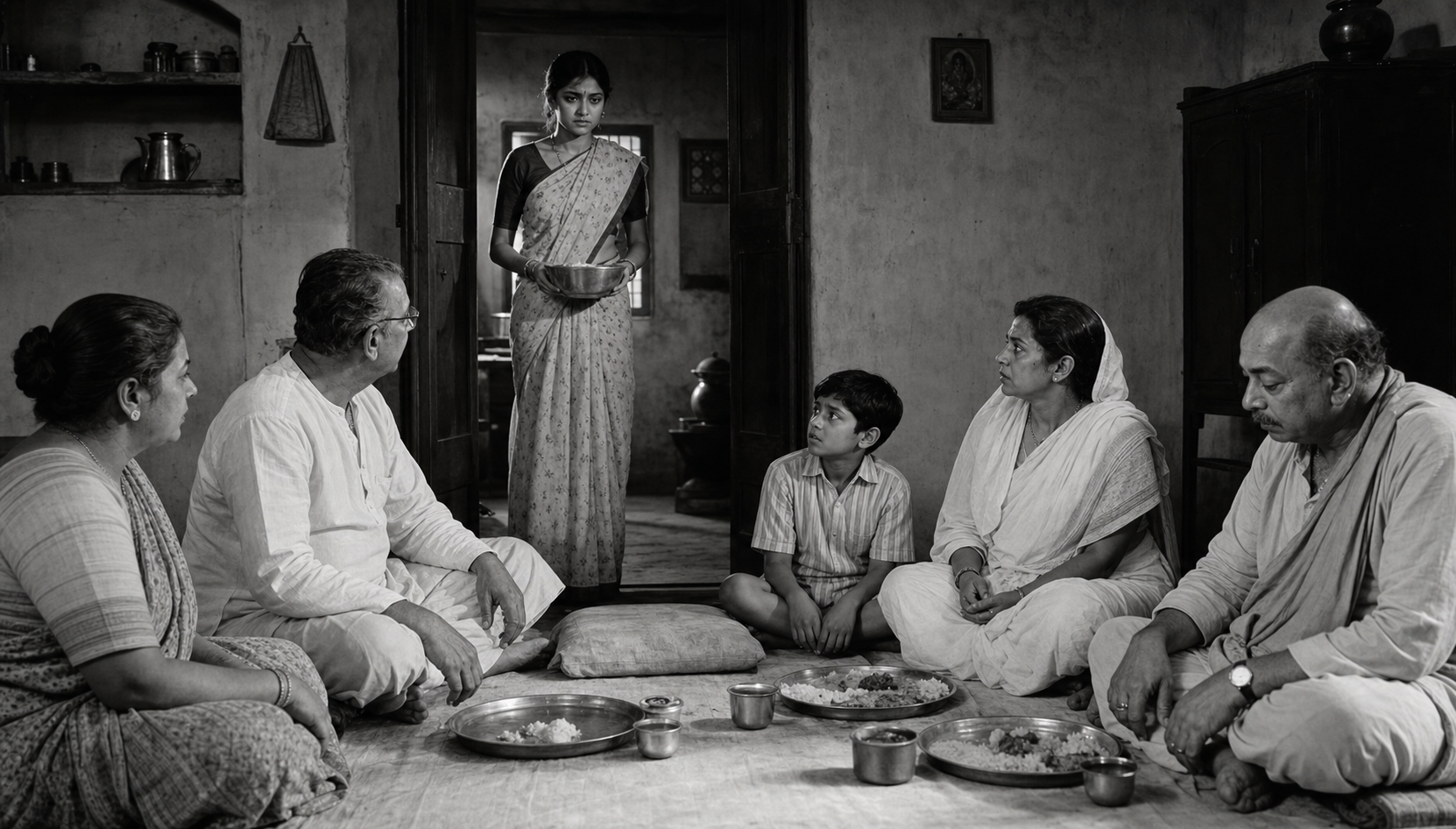
Classic Hindi social cinema often places moral conflict inside a household because domestic decisions make abstract values visible. In the digital presentation titled This Is Life, Anand Narayan heads a poor household with his wife Gayetri, daughter Kamla, and sons Madhu and Govind. Scarcity means that one person’s choice can immediately affect everyone else’s security, dignity, and future.
Do not begin by declaring a character righteous, selfish, traditional, or modern. Those labels close the inquiry before it starts. Pause at a consequential choice and ask four concrete questions:
- What is the person trying to protect: livelihood, family unity, reputation, aspiration, or another obligation?
- Which constraints are real, and which are being presented as inevitable merely because society expects them?
- Who pays for the decision in labor, lost opportunity, humiliation, or silence?
- What new duty will this choice create for the household later?
This keeps poverty from becoming sentimental scenery. A sacrifice may preserve a family while transferring the heaviest cost to the member with the least authority. A refusal to compromise may defend integrity while leaving dependents exposed. A harmonious ending may settle a dispute without correcting the structure that produced it.
The Hindu framework of grihastha dharma is useful here because householder life joins material and ethical responsibility. Earning, protecting dependents, and sustaining social trust matter together. Artha, or material security, is not rejected; it is tested by dharma. Kama, including legitimate human aspiration, is not automatically selfish; it must be negotiated alongside obligation. Moksha remains a larger horizon rather than an excuse to neglect the household in front of you.
That distinction changes what you notice. Do not ask only, “Did the parent uphold duty?” Ask, “Was the livelihood honest, were dependents protected, and was harmony achieved without denying another person’s moral agency?” Dharma is an exacting standard for conduct, not a ceremonial label for whatever an elder demands.
Use four Dharmic lenses without forcing one verdict

Hinduism, Buddhism, Jainism, and Sikhism share a civilizational concern with disciplined conduct, compassion, and responsibility. They do not become identical because they share that ground. An interfaith reading becomes useful when each tradition is allowed to sharpen a different part of the same problem.
The following are working questions for a film discussion, not complete accounts of four rich traditions:
| Ethical lens | What it brings into focus | Question to ask of the scene | Misreading to avoid |
|---|---|---|---|
| Hindu | Grihastha duty and the ordering of artha and kama by dharma | Does the pursuit of security or aspiration remain within an ethical responsibility to others? | Do not assume that an inherited family role is dharmic merely because it is traditional. |
| Buddhist | Karuna, maitri, right livelihood, intention, and the suffering produced by action | Do the person’s intention and means reduce suffering, or merely relocate it to someone less powerful? | Do not confuse compassion with passive endurance of preventable harm. |
| Jain | Daya, aparigraha, the anuvratas, restraint, and attention to avoidable harm | What harm is being justified, and could possessiveness, pride, or appetite be restrained instead? | Do not romanticize poverty by confusing involuntary deprivation with freely chosen restraint. |
| Sikh | Seva, equality, honest responsibility, and the dignity of participation | Does service strengthen another person’s equal standing, or require that person to remain dependent and voiceless? | Do not celebrate service that preserves an avoidable inequality. |
Use all four questions on the same decision. Do not assign one character to each religion unless the film itself establishes those identities. The characters are not allegorical representatives simply because you are conducting an interfaith discussion. The traditions are interpretive lenses through which you examine action, means, burden, and consequence.
Consider a hypothetical refusal to earn through dishonest means. A Hindu reading may affirm the protection of dharma while still asking whether the householder has found another way to support dependents. A Buddhist reading can test intention, livelihood, and resulting suffering. A Jain reading can examine complicity in harm and the discipline required to refuse it. A Sikh reading can ask whether honest work and mutual service preserve everyone’s dignity. The refusal may be morally serious under every lens, yet each lens can reveal an unfinished responsibility.
This is more productive than searching for a lowest common denominator. “All traditions teach goodness” gives a discussion nowhere to go. “All four reject an easy separation between private virtue and the consequences borne by others” gives you a claim that can be tested scene by scene.
Read rooms, faces, sound, and subtitles as ethical evidence
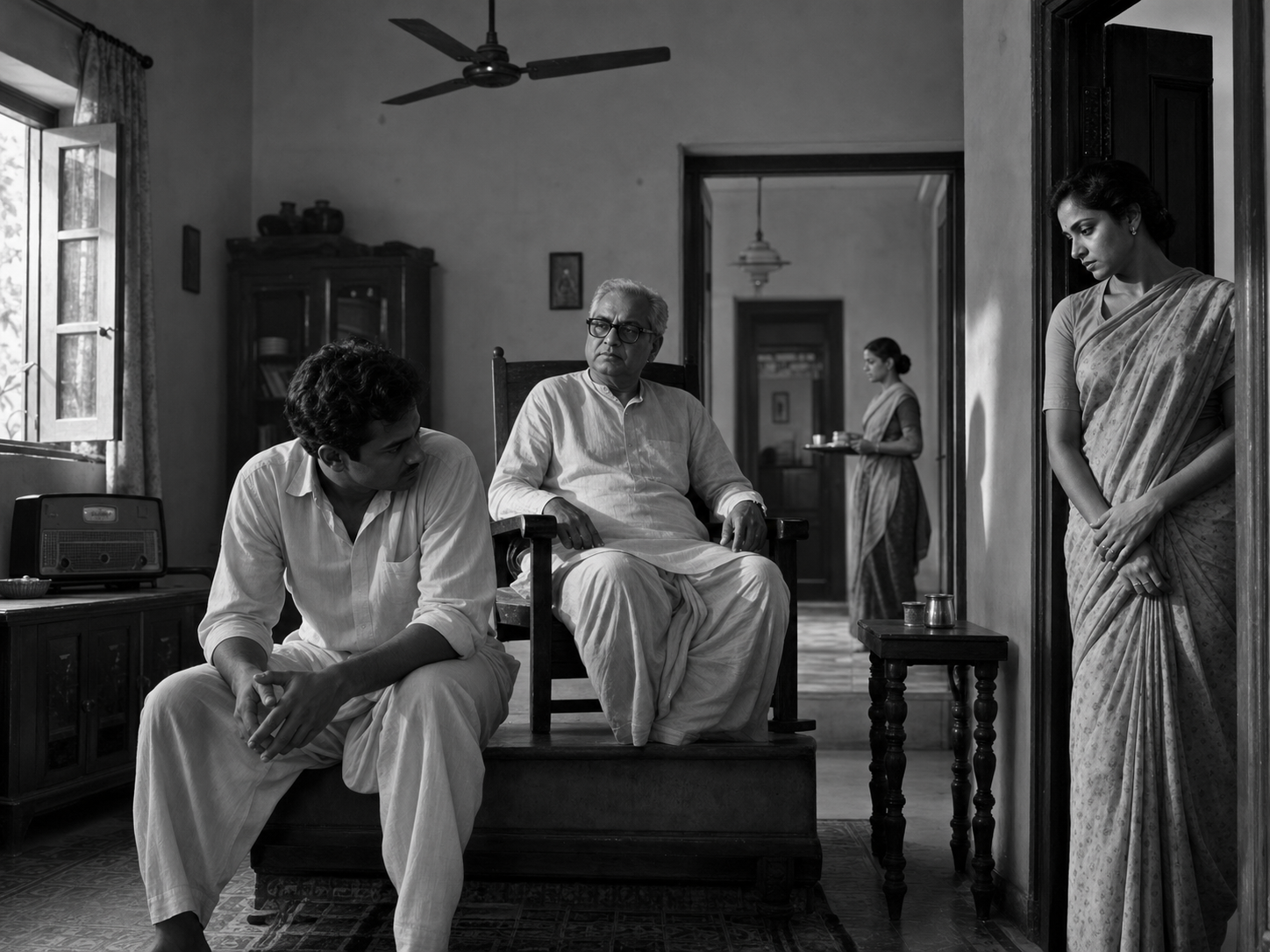
In classic social drama, ethics is not carried by dialogue alone. Small interiors, courtyards, thresholds, and public streets can function as moral stages. A doorway can separate the authority of the household from the judgment of the neighborhood. A cramped room can make private disagreement impossible. A street can expose a family decision to social pressure.
Use separate viewing passes so that plot does not swallow form:
- On the story pass, follow who wants what, what prevents it, and what each decision changes. Do not stop to classify every act.
- On the spatial pass, note who occupies the center, who remains at an edge or threshold, and who is absent when a decision affecting them is made.
- On the performance pass, distinguish a close-up that asks for sympathy from a medium shot that lets you see the family’s collective response. Emotional emphasis is evidence of the film’s argument, not proof that the argument is correct.
- On the sound pass, note where music intensifies sacrifice, shame, honor, or reconciliation. Ask whether the music is helping you understand a cost or encouraging you to overlook it.
- On the language pass, mark any proverb, kinship term, religious concept, or culturally dense phrase whose translated wording feels unusually flat or awkward.
A simple scene record needs only four columns: the choice, the constraint, the cinematic cue, and the ethical claim. “Daughter remains at edge of frame” belongs under cinematic cue. “Her consent does not matter” is an interpretation that still has to be tested against dialogue, later action, and consequence. Keeping observation separate from judgment prevents a persuasive close-up or musical swell from doing your reasoning for you.
The surviving presentation also requires archival patience. Earlier television and film transfers may carry a 4:3 image, mono sound, variable contrast, grain, or uneven soundtrack fidelity. Those properties can document the work’s path through exhibition and broadcast. Do not automatically treat every visual limitation as an original artistic choice, but do not dismiss the film because it lacks the polish of a contemporary digital production either.
The available edition permits subtitle autotranslation into English, which makes the film more accessible to international viewers, students, and diaspora families. Machine translation depends on accurate underlying subtitles, sensible sentence boundaries, and recognition of the cultural domain. Idioms and moral vocabulary can therefore arrive distorted.
If a discussion turns on a translated word, do not build a large philosophical conclusion on that line alone. Record the audible term when someone in the group recognizes it, compare another translation or glossary when available, and state the interpretation provisionally. Terms such as dharma, daya, seva, maryada, karuna, and aparigraha carry fields of meaning that a single English substitute may narrow too aggressively.
Separate enduring responsibility from inherited hierarchy

Older Hindi cinema can preserve humane insights while also carrying the gender expectations, class hierarchy, and didactic habits of its period. You do not have to choose between reverence and dismissal. The more demanding response is to identify exactly what remains ethically sound and exactly what should not be carried forward.
Test the film’s moral language through five distinctions:
- Duty versus coercion: a responsibility accepted through moral agency is not the same as obedience extracted through fear, dependence, or shame.
- Sacrifice versus cost shifting: ask whether the person praised for sacrifice chose the burden and whether others who benefit share it.
- Harmony versus silence: the end of open conflict does not prove that the underlying grievance has been heard.
- Restraint versus deprivation: aparigraha concerns disciplined non-possessiveness; material scarcity imposed on a poor household is not automatically a spiritual achievement.
- Reconciliation versus accountability: restored affection may be valuable, but it does not by itself repair an unjust rule or unequal distribution of authority.
Pay particular attention to Gayetri and Kamla. Do they initiate decisions, or only absorb their effects? Is practical wisdom credited as moral intelligence, or used to make an unfair arrangement survivable? Does aspiration receive a fair hearing before it is judged? These questions neither predetermine the characters’ positions nor impose a contemporary slogan on them. They direct your attention to agency, which a family-centered moral drama can easily subordinate to order.
You can then run a disciplined group conversation:
- Describe the selected scene without using approving or condemning labels.
- Name the material, familial, and social constraints visible in the scene.
- Apply each of the four ethical lenses to the same choice.
- Identify whose voice, labor, or loss is least visible.
- Distinguish the behavior the film appears to reward from the behavior your group believes is defensible.
- Name one present-day responsibility that follows from the discussion.
If practitioners from these traditions are present, invite them to clarify concepts from their own experience without asking anyone to represent an entire religion. Where interpretations differ, record the disagreement. Unity does not require a manufactured verdict. It requires enough trust to state a difference accurately and enough ethical seriousness to keep examining the human consequence at stake.
Key takeaways
- Start with the pressured choice, the real constraint, the person who pays, and the duty created afterward.
- Use Hindu, Buddhist, Jain, and Sikh ethics as distinct lenses on the same action, not as interchangeable labels or character assignments.
- Treat framing, space, performance, music, and silence as parts of the film’s moral argument.
- Verify culturally dense language when autotranslated subtitles carry the weight of your interpretation.
- Preserve insights about care, honest livelihood, restraint, and solidarity while rejecting coercive gender or class assumptions.
- Let genuine disagreement remain visible; precise difference is a stronger basis for interfaith respect than vague sameness.
At your next screening, choose one household decision and make the four-column record: choice, constraint, cinematic cue, ethical claim. Then apply every Dharmic lens to that one moment. If all four answers sound identical, look again at the means used, the burden imposed, the dignity preserved, and the voice excluded. That second look is where cinema becomes ethical practice rather than moral decoration.