

If someone has warned you that Shani will harm your child, pause before allowing that prediction to shape family life. The Pippalada-Shani covenant gives Hindu parents a very different starting point: childhood is a protected period of formation, not the proper place for adult-sized astrological fear.
You can take Shani seriously without teaching your child to feel cursed. The practical response is to understand what the covenant promises, treat disputed age limits honestly, keep horoscope interpretations proportionate, and turn Saturday worship toward steadiness, service, and trust.
What the covenant promises, and what it does not
Pippalada is remembered as both a demanding spiritual teacher and a figure formed by an extraordinary lineage. In the Prashna Upanishad, seekers live under discipline before bringing him six questions concerning life, consciousness, karma, and ultimate reality. His association with Dadhichi and Suvarcha places him within a family memory marked by Dadhichi’s self-offering for the defeat of adharma.
The covenant belongs to Pippalada’s later devotional and Purāṇic remembrance. Moved by the vulnerability of children, the sage performs tapas and asks Shani not to impose his severest trials upon those who have not yet developed the understanding needed to bear them. Shani accepts the boundary. The protection is remembered as a compassionate restraint upon Saturn’s harsher influence during childhood.
That distinction matters. The covenant does not declare that children will never become ill, face loss, make mistakes, or experience the consequences of ordinary actions. It does not erase karma, promise an effortless childhood, or justify ignoring a child’s actual needs. Its narrower and more useful meaning is that the heaviest Saturnine judgments should not be imposed upon a person whose moral and cognitive capacities are still developing.
Shani is therefore not defeated, bribed, or shown to be unjust. He remains the slow-moving guardian of time, work, responsibility, endurance, and consequence. Pippalada’s intervention reveals that justice within dharma must account for capacity. A child needs instruction before full accountability, correction without humiliation, and protection while discernment is being formed.
There is also a textual distinction worth preserving. The Prashna Upanishad establishes Pippalada’s stature as an ācārya; the remembrance of Dadhichi supplies the lineage’s ethic of sacrifice; later Shani-māhātmya and regional traditions carry the explicit covenant. You need not pretend that every detail comes from one passage in one early scripture in order to honour a living Hindu tradition responsibly.
Why some families say twelve and others say sixteen
You may hear that Shani’s dispensation protects a child until twelve years of age. Another priest, family, or regional tradition may say sixteen. Both twelve and sixteen occur in transmitted versions of the covenant, so presenting either number as the only undisputed limit overstates the evidence.
For a parent, the variation is not a reason to discard the teaching. It is a reason to apply its central principle carefully: responsibility should grow with capacity. The numbers mark a passage from early dependence toward greater discernment; they are not expiry dates after which divine protection suddenly disappears.
If your child is younger than twelve, both versions point in the same direction: do not load adult interpretations of Shani upon the child. If your child is between twelve and sixteen, ask which lineage or regional telling an astrologer is following. More importantly, look at the adolescent’s actual maturity, family circumstances, and ability to understand what is being said. A disputed boundary should produce humility, not a more frightening prediction.
Saturn’s astronomical and astrological timings can sound especially intimidating when stated without context. Its cycle is about 29.5 years, while sade-sati covers Saturn’s movement through the sign before the natal Moon, the Moon’s sign, and the following sign, lasting roughly seven and a half years. Those durations identify cycles, not guaranteed misfortunes. For a minor, they must be interpreted in light of age, dependence, and incomplete agency.
This is the common misreading to correct: sade-sati is not a seven-and-a-half-year sentence, and a Saturn placement is not a diagnosis of your child’s character. At most, the symbolism can direct an adult’s attention toward structure, patience, responsibility, and the conditions surrounding the child. It should never be used to make a young person expect rejection, failure, punishment, or death.
How to respond to a frightening horoscope reading
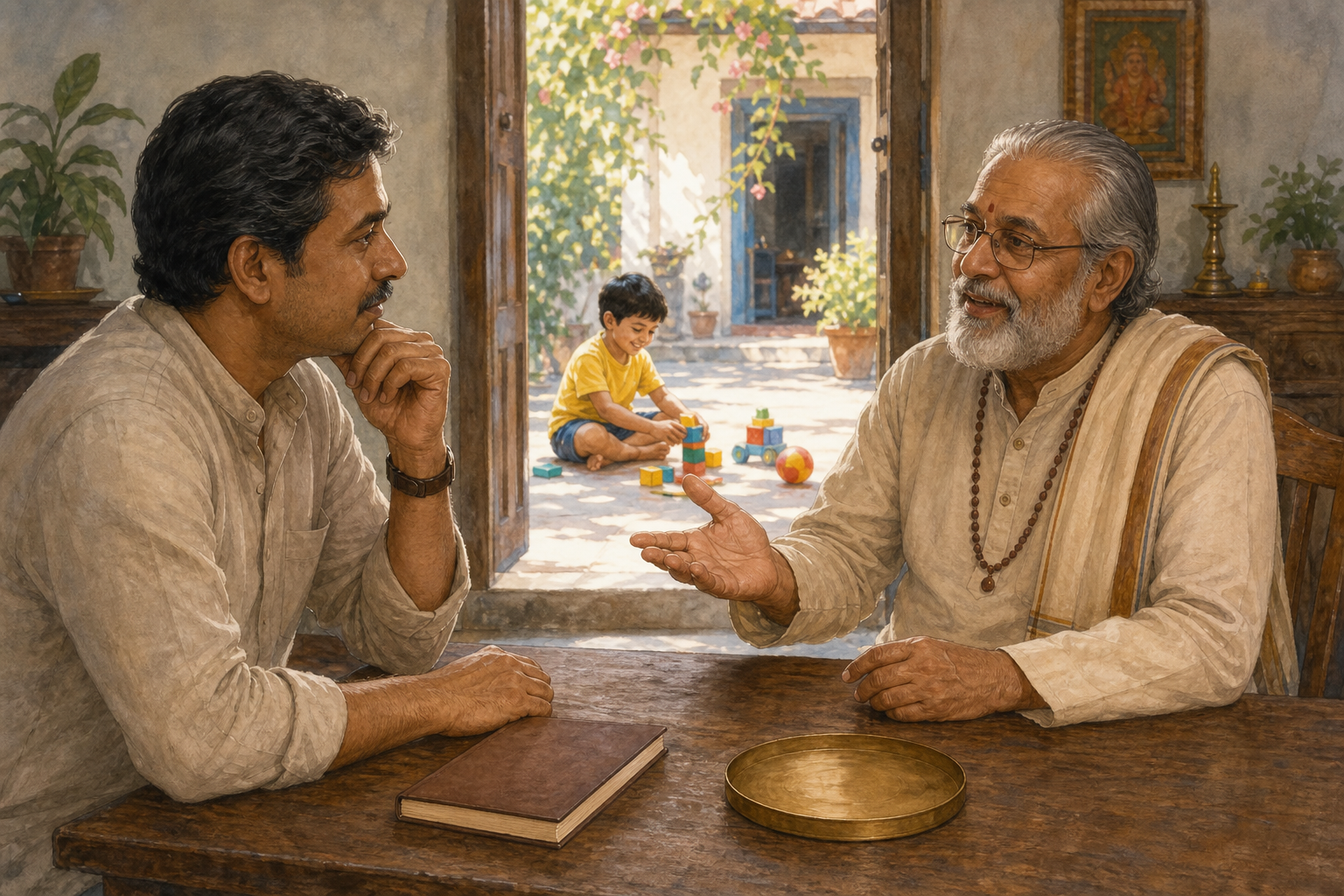
A responsible consultation should leave you with clearer duties, not helpless dread. When someone claims that Shani is threatening your child, ask these questions before accepting the conclusion:
- What exactly is being interpreted? Ask whether the concern involves a natal placement, a current transit, sade-sati, aṣṭama-śani, an aspect, or something else. The word “Shani” by itself is not an explanation.
- How has the child’s age been considered? Ask how the Pippalada covenant and the attenuated treatment of Saturn for minors affect the interpretation. If an adult reading has simply been copied onto a child, the reading lacks an essential qualification.
- Which age limit and lineage are being used? A confident claim of protection until twelve or sixteen should be identified as a particular transmitted version, not passed off as a universally fixed rule.
- What real condition is the prediction supposed to explain? Separate observable facts from astrological inference. Difficulty sleeping, falling grades, illness, grief, or conflict each requires attention on its own terms; a planetary label does not tell you what happened.
- What constructive duty follows? Useful counsel should lead toward calm worship, better routine, patient guidance, charity, or service. Advice that depends on terror, shame, large promises, or repeated declarations of doom has moved away from the covenant’s protective spirit.
- Would you say this in front of the child? If the language could make a child believe that the cosmos is against them, do not permit it to become part of their self-understanding.
Keep the chart and the child in their proper order. The chart is an interpretive aid; the child is a living person whose conduct, relationships, health, education, and emotional state must be observed directly. Do not withdraw ordinary care, delay professional help, or explain away a serious problem as Shani’s work. Devotional practice can accompany appropriate medical, psychological, educational, or safeguarding support; it cannot replace it.
Be equally careful with praise. Telling a child that Shani has made them unusually mature can also place an unfair burden on them. Children should be allowed to learn gradually, depend on adults, make repairable mistakes, and ask for help. Protection is not only freedom from frightening predictions; it is freedom from premature adulthood.
A Saturday practice that teaches protection without fear

Śani-vāra observance works best when it expresses relationship rather than panic. Customary practices include lighting an oil lamp, offering black sesame or oil in dāna, and reciting the Pippalada Shani Stotra or Dāśaratha Shani Stuti. Some families also pray near an aśvattha or pipal tree, which carries a natural association with Pippalada’s name and remembrance.
You do not need to perform every practice. Choose a simple form your family can sustain:
- Prepare quietly. Clean the prayer space and let an adult handle the oil lamp and flame. The atmosphere should tell the child that worship is safe and orderly.
- State the intention plainly. In your own words, ask Shani Deva for protection, patience, truthful conduct, and the strength to meet duties without fear. Do not present these words as a canonical mantra.
- Recite what your tradition knows. Use the Pippalada Shani Stotra, the Dāśaratha Shani Stuti, or the established Shani prayer of your household. Consistency is more valuable than collecting unfamiliar remedies after a frightening consultation.
- Join prayer to dāna. Give black sesame, oil, or another suitable form of assistance according to family custom. Explain to the child that generosity, not a transaction with a planet, is the heart of the act.
- Choose one Saturnian discipline. Keep a promise, finish an assigned duty, arrive when you said you would, care for an older relative, or repair something neglected. The task should fit the child’s age rather than imitate an adult austerity.
- Close with reassurance. Tell the child that Shani represents justice guided by patience and that Pippalada asked for the young to be treated with compassion. Never end by warning that a missed ritual will bring punishment.
The strongest remedy here is the family ethic surrounding the ritual. If adults light a lamp but frighten, insult, or overburden the child, the form has contradicted the covenant. If adults model punctuality, truthful speech, restraint, service, and patient correction, the child begins learning Shani’s virtues without carrying Shani as a threat.
This ethic also reaches beyond one Hindu narrative. Compassion, non-harm, kindness, disciplined conduct, and concern for the welfare of all are recognisable across Hindu, Buddhist, Jain, and Sikh life. The covenant’s civilizational insight is therefore practical: the vulnerable require a protected field in which conscience can grow.
Key takeaways for parents
- The Pippalada-Shani covenant tempers strict justice with compassion for children; it does not promise that nothing difficult will ever happen.
- The traditional age limit varies. Twelve and sixteen are both remembered, so use the principle of age-appropriate responsibility rather than treating one number as an uncontested cosmic deadline.
- Sade-sati and other Saturn conditions identify astrological periods, not predetermined disasters. Interpretations for minors require special restraint.
- Never let a prediction become a child’s identity. Discuss adult concerns away from the child and reject language that creates fatalism.
- Saturday worship can include a lamp, stotra, dāna, and an age-appropriate duty, but it should be performed as devotion and ethical training rather than payment made out of fear.
- Respond to a child’s observable needs directly. Spiritual practice should support, never replace, appropriate care and professional help.
The next time someone makes a severe claim about Shani and your child, ask them to name the exact condition, explain how age changes the reading, and identify the constructive duty that follows. Then bring the family back to the covenant’s centre: protect the child now, cultivate steadiness gently, and let accountability mature alongside understanding.