

If you are planning a vrata, puja, journey, signing, or other important beginning on Monday, April 6, the date alone is not enough. The decisive boundary falls before noon: Krishna Paksha Chaturthi gives way to Panchami at 11:59 AM.
That answers only the first timing question. A Sankashti observance may depend on the tithi at moonrise, while Rahu Kalam and other daily periods depend on your local sunrise and sunset. You therefore need to separate the day’s fixed lunar sequence from the local calculations that complete your ritual plan.
The 11:59 AM boundary governs how you use the day
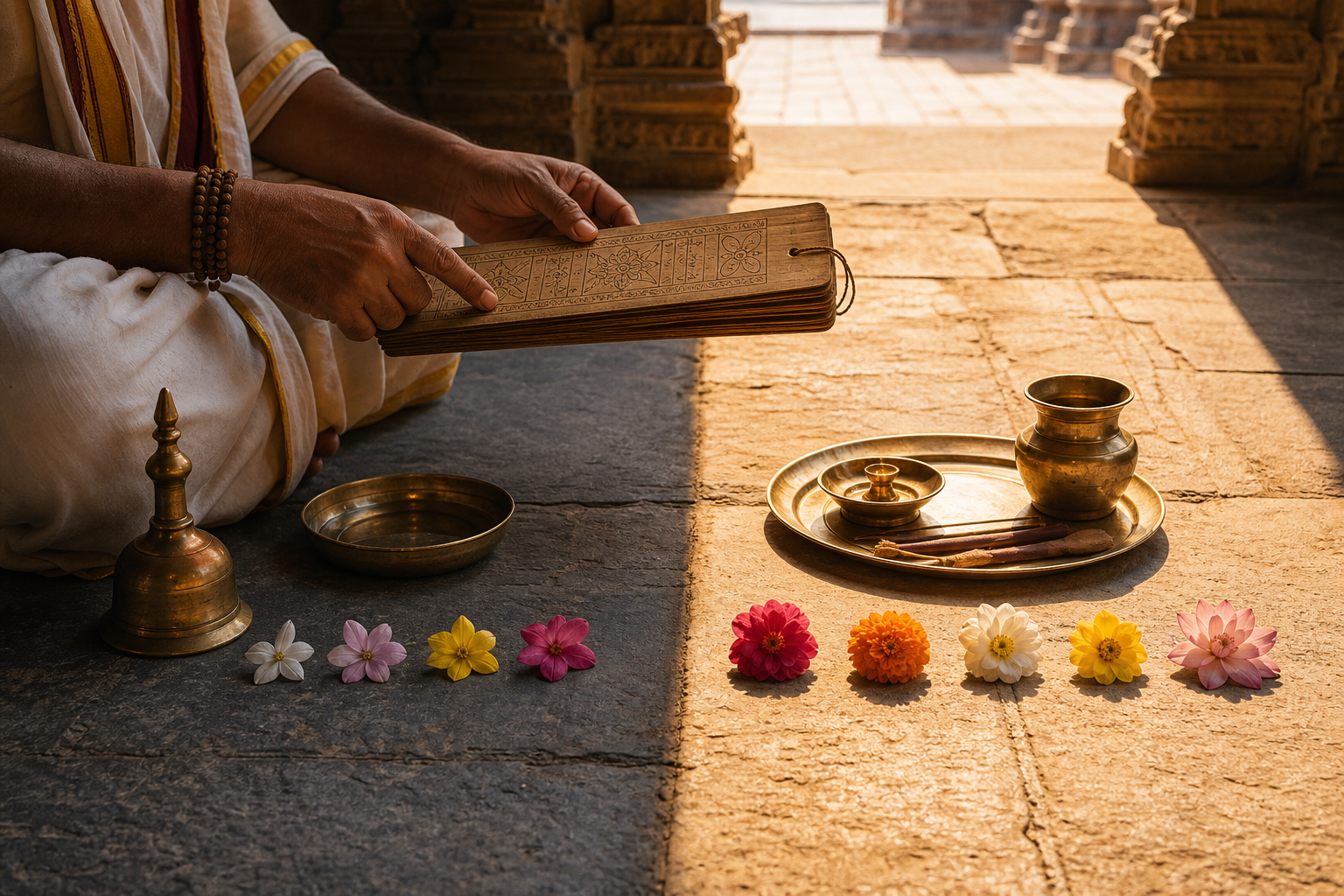
For April 6, the working sequence is straightforward: Krishna Paksha Chaturthi continues until 11:59 AM, and Krishna Paksha Panchami begins at that point. This is a change of tithi within the civil day, not a change at sunrise or midnight.
| Reference time on April 6 | Prevailing tithi | Practical use |
|---|---|---|
| Before 11:59 AM | Krishna Paksha Chaturthi | Suitable for a simple Chaturthi-oriented Ganesha prayer or household worship, subject to your local muhurta and tradition. |
| From 11:59 AM onward | Krishna Paksha Panchami | Use Panchami when judging work begun after the transition. Quiet study, remedial worship, procedural review, and consolidation of existing work fit the day’s more measured character. |
| At the transition itself | Tithi boundary | Do not deliberately place an important beginning on the boundary. Choose a time clearly before or after it according to the tithi your activity requires. |
A tithi measures a 12-degree separation between the Sun and Moon. Because that angular relationship changes continuously, a tithi does not have to begin at sunrise or last until the next sunrise. The civil date may therefore contain parts of two tithis.
Many traditions name a religious day by the tithi present at sunrise. Since Chaturthi prevails at sunrise on April 6, a daily calendar may identify the day with Chaturthi even though Panchami occupies the afternoon and evening. That label does not freeze Chaturthi for the rest of the day. When choosing an actual ritual time, use the tithi prevailing at the required ritual moment.
The 11:59 AM value should still be checked against a Panchang prepared for your city. Location, time zone, astronomical framework, and the almanac’s definition of sunrise can produce small differences. If your accepted local Panchang gives a different boundary, its local value should govern your observance.
Resolve the Sankashti date before beginning a fast
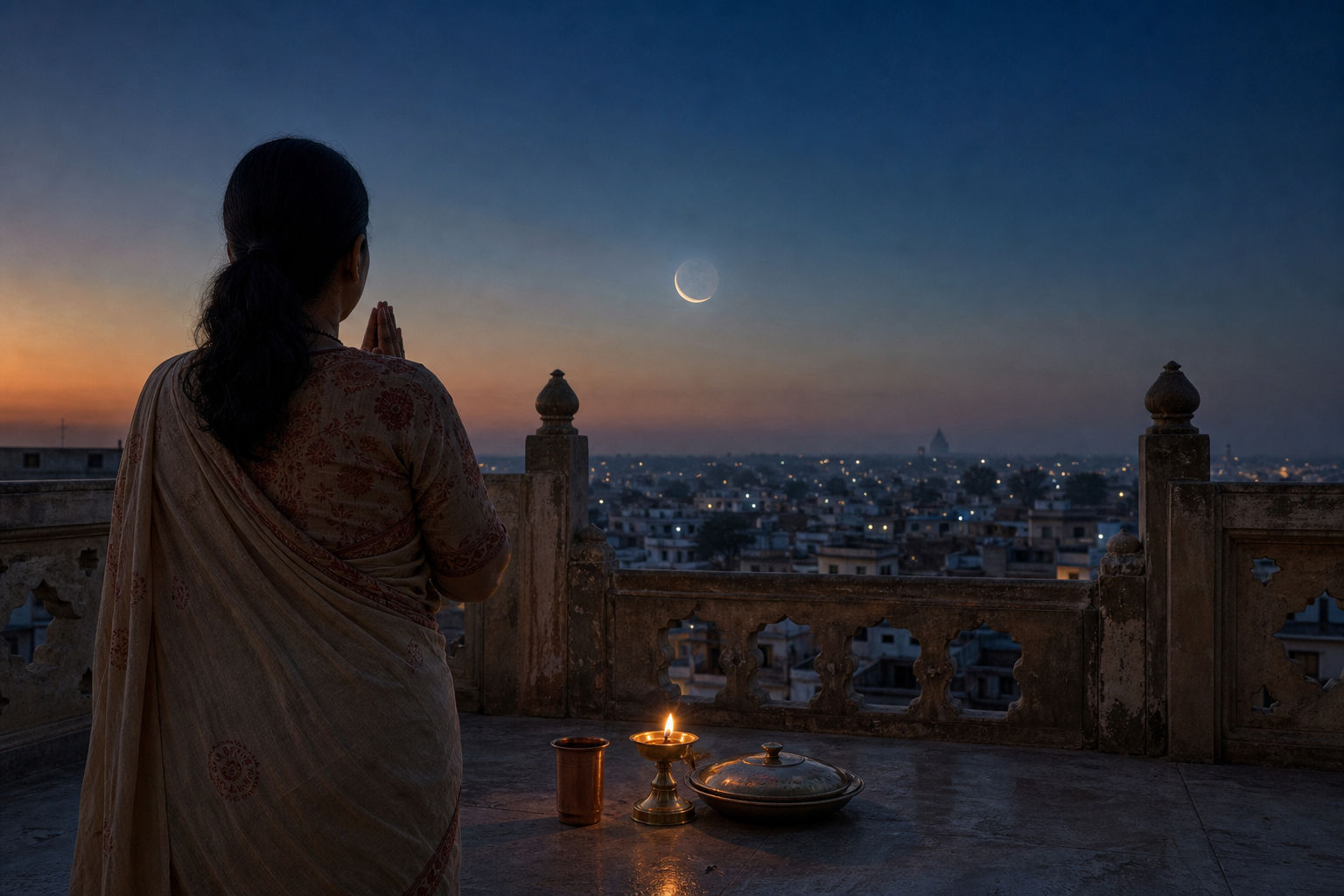
The most consequential mistake on this date would be to see “Chaturthi” at sunrise and automatically begin a Sankashti fast on Monday. Ordinary Chaturthi worship and a formal Sankashti vrata do not necessarily use the same rule.
Krishna Paksha Chaturthi is associated in many regions with Sankashti or Sankatahara Chaturthi, dedicated to Shri Ganesha. A common vrata sequence includes fasting, sighting the Moon, offering arghya, presenting simple naivedya to Ganesha, and then taking prasad. In traditions that require Chaturthi at moonrise, the tithi prevailing in the morning is not enough to establish the observance date.
- First identify the rule followed by your family, temple, or guru-parampara: does it assign Sankashti by the tithi at moonrise, by the tithi at sunrise, or by a regional calendar convention?
- Check the Sankashti listing and moonrise for your city rather than relying on a calendar prepared for another location.
- Because Chaturthi ends at 11:59 AM on April 6, it does not continue into the usual evening moonrise period. Several regional conventions may therefore attach the vrata to the prior evening.
- If your local Panchang assigns Sankashti to the prior day, perform the moon-related conclusion on that designated evening. Do not move it to Monday evening merely because Monday began under Chaturthi.
- If two calendars assign different dates, follow the one used by the temple or priest conducting the rite. For a private family observance, continuity with your established parampara is more meaningful than switching rules to obtain a preferred date.
You can still offer a simple Ganesha prayer during Monday morning while Chaturthi prevails. That personal worship does not, by itself, reassign a formal moonrise-based vrata. The distinction lets you honor the morning tithi without confusing it with the vrata’s prescribed completion rule.
Calculate Monday’s Rahu Kalam from local daylight
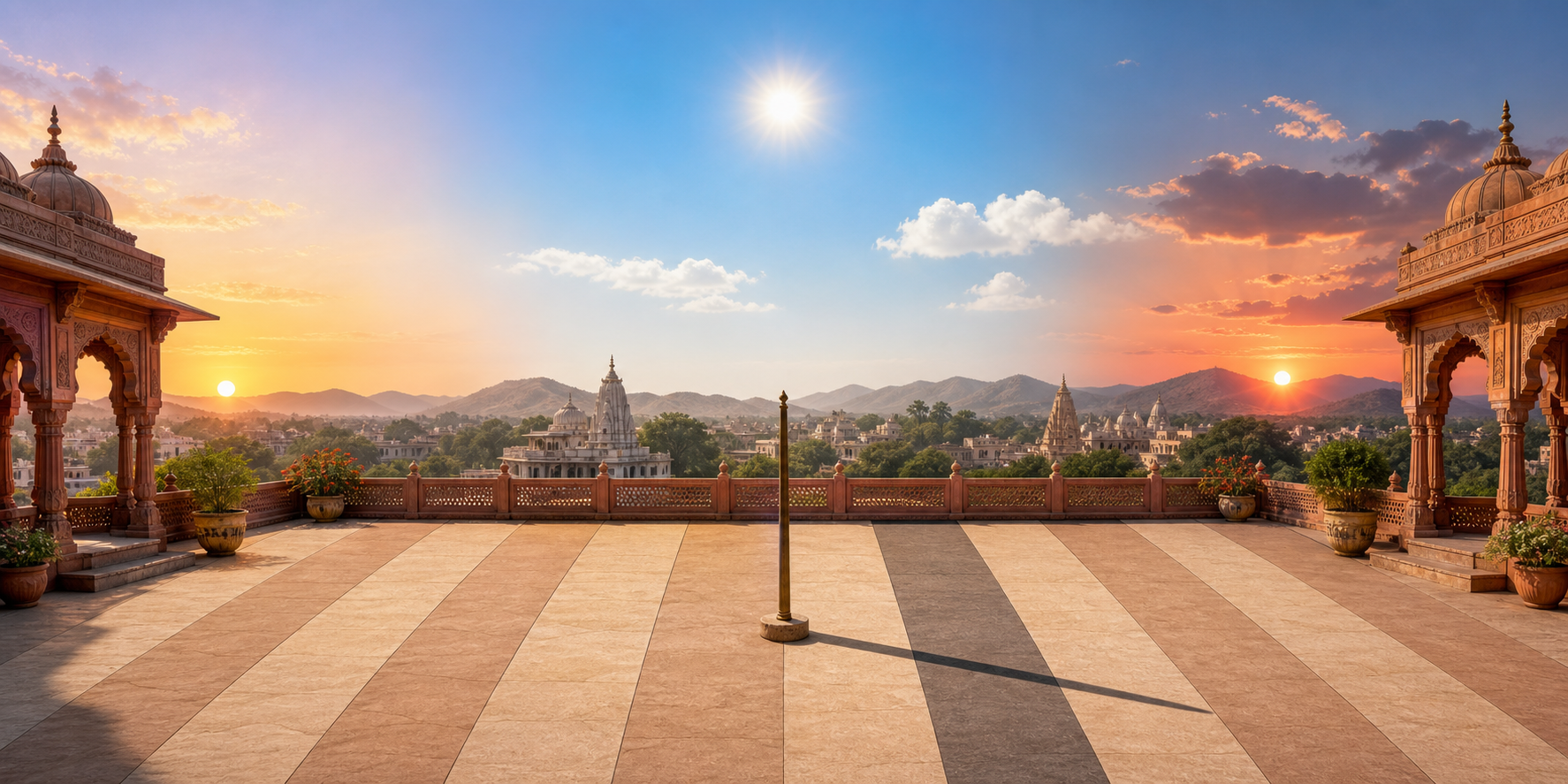
Rahu Kalam is not a universal clock interval. It is calculated from the daylight at your location, so copying a familiar fixed range from a poster or search result can put the boundary in the wrong place.
Let S be local sunrise and E be local sunset. The daylight duration is E minus S. Divide that duration into eight equal segments. On Monday, Rahu Kalam occupies the second segment. In practical terms, it begins one segment after sunrise and ends two segments after sunrise.
- Record the April 6 sunrise and sunset for the city where the action or ritual will occur.
- Subtract sunrise from sunset to obtain the complete daylight duration.
- Divide that duration by eight.
- Add one segment to sunrise to find the beginning of Monday’s Rahu Kalam.
- Add two segments to sunrise to find its end.
- Keep the full local precision until the calculation is complete. Rounding the sunrise first can shift both ends unnecessarily.
The often-repeated 7:30–9:00 AM shorthand comes from a standardized daylight assumption; it should not be treated as the Monday answer for every season and city. Your local sunrise and sunset are the inputs that matter.
Yamaganda and Gulika Kalam are also assigned by weekday-based daylight segments, but they occupy different portions from Rahu Kalam. Obtain their April 6 intervals from the same local Panchang or its weekday table. Varjyam, where your tradition uses it, must likewise be checked locally because it is tied to the day’s stellar calculations.
Abhijit Muhurat can provide a strong candidate around local solar noon for success-oriented work, but solar noon is not necessarily 12:00 PM on the civil clock. It is also not an automatic override for an unsuitable tithi, an applicable textual exception, or a conflicting prohibited interval. Confirm the locally calculated Abhijit window before using it.
Match the muhurta to the action you are beginning

A useful muhurta is selected for a particular act. There is no single “best time” that serves a vrata, a business opening, a journey, and a document signing equally well.
Start with the Panchang’s five limbs in a disciplined order. Tithi establishes the lunar day and often the ritual eligibility. Vara identifies Monday and supplies the weekday framework. Nakshatra refines the suitability of the proposed action. Yoga describes the broader qualitative tendency, while Karana, as a half-tithi division, sharpens the action-level timing. Chandra Rashi is not one of the five limbs, but it can add personal or situational refinement.
| Your intended action | First timing question | Refinement to check | Mistake to avoid |
|---|---|---|---|
| Simple Ganesha worship | Can it be completed while Chaturthi prevails before 11:59 AM? | Local prohibited periods and the household’s normal worship practice. | Treating every Chaturthi puja as a moonrise-based Sankashti vrata. |
| Formal Sankashti vrata | Which date does your local tradition assign by its moonrise rule? | Local moonrise and the convention followed by your family or temple. | Choosing April 6 only because Chaturthi is present at sunrise. |
| Important filing, signature, or first business call | Does the proposed start fall outside local Rahu Kalam and Yamaganda? | Nakshatra, Yoga, Karana, and a valid Abhijit interval if appropriate. | Using fixed clock times calculated for another city. |
| Journey or business opening | Is the beginning compatible with the tithi and free of the main prohibited periods? | An auspicious daytime or nighttime Choghadiya, followed by Nakshatra and Karana. | Using Choghadiya alone while ignoring a conflicting Panchang factor. |
| Study, review, or remedial worship | Would beginning after 11:59 AM make constructive use of Panchami? | A stable interval without an imminent Nakshatra, Yoga, or Karana change. | Confusing ordinary Krishna Panchami with a major Panchami festival belonging to another month or lunar phase. |
| Consolidating work already underway | Can it proceed during Panchami without being treated as a ceremonial new beginning? | The practical schedule and any local restrictions your tradition applies. | Delaying routine continuation merely because no ceremonial muhurta was selected. |
Once you have a candidate interval, check whether Nakshatra, Yoga, Karana, or Chandra Rashi changes inside it. A value listed for the date may not remain in force all day. If a boundary sits inside your proposed window, move the beginning to a clearly stable side rather than scheduling it at the transition.
For an important beginning, the practical sequence is: establish the ritual rule, confirm the prevailing tithi, exclude the locally calculated unsuitable periods, and then refine the remaining choices with Nakshatra, Yoga, Karana, and any task-specific Choghadiya. This prevents a favorable label in one column from being mistaken for approval from the whole Panchang.
When two Panchangs disagree
A small difference does not automatically mean that one calendar is careless. Almanacs may use different ayanamsha systems, astronomical ephemerides, sunrise definitions, refraction corrections, coordinates, or time-zone handling. These choices can shift a boundary and alter which interval is recommended.
Do not build a hybrid schedule from unrelated calendars—for example, taking sunrise from one city, Rahu Kalam from a national chart, and Nakshatra end time from another almanac. Choose one reliable, location-specific Panchang accepted by your tradition and use its values consistently. If a temple ceremony is involved, the officiating temple’s calendar should settle the operational timing.
Key takeaways for April 6, 2026
- Krishna Paksha Chaturthi prevails until 11:59 AM; Krishna Paksha Panchami begins at 11:59 AM.
- The tithi at sunrise may name the religious day, but the tithi at the prescribed ritual moment determines many specific observances.
- Do not assume that the Sankashti fast belongs to Monday. If your tradition requires Chaturthi at moonrise, check whether the local calendar assigns the vrata to the prior evening.
- Calculate Monday’s Rahu Kalam from local sunrise and sunset. It occupies the second of eight equal daylight segments.
- Check Yamaganda, Gulika Kalam, Varjyam, Nakshatra, Yoga, Karana, Chandra Rashi, and Abhijit Muhurat in one consistent local Panchang.
- For an action near 11:59 AM or another calendrical boundary, choose a time clearly on the required side instead of beginning at the transition.
Before April 6, write down your city’s sunrise, sunset, moonrise, tithi-end time, and the change times for Nakshatra, Yoga, and Karana. If you intend to observe Sankashti, settle the correct observance date with your family calendar or priest in advance. With those decisions made, the Panchang becomes what it is meant to be: a precise aid to disciplined action, not a collection of generic clock times.