
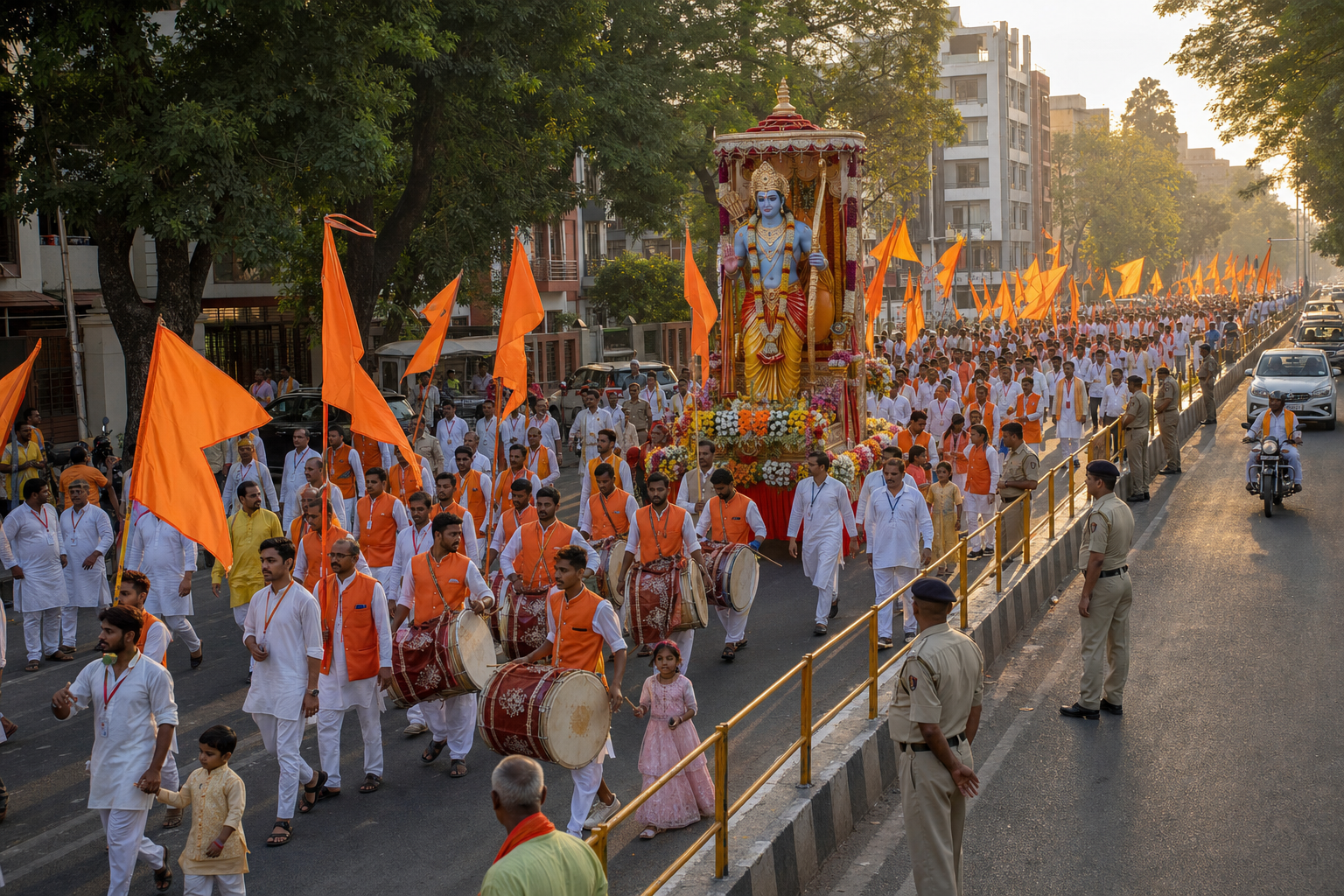
If you are organizing a Ram Navami procession and the police restrict its route, timing, or sound, the immediate question is simple: is this a genuine safety measure, or is your community being treated differently? Anger alone will not answer it. You need a test that can distinguish reasonable public-order conditions from unequal treatment.
You should not have to choose between visible Ram bhakti and public peace. The sound position is to defend the right to celebrate, demand written and comparable rules, prepare seriously for foreseeable risks, and refuse the retaliatory conduct that turns devotees into defendants.
Equal rules must be visible in decisions, not just speeches
India’s constitutional structure protects equality before the law under Article 14; speech, peaceful assembly, and association under Article 19; life and dignity under Article 21; and religious freedom under Articles 25-28. Those freedoms coexist with lawful restrictions for public order, morality, and health. The practical principle is therefore neither "every procession gets everything it requests" nor "the police may impose anything in the name of sensitivity."
A defensible restriction should be lawful, directed at a legitimate risk, necessary to address that risk, and no broader than required. Permission conditions should regulate time, place, manner, traffic, sound, crowd density, and safety. They should not suppress an event merely because its religious identity is politically inconvenient.
Equal treatment does not mean deploying exactly the same number of officers at every festival. A narrow road, a large expected crowd, a hospital entrance, a dangerous bottleneck, or a recent local incident may justify additional barriers or a modified plan. The state may respond to different risks differently. What it may not do is use religious identity as a substitute for a risk assessment.
This distinction matters when a Ram Navami route passes through a locality described as "sensitive." That label cannot be the end of the discussion. Ask what the identified hazard is, where it occurs, how the proposed restriction addresses it, and whether less restrictive measures were considered. More police, staggered movement, temporary traffic control, a short no-stoppage stretch, or protected emergency access may address a specific danger without erasing the procession from the road.
Use four questions to test a disputed condition
- What is the written rule? Ask for the permission order, the applicable noise or assembly rule, the approved route, and every attached condition. An oral warning is difficult to review and easy to dispute later.
- What concrete risk is being addressed? "Possible tension" is not a useful operational explanation. Road width, crowd estimates, conflicting events, emergency access, and documented local history are assessable factors.
- Was a less restrictive option considered? Ask whether additional deployment, barriers, revised stopping points, or a narrower timing adjustment could manage the risk while preserving the procession.
- How were comparable events treated? Compare the application process, sound limits, route standards, time windows, traffic diversions, enforcement, and reasons for exceptions. Compare like with like: crowd size, road conditions, duration, and risk profile all matter.
If the answers reveal a serious disparity, do not try to overturn the order through confrontation on the street. Request written reasons and use the available grievance, administrative-review, or legal channels. Local procedures differ, so an organizer facing a consequential denial should obtain advice from a lawyer familiar with the applicable state and municipal rules.
Put the entire procession plan in writing before the first drumbeat

A permit is only one part of preparation. Many failures occur in the space between the official order and the volunteers who must implement it. The person leading the procession, the marshal at the rear, the sound-vehicle operator, and the police contact should all be working from the same version of the plan.
Build one written operations sheet with the following elements:
- The approved route and stopping points. Mark junctions, narrow stretches, places where the procession may pause, places where it must keep moving, and all entry and dispersal points.
- The operating window. Record assembly time, departure time, expected arrival, sound cutoff, and final dispersal. Give each zone marshal the same schedule.
- The sound plan. Identify the responsible vehicle and operator, applicable limits, speaker direction, and who has authority to reduce or stop amplification immediately.
- The volunteer chain of command. Assign named leaders for the front, middle, rear, sound vehicle, medical response, and liaison desk. Volunteers should know whom to call instead of improvising under pressure.
- The emergency corridor. Preserve access for ambulances, fire services, and police movement. A dense devotional crowd can become dangerous even when no hostile act occurs.
- The incident ladder. Define what marshals do if the route is blocked, a participant breaches a condition, a rumor appears online, an object is thrown, or police direct the procession to pause.
- The communication channel. Use one verified organizer channel for operational instructions. Record the names and numbers of police, municipal, medical, and organizer contacts on a one-page command card.
- The evidence record. Keep the final permission, route map, organizer brief, volunteer assignments, public advisories, and any written changes together. Record when an instruction is received and who issued it.
Before the event, walk the route with the relevant officials and senior volunteers. A map does not reveal everything: a parked vehicle can narrow a turning point, a market can create an unexpected crowd, and an ambulance entrance can be missed in a general traffic plan. Write down agreed corrections and circulate the revised version. Do not rely on different people remembering the same conversation in the same way.
The organizers should also brief participants on conduct. Keep the cultural and devotional program clear. Tell marshals how to respond to a provocative exchange without answering it, who can speak to police, and who can issue an organizer announcement. Discipline is not an admission that the procession caused the danger. It is how you protect devotees, preserve the legitimacy of the celebration, and prevent one person’s act from defining the whole yatra.
When something goes wrong, stop one incident from becoming two
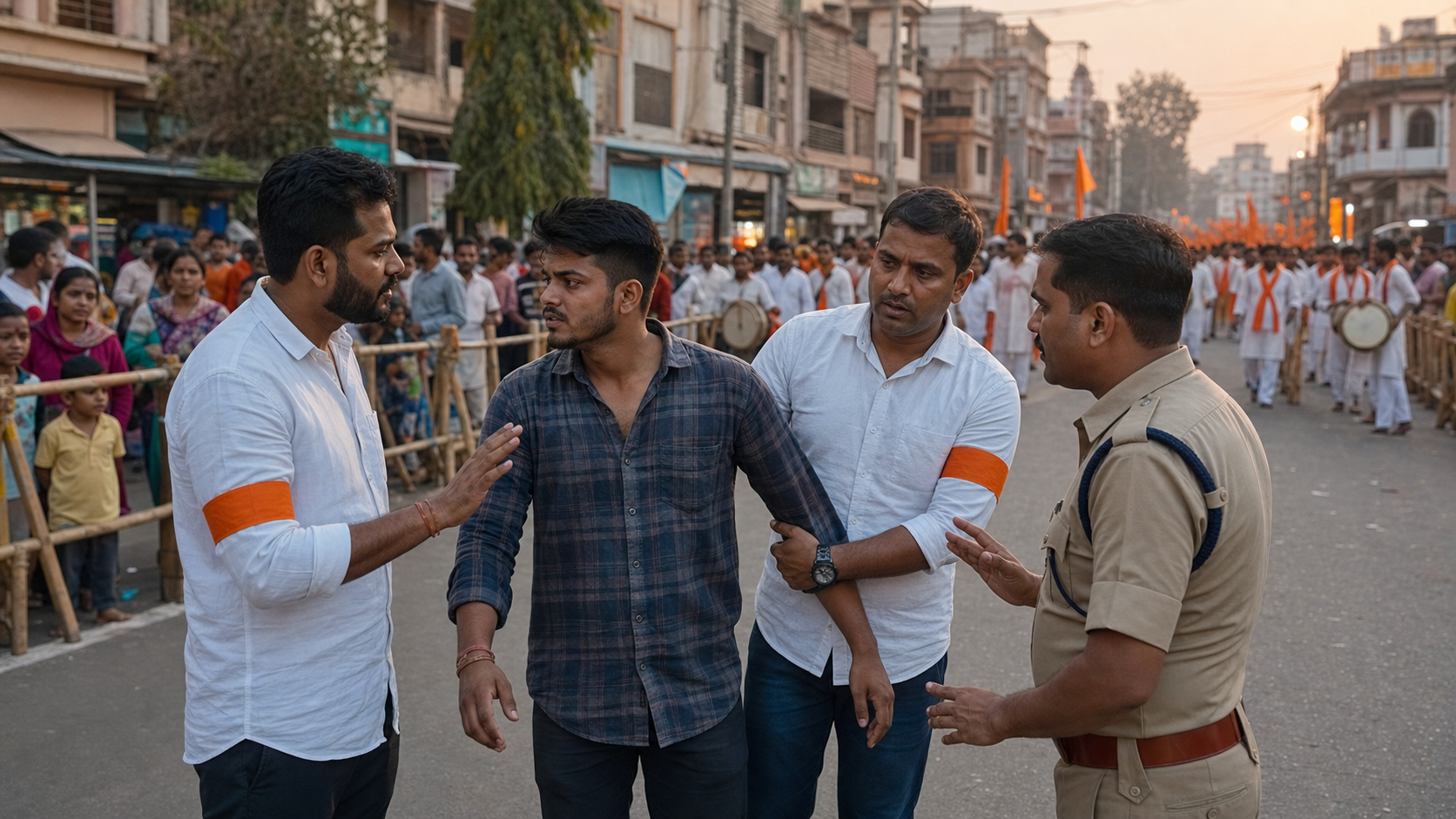
The first dangerous act and the crowd’s response to it are separate events. A thrown object, blocked route, threatening slogan, or rumor may be the first incident. A retaliatory rush, group accusation, or forwarded falsehood can create the second. Your incident plan should be designed to prevent that second event without concealing the first.
Protect people before pursuing an argument
- Marshals should alert the designated police and organizer contacts immediately. They should not leave their zones to chase, investigate, or confront suspected offenders.
- Move children, older participants, and anyone with limited mobility away from the exposed edge of the crowd. Keep the emergency corridor clear.
- Follow police movement instructions unless doing so would place people in immediate danger. If an instruction appears to contradict the written plan, record it and challenge it afterward through the proper channel.
- Capture evidence only from a safe position. Do not approach an active confrontation to obtain a clearer video.
- Record time, place, direction, and the sequence of events. Preserve the original file or link where possible instead of circulating edited fragments.
- Do not announce the identity or community of an alleged offender before it has been verified. A false group accusation can mobilize people far beyond the original location.
If there is active violence, fire, serious injury, or an immediate threat to life, contact emergency services and follow on-scene safety directions. The priority at that moment is not winning the public narrative. It is getting people out of danger while preserving enough reliable information for accountability.
Treat an unverified clip as a public-order hazard
A short video can move through messaging groups faster than officials can establish where or when it was recorded. Before forwarding any alarming clip, ask four things: Who first uploaded it? Can the location be identified? Is the recording current and complete? Has a responsible local contact confirmed the event?
If those answers are missing, do not add a communal label and send it onward. Pass the link privately to the designated verification contact. Organizers and police should issue brief, timestamped updates through known channels: what is confirmed, what is not confirmed, which route instruction is in force, and when the next update will appear. If an earlier statement is wrong, correct it in the same channels where it circulated.
Neutrality is crucial here. Falsehoods alleging an attack on Hindu devotees require rapid correction when false, but genuine attacks must not be minimized as mere "rumors." The same verification standard should apply to claims made by procession participants, opponents, political accounts, and officials. Verification protects the innocent without granting impunity to the guilty.
Audit the enforcement after the road reopens

A peaceful dispersal does not prove that the system was fair, and a clash does not by itself identify who failed. Within the post-event review, separate organizer compliance, attacks on the procession, counter-group conduct, police decisions, emergency response, property loss, and online misinformation. Mixing them together creates collective blame and hides correctable failures.
Parity can be audited through permissions granted, conditions imposed, deviations recorded, violations identified, and action taken. A city need not disclose sensitive personal or operational information to publish a useful anonymized report.
| Audit test | Evidence to compare | What parity looks like |
|---|---|---|
| Application process | Forms, required documents, deadlines, processing time, and written reasons | Comparable events face the same documentary burden and a time-bound decision process |
| Route and timing | Approved roads, prohibited stops, operating window, and stated hazards | Differences follow road, crowd, traffic, or safety conditions rather than religious identity |
| Sound control | Applicable limits, cutoff times, monitoring, warnings, and recorded breaches | The same rule and enforcement sequence apply to similarly situated events |
| Police deployment | Barricades, patrols, cameras, crowd zones, and emergency access | Deployment follows a recorded risk assessment, even when the resulting numbers differ |
| Violations and violence | Organizer deviations, bystander conduct, attacks, vandalism, and official response | Each act is assessed on evidence and due process; one side’s breach does not excuse another’s violence |
| Verified losses | Damage reports, eligibility rules, evidence requested, decisions, and payment timing | The same claims and compensation process is open to every eligible person |
The fifth row is especially important. A sound violation by a procession does not excuse stone-pelting or vandalism. An attack on devotees does not make every later breach by participants lawful. Equal accountability means investigating both without using one to erase the other.
Community representatives should ask for a formal debrief with reasoned follow-up: which bottleneck caused delay, whether warnings reached the right marshal, whether cameras covered the relevant stretch, how quickly medical help arrived, what rumors circulated, and which condition should be revised next time. A grievance portal, third-party review, or published post-event note makes the process harder to manipulate through selective memory.
Dharmic firmness means disciplined strength, not withdrawal
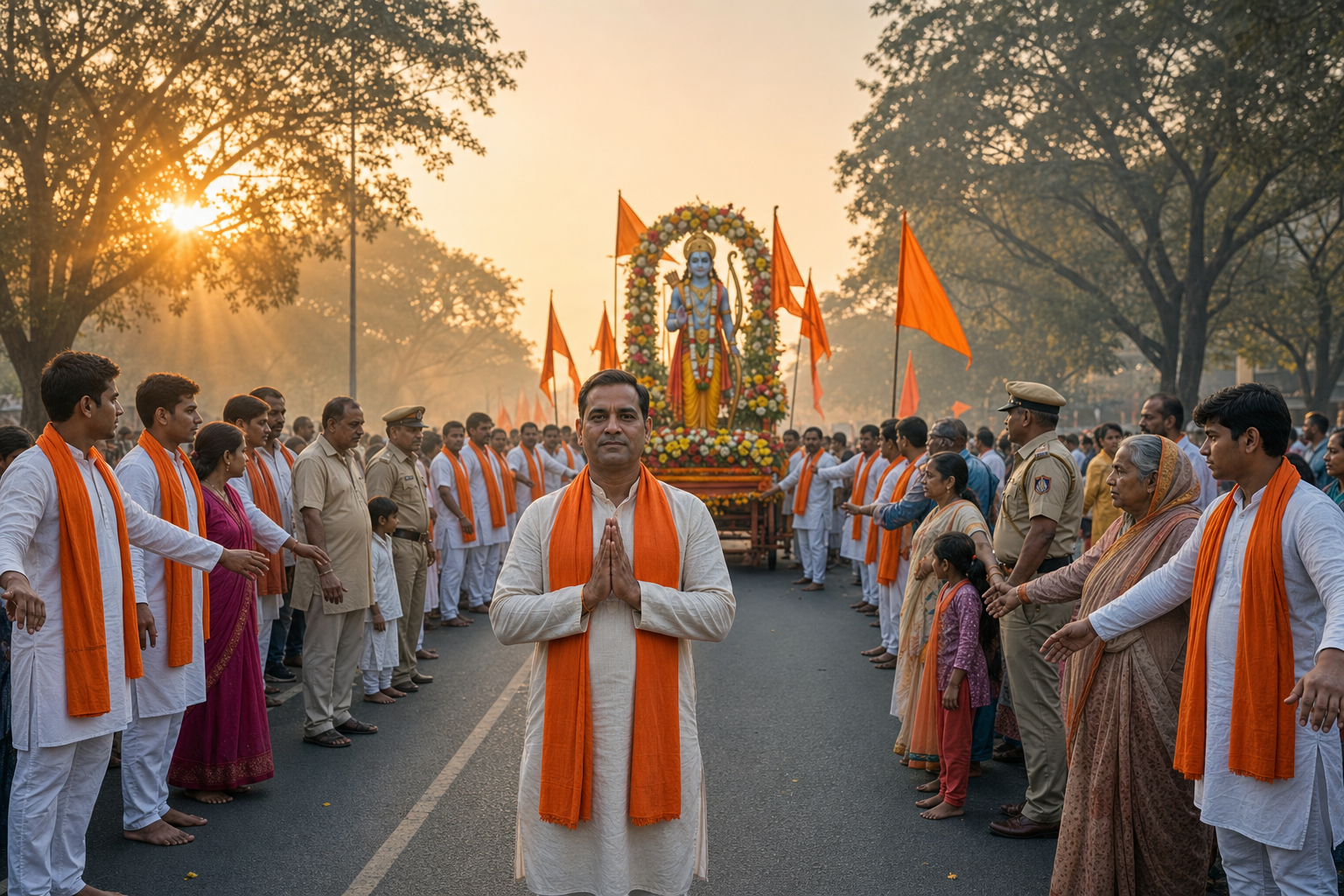
Ram Navami should be celebrated with confidence. Public devotion is not a concession granted to Hindus when officials find it convenient. At the same time, a procession dedicated to Shri Ram should embody maryada: ordered conduct, responsibility, courage, and restraint.
Ahimsa does not require passive acceptance of an assault, and it does not ask Hindu society to disappear from public space. It rejects retaliatory mob action while leaving room for lawful protection, evidence, and firm accountability. Jain anekantavada encourages us to test what we think we know; it does not require false equivalence between an aggressor and a victim. Buddhist metta and karuna discourage humiliation that keeps a conflict alive. Sikh seva and sarbat da bhala turn public service into a practical commitment to everyone’s safety.
These values can be built into the event rather than added as ceremonial language. A Jain sangh can operate a water station, a gurdwara can support a medical camp, and Buddhist volunteers can assist with traffic coordination. Hindu organizers can offer the same service when neighboring communities hold public events. Such cooperation does not dilute the Hindu character of Ram Navami. It creates trusted contacts who can solve a road-level problem before political actors turn it into a communal test.
Sarva dharma sambhava likewise does not mean hiding Hindu symbols or pretending that every tradition is identical. In civic administration, it means that the state should not distribute rights, burdens, or remedies according to religious preference. For communities, it means extending basic regard to neighbors without surrendering one’s own sacred identity.
Public leaders should use the same discipline. Calls for equal rules are strongest when they name the principle, the disputed decision, the requested remedy, and the evidence. Invective may produce a moment of attention, but it makes operational cooperation harder and gives officials room to treat a solvable governance failure as an unavoidable communal quarrel.
Key takeaways
- Equal rules mean the same permission framework, risk criteria, enforcement standards, due process, and access to remedies.
- Different police deployments can still be fair when differences are tied to documented road, crowd, traffic, or safety risks.
- Get routes, timing, sound conditions, official changes, and reasons for restrictions in writing.
- Give marshals a precise incident ladder so that one hostile act does not trigger a second, retaliatory crisis.
- Do not forward an alarming clip until its time, place, origin, and context have been checked.
- Audit attacks on devotees, organizer violations, counter-group conduct, police actions, and verified losses as separate questions.
Before your next coordination meeting, prepare three things: a marked route map, a one-page command card, and a comparison sheet showing the conditions applied to similar public events. Ask officials to resolve discrepancies before the procession begins. That is how "equal rules" becomes more than a slogan – and how Ram Navami remains both unmistakably public and responsibly protected.