
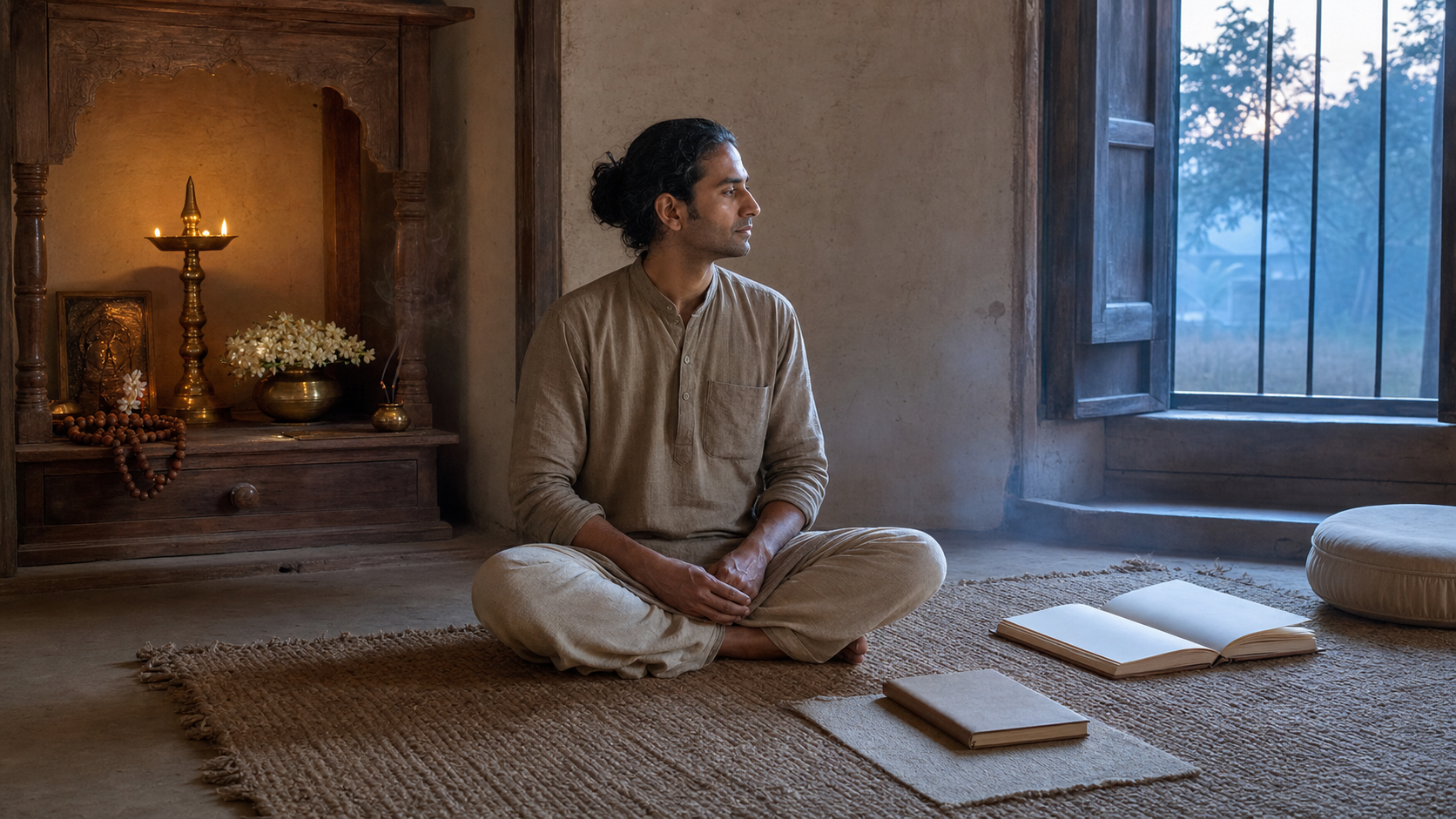
You may feel at home in prayer, nama-japa and loving service, yet still be drawn to the Upanishadic inquiry into atman, Brahman and moksha. The practical question is whether you must choose one path, or whether devotion and self-inquiry can strengthen each other.
You do not need to amputate either side of your spiritual life. You do, however, need enough precision to keep one tradition from becoming a vague translation of the other. A sound practice combines the shared discipline of hearing, reflection and contemplative assimilation with the devotional movement of hearing, recitation, remembrance and service. It lets the heart soften without asking the intellect to become careless.
Do not force bhakti and Advaita into one doctrine

The word liberation does not carry an identical explanation in every Hindu sampradaya. That is the first distinction to preserve.
In a Krishna-bhakti setting, study is relational. You hear about Bhagavan, remember Krishna, recite His teachings and turn understanding into seva. Bhagavad Gita, Srimad Bhagavatam and Chaitanya Charitamrita are approached not merely as repositories of ideas but as means of deepening devotion. A verse has been assimilated when it changes your remembrance, speech, choices and service.
Within the Advaita orientation associated with the Muktikopanishad, bondage is traced to avidya, and liberating knowledge clarifies the non-difference of atman and Brahman. Bhakti and dhyana remain valuable, but they steady and purify the mind for knowledge. The mahavakyas, neti-neti, disciplined reasoning and direct contemplation belong to that specific account of release. Through Om, the states of waking, dreaming and deep sleep, and turiya, the Mandukya curriculum brings the inquiry directly into your examination of consciousness.
These orientations can coexist respectfully in your life, but respect is not created by erasing their differences. If a bhakti commentary presents loving service as the spiritual goal, do not silently rewrite service as a temporary metaphor for nondual realization. If an Advaita argument establishes atman-Brahman identity, do not reduce it to a general statement that all religious people should be loving. First understand what each teaching claims in its own theological grammar. Only then ask how the practices relate within your sadhana.
Apply the same care when speaking about the wider dharmic family. Buddhism, Jainism and Sikhism share serious commitments to truth, discipline, compassion, non-harm and freedom from delusion, but nirvana, kevala-jnana, moksha and liberation through naam-simran are not interchangeable labels. Shared ethical aspirations support fellowship; they do not abolish doctrinal substance.
When you take notes, separate three questions: What does this passage actually teach? How does its tradition reason toward that teaching? What practice does it ask of you? This small discipline prevents a familiar error: agreeing with every text only because its distinctive claim has been blurred into something you already believed.
Use the shared discipline without erasing the destination
Bhakti study and Upanishadic inquiry meet most fruitfully in method. Both require receptivity, sustained attention, reflection and assimilation. Neither is fulfilled by collecting quotations.
Shravana begins with disciplined hearing. In devotional study, this includes receiving Krishna-katha and the explanations of the guru-parampara. In Vedantic inquiry, it includes systematic attention to shruti and its teaching about the Self. Manana then tests whether you have understood the reasoning rather than merely retained its vocabulary. Nididhyasana allows the teaching to become steadily present instead of remaining an idea visited during reading time.
The terms overlap, but their emphasis can differ. Use the following map as a study aid, not as a claim that the paths are identical.
| Phase | Devotional emphasis | Upanishadic emphasis | Error to avoid |
|---|---|---|---|
| Prepare | Offer the session in humility and service | Settle the mind for an honest inquiry into truth | Opening the book while attention remains scattered |
| Hear | Receive the verse, translation and theological explanation | Follow the mantra, context and intended proposition | Selecting an attractive line while ignoring its argument |
| Reflect | Ask what obstructs remembrance, surrender or service | Ask what is being superimposed, negated or established | Repeating terminology without resolving the doubt |
| Assimilate | Recite, remember, perform japa and contemplate the teaching | Contemplate Om, awareness or a mahavakya within its method | Substituting a pleasant mood for sustained attention |
| Embody | Translate insight into achara and seva | Act with ethical clarity, restraint and non-attachment | Claiming realization while conduct remains untouched |
Ethics belongs inside this process. Truthfulness, ahimsa, disciplined speech, self-restraint and non-possessiveness are not decorative preliminaries. Agitation, deceit and cruelty distort attention and make subtle study easier to misuse. If you study non-attachment but become indifferent to another person’s suffering, or study devotion while becoming contemptuous of another sampradaya, your conduct has exposed a problem that your vocabulary concealed.
Keep devotion from collapsing into sentiment by asking for the teaching’s logic. Keep analysis from becoming dry by asking what the insight should purify in you. Alternating these questions gives both head and heart a real task.
Build a 20- to 40-minute session that changes something
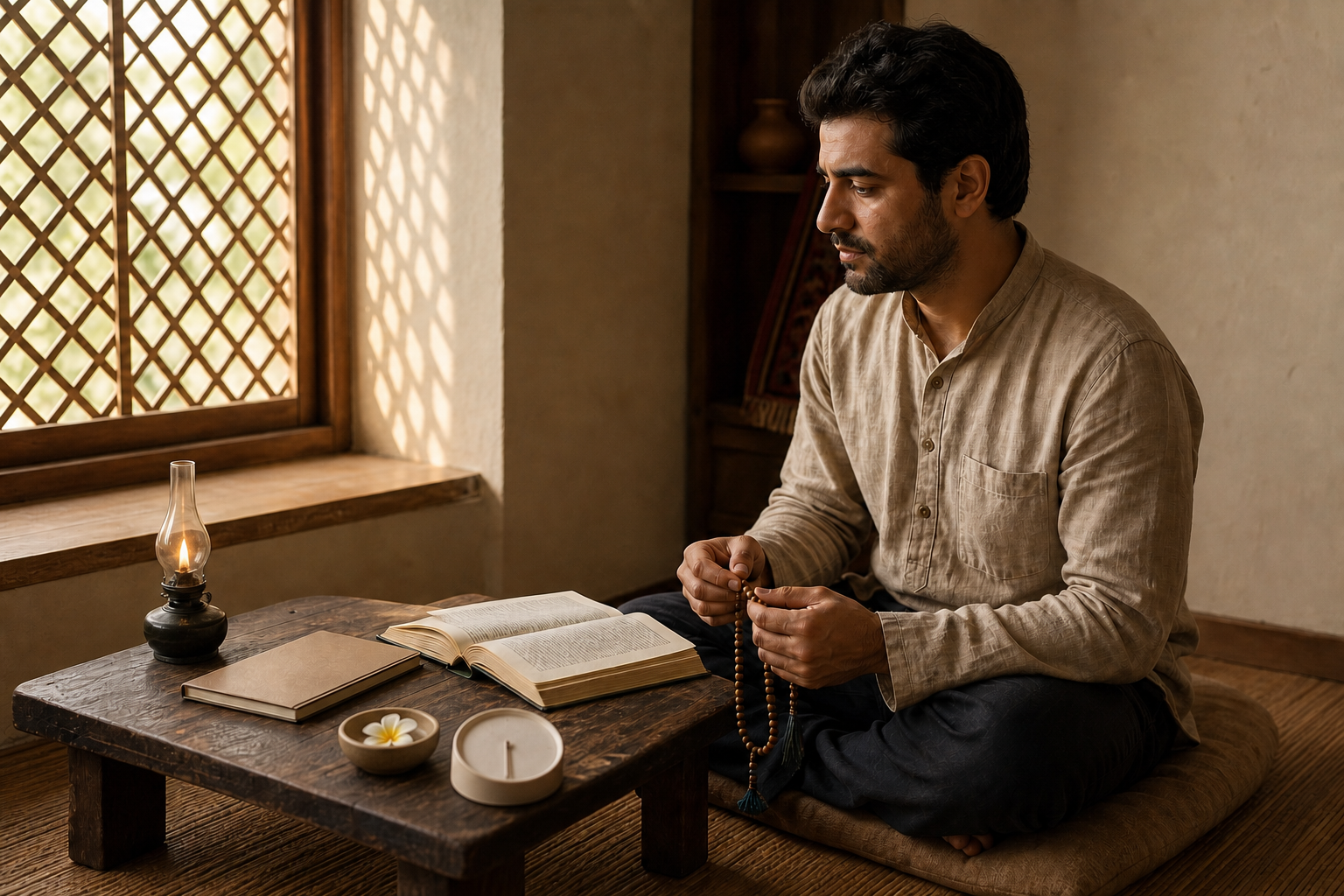
Long, irregular reading marathons often create the feeling of progress without stable retention. A consistent session of 20 to 40 minutes gives you enough room to read slowly, reflect and leave with one practicable instruction. Use the same place and approximate time when possible so that beginning requires less negotiation with yourself.
- Prepare the setting. Choose a quiet, clean and well-lit place. Put the text, journal and pen within reach, and silence digital interruptions before you begin. Brahma-muhurta can be especially conducive when it genuinely fits your duties, but a sustainable period is better than an ideal hour you repeatedly miss.
- State a sankalpa. Use one plain sentence: may this study help you understand truth, remember it and embody it in service. This keeps the session aimed at transformation rather than spiritual self-display.
- Settle for a few minutes. Begin with a brief invocation, gratitude, nama-japa or conscious breathing. Even three minutes of deliberate settling can mark a clean transition from ordinary concerns to sacred attention.
- Read one manageable unit slowly. Follow the actual structure of the edition in front of you. With Srila Prabhupada’s books, observe the Sanskrit verse, word-for-word meanings, translation and purport. With an Upanishadic passage, attend to the mantra, translation, teaching context and chosen commentary. Do not decide what a Sanskrit term means from its familiar English equivalent alone; track how it functions in that passage and school.
- Interrogate your understanding. Close or cover the page and state the central claim in one sentence. Then identify the problem being addressed, the reasoning or instruction offered, and the obstacle the passage anticipates. If you cannot do this without repeating a memorable phrase, reread before moving forward.
- Give the teaching another form. Recite a key verse aloud, repeat it softly, or reconstruct it from memory. In bhakti practice, this can flow into japa and smarana. In Mandukya-centered inquiry, it can flow into disciplined contemplation of Om and the modalities of experience. End with two or three minutes of stillness rather than reaching immediately for the next notification.
- Choose one visible act. Convert the session into conduct before you close the journal. The action should be small enough to verify during the same day.
Your journal entry does not need to become a second commentary. Use five short prompts:
- Claim: What is being asserted?
- Reason: How does the passage establish it?
- Term: Which Sanskrit word must remain precise?
- Practice: What will you do or notice differently?
- Doubt: What should you ask a teacher or check in context?
Make the practice cue concrete. If the teaching concerns truthfulness, correct an exaggeration before repeating it. If it concerns ahimsa, remove one contemptuous remark from your speech. If it concerns non-attachment, complete a necessary duty without mentally rehearsing the recognition you expect. If it concerns seva, perform a useful act without making yourself its subject. A grand vow is usually less informative than a modest action you can actually observe.
Context is your protection against cherry-picking. Ask what comes before and after the passage, what question is being answered, what key terms recur, and how the interpretation fits the larger work. Anvaya-vyatireka, prakarana and tatparya are useful because they force you to test direct implication, contrast, context and intended purpose. A light awareness of Sanskrit roots and sandhi can improve recognition over time, but linguistic fragments should never replace the theological and argumentative context.
Choose a reading path that matches your actual question

Do not begin by promising yourself that you will read everything. Begin by naming what you are seeking. Your first sequence should serve that question, not your anxiety about the size of the tradition.
If your primary question is how to know and serve Krishna: begin with Bhagavad Gita to establish the core account of the self, action, guna, yoga and devotion. Continue into the opening cantos of Srimad Bhagavatam to deepen theology and devotional vision, then approach Chaitanya Charitamrita for the lived mood, teaching and history of Gaudiya Vaishnavism. In a Prabhupada-centered curriculum, use the purports as the consistent theological compass. Record disagreements found in auxiliary commentaries without turning your journal into a polemical scorecard.
If your primary question is how consciousness relates to atman and Brahman: the Advaita-oriented Muktika curriculum gives a sharply focused route through the Mandukya Upanishad with Gaudapada’s Karika, followed by the ten principal Upanishads and then the wider collection of 108. This is a graded pedagogy, not proof that every seeker or Vedantic school must adopt the same order.
The celebrated 108 should be treated as a received study syllabus, not as a claim that every listed work has the same date, influence or status. The Muktikopanishad is generally regarded as relatively late, and transmitted lists show historical variation. That does not make the curriculum useless. It tells you to distinguish spiritual authority and lived use from a simplistic claim that every member of the collection is equally ancient.
If you remain undecided: select one anchor text and stay with it until you can explain its central problem, method and goal without notes. Keep a separate page titled Questions from the other path. When a real question recurs, consult the relevant passage or a teacher rooted in that lineage. This is more productive than switching texts every time a new term feels profound.
When you encounter a mahavakya such as tat tvam asi or aham brahmasmi, resist treating it as a self-sufficient affirmation. Record the surrounding argument, the method used to remove superimposition, and the meaning supplied by the commentary you are following. When you encounter a devotional declaration, likewise ask who is speaking, to whom, in what relationship and toward what practice. Precision is not hostility to synthesis; it is what makes an honest synthesis possible.
A study circle can help once everyone agrees to remain answerable to the text. Rotate facilitation, keep time, place unresolved interpretive claims in a question list, and end with each participant naming one actionable takeaway. Discussion becomes unhelpful when personal speculation outruns the passage or when comparison becomes a contest among traditions.
Key takeaways for a study practice that leads somewhere
- You can practice devotion and study the Upanishads without pretending that every school defines liberation identically.
- Understand a teaching in its own lineage before translating it into the vocabulary of another path.
- Use shravana, manana and nididhyasana as a complete cycle: receive the teaching, resolve its reasoning and contemplate it steadily.
- Keep sessions within a sustainable 20- to 40-minute window, and leave with one action rather than another pile of highlighted pages.
- Treat ethical conduct as evidence of assimilation. Greater learning should produce more truthfulness, restraint, compassion and service, not greater sectarian pride.
- Choose one primary curriculum according to your actual question; use the other path to clarify genuine questions, not to avoid depth.
Retention needs a schedule. Revisit your notes on the same day, again after 48 hours, after one week and after one month. At each review, try to recall the claim before looking. Then add a cross-reference under a stable theme such as the self, Brahman, Bhagavan, maya, guna, devotion, non-attachment or liberation. Over time, these links will show whether your understanding is becoming coherent or merely crowded.
For your next session, choose the one text that addresses your present spiritual question, place that question at the top of a clean page, and reserve 20 to 40 uninterrupted minutes. Read less than you think you should. Reflect until you can say what the passage asks of you. Then do that one thing before the day ends.
References
- Dandavats – 8 Powerful Steps for Prayerful Reading of Srila Prabhupada’s Books for Deep Bhakti Insight
- DharmaRenaissance Blog – Unlocking Liberation: The Muktikopanishad’s Timeless Guide to the 108 Upanishads and Moksha