

If you saw the words Iftar-on-Ganga, desecration and bail denied circulating together, keep three questions separate: was a riverfront norm breached, does the evidence prove a criminal offence, and should the accused remain in custody while the case proceeds? Collapsing those questions may produce outrage, but it doesn’t produce justice.
In early April 2026, a Sessions Court in Varanasi reportedly denied bail to 14 men, giving weight at that preliminary stage to religious sentiment, social harmony and the danger of public disorder. That deserves careful attention. It does not, however, amount to a judgment that the accused committed every act alleged against them.
Key takeaways
- A Sessions Court’s refusal of bail is a provisional decision about custody and risk, not a conviction.
- Ganga’s sanctity, the sensitivity of Varanasi’s ghats and the foreseeable effect of conduct there are relevant context. They don’t eliminate the need to prove the ingredients of a charged offence.
- The full bail order, FIR, applicable charges, complete recordings, permit records and evidence of intention matter more than viral captions.
- Riverfront rules should apply equally to every religious, political, commercial and cultural gathering.
- The accused may approach a higher court or renew a bail request if circumstances materially change. Anyone directly involved should rely on the complete record and qualified legal counsel.
The bail order answers a limited question

Bail isn’t a reward for innocence, and its refusal isn’t punishment after conviction. A bail court decides whether temporary release is compatible with a fair investigation, an orderly trial and public safety. The presumption of innocence continues to apply.
Indian courts ordinarily look at three practical risks: whether an accused may abscond, interfere with evidence or witnesses, or repeat the alleged conduct and disturb public order. The seriousness of an allegation and the sensitivity of its setting can affect that assessment. In this case, the Sessions Court reportedly treated the possibility of communal escalation around the ghats as sufficiently important to refuse release at that stage.
That reasoning should be evaluated on its own terms. Ask whether the order identifies a concrete risk connected to these accused, or relies mainly on the charged atmosphere surrounding the incident. Ask whether a risk could be managed through conditions such as regular reporting, non-contact directions, restrictions on unauthorized mass events or other proportionate safeguards. Those are bail questions. Whether malicious intention and the alleged acts can ultimately be proved remains a trial question.
The familiar principle that bail is the rule and jail the exception does not make release automatic. Nor does an allegation involving religious feelings make detention automatic. State of Rajasthan v. Balchand and Satender Kumar Antil v. CBI represent the liberty-protecting side of Indian bail jurisprudence; Kalyan Chandra Sarkar v. Rajesh Ranjan and State of U.P. v. Amarmani Tripathi illustrate why gravity, interference risks and public-order consequences can still matter. A court must apply those principles to evidence and identifiable risks, not to the volume of public anger.
Refusal by the Sessions Court also isn’t the end of the procedural road. A higher court may reconsider bail, and a later application may become appropriate when the investigation advances, evidence is secured, custody length changes or another material circumstance emerges. The precise remedy and timing depend on the case record, so parties should obtain advice from counsel rather than treating social-media commentary as legal guidance.
Ganga’s sanctity is real, but guilt still requires proof

For a Dharmic reader, Ganga cannot be reduced to an interchangeable event venue. She belongs to a living sacred geography shaped by pilgrimage, prayer, family rites, lamps set upon the water and daily habits of reverence. Varanasi’s ghats are simultaneously public places, ritual spaces and environmentally fragile riverfronts. Conduct that might appear ordinary elsewhere can therefore carry a very different meaning and consequence there.
Recognizing that reality isn’t communal prejudice. A society is entitled to protect sacred spaces, preserve ritual access, control pollution and prevent deliberate provocation. Dharmic ideas such as ahimsa in conduct, shauch in practice and seva toward the river point toward restraint rather than entitlement. Visitors and organizers of every faith should understand the character of the place before staging a public event there.
Yet two errors must be resisted at once. The first is dismissing every objection as intolerance, as though Ganga were culturally empty. The second is treating the fact that people felt offended as complete proof of a criminal offence. Hurt sentiment may explain the seriousness of the reaction and the foreseeability of tension. It cannot, by itself, establish every act, intention and legal element that the prosecution must prove.
That distinction becomes especially important if an offence requires deliberate or malicious intention. A complete recording, communications about the event, the organizers’ stated purpose, permit applications, warnings received, conduct at the site and what happened afterward may all bear on intention. An edited clip and a hostile caption cannot safely answer those questions. The exact charges must also be read from the FIR and court record; provisions commonly discussed in religious-sensibility disputes shouldn’t be assumed to have been invoked merely because they seem relevant.
The Constitution holds rights and restraints together. Article 19(1)(a) protects expression, subject to reasonable restrictions under Article 19(2), including for public order. Article 25 protects freedom of conscience and religious practice subject to public order, morality and health. No group gains an unlimited veto over another group’s lawful presence. Equally, calling an event devotional, inclusive or expressive doesn’t create a right to disregard neutral rules governing a sacred and shared riverfront.
Equal riverfront rules are the strongest protection
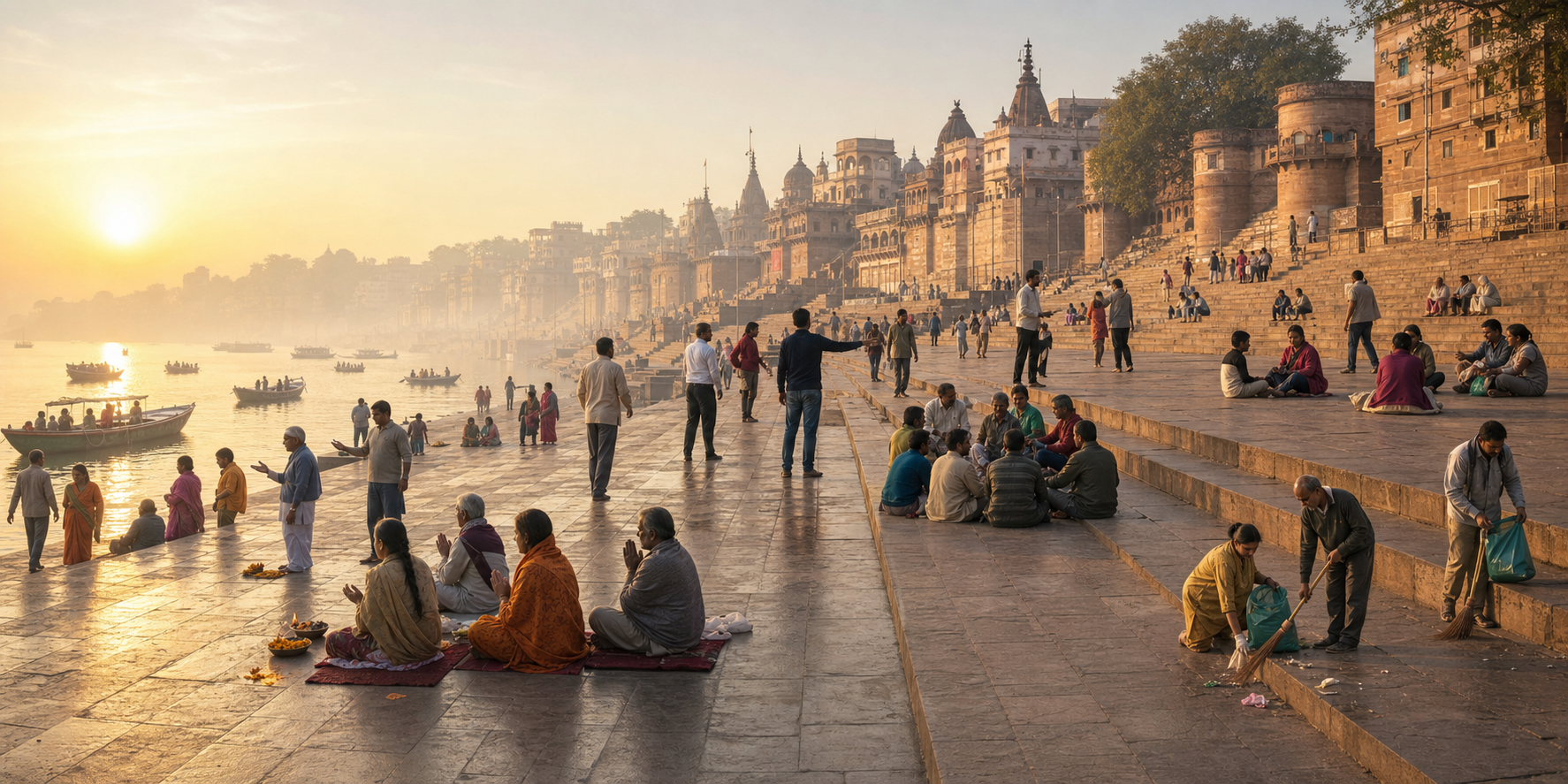
The durable response is a clear code established before the next controversy. Varanasi’s administration, ghat authorities, temple trusts and community representatives should make riverfront requirements easy to find and difficult to misunderstand. A visitor shouldn’t have to discover the rules only after police action or communal anger begins.
A workable code should answer concrete questions:
- Which parts of the riverfront permit organized gatherings, food service, sound equipment, lighting or temporary structures?
- Which activities require prior written permission, and which authority grants it?
- How must organizers protect ongoing worship, pilgrim movement, bathing access and established ritual use?
- What crowd-control, waste-removal and pollution-prevention arrangements must be in place?
- What conduct triggers an administrative direction to stop, a fine, removal from the site or referral for criminal investigation?
- How can an organizer seek review when permission is refused or enforcement appears selective?
The same published requirements should govern an iftar, a bhajan gathering, a political program, a community meal or a commercial shoot. Equal enforcement doesn’t diminish the Hindu character and sanctity of Kashi. It strengthens the legitimacy of protecting that character by showing that the rule concerns conduct, location and impact rather than the identity of the participants.
Authorities must also distinguish different kinds of wrongdoing. A permit failure, obstruction or waste violation may justify stopping an event and imposing the applicable administrative consequence. It doesn’t automatically prove a deliberately communal crime. Conversely, possession of a general event permission wouldn’t excuse independently provable malicious conduct. Keeping those categories separate makes enforcement more credible and prosecution more defensible.
When an incident occurs, officials should promptly identify the applicable rule, the permit status, the specific alleged conduct, the evidence being preserved and the public-order measures imposed. They need not disclose material that would compromise an investigation. They should disclose enough verified information to prevent rumor from becoming the public’s substitute for the record.
What you should do before sharing or organizing
Before you share a claim about the case
- Separate established facts from allegations. The safe formulation is that 14 men were reportedly denied bail in a pending case, not that the bail order proved desecration or malicious intent.
- Look for the complete order and FIR rather than relying on screenshots of selected lines. Check which legal provisions were actually invoked.
- Test the media evidence. Ask whether a video shows the entire event, whether its time and location are established, whether audio has been removed, and whether the caption adds claims the footage doesn’t demonstrate.
- Distinguish the court’s custody reasoning from the merits. A finding about possible public-order risk isn’t necessarily a finding that every alleged offence is made out.
- Don’t circulate personal addresses, threats, calls for retaliation or unverified identities. Such conduct can expose individuals to harm and make an already sensitive situation harder to adjudicate fairly.
Before you organize any event at a ghat
- Get written clarification on permission requirements. Verbal assurances and assumptions about past practice are poor protection when an event becomes controversial.
- Describe the activity accurately in the application, including food, equipment, expected attendance, timing, cleanup and any amplified sound. A permission obtained through an incomplete description may not cover what actually occurs.
- Plan around existing ritual use. Keep access routes clear, avoid interfering with worship and consult the responsible local authority when the sacred character of a particular space is uncertain.
- Use a no-discharge approach to the river. Arrange collection and removal of food waste, packaging and event materials rather than treating the current as a disposal system.
- Name people responsible for crowd management, liaison with authorities and immediate compliance with lawful directions. Confusion at the site can turn a manageable dispute into a public-order incident.
Community leaders have a further duty when tension has already risen: acknowledge legitimate concern without declaring guilt, clarify intention without belittling Hindu sentiment, and support a fact-based process. A joint commitment to river etiquette or a shared Ganga-seva effort can help repair trust, provided it doesn’t become a substitute for investigation or trial.
As higher courts or later bail applications revisit the case, judge the outcome by a demanding but even standard: Are the risks supported by the record? Could proportionate conditions manage them? Is the prosecution moving promptly? Are the same river protections enforced against everyone? If you want to defend Ganga and dharma effectively, insist on published rules, verified evidence, equal enforcement and a fair process from bail through trial.