

You see a monkey approach the body of a person who once fed it, remain close, and offer what looks like an embrace. The moment is moving. It also leaves you with a practical question: if you want to care for another species, should you feed the animal, approach it, protect its habitat, or simply leave it alone?
Dharmic compassion does not ask you to become indifferent. It asks you to make tenderness intelligent. The right action is the one that reduces harm without turning a free animal into a dependent one, transferring danger to a neighbour, or damaging the ecological relationships that sustain life.
The first discipline is to read the animal carefully
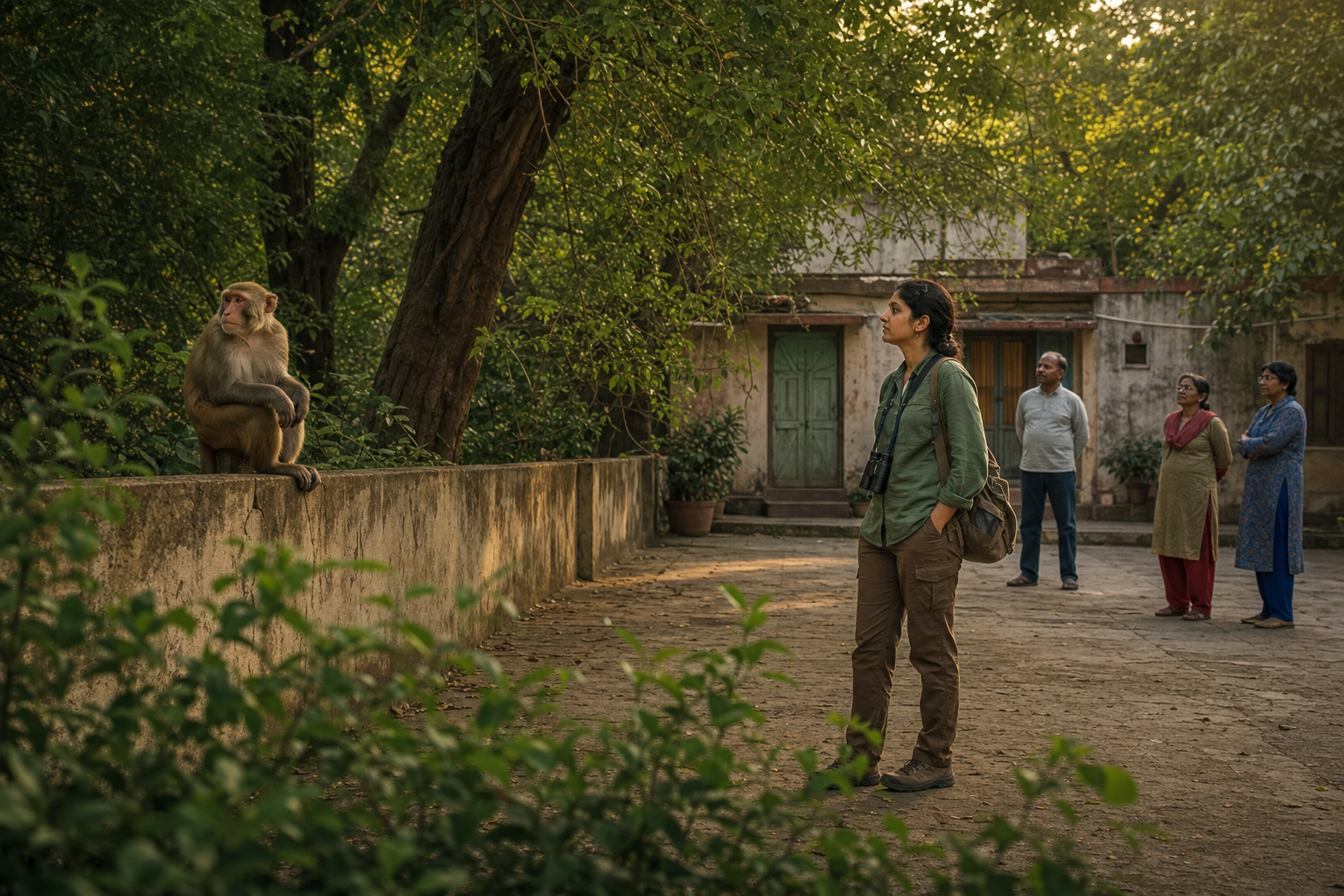
In Rayara Doddi near Channapatna, an elderly woman had routinely fed free-ranging monkeys. After her death, a monkey approached her body, stayed beside her, and briefly embraced her. It is reasonable to be touched by that behaviour. It is not reasonable to claim certainty about the animal’s inner experience.
Bonnet macaques living around temple precincts, village margins and roadside groves can become familiar with particular people. Predictable, peaceful provisioning can produce individual recognition, reduced flight responses and sustained proximity. Macaques also use contact, grooming and close presence in their own social lives. Conditioning, familiarity, arousal regulation and an affiliative response can therefore coexist. You do not have to choose between romantic certainty and cynical dismissal.
The crucial question is not whether the animal felt exactly what a human would have felt. It is whether a relationship crossed the species boundary and, if so, what responsibilities followed from it. Recognising another being’s responsiveness can deepen compassion. Assuming that the being wants a human-style relationship can make that compassion intrusive.
This distinction matters most when food is involved. A piece of fruit offered today may appear harmless, yet repeated feeding can change an animal’s expectations and movements. With free-ranging monkeys, habituation can increase boldness, displace natural foraging and draw animals into homes, markets, schools and places of worship. The resulting contact can raise the risks of bites, conflict and disease transmission. Energy-dense foods that do not belong in the animal’s normal diet can also contribute to poor nutrition. Food wrapped in plastic adds another route to injury and pollution.
Before calling an action compassionate, examine it across three horizons:
- The immediate encounter: Does the act avoid fear, injury, crowding and direct contact?
- The animal’s future behaviour: Will repetition encourage dependency, boldness or movement into dangerous human spaces?
- The shared habitat: Does the act improve food webs, water, soil, vegetation and safe movement, or does it merely concentrate animals around human waste?
A kind intention can pass the first test and fail the other two. Dharmic ecology requires all three.
Four Dharmic tests for compassionate action
Hinduism, Buddhism, Jainism and Sikhism are not interchangeable traditions. Their metaphysics, disciplines and religious vocabularies differ. Yet they offer a shared ethical grammar that can help you decide what to do when affection, animal welfare and ecology pull in different directions.
Ahimsa: count indirect and delayed harm
Ahimsa is more demanding than refraining from an obviously violent act. It asks you to notice harm displaced across time and space. Feeding a macaque may satisfy its immediate appetite while increasing its exposure to traffic, retaliation or conflict later. Throwing edible waste into an open area may look generous while attracting several species into an unhealthy concentration.
Use a whole-chain question: who or what could be harmed if this action becomes a habit? Include the individual animal, its group, people who did not choose the encounter, other species competing for the same space, and the habitat itself.
Aparigraha: let a wild being remain wild
Non-possessiveness applies to more than material goods. You can also become attached to being recognised by an animal, receiving its trust, photographing its approach or seeing yourself as its protector. That attachment subtly moves the encounter toward your emotional reward.
Aparigraha introduces restraint. If closeness is unnecessary, do not manufacture it. If a free-ranging animal can forage and move without you, support those capacities. Compassion is not measured by how near the animal comes to your hand.
Interdependence and yajna: protect the sustaining cycle
The Bhagavad Gita’s vision of reciprocal nourishment through yajna directs attention to the cycles connecting rain, crops, food and action. Buddhist dependent origination likewise trains the mind to see events as conditioned rather than isolated. An animal encounter is connected to waste collection, tree cover, water, roads, human consumption and local land use.
This changes the scale of your response. Instead of asking only what to give the animal, ask what ecological relationship has been broken. An open rubbish heap calls for waste governance. The loss of a feeding corridor calls for habitat repair. A polluted temple tank calls for restoration. Dharmic stewardship joins reverence to the repair of soil, water, forests and animal life.
Seva and collective welfare: choose care that others can sustain
Sikh seva and sarbat da bhala direct service toward the welfare of all. Hindu lokasangraha places action within the cohesion and well-being of the world. Buddhist karuna and metta cultivate compassionate regard, while Jain anekantavada warns against treating a single viewpoint as the whole truth.
These principles point away from solitary rescue fantasies and toward coordinated care. A household cannot solve a troop’s changing behaviour by feeding it privately. A temple cannot protect animals while leaving food waste accessible outside its gate. A panchayat cannot deter wildlife humanely unless it also addresses the attractants and habitat pressures drawing animals into dense settlement.
The Dharmic convergence is practical: minimise harm, restrain possessiveness, understand interdependence and organise service around shared welfare. Equal spiritual regard does not require identical treatment. A macaque is not a pet, a cow is not a machine, a river is not a drain, and a grove is not vacant land.
A lowest-harm ladder for wildlife encounters

When a wild animal enters a human space, begin with the least intrusive action capable of addressing the actual problem. Escalate only when safety or welfare requires it.
- Identify the relationship before acting. Ask whether the animal is free-ranging, domesticated, trapped, visibly injured or merely passing through. Do not treat a wild macaque as a temple pet simply because the species carries sacred associations.
- Create calm distance. Do not hand-feed, touch, surround or lure the animal for a photograph. Keep food out of reach and allow an unobstructed route away. Quiet observation respects the animal without training it to approach people.
- Remove the attractant, not the animal’s dignity. Secure organic waste, use monkey-resistant bins where macaque conflict is established, and prevent discarded offerings from accumulating near schools, homes and places of worship. Do not leave food inside plastic packaging as an offering.
- Replace provisioning with habitat support. Work with the relevant local bodies to plant suitable native fruiting trees along green corridors, protect sacred groves, restore water bodies and improve connected vegetation. The aim is natural foraging away from dense human activity, not another feeding station under a greener name.
- Coordinate recurring conflict. Involve the Forest Department, panchayat and affected community rather than attempting capture, punishment or relocation yourself. Humane deterrence works best when combined with waste control and habitat improvement.
- Redirect dana and seva. Support habitat restoration, responsible animal-welfare work, waste infrastructure or public education. This still expresses generosity, but it does not require a wild animal to become dependent on an individual donor.
If a person is bitten or scratched, do not interpret the injury as a spiritual test or rely only on a home remedy. Animal contact can carry a disease risk, so seek prompt professional medical care. If an animal is injured, trapped or creating an immediate public danger, contact the appropriate wildlife or civic authority rather than handling it directly.
This ladder also helps you resist two opposite errors. Sentimentality ignores ecological consequences because the immediate gesture feels pure. Hostility treats the animal as an invader while ignoring the waste, construction or habitat loss that shaped its behaviour. Compassionate realism examines both the animal and the human system around it.
Turn religious spaces into living ecological classrooms
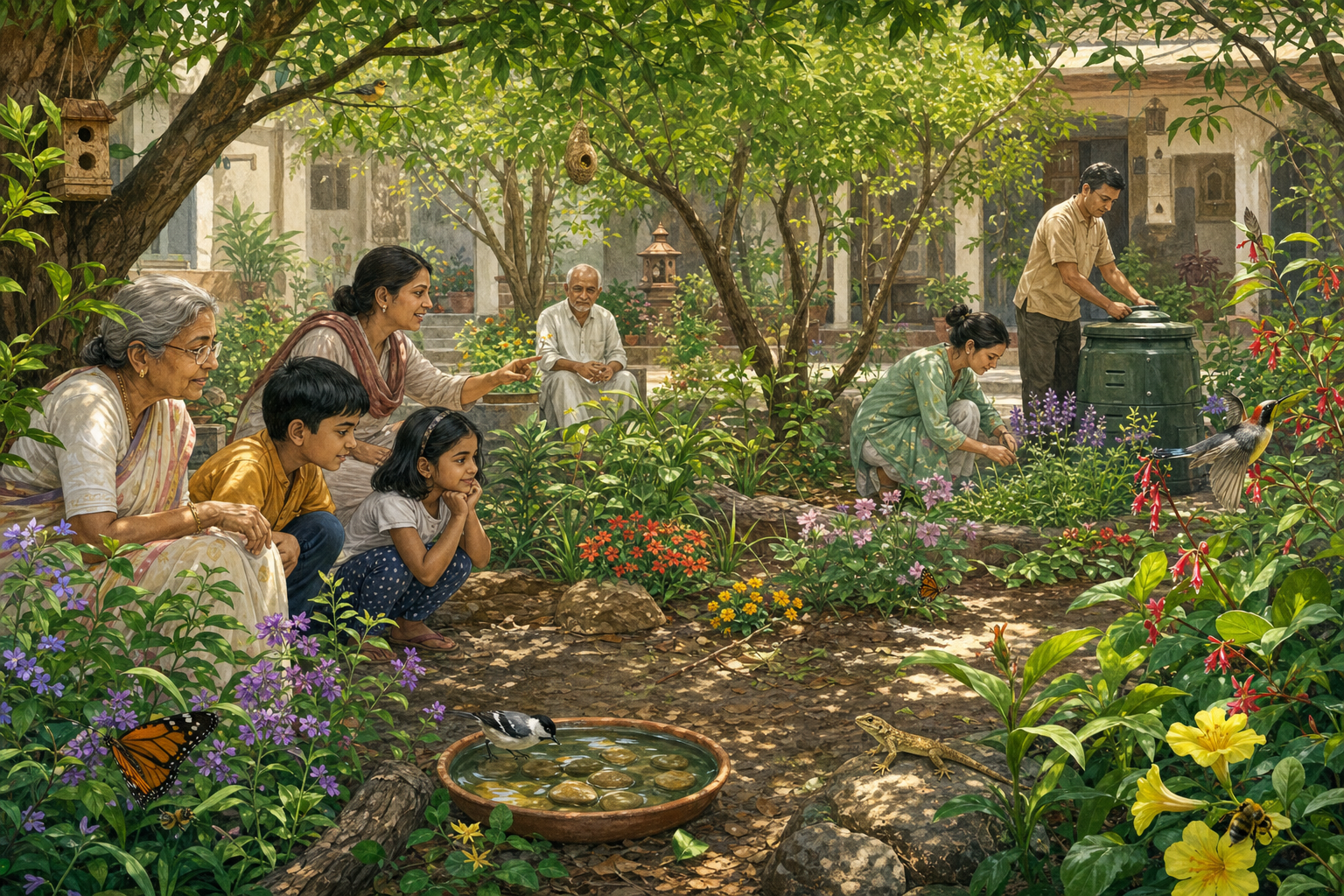
Temples, mathas, viharas and gurdwaras shape habits at a scale that private reflection cannot. A devotee who sees secure waste storage, water harvesting, native planting and safe wildlife boundaries at a sacred site learns that ecological discipline belongs inside religious life. A sign requesting no hand-feeding is stronger when the institution also removes the rubbish that attracts animals.
Begin with the interface your community actually controls. Match each visible commitment to a measure that can reveal whether it is working.
| Setting | Replace this pattern | With this practice | Track what changes |
|---|---|---|---|
| Home, shop or neighbourhood | Accessible food waste and habitual hand-feeding | Secured bins, separated organic waste and clear distance from wildlife | Recurring animal entry points, overflowing waste sites and conflict reports |
| Temple, matha, vihara or gurdwara | Plastic-packaged offerings, unmanaged leftovers and informal feeding zones | Plastic-free procedures, protected waste storage, rainwater harvesting and native or edible landscaping | Plastic and food waste, water use, green cover and wildlife conflict |
| Community kitchen | Overproduction and mixed disposal | Plant-forward meals, careful preparation, separation of organics and decentralised waste management | Food discarded, organic material recovered and avoidable packaging |
| Panchayat, campus or common land | Isolated clean-ups and ceremonial planting without follow-through | Water budgets, connected native planting, sacred-grove protection and restoration of tanks or other water bodies | Biodiversity counts, water quality, soil organic matter, canopy and green-cover change |
Measurement is not a concession to technocracy. It is a check on self-deception. A photographed sapling may satisfy the organisers while offering little habitat if it does not survive. A plastic-free announcement means little if vendors continue using disposable packaging outside the gate. Biodiversity counts, water quality, soil organic matter and green-cover change connect moral intention to ecological results.
Institutions should also connect outward. A temple committee can coordinate waste control with nearby vendors and the panchayat. A gurdwara kitchen can make food stewardship part of seva. A school or pathshala can pair teachings on ahimsa with composting, water care and observation of local biodiversity. A pilgrimage circuit can reduce plastic, protect water sources and teach visitors why feeding free-ranging animals creates risk.
Inner discipline keeps this work from becoming another campaign of consumption. Sattva encourages clarity and balance; aparigraha checks accumulation; right livelihood examines the harm embedded in work; japa, dhyana and other contemplative practices can interrupt compulsive appetite. The ecological consequence appears in ordinary choices: what you eat, how much you acquire, what you discard and which forms of labour you support.
Key takeaways
- An animal’s behaviour can be emotionally meaningful without proving a precise human-like emotion.
- For a free-ranging animal, repeated feeding may create familiarity while also increasing dependency, boldness, conflict and health risks.
- Ahimsa asks you to count delayed and indirect harm, not only the kindness visible in the moment.
- Aparigraha means giving up the desire to possess an animal’s attention or make its trust serve your emotional needs.
- Interdependence redirects care toward habitat, water, soil, vegetation and waste systems.
- Seva becomes ecologically durable when households, religious institutions, panchayats and wildlife authorities coordinate their roles.
- The strongest offering to wildlife is often safe distance, protected habitat and freedom from dependence on human food.
Choose the nearest human-animal interface you can influence. At home, secure food waste and stop direct feeding. In a religious committee, pair a no-feeding rule with protected bins and habitat work. In a school or panchayat, map the attractants that pull animals into danger and measure whether the repair improves water, vegetation and biodiversity.
The Dharmic test is not whether an act feels kind while you perform it. Ask whether other beings remain safer and freer, and whether the shared place becomes healthier after your involvement. That is how compassion matures into ecology.
References
- Hindu Human Rights — Viral Bengaluru Video: Monkey’s Embrace for Elderly Caregiver Reveals Profound Dharmic Bond
- Dandavats — Deep Ecology through Vedic Wisdom: A Dharmic Blueprint for Compassionate Sustainability