
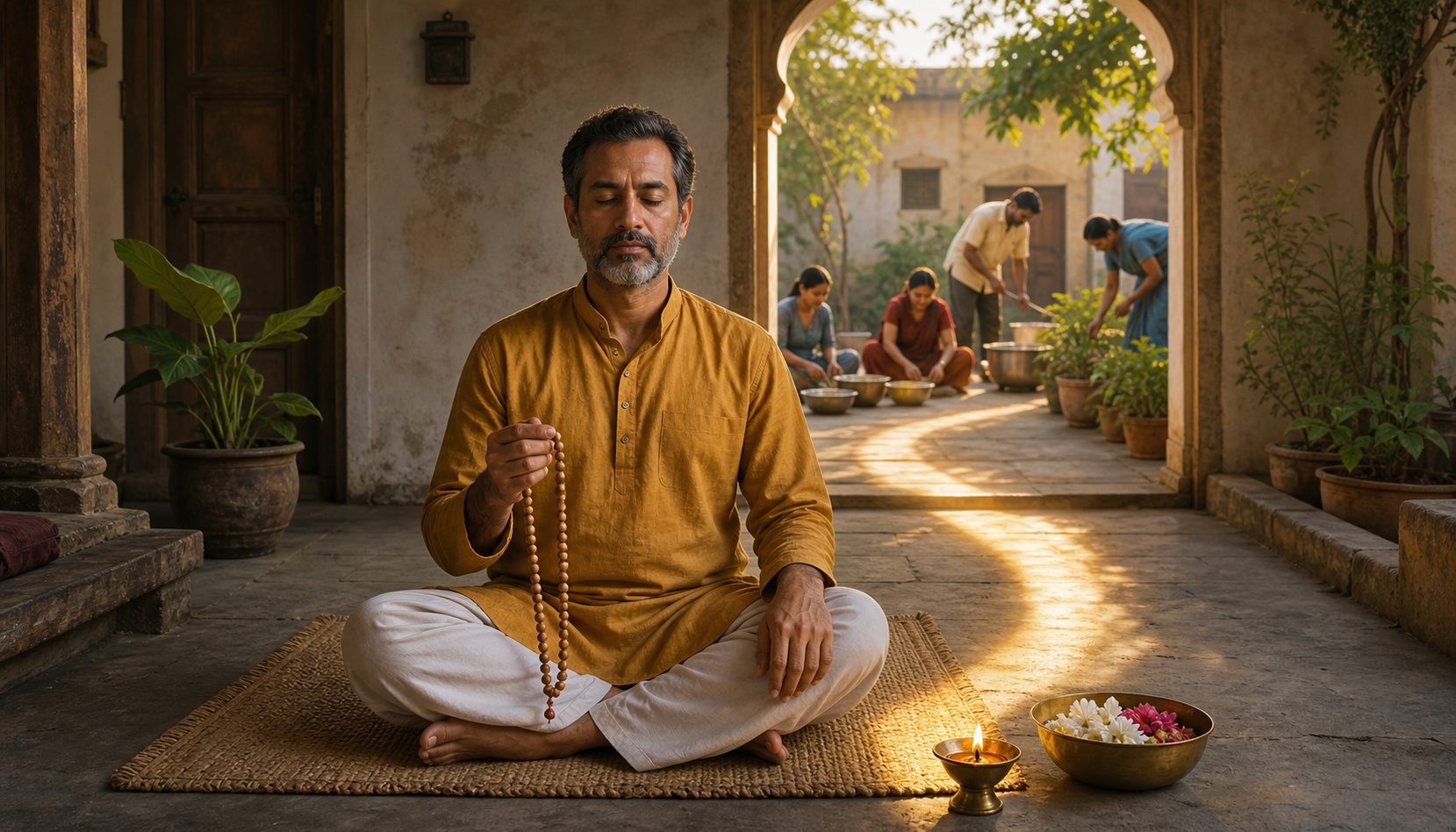
You can finish a round of japa, put down the mala, and still speak harshly five minutes later. When that happens, the useful question is not whether the mantra worked. It is: what did you actually train while repeating it?
Mantra and bhakti become disciplines of consciousness when they reshape more than the mood of a meditation session. Mantra trains attention to return. Bhakti gives that attention a sacred centre, an ethical direction, and a reason to become service. Their mature result is not an unusual inner sensation but a mind that remembers more readily, reacts less blindly, and serves without constant calculation.
Mantra supplies a return path; bhakti chooses the destination

Consciousness is not trained by repetition alone. It is trained by what you repeat, how you attend to it, what meaning you place in it, and how you act afterward. A commercial slogan can also occupy the mind through repetition. Sacred repetition differs because the sound is joined to reverence, an Ishta or liberating ideal, ethical discipline, and a way of life.
Mantra gives the wandering mind a precise object and a reliable way back. Bhakti answers the next question: back to what? You may return to the Divine Name, the presence of Devī, remembrance of Krishna, the Shabad, the vows represented by Amitābha, or the purified beings honoured in the Namokar Mantra. These are not interchangeable theological claims. Yet their devotional disciplines share an operational pattern of intention, attention, affect, embodiment, community, and conduct.
A single repetition can be understood as a small cycle:
- You articulate or recollect the sacred sound.
- Your attention leaves it for a thought, memory, sensation, or plan.
- You notice that departure.
- You return without arguing with the distraction.
- You renew the devotional meaning carried by the sound.
The third and fourth movements are crucial. Wandering does not prove that you are bad at japa. Not noticing the wandering is the real loss of practice. Every conscious return trains recollection. Bhakti then prevents that skill from becoming spiritually neutral by attaching the return to love, truth, surrender, compassion, or service.
This also explains why a peaceful session and a transformed character are different achievements. Calm is a temporary state. Steadiness, truthful speech, patience, and generosity are dispositions that appear across situations. Use the state to cultivate the disposition, but do not mistake one for the other.
What sacred repetition trains in consciousness
Attention: the capacity to notice and return
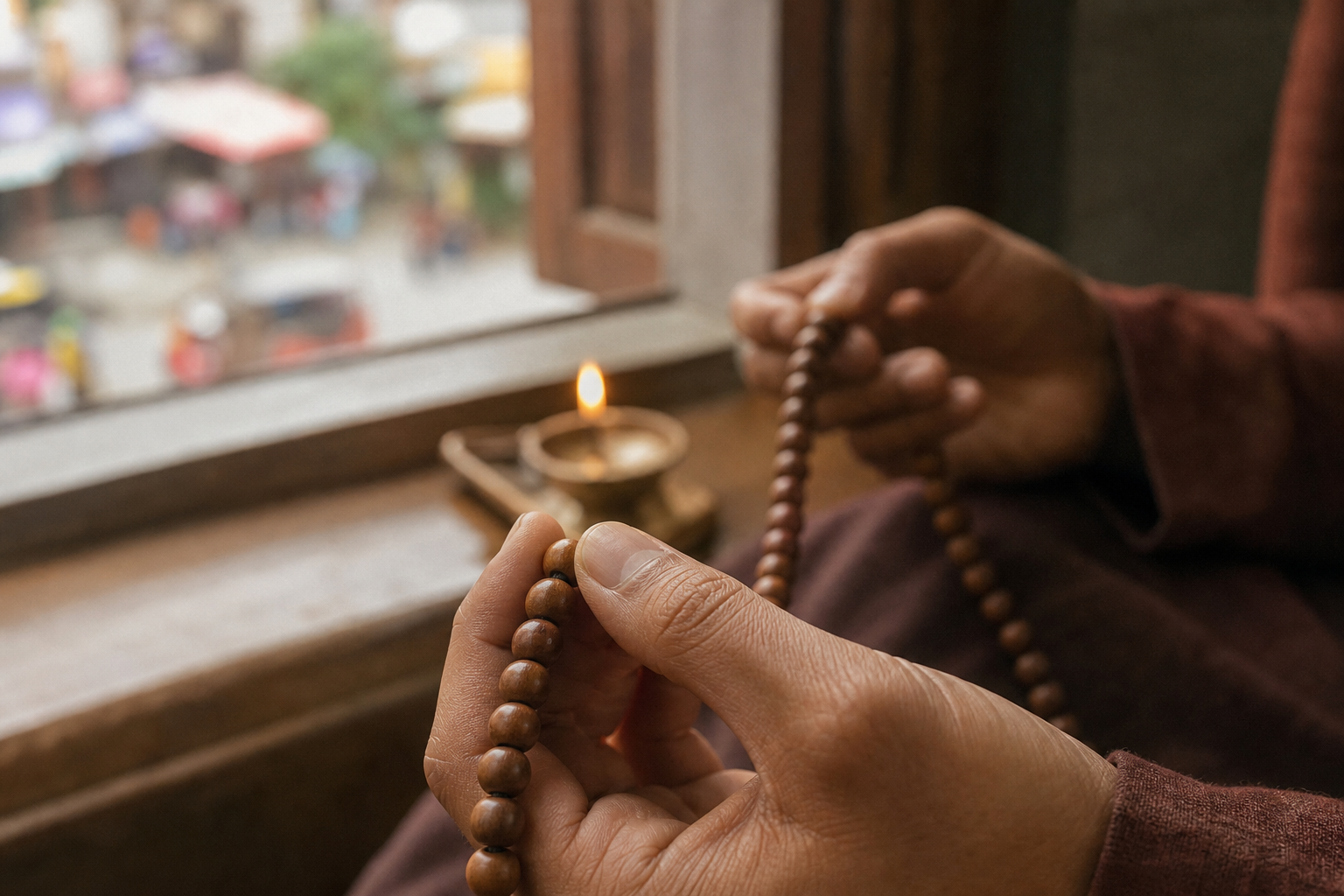
A mantra makes distraction visible. Ordinary thinking can continue for a long time without revealing how scattered it is. During japa, the loss of even a few syllables shows that attention has wandered. The mantra also removes ambiguity about what to do next: return to the next clear repetition.
Audible or near-audible recitation is often the best starting mode because your voice, hearing, breath, and articulation support one another. As attention becomes stable, whispered upāṁśu or mental mānasika japa may become appropriate. Silence is not automatically deeper. If mental repetition turns vague, return to a voice you can hear. Clarity should govern the transition from voiced to mental japa, not a desire to appear advanced.
A mala adds touch to the attentional loop. Feel the bead, complete the mantra, and then move. If the hand advances while the mind is elsewhere, slow down. The bead is not merely a counter; it tells you whether sound, attention, and bodily action are still together.
Embodiment: a rhythm the mind can inhabit
Posture, breath, sound, and attention form one system. Sit upright enough to remain alert, but do not hold the spine rigidly. Let the breath remain quiet and unforced. A comfortable cadence near five or six breaths per minute can support autonomic steadiness for many practitioners, but it is not a quota and should never be forced. The mantra should ride the breath that is available rather than turning japa into a breath-holding exercise.
Pronunciation matters because careful articulation gathers attention. Long vowels, nasals, and consonant placement create distinct tactile and acoustic cues. Learn the form you have received instead of rushing through an approximate version. Then notice the whole arc of a repetition: emergence, resonance, completion, and the brief quiet before the next beginning.
Physical calm is useful, but it is not proof of spiritual attainment. Rhythmic vocalisation can settle the nervous system while the practitioner’s motives remain selfish. Regard composure as a condition that makes deeper attention possible, not as a certificate of liberation.
Affect and identity: what the mind learns to value
Attention repeatedly placed on a revered name or ideal gradually acquires an emotional orientation. This is the practical force of bhakti. You are not only becoming better at holding a sequence of syllables; you are rehearsing what deserves remembrance when fear, anger, desire, or vanity competes for the mind.
The devotional traditions describe this movement in different ways. Vaishnava practice can move from Name toward remembrance of form, qualities, and līlā. Sikh simran receives the Name through the Shabad and carries remembrance into hukam and seva. Pure Land recitation directs the heart toward liberating grace and compassion. Jain recitation honours spiritual victory and strengthens the resolve toward purification and ahiṁsā. The shared feature is disciplined remembrance, not a claim that all four paths mean the same thing.
Not every sacred sound is a beginner’s technique
A Divine Name used openly in a living tradition and a specialised bīja embedded in tantric ritual do not carry the same practice requirements. A seed syllable such as hrīṁ is understood in Śākta and Śrī Vidyā traditions as a concentrated presence of Śakti, not as a generic sound for relaxation. Its use can involve precise pronunciation, visualisation, nyāsa, composite mantras, and questions of adhikāra or qualified readiness. The syllable’s traditional analysis joins sound, radiance, Śakti, bindu, and the movement from manifestation into silence.
If you have received a mantra from a competent teacher, follow that instruction rather than mixing it with a generic routine. If you have not, do not assemble an advanced practice from attractive bījas found online. Begin with an established form of nāma, prayer, or recitation that your tradition treats as appropriate for open practice, and seek lineage guidance before adding tantric installation or intensive energetic methods.
Bhakti changes the aim from acquisition to service
Many people begin chanting because they want relief, success, protection, clarity, or a particular outcome. That beginning need not be despised. It does, however, need to mature. If every repetition remains a bargain with the sacred, the practice can reinforce the very self-centred pattern it was meant to loosen.
Before sitting, state a saṅkalpa that directs the practice beyond acquisition. Keep it short enough to remember and concrete enough to test. For example: May this remembrance make my speech more truthful and my service less self-seeking. This is more useful than asking vaguely to become spiritual because you can examine your speech and conduct later that day.
Bhakti is therefore not mere emotional intensity. It joins at least four disciplines:
- Recollection: returning to the sacred focus when attention wanders.
- Veneration: allowing humility, gratitude, love, or reverence to shape the return.
- Congruence: bringing speech, livelihood, relationships, and habits into alignment with the ideal being remembered.
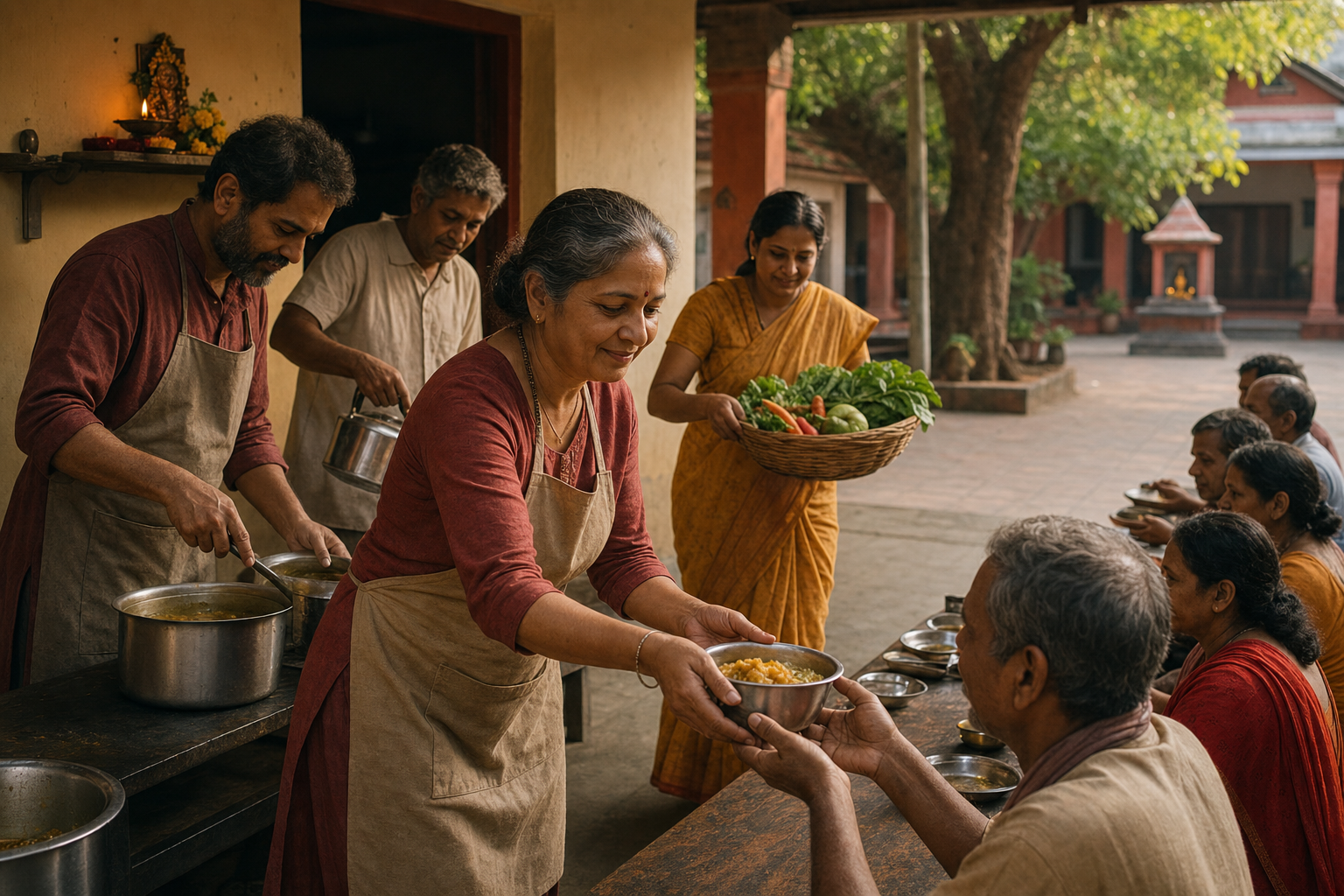
- Offering: converting the inward practice into seva, dāna, forgiveness, protection of life, or another concrete good.
Ethical congruence is not an optional supplement. Repetition performed alongside deliberate cruelty, dishonesty, or contempt creates a divided practice. The mouth invokes what the conduct refuses. This division weakens collectedness because part of the mind must defend the contradiction.
Use your chosen sacred focus as a behavioural question. If you remember Krishna, ask how service rather than possession should guide the next act. If you remember Devī, ask whether your speech honours the dignity and power of life. If you practise simran, ask what obedience to truth and seva requires now. If you recite the Namokar Mantra, examine whether the next choice reduces harm. If you recite nembutsu, let remembered grace become compassion rather than passivity.
This outward movement is the clearest safeguard against spiritual narcissism. The mature arc is sound becoming remembrance, remembrance becoming surrender, and surrender becoming service. A striking meditation experience may accompany that arc, but it cannot replace it.
Grace remains grace; it cannot be manufactured by completing a count. Discipline prepares the practitioner by reducing distraction, contradiction, and self-absorption. It establishes conditions of readiness without turning the Divine into a predictable mechanism. Keep the practice exact, but do not turn exactness into a claim on the sacred.
A 40-day discipline that joins japa to daily life

A forty-day vrata can give the practice enough continuity to reveal patterns that one enthusiastic weekend cannot. It is a container for observation, not a guarantee of visions, serenity, or answered requests. If your lineage prescribes a different count, time, or method, its instruction takes precedence.
- Choose one authorised focus. Use the mantra, nāma, shabad, nembutsu, or recitation you have legitimately received or that your tradition makes available for ordinary practice. Do not switch whenever novelty fades. The fading of novelty is where discipline becomes visible.
- Write one non-transactional saṅkalpa. Name the quality and its outward expression. May remembrance make me patient is incomplete; add where patience is needed, such as family speech, work under pressure, or care for someone dependent on you.
- Keep a repeatable daily setting. A regular window helps establish rhythm. Brahma-muhūrta is valued by many practitioners, but a later time you can maintain is better than an ideal time you repeatedly miss. Silence notifications and remove the device from reach unless it is genuinely required for the recitation.
- Prepare without turning preparation into another ritual burden. Take a stable seat, release unnecessary tension, and allow the breath to settle. Do not wait for a special mood. Begin from the condition you are actually in.
- Complete a clear, sustainable count. One mala of 108 repetitions is a conventional option where appropriate. It is not a universal command. Use a count established by your teacher or tradition if you have one. Give each repetition enough time to be heard or mentally apprehended; speed that erases the mantra defeats the count.
- Match the mode to your actual attention. Chant audibly or near-audibly when restless. Use a whisper when collected. Use mental japa only while each repetition remains distinct. Move back to sound as soon as mental recitation blurs.
- Let the final sound resolve into quiet. Do not reach immediately for the phone. Notice the quality of the mind without trying to manufacture blankness. This shows whether attention remains gathered after the external cue stops.
- Name one act of seva for the same day. Choose a finite act rather than a noble abstraction: complete an unglamorous duty, repair harsh speech, give attention to someone usually ignored, offer food, protect an animal, or help without seeking recognition.
- Keep a three-line record. Note whether you practised, what repeatedly captured attention, and whether the day’s conduct expressed the saṅkalpa. Once a week, look for patterns. The purpose is feedback, not self-punishment.
If you miss a day, record it honestly and resume at the next available practice window. Do not race through extra repetitions merely to repair the appearance of an unbroken record. Continuity matters because it trains return, and returning after a lapse is itself part of that discipline.
Satsaṅga can strengthen the vrata. Group kīrtan, shared simran, collective recitation, and contact with sincere practitioners add rhythm, accountability, and correction. Community is helpful when it deepens humility and service. If it encourages sectarian contempt, competitive counting, or claims of superiority, it is training a different form of consciousness than bhakti intends.
Measure the fruits and correct the drift
Evaluate mantra practice where your ordinary defences are weakest: interruption, disagreement, fatigue, envy, inconvenience, and lack of recognition. These moments show whether remembrance is becoming available under pressure. The relevant question is not whether anger ever appears. Notice whether you recognise it earlier, feed it less eagerly, and repair its consequences more readily.
Correct the specific failure mode
- If you race through the count: slow the hand, articulate every syllable, and move the bead only after the mantra is complete. Your immediate goal is one intact repetition, not a faster round.
- If thoughts repeatedly carry you away: use an audible voice and treat each noticed departure as the cue to return. Do not spend the practice analysing why the thought appeared.
- If you become sleepy: straighten the posture, open the eyes softly, increase vocal clarity, or use walking recitation. Muted mental japa is usually the wrong mode when alertness is already falling.
- If the practice feels dry: do not chase a new mantra. Refresh the relationship through kīrtan, scriptural narrative, remembrance of divine qualities, satsaṅga, or a deliberate act of seva. Dryness may reveal that repetition has become detached from meaning.
- If emotion becomes intense: let it be present without performing it or using it as evidence of rank. Return to the mantra’s clarity and examine what the emotion produces in conduct.
- If pride or comparison appears: stop using counts, experiences, or lineage identity as a hierarchy over other practitioners. Reverence that produces contempt has turned back toward the ego.
- If practice makes you calm but not kinder: revise the saṅkalpa and make the seva link explicit. Calm without ethical movement may be regulation, but it has not yet matured into devotion.
A useful practice audit draws from three perspectives. First-person observation tells you about clarity, warmth, resistance, and distraction. A trustworthy teacher or mature practitioner can notice self-deception that you miss. Daily behaviour shows whether the change survives outside the practice seat. This combination is more reliable than relying on either an elevated feeling or a bare count alone.
Key takeaways
- Mantra trains consciousness through repeated noticing and returning; distraction becomes useful when it is recognised.
- Bhakti gives repetition its sacred object, emotional orientation, ethical discipline, and movement toward seva.
- Clear audible japa is better than indistinct mental repetition, and one attentive round is better than a hurried numerical achievement.
- A specialised bīja or tantric procedure should be practised according to lineage, pronunciation, and adhikāra rather than assembled casually.
- The strongest signs of progress are reduced reactivity, truthful speech, patience, forgiveness, humility, and service without a demand for recognition.
At your next practice, make one change: write a saṅkalpa that names the conduct your mantra should shape. Keep the sound clear, carry it into one concrete act of seva, and watch what happens in the next difficult interaction. That is where a repeated sacred sound begins to become a discipline of consciousness.
References
- DharmaRenaissance Blog — HRĪṂ, the Māyā Bīja: Definitive Guide to Shakta Power, Heart Awakening, and Mantra Science
- Dandavats — From Stalemate to Synthesis: Laws of Bhakti as a Rigorous, Measurable Science of Consciousness
- Dandavats — Unlock the Ultimate Aim of Chanting: A Rigorous, Heart-Centered Guide to Japa and Seva