

You are told that a gavaya, an unfamiliar forest animal, is like a cow. Later, you see a cow-like animal in the forest. Your eyes reveal its shape, but sight alone doesn’t tell you that this is the animal previously described. The earlier statement supplied a description, but it didn’t place the animal before you.
The recognition occurs when you connect the remembered description with the animal now perceived. Mīmāṃsā calls attention to that connection because it answers a practical question: when does resemblance give you knowledge, and when does it merely tempt you into a plausible mistake?
Start with the gap that only comparison can fill
Upamāna is commonly translated as comparison. That translation is correct but incomplete. In epistemology, upamāna isn’t the casual observation that two things look alike. It is a pramāṇa: a distinct means by which a previously unknown object can become known through its relevant similarity to something already familiar.
The gavaya case works because it contains two incomplete encounters. First comes verbal testimony: a trustworthy informant tells you that a gavaya resembles a cow. The statement gives you a usable template, but not a perception of the gavaya. Later comes perception: you encounter an animal with the relevant cow-like characteristics, but perception by itself doesn’t connect that animal with the unfamiliar word. Comparative recognition closes the gap.
This is why the new cognition isn’t simply “I see an animal” or “I remember what someone said.” It is closer to “this perceived animal is the kind that was described to me through its similarity to a cow.” The known object supplies the point of comparison; the remembered description directs attention; the present encounter supplies the candidate; and upamāna produces the recognition.
Both major classical Mīmāṃsā lines retain upamāna as a valid means of knowledge. The Bhāṭṭa school associated with Kumārila Bhaṭṭa generally accepts six pramāṇas: perception, inference, comparison, postulation, non-cognition and verbal testimony. The Prābhākara school generally accepts five because it doesn’t grant non-cognition an independent place. Their disagreement over non-cognition doesn’t remove upamāna from either system.
You should also distinguish upamāna from upamā, the literary use of simile or analogy. A poetic comparison can illuminate an emotion, embellish a description or invite contemplation without establishing a literal fact. Upamāna has a stricter burden. It must generate a cognition that survives scrutiny. Beauty is enough for a simile; epistemic accountability is required of a pramāṇa.
One question will keep your understanding precise: what becomes known at the comparative moment that wasn’t already known through speech or sight? Nyāya often answers by emphasizing knowledge of the relationship between a word and its referent: you learn what the word gavaya denotes. Mīmāṃsā discussions frequently emphasize the present identification of the previously described object, while the earlier testimony prepares and secures the linguistic connection. If you are explaining the Mīmāṃsā position, state the new cognition explicitly instead of treating every Indian account of upamāna as identical.
Follow the five moves from description to recognition
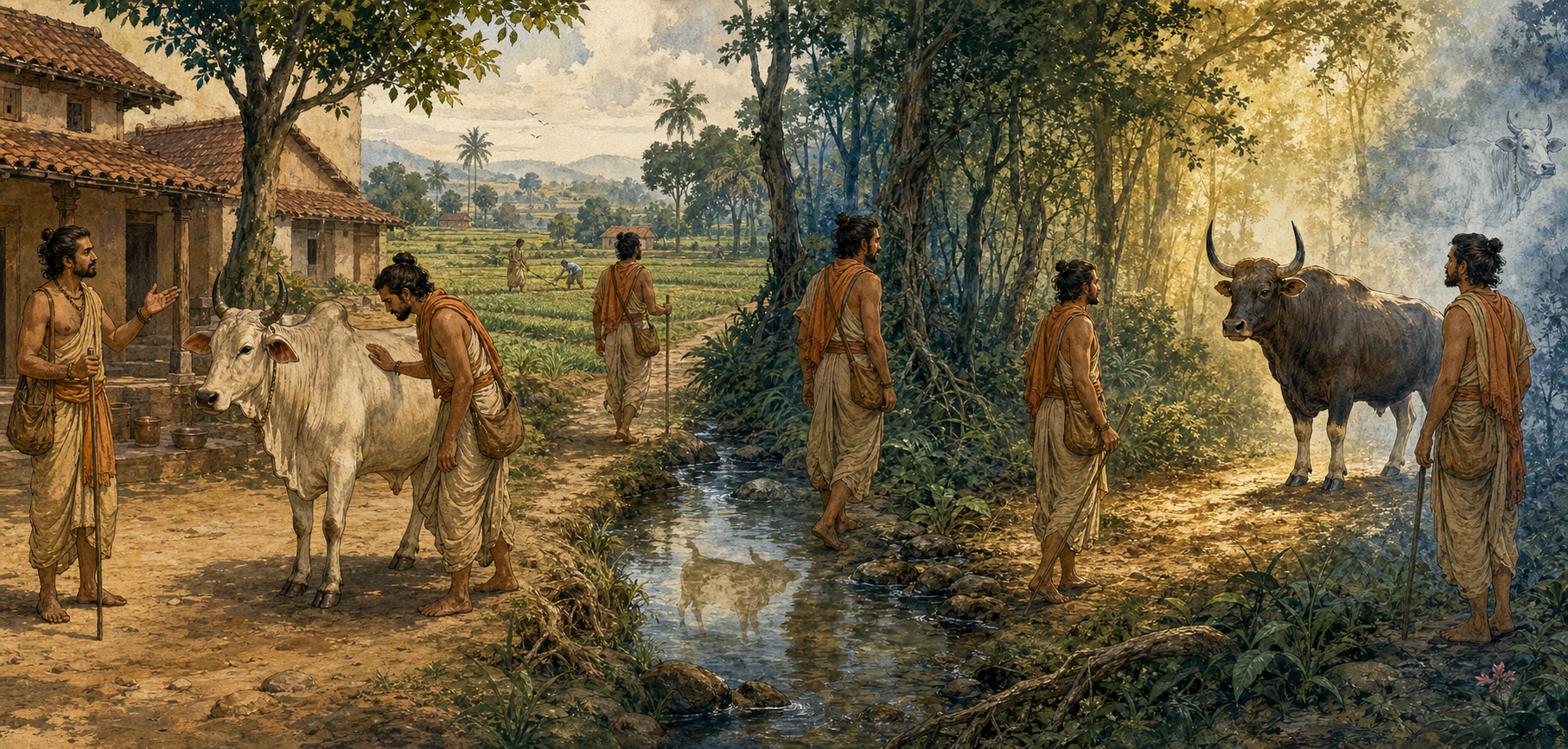
A comparison can feel instantaneous, but its epistemic structure contains several distinct operations. Separating them helps you locate both the knowledge and the possible error.
- A trustworthy description supplies the template. You receive information such as “a gavaya is like a cow.” The statement must be reliable enough to guide a later identification. A vague remark or an untrustworthy speaker weakens the process at its beginning.
- Memory preserves the relevant description. You retain the comparison until the unfamiliar object is encountered. Memory is necessary here, but it isn’t itself the fresh knowledge produced by upamāna; it carries forward what was learned earlier.
- Perception presents a new candidate. You see the forest animal and apprehend its observable characteristics. This gives you the object presently before you, not yet the completed comparative identification.
- Comparison aligns present features with the remembered template. You notice the characteristics that matter for the earlier description. This is a directed comparison, not a general feeling that the animal looks familiar.
- Determinate cognition completes the recognition. The comparison yields a settled judgment about the animal as the previously described kind, provided that no stronger evidence defeats it.
The order matters. If you never received the description, a cow-like appearance doesn’t connect the animal with the word gavaya. If you remember the description but never encounter a candidate, you possess testimony rather than comparative recognition. If the candidate is present but the resemblance concerns an irrelevant detail, the final judgment isn’t warranted.
When you need to analyze an example, write four short lines: the known model, the unknown target, the remembered description and the presently observed features. Then write the exact new judgment. If you can’t identify what the comparison adds, the case may belong to perception, testimony, inference or memory instead of upamāna.
This structure also explains why upamāna depends on other epistemic resources without simply becoming one of them. Verbal testimony gives it direction. Memory preserves that direction. Perception supplies the encountered object. Comparison performs the distinctive alignment through which recognition becomes possible.
See why the other pramanas do not make it redundant

The quickest way to understand upamāna’s independence is to ask what would remain if comparison were removed from the gavaya case.
- Perception, or pratyakṣa, reveals the animal and its visible characteristics. It doesn’t, by itself, identify the animal as the object previously introduced through an unfamiliar term.
- Verbal testimony, or śabda, gives the description and the word to be understood. It doesn’t produce the later, present recognition before the animal.
- Memory, or smṛti, reproduces the earlier description. Remembering old information isn’t the same as gaining the new cognition made possible by matching it to a present object.
- Inference, or anumāna, ordinarily moves through a reason connected with a rule. The gavaya case doesn’t license the universal rule that every cow-like animal is a gavaya. Such a rule would turn a limited description into an unjustified generalization.
- Postulation, or arthāpatti, introduces what must be accepted to reconcile facts that otherwise resist explanation. Comparative recognition isn’t driven by that explanatory necessity.
- Non-cognition, or anupalabdhi, concerns knowledge of absence in the Bhāṭṭa account. It doesn’t perform the positive identification accomplished through similarity.
Dependence on inputs is therefore not the same as reducibility. Upamāna doesn’t create an object without perception or invent a description without testimony. Its claim to independence rests on the distinctive cognition produced when those materials are brought together through relevant similarity.
That claim isn’t shared uniformly across Indian philosophy. Buddhist pramāṇa thinkers such as Dignāga and Dharmakīrti generally analyze comparison within inference rather than treating it as a separate pramāṇa. Jain approaches are diverse, while anekāntavāda makes attention to both similarity and dissimilarity especially important. Sikh scriptural interpretation uses powerful analogies in Gurbani, often joining śabda with lived realization, but it isn’t organized around the classical Mīmāṃsā taxonomy.
This difference should sharpen, not blur, your account. The Dharmic traditions can share a disciplined use of comparison without agreeing on where comparison belongs in an epistemological classification. If you defend the Mīmāṃsā view, you must show what novel cognition upamāna produces and why an inferential reconstruction doesn’t fully capture it.
Test a comparison before you treat it as knowledge

Resemblance is abundant. Valid recognition is selective. A painted imitation may share the outline of a ritual implement without possessing its material, function or ritual fitness. A superficial match therefore produces only the appearance of comparison as a pramāṇa. Mīmāṃsā vocabulary can describe such failure as upamānābhāsa, a semblance of upamāna.
Use the following test whenever an argument asks you to move from “X is like Y” to a conclusion about X:
- Fix the target. State exactly what is unknown. Are you trying to identify an object, understand a word, classify a practice or justify a ritual substitution? An analogy that answers a different question is beside the point.
- Record what was actually conveyed. Don’t silently enlarge a limited description. If you were told only that the unknown animal resembles a cow, that statement doesn’t establish that it shares every property, function or behavior of a cow.
- Name the shared features. Similarity may concern form, a broader kind, function or practical role. Writing down the features prevents an impression of familiarity from masquerading as a reasoned match.
- Ask whether those features are relevant. Color may be striking yet useless for identifying an implement whose decisive property is ritual function. Shape may matter in one classification and be accidental in another.
- Look deliberately for dissimilarity. A disciplined comparison searches for differences capable of overturning the match. This is especially important when several candidates share the same superficial characteristics.
- Check for a defeater. Confirmed knowledge that the object is a decoy, belongs to an incompatible kind or lacks a required function blocks the recognition. Several weak similarities don’t outvote one decisive contradiction.
- Limit the conclusion to the evidence. Upamāna can justify the identification licensed by the description. It doesn’t transfer every property of the familiar model to the unfamiliar object.
This test distinguishes three broad kinds of similarity. Morphological similarity concerns shared form. Generic or functional similarity concerns kind or operation. Pragmatic similarity concerns a role within a practice. More than one may support a recognition, but their importance changes with the question. An animal identification may rely heavily on form and generic markers; a ritual substitution may depend more heavily on prescribed function than appearance.
Apply the same discipline to Vedic interpretation
Mīmāṃsā needs this precision because Vedic interpretation can turn on the identification of an uncommon term, implement, substance, procedure, place, time or agent. When an item is described by resemblance rather than a familiar proper name, comparison helps the interpreter connect the textual description with an identifiable candidate. It cannot be allowed to weaken or rewrite the injunction in the process.
Suppose a possible substitute for an oblation resembles the primary substance in heat, texture and ritual role. The relevant question isn’t simply whether the two look alike. You must determine whether the characteristics specified by the ritual context are preserved, because an incidental resemblance doesn’t establish equivalence in relation to the rite’s intended apūrva, its ritual efficacy or potency.
When reading such a passage, make three notes. First, copy the textual characteristics without adding any. Second, list the candidate’s matching characteristics and classify them as formal, functional or pragmatic. Third, record contextual differences and possible defeaters. Keep the identification of the object separate from the force of the prescription. Upamāna may help establish what an expression picks out; it doesn’t independently authorize whatever ritual action you prefer.
The same care helps with obscure Vedic vocabulary. Recurring similarities across uses can reveal a stable semantic family, as in the lexical and etymological disciplines associated with the Nighaṇṭu and Nirukta. But resemblance between contexts isn’t a license for uncontrolled extension. Mīmāṃsā’s attention to denotative power, secondary signification and modes of signifying helps determine when an analogical extension preserves meaning and when it merely imports an accidental overlap.
You can use this method outside ritual hermeneutics as well. Whenever you learn an unfamiliar concept through a prototype, compare a new legal category with a known one, or classify a tool by its resemblance to a familiar tool, you are using a similar cognitive pattern. The practical safeguard remains the same: identify the feature doing the epistemic work, and then search for the difference that would make the classification fail.
Key takeaways
- Upamāna is a means of knowledge through disciplined comparison, not the mere observation that two things resemble each other.
- Its classical structure joins a trustworthy description, retained memory, present perception, relevant similarity and determinate recognition.
- Perception supplies the encountered object and testimony supplies the descriptive template; upamāna supplies the comparative cognition that neither gives alone.
- Nyāya commonly emphasizes knowledge of the word-referent relationship, while Mīmāṃsā discussion often emphasizes identifying the previously described object in the present encounter.
- A valid comparison depends on relevant characteristics, absence of defeating evidence and a conclusion no broader than the description warrants.
- In Vedic hermeneutics, upamāna can help identify rare terms, implements and possible ritual equivalents, but superficial resemblance cannot override the governing prescription.
The next time you write or hear “this is like that,” don’t rush to the conclusion. Name the shared characteristic, explain why it matters to the question, and identify the difference that would defeat the comparison. If you can do all three, you have begun to treat analogy with the rigor Mīmāṃsā expects of knowledge.