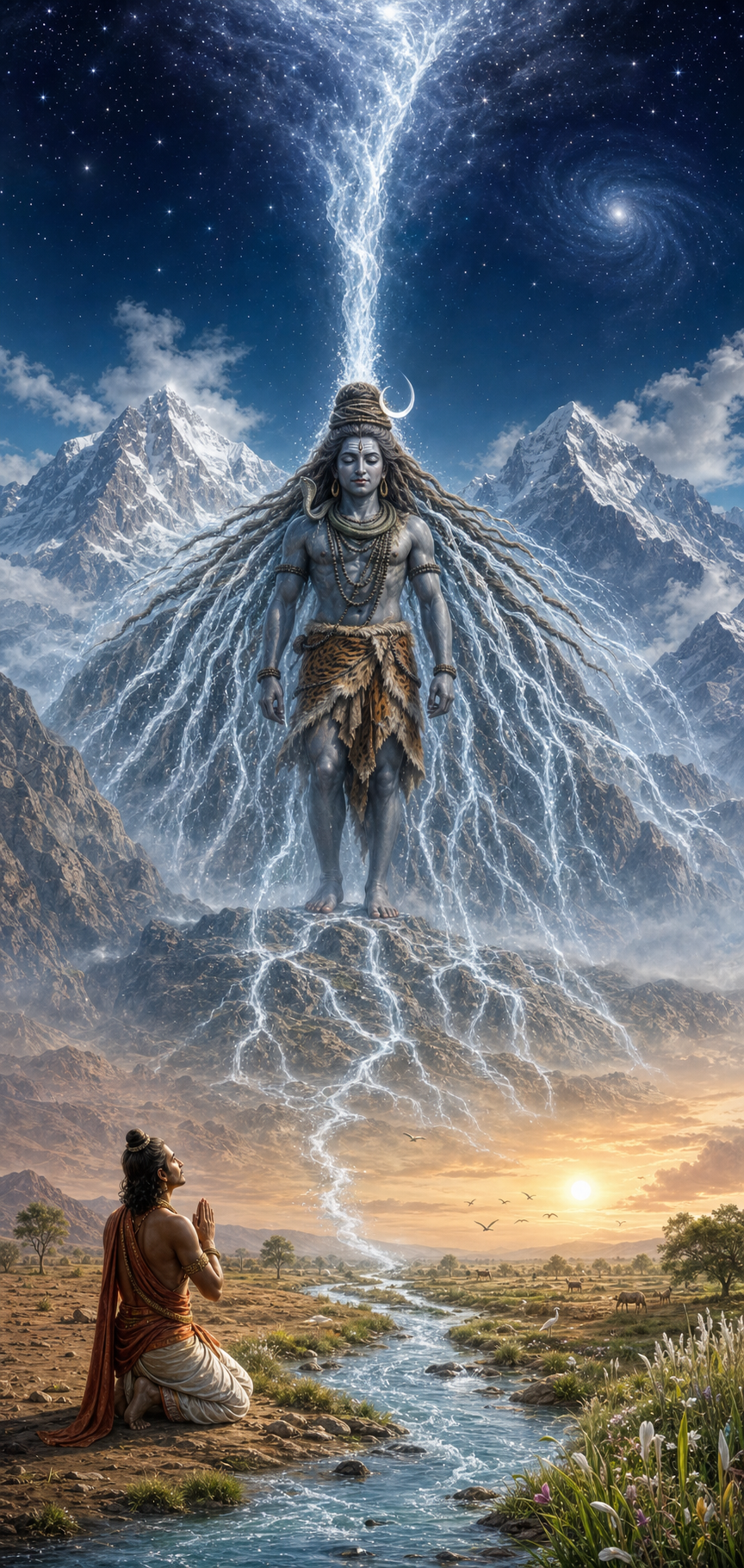
You may know the two great images separately: Agastya drinks an ocean, and Ganga descends from heaven through Shiva’s matted hair. The natural question is whether they belong to one story and, if they do, what their connection is meant to teach.
They belong together most fruitfully as a Dharmic pattern of repair, not as one flat chronology that every text narrates in exactly the same way. Agastya removes the cover under which disorder survives. Bhagiratha, Shiva, and Ganga then show how life can be restored without releasing destructive force. Read in that order, the episodes give you a precise way to think about imbalance: expose it, restrain it, judge it, channel the remedy, and replenish what has been depleted.
Read the episodes together without flattening their differences
In the ocean-drinking episode, the Kalakeyas use the sea as a place of concealment. The devas face an enemy they cannot reach because the surrounding environment protects it. Agastya intervenes through tapas. By drinking the waters, he does more than perform an astonishing feat: he removes the condition that has allowed the threat to remain hidden. Once exposed, the Kalakeyas can be confronted.
The important detail comes after the victory. In many tellings, the sea does not immediately regain its former waters. Exposure has solved one problem, but it has created or revealed another. The world is no longer threatened in the same way, yet it is not whole. This prevents us from confusing the defeat of adharma with the completion of dharma.
Ganga’s descent begins from a different crisis. King Sagara’s sixty thousand sons have been reduced to ashes through the tapas of the seer Kapila, and their condition remains unresolved across generations. Bhagiratha undertakes sustained austerity for their liberation. Ganga agrees to descend, but her unmediated force would overwhelm the earth. Shiva receives her in his matted hair and releases her in a bearable current. She reaches the ashes, grants the ancestors release, and continues toward the sea. In many retellings, that arrival also participates in the restoration of the ocean’s waters.
The Ramayana, Mahabharata, and Puranic traditions preserve these motifs with differences of emphasis, sequence, setting, and local memory. You therefore do not need to claim that every version supplies an identical chain of events. The stronger reading recognizes a shared architecture of disruption and restoration: concealed disorder is exposed, excessive force is governed, ancestral suffering is addressed, and the waters of life are returned to their proper course.
This distinction matters whenever you interpret sacred narrative. If you force every variation into a modern demand for a single literal timeline, you miss the theological work of the images. If you treat the images as arbitrary fantasy, you miss it again. The useful question is not merely, “Which event happened first?” It is, “What kind of disorder is present, and what kind of power can repair it without producing another disorder?”
Rta measures whether power has restored right relationship
The Vedic idea of rta, more precisely transliterated as ṛta, names the order by which the cosmos remains intelligible and life-giving. It encompasses the regularity of the heavens and seasons, but it is not confined to physical recurrence. Truthful speech, moral action, ritual integrity, and the responsible exercise of power also participate in it. The later, wider language of dharma carries forward much of this concern with sustaining right order.
Rta should not be reduced to quietness. A calm surface can conceal the Kalakeyas. Nor does it mean that every disruption is wrong. Agastya’s act radically interrupts the visible world, yet it serves order because it makes concealed adharma answerable. Ganga’s descent is also a disruption, but one ordered toward liberation and renewal.
The real test is relationship. Has truth been uncovered? Has power been placed under discipline? Has the remedy been proportioned to the world that must receive it? Can life, memory, and obligation flow again after the intervention? An action may be forceful and still serve rta. Another may look peaceful while protecting disorder.
This is why no solitary power completes the repair. Agastya’s tapas exposes what ordinary force cannot reach. The devas act once the enemy is visible. Bhagiratha’s tapas gives the later restoration a morally directed purpose. Shiva mediates a force too great for the earth to bear directly. Ganga purifies, liberates, and replenishes. Cosmic order appears through coordinated responsibilities, not through the unchecked will of a lone hero.
You can use that principle when judging leadership, religious authority, or collective action. Do not ask only whether a person has enough power to intervene. Ask what disciplines that power, who or what channels it, which hidden harm it makes visible, and whether the result restores a shared good. Capacity without restraint is not a sufficient sign of dharma.
Agastya’s containment is a beginning, not a complete cure
Agastya repeatedly appears in sacred memory as a stabilizing presence. He is counted among the Sapta Rishis and remembered as a Vedic seer, a bearer of learning, and a bridge between northern and southern sacred geographies. Traditions associate him with restraining the upward surge of the Vindhya range, journeying south to balance the earth during Shiva and Parvati’s wedding, and transmitting refined learning into the Tamil country. The circumstances vary, but the function is remarkably consistent: when the field tilts, Agastya supplies ballast.
Ocean-drinking expresses that function at its most concentrated. You can read it as cosmic withdrawal: the surrounding medium is taken in so that what has been moving unseen within it becomes visible. In yogic language, it resembles pratyahara, the drawing inward of the senses before clearer discernment becomes possible. That resemblance is an interpretation, not a claim that the narrative is merely an allegory for one yogic technique.
The practical lesson is subtraction. When disorder survives because a situation is too noisy, too diffuse, or too protected by habit, adding more force may accomplish little. First remove the refuge. Pause the process that continually feeds the problem. Narrow the field. Make responsibilities visible. Separate the harmful actor from the conditions that have concealed or enabled the harm.
Containment must nevertheless have a defined purpose and limit. Agastya does not drink the sea for possession, amusement, or rage. His tapas is directed toward a threat to order. That distinction prevents the story from becoming a sacred excuse for indiscriminate coercion. Dharmic restraint begins with self-restraint; the person exercising unusual power must first be governed by a purpose beyond personal appetite.
Before you use the Agastya principle in a personal or communal conflict, identify four things in plain language: the harm, the refuge that hides it, the smallest interruption that can expose it, and the condition under which normal flow should resume. If you cannot name the last condition, your proposed containment may be punishment without a path to restoration.
This is also the limit of an exclusively ascetic response. Emptying the field can reveal truth, but emptiness cannot sustain a world indefinitely. A community may stop a harmful practice and still leave its victims unsupported. A person may withdraw from a destructive habit and still lack a life-giving replacement. A society may expose wrongdoing and still fail to rebuild trust. The dry ocean tells you not to mistake necessary restraint for finished repair.
Ganga shows why compassion also needs a channel
Bhagiratha’s work begins where a merely punitive story would end. His ancestors cannot free themselves, and the passage of time has not dissolved the obligation. He accepts responsibility for suffering he did not personally create. His tapas therefore looks backward and forward at once: it honours the dead while reopening a future for the living.
Ganga embodies the restorative current, but the narrative does not equate compassion with uncontrolled release. Her descent carries such force that the earth cannot receive it directly. Shiva’s matted hair is not an obstacle to grace; it is the form that makes grace inhabitable. Bhagiratha supplies direction, Shiva supplies mediation, and Ganga supplies the life-giving flow. Remove any one of these functions and the repair is incomplete.
This gives you a sharp distinction to carry into ordinary decisions. Containment without replenishment makes a desert. Release without mediation makes a flood. Rta requires both a disciplined boundary and a life-giving current, applied in the right sequence.
After confronting a wrong, therefore, do not stop with the question of who must be restrained. Ask what must be restored. Does the injured party need material repair, truthful acknowledgement, renewed participation, a protected boundary, or the recovery of a broken ritual or relationship? Then ask what will channel that restoration so that it does not recreate the original conditions of harm. Forgiveness without discernment can expose people to repetition; restraint without a route back can harden into permanent exclusion.
Ganga also widens responsibility beyond the immediately visible participants. Her journey binds ancestors, present communities, land, river, and sea into one moral geography. The liberation of Sagara’s sons is not sealed off from the restoration of waters. Human memory and ecological continuity belong to the same field of obligation.
That vision should change how a devotee approaches a sacred river. Reverence is not exhausted by praise, pilgrimage, or ritual contact. If a river is received as a living bearer of sanctity, conduct toward it must express restraint, gratitude, and repair. The immediate test is simple: does your action protect the river’s capacity to sustain and purify, or does it treat sacredness as permission to take without returning care? Mythic reverence is not a substitute for competent water governance, but it supplies the moral reason not to treat water as inert property or a disposal space.
Key takeaways: use the five movements of restoration
When you face a persistent imbalance in yourself, a family, an institution, or a public cause, the Agastya-Ganga pattern can become a practical discipline. Write down one answer for each movement before deciding that your intervention is complete.
- Expose the concealment. Name the environment, habit, silence, or complexity that allows the harm to remain unreachable. Do not confuse the refuge with the underlying wrong.
- Contain what feeds the disorder. Interrupt the harmful flow narrowly enough to reveal the problem. Define the purpose and limit of the interruption before using it.
- Discern and act proportionately. Once the field is clear, distinguish the harmful agent, the enabling condition, and the people affected. Apply judgment to what has actually been revealed rather than striking at everything around it.
- Channel the restorative force. Decide what form of mediation, responsibility, ritual, institution, or boundary will let renewal arrive without becoming another source of damage.
- Replenish the field. Restore the relationships, resources, memory, participation, and life-giving flow that mere exposure could not provide. Include inherited obligations rather than limiting repair to the most visible present dispute.
The pattern has resonances across the wider Dharmic family without making the traditions interchangeable. Buddhist language often presents samsara as an ocean crossed through wisdom and compassion. Jain tradition speaks of the tirtha, a ford or crossing opened through the restraint and insight associated with the Tirthankaras. Sikh practice gives remembrance of Nam a purifying centrality, while the sarovar makes sanctifying water part of communal sacred space. Each tradition retains its own doctrines and disciplines, yet all resist the idea that liberation comes from force without moral formation.
The same resistance should guide any civic use of these narratives. Do not invoke cosmic order merely to defend whatever arrangement already exists. The sea looked settled while it sheltered the Kalakeyas. Do not invoke compassion to bypass truth either. Ganga descends only after Bhagiratha’s tapas, and her force is deliberately mediated. Order is recovered when truth, restraint, responsibility, and renewal are brought into right relation.
Choose one unresolved imbalance you can actually influence. Name what must be contained, what the containment is meant to reveal, and what you will restore once the truth is visible. Then place the restorative step on the same plan as the corrective one. Agastya teaches you to clear the field; Ganga reminds you not to leave it dry.