

You may know what happens at a temple on a disappearance day and still wonder what to do with the absence after the program ends. If Gopal Krishna Goswami Maharaj’s guidance mattered to you, the difficult question is not how to remember him for a few hours. It is how to let that remembrance govern your next ordinary decision.
On 14 April 2026, ISKCON Delhi marks his second Disappearance Day. Gaudiya Vaishnava tradition gives separation a practical direction through viraha-bhakti: receive the acharya’s teachings more attentively, strengthen your sadhana, serve devotees cooperatively, and carry his mission forward. You do not have to manufacture an emotion. You do have to decide what his guidance will change in your life.
Let separation change your service, not merely your mood
Gaudiya Vaishnavas distinguish between vapu, personal association with the guru’s visible form, and vani, association through his teachings and instructions. This distinction does not make personal loss unreal. It tells you where to turn when you can no longer ask a question in person, hear a familiar voice in the same room, or receive direct correction.
Vani is not a collection of affectionate quotations kept for ceremonial occasions. It becomes living association when an instruction shapes your chanting, speech, use of time, treatment of other devotees, and willingness to serve. A remembered teaching that never reaches conduct remains a memory. A remembered teaching that changes a habit becomes part of your discipleship.
This is why viraha-bhakti should not be measured by tears, eloquence, or how close someone appeared to be to Maharaj. Its more reliable signs are attentiveness, responsibility, humility, and increased dependence on śāstra, sādhu-saṅga, and śravaṇa-kīrtana. Separation becomes spiritually fruitful when it reduces negligence rather than producing a devotional performance.
Before the observance, sit with four questions:
- Which instruction do you remember clearly but continue to postpone?
- Which part of your daily sadhana becomes irregular when no one is watching?
- Which relationship in the devotee community needs more humility, honesty, or cooperation from you?
- Who could receive Krishna’s name, prasadam, a book, or simple encouragement through your effort?
Do not answer with a grand description of the devotee you hope to become. Name the next act. It might be completing your vowed chanting before distractions take over, returning to neglected study, apologizing for harsh speech, accepting an unglamorous service, or contacting someone who has drifted away from the congregation. Viraha becomes actionable when the answer is small enough to obey.
Build the observance around vani

A disappearance observance normally brings together kīrtana, hari-kathā, puṣpāñjali, guru-pūjā, special bhoga offerings, and prasadam distribution. These are not disconnected ceremonies. Kīrtana gathers the mind, hari-kathā preserves instruction and example, an offering expresses gratitude, and seva carries gratitude beyond private feeling.
You can move through the day in a deliberate sequence:
- Confirm the observance used by your community. Vaishnava appearance and disappearance days follow a lunar tithi, not merely a recurring Gregorian date. ISKCON Delhi is observing the occasion on 14 April 2026. If you are elsewhere, check the local temple or Gaurabda calendar rather than assuming that every region will publish identical civil-date timing.
- Prepare before arriving. Complete your regular spiritual duties with particular care. Read an instruction, biography passage, or remembrance connected with Maharaj. Bring a simple flower if the temple welcomes individual offerings, and ask in advance if you are uncertain about local etiquette.
- Listen for an instruction during hari-kathā. Memories can be moving, but do not listen only for unusual stories or evidence of personal closeness. Note the quality being illustrated and the duty it places before you. Ask, “What does this require me to do?”
- Participate without making yourself the center. Join the kīrtana, follow the temple’s direction during puṣpāñjali and guru-pūjā, and help the program run smoothly. Remembrance is weakened when the desire to be seen displaces the desire to serve.
- Choose a continuing service before you leave. Speak with the responsible devotee for book distribution, temple service, education, prasadam, or congregational care. Ask what is actually needed rather than announcing a project that may duplicate someone else’s work.
- Record the decision. Write the commitment in a sentence beginning, “In remembrance of Maharaj, I will…” Add the ordinary cue that will prompt it. A commitment tied to a real place, time, or community responsibility is more likely to survive the emotion of the day.
If you cannot attend in person, do not try to reproduce every temple ceremony without guidance. You can chant attentively, hear an authorized remembrance or teaching, read, make an appropriate offering to Krishna within your established practice, honor prasadam, and perform a concrete service where you are. Physical distance from Delhi does not prevent you from honoring vani.
Families can make the day intelligible to children without turning it into a long lecture. Tell an accessible account that reveals a quality such as steadiness or compassion. Let the child offer a flower, join a simple kīrtana, help serve prasadam, or choose a small act of kindness. The child then encounters remembrance as something done, not merely something adults discuss.
If you come from another Dharmic tradition, participate with respect without pretending that all traditions teach the same theology. Reverence for teachers, disciplined remembrance, charity, sacred singing, and service are recognizable across Hindu, Buddhist, Jain, and Sikh communities, while their understandings of liberation, guru, nirvana, and divine reality remain distinct. You can join what the hosts invite you to join, listen carefully, accept prasadam respectfully, and allow the tradition to speak in its own terms.
Choose a living vow from the work Maharaj strengthened
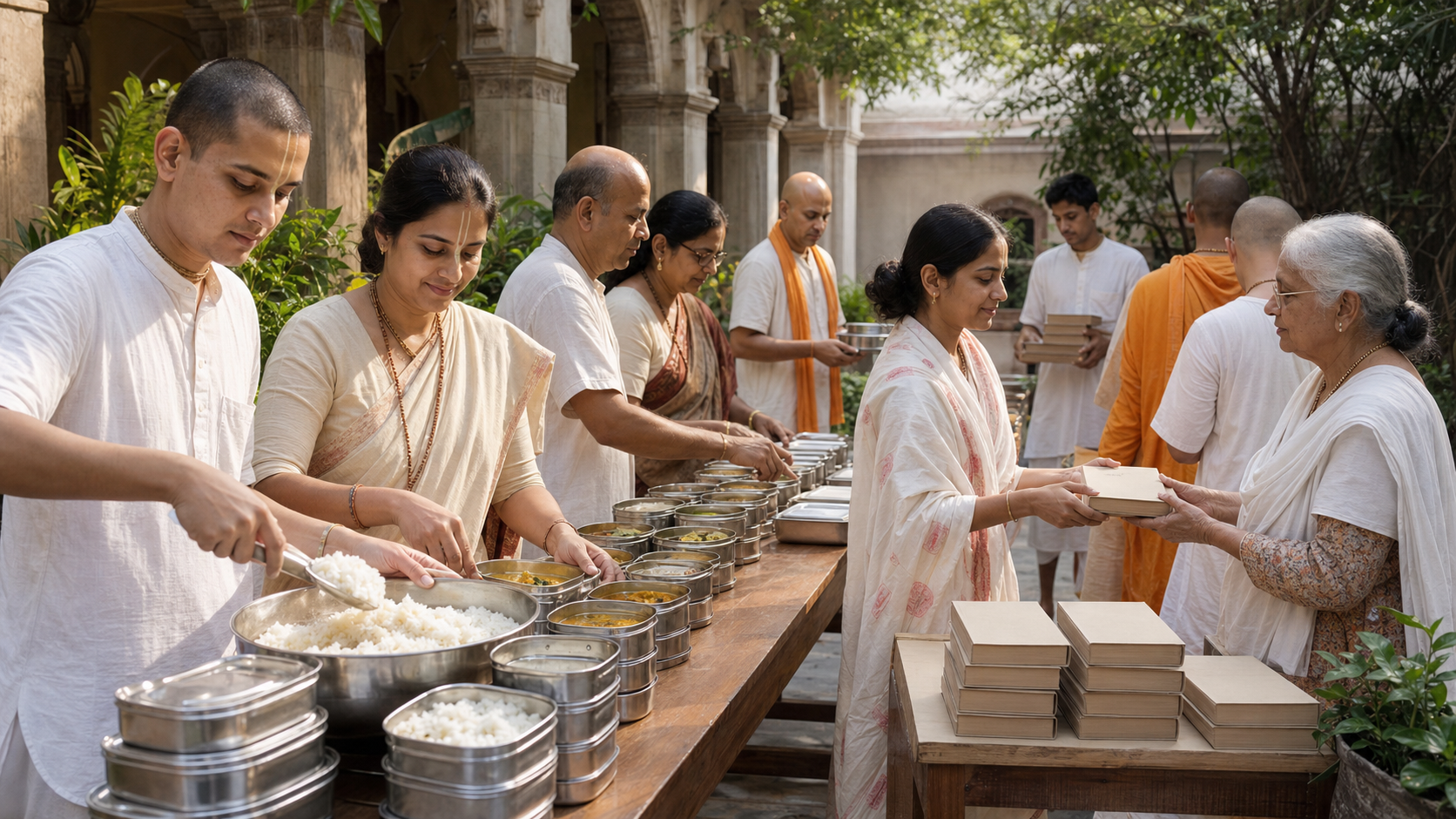
Gopal Krishna Goswami Maharaj is especially remembered for book distribution, temple development, and the cultivation of devotee communities across varied regions. These are useful lanes for remembrance because each can be translated into work that continues after the commemorative program.
Carry forward book distribution as responsible outreach
If you already distribute books, make your participation dependable rather than occasional and dramatic. Coordinate with the local team, learn how they approach people respectfully, keep your own reading active, and follow up where appropriate. If you are new, accompany an experienced devotee before attempting to represent the tradition on your own.
Book distribution is not only the transfer of an object. The way you speak, listen, answer uncertainty, and respect a refusal also represents the teaching. Do not let pressure for visible results produce exaggeration or argument. Compassionate outreach requires fidelity to the message and regard for the person in front of you.
Support the temple through work that is actually needed
Temple development includes more than construction or public events. A temple depends on cleaning, hospitality, administration, teaching, maintenance, cooking, communications, donor care, and the quiet reliability of devotees who complete what they accept. Ask a responsible leader which recurring duty is under-supported. Then take a task that matches your capacity and keep it without needing repeated reminders.
Do not expand your public service by neglecting your vowed chanting, family duties, health, or commitments already made to others. Sustainable seva is not lesser seva. Reliability over time serves the temple better than a burst of activity followed by disappearance.
Strengthen the community one relationship at a time
Community cultivation often begins with conduct too ordinary to appear in a tribute. Notice the newcomer standing alone. Learn the name of the person who keeps attending but has not found a place to serve. Introduce that person to a stable devotee, explain an unfamiliar practice without condescension, and check whether the connection held after the program.
For established devotees, community care may require a harder service: refusing gossip, resolving a misunderstanding directly, sharing credit, or cooperating with someone whose temperament differs from yours. Guru-tattva is not honored by praising the acharya while treating his servants carelessly.
Choose one primary lane rather than making promises in all three. Write the vow as an observable action, attach it to your existing routine, and tell the devotee who needs to coordinate with you. Review it regularly. If it is not happening, reduce its scope until it becomes honest; do not preserve an impressive sentence that no longer describes your conduct.
Protect remembrance from common distortions

A sacred anniversary can sharpen devotion, but it can also expose habits that weaken community life. Watch for these distortions at the point where they arise:
- Calendar anxiety replacing remembrance. Tithi calculation reflects the Moon’s position relative to the Sun, and local observance ordinarily depends on the relevant calendar standard and local timing. Follow the schedule set by the community hosting the program. Do not turn a timing difference into suspicion or conflict.
- Sentiment without obedience. A moving program can create the feeling that something important has been completed. Before the day ends, connect the feeling to a practice, repair, or service. Otherwise the observance may change your mood without changing your life.
- Competition over closeness. Ranking memories, access, disciples, or institutions turns the acharya into a possession. Receive another devotee’s remembrance as an offering. If a factual or organizational disagreement must be addressed, handle it through the appropriate responsible channel rather than during commemorative glorification.
- Criticism disguised as loyalty. Vaiṣṇava-aparādha is not made harmless by invoking the guru’s name. Avoid gossip, contempt, and sweeping judgments about devotees. Speak truthfully when responsibility requires it, but choose the proper person, setting, and purpose.
- Imitating emotion. Some devotees will weep; others will become quiet; others will feel unsettled or apparently ordinary. Do not grade your devotion by an outward response. Give the mind a genuine task: hear carefully, chant, serve, remember an instruction, and act on it.
- Outreach detached from inner practice. Books, temples, programs, and prasadam distribution are powerful forms of service, but activity does not excuse careless japa, harsh conduct, or neglect of śāstra. Let external service grow from sadhana rather than compete with it.
These corrections all protect the same principle: remembrance belongs inside Vaishnava character. Humility, truthful speech, gratitude, restraint, and cooperative service are not secondary manners added to devotion. They determine whether the community can safely carry an acharya’s mission into another generation.
Key takeaways
- Viraha-bhakti does not require you to suppress grief or manufacture visible emotion. It directs separation toward deeper hearing, steadier practice, and useful service.
- Association through vani becomes real when a teaching changes a decision, habit, relationship, or accepted duty.
- ISKCON Delhi is observing the second Disappearance Day on 14 April 2026. Outside Delhi, confirm the applicable tithi and program with your local community.
- Kīrtana, hari-kathā, puṣpāñjali, guru-pūjā, offerings, and prasadam form a single devotional arc when attentive hearing leads to continuing seva.
- Book distribution, temple support, and community cultivation offer practical ways to continue Maharaj’s work. Choose a defined responsibility you can sustain.
- Protect the observance from rivalry, gossip, calendar disputes, performative emotion, and promises that outrun your actual capacity.
Before the observance ends, place the next instance of your chosen service into your real schedule and inform anyone who depends on you. Then, when an ordinary choice tests your chanting, speech, cooperation, or willingness to serve, ask which choice is faithful to vani. That is where remembrance stops being an anniversary and becomes continuing association.