
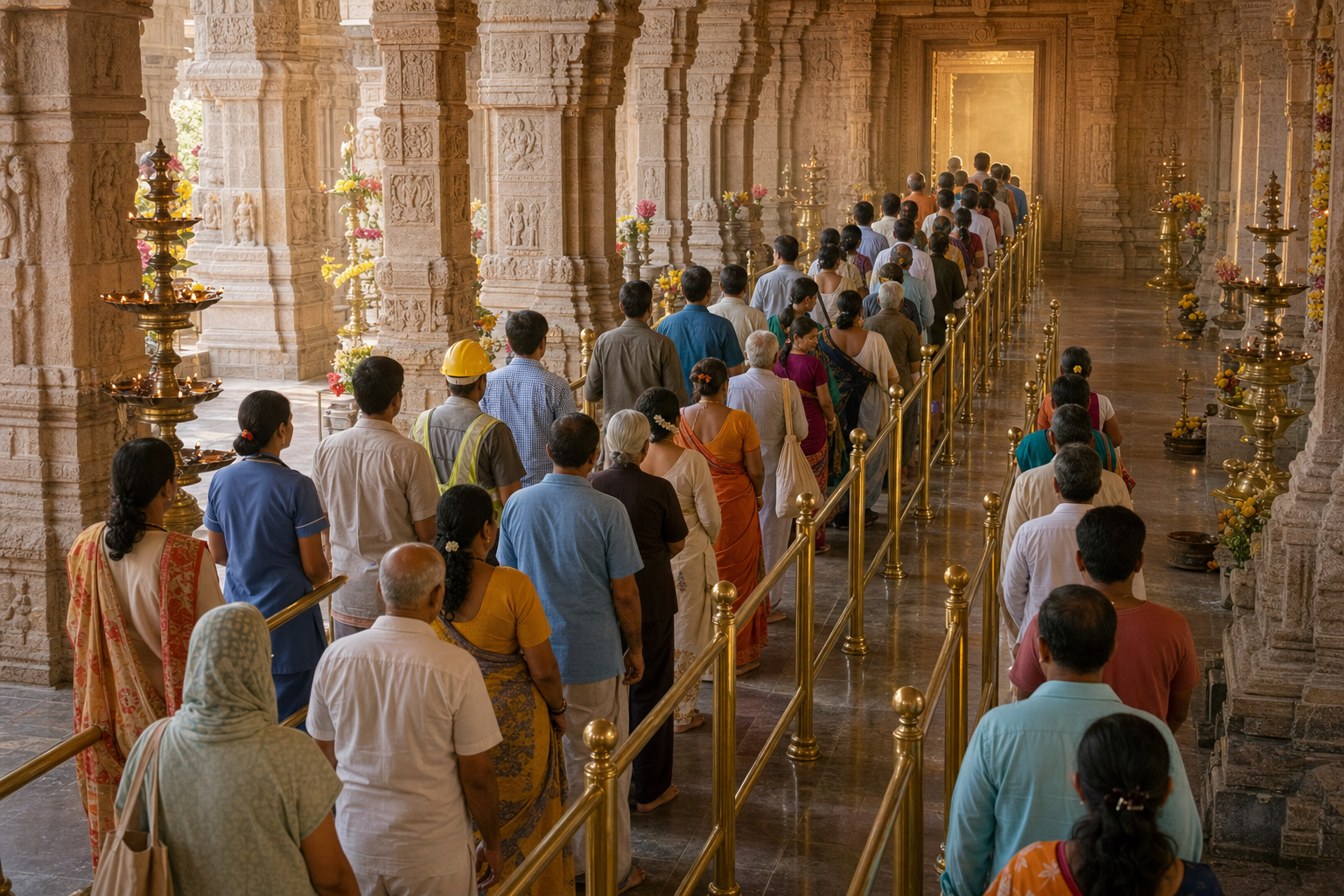
If you have watched one queue stand still while a paid queue moves toward the garbhagriha, you already know the problem. The devotee who cannot buy priority is made to feel that money, status, or connections determine whose prayer receives space first.
Reform begins with a precise distinction. A temple may charge transparently for accommodation, prasadam, or a separately requested seva. It should not sell a better place in the line for darshan. Once that boundary is clear, you can judge any access system, funding proposal, or governance model without confusing operational necessity with monetised privilege.
The fairness test: does money change your place in line?
Equal darshan does not mean that every person must move through an identical physical channel. An elderly pilgrim who cannot stand for long, a person with a disability, a pregnant woman, or someone facing a genuine emergency constraint may need a different route. That is an accommodation based on need. It does not make one devotee more spiritually entitled than another.
Paid priority is different because it converts purchasing power into proximity. The simplest policy test is therefore not whether a temple has multiple queues. It is whether money, political influence, donor status, or administrative connections can move an otherwise able pilgrim ahead of others waiting under the same conditions.
- If a pilgrim can improve a place in the general darshan queue solely by paying, the arrangement fails the fairness test.
- If a separate route exists only for a clearly defined accessibility or safety need, it can be a legitimate accommodation.
- If a paid archana or seva is a distinct ritual service, assess it separately. It becomes an equal-access problem when the payment is bundled with priority in the general darshan line.
- If trustees, politicians, officials, donors, or their guests receive routine priority without a ritual, accessibility, or immediate operational reason, the same objection applies even when no ticket is sold.
- If an unofficial agent can arrange faster entry, the formal queue may appear equal while the real system remains corrupt.
The constitutional position requires care. Article 14 places equality at the centre of public decision-making, while Articles 25 and 26 protect religious freedom and the management of religious affairs within constitutional limits. These principles support a strong case for fair access, but they do not erase denominational rights or make every temple subject to an identical administrative rule.
Temple regulation is also state-specific. Tamil Nadu, Karnataka, and Andhra Pradesh operate under their respective Hindu religious and charitable-endowment frameworks, while many public temples in Maharashtra fall under the Bombay Public Trusts Act, 1950. Before challenging an arrangement, identify the temple’s legal status, governing statute, trust instrument, and notified administrative scheme. A policy campaign can begin with a fairness test; litigation or statutory drafting needs advice grounded in the applicable state law.
Crowd control does not require selling proximity
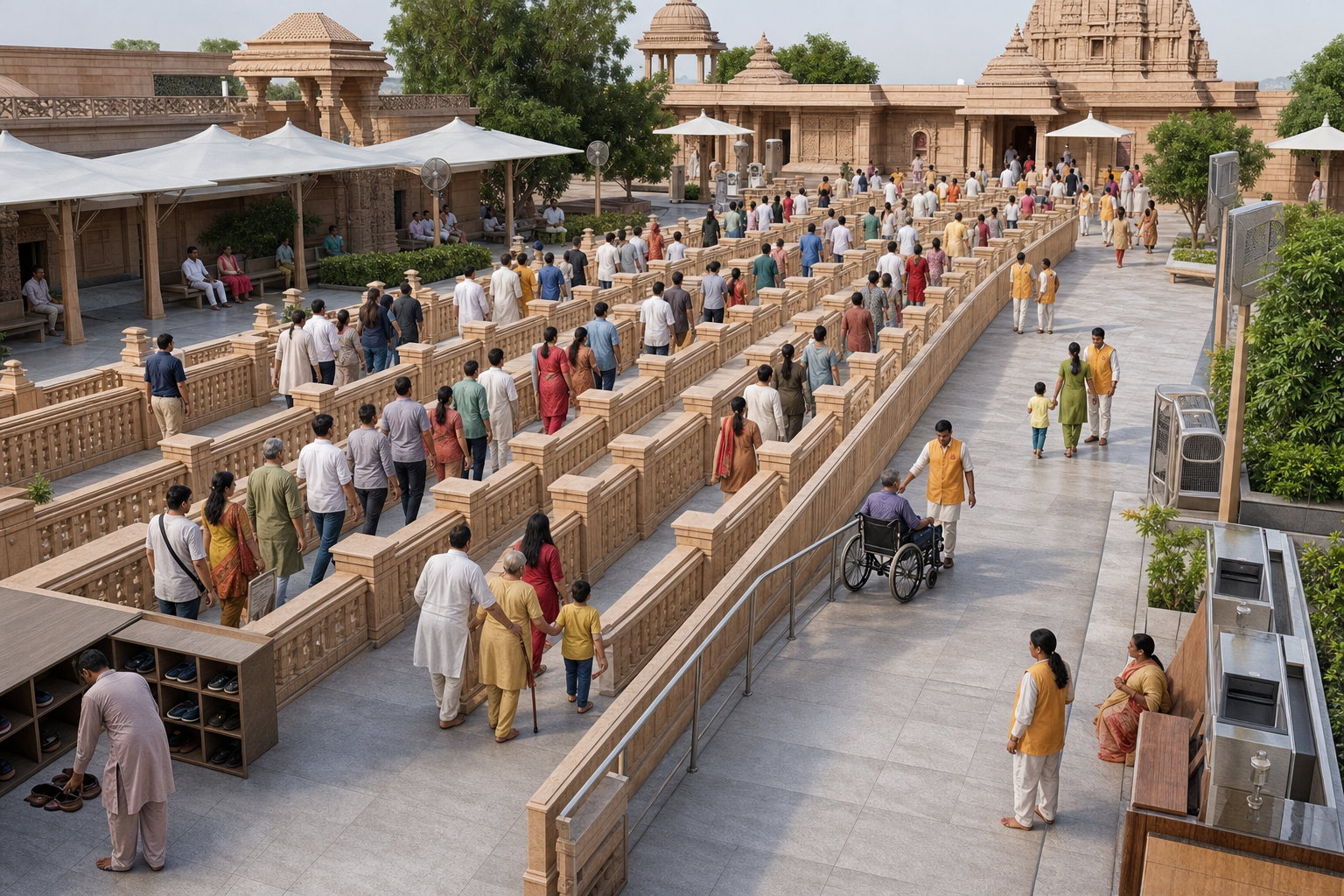
The strongest practical defence of paid darshan is usually crowd pressure: large numbers must somehow be organised. That identifies a real operational problem, but selling a shortcut is not the only way to solve it. It can even obscure poor queue design by making delay profitable.
A fair system manages demand before pilgrims enter a congested passage. Temples can issue time-slot tokens online and on-site, operate a first-come-first-served digital queue, send an SMS when a pilgrim’s turn approaches, and display current crowd density and expected waits. On-site tokens matter because an online-only system would disadvantage pilgrims without smartphones, reliable connectivity, digital payment access, or confidence using an app.
- Measure how many pilgrims can safely complete darshan in each operating hour. Token capacity should follow observed throughput rather than wishful estimates.
- Separate arriving, waiting, and departing flows. One-way circulation reduces the cross-movement that causes stoppages and unsafe pressure.
- Add trained staff and volunteers during festivals, weekends, and other known peaks instead of keeping staffing fixed while demand changes.
- Display expected wait times before a pilgrim joins the queue. A person can then decide whether to enter, take a later slot, or return after the peak.
- Maintain an accessibility lane that cannot be purchased, transferred, or converted into a donor benefit.
- Record both the average wait and the 90th-percentile wait. An acceptable average can hide a badly served minority; the 90th percentile shows the time within which nine out of ten recorded waits were completed.
No universal waiting-time target will fit a small local mandir, a festival day, and a major pilgrimage centre. Each institution should publish its own service objective, explain the ritual and safety constraints behind it, and report actual performance. The relevant questions are measurable: How long did people wait, how many passed through safely each hour, and how often did the system exceed its stated objective?
At very high-footfall institutions such as Tirumala Tirupati Devasthanams or the Shree Jagannath Temple Administration in Puri, transition must be phased around peak seasons so that equality reform does not create a new safety hazard. The same caution applies when extending common standards to bodies such as the Badrinath Kedarnath Temple Committee. Phasing should change the implementation timetable, not preserve a permanent market in priority.
Temple finances need a cleaner bargain with devotees
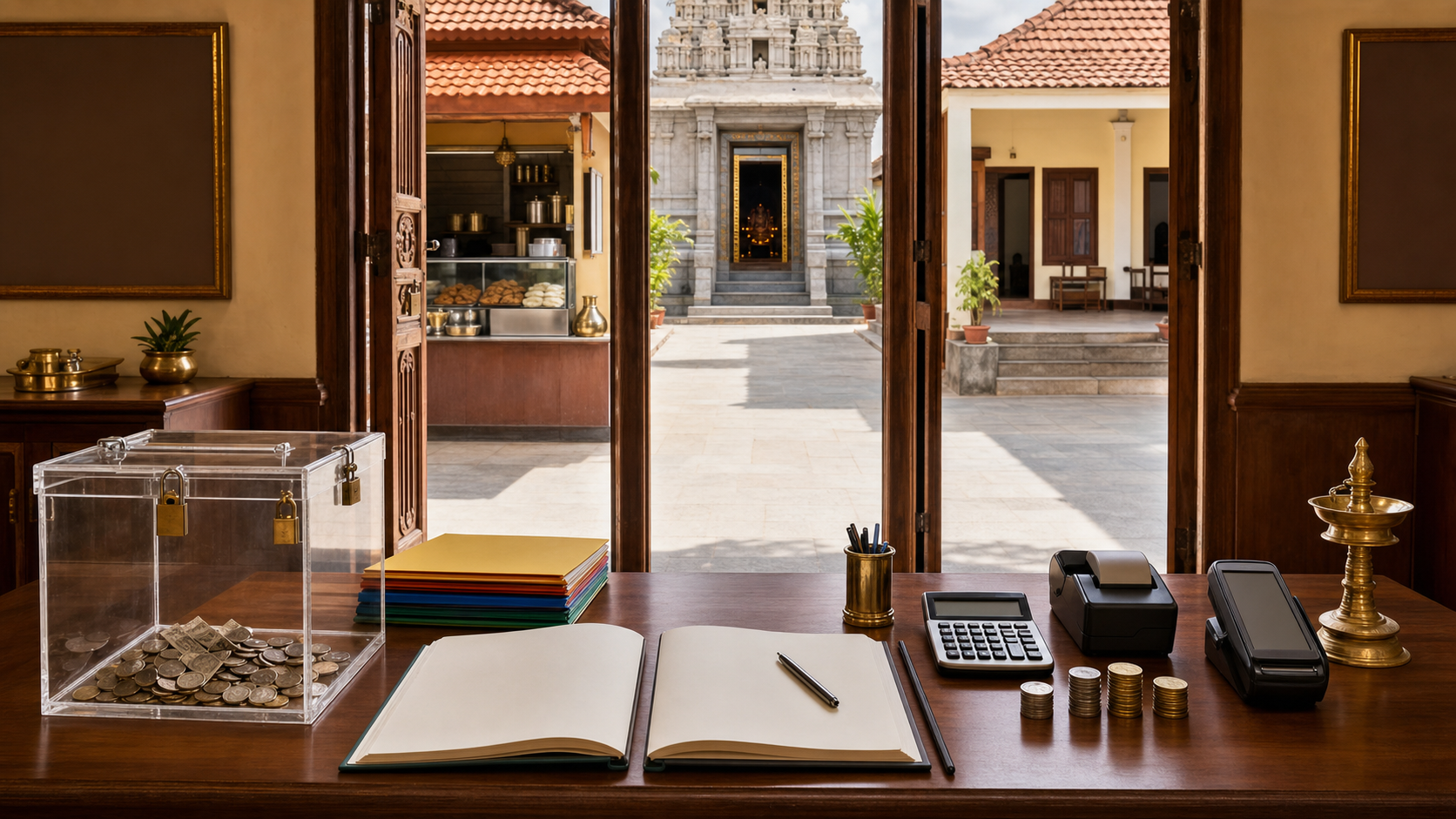
Ending paid queues can remove revenue that administrators have come to treat as routine. Ignoring that gap would threaten staffing, sanitation, maintenance, and crowd safety. Treating the gap as a reason to continue selling access would be equally mistaken. The answer is to separate the right to approach the deity from the duty to fund a well-run institution.
Hundi offerings, endowment income, voluntary donations, sevas and archanas, prasadam, accommodation, and philanthropy can all contribute to temple finances. The governing condition should be visible to every devotee: a donation is voluntary and does not purchase a better position in the general darshan queue.
- Ring-fence crowd-management funds. Show what is budgeted for barriers, token systems, sanitation, accessibility, staff, volunteers, emergency readiness, and maintenance.
- Publish a monthly financial dashboard. Devotees should be able to see major income streams, operating expenditure, designated funds, and whether required disclosures were made on time.
- Use targeted philanthropy. A donor may fund an accessibility ramp, queue shelter, drinking-water point, or technology upgrade without receiving priority darshan in return.
- Commission periodic independent audits. Audits should follow the relevant endowment or public-trust law, with exceptions tracked until they are closed rather than quietly repeated.
- Keep prices and entitlements explicit. If accommodation, prasadam, or a distinct seva carries a charge, state exactly what the payment covers and confirm that it does not alter the general queue.
A public dashboard should join financial and service information. That connection prevents two common evasions: claiming that paid access is essential without showing the underlying budget, and claiming that a new queue system works without publishing waiting-time data.
| Measure to publish | What it lets devotees assess |
|---|---|
| Average and 90th-percentile wait | Whether acceptable averages conceal excessive waits for a substantial group |
| Pilgrims served per hour | Whether staffing and circulation changes improve safe throughput |
| Accessibility compliance | Whether need-based accommodation exists in practice, not merely in policy |
| Grievances and resolution time | Whether complaints receive timely, traceable decisions |
| Audit exceptions closed each quarter | Whether identified financial and control failures are actually corrected |
| Disclosure publication dates | Whether transparency is regular or appears only after controversy |
When this information is public, a trustee can defend necessary expenditure with evidence and a devotee can distinguish an honest operational constraint from an excuse. Transparency is therefore not an administrative ornament. It is part of the funding model because people are more able to give with confidence when they can see what their dana sustains.
Depoliticisation needs rules, not slogans
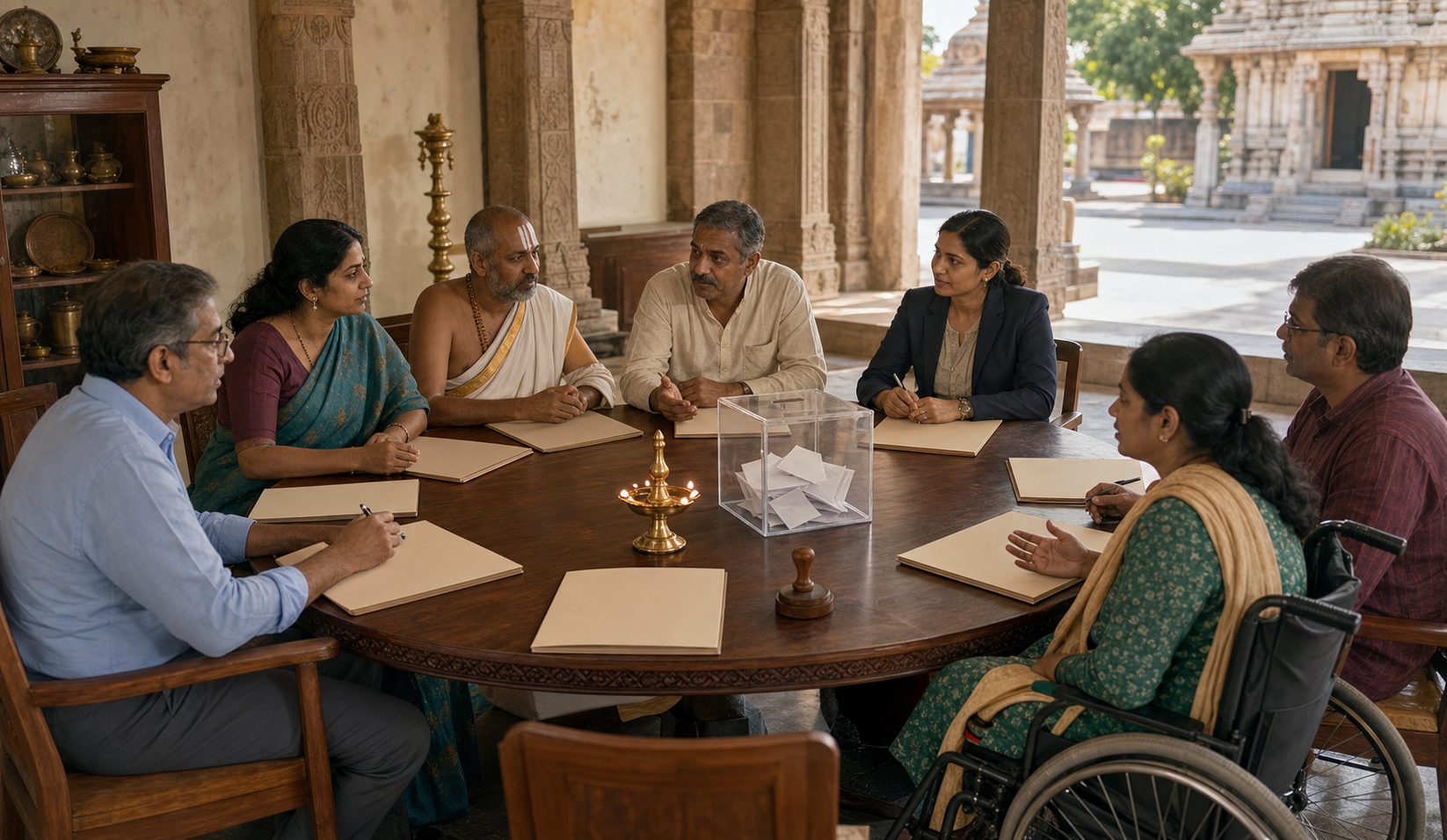
Removing overt political appointees will not by itself create good governance. An unaccountable private circle can misuse a temple as readily as a partisan board. Depoliticisation must therefore answer four questions: who may nominate trustees, what qualifies a nominee, how conflicts are disclosed, and how poor performance or misconduct is corrected.
An independent nominations committee offers a workable starting point. It should include competence in religious-endowments law, the temple’s spiritual tradition, finance, ethics, and heritage conservation. Broader advisory participation from Hindu, Buddhist, Jain, and Sikh communities can bring useful experience in seva, dana, community administration, and the protection of sacred institutions, while the temple’s own ritual identity remains intact.
- Publish trustee vacancies, eligibility requirements, disqualifications, and the selection timetable.
- Apply a fit-and-proper test covering competence, integrity, financial conflicts, relevant experience, and commitment to the institution’s religious purpose.
- Use fixed terms and staggered rotation so that neither a government nor a private faction can replace the whole board at once.
- Require declarations of political, business, family, contractor, and donor conflicts before appointment and whenever circumstances change.
- Provide meaningful gender and community representation without treating trusteeship as patronage.
- Publish a code of conduct and annual performance review for trustees and senior administrators.
- Separate ritual authority, trustee oversight, professional administration, and independent audit so that no single group controls doctrine, money, appointments, and self-review.
The constitutional balance is important here. The Shirur Mutt decision of 1954 protects autonomy in essential religious matters, while later decisions including Sri Venkataramana Devaru, A.S. Narayana Deekshitulu, and Subramanian Swamy v. State of Tamil Nadu address the relationship among denominational rights, social reform, secular administration, and state intervention. The practical principle is that lawful intervention may correct mismanagement, but corrective supervision should not quietly become indefinite control over a sacred institution.
This is why India does not need one central board dictating every local ritual. It needs consistent minimum standards for access, trustee integrity, accounts, conflicts, audits, and grievance handling, applied through the legal framework governing each institution. Religious autonomy and public accountability are not opposites when their responsibilities are properly separated.
Other dharmic institutions also keep the moral purpose visible. Gurdwara access and langar express equality through shared presence and seva. Community-led administration and dana within many Jain derasars and Buddhist viharas offer further experience in sustaining sacred spaces without making purchased proximity the organising principle. A Hindu temple need not copy another tradition’s institutional form to recognise the shared discipline: wealth may support worship, but it should not rank worshippers.
A 100-day transition that devotees can hold to account
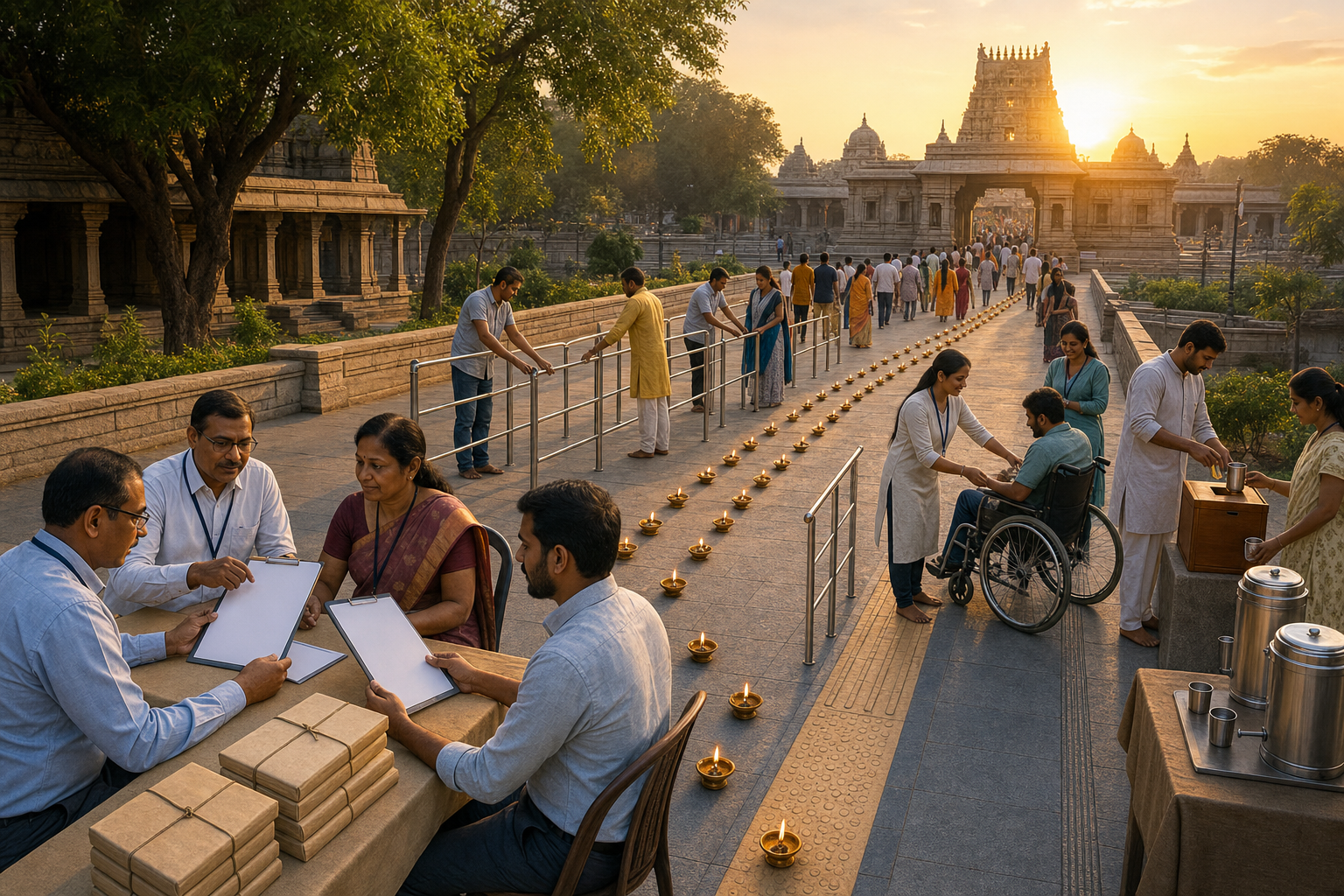
A serious reform programme needs a visible sequence. Otherwise an announcement against paid darshan can leave unofficial privileges untouched, while a technology rollout can merely digitise the old hierarchy. The following 100-day agenda combines equal access, operational continuity, and independent oversight.
- Impose an immediate moratorium on the sale of queue priority. The order should define protected accessibility arrangements so that staff do not mistake equality for the withdrawal of necessary assistance.
- Publish a complete access inventory. List every paid, complimentary, donor, official, protocol, trustee, agent-arranged, and informal entry channel. A reform cannot close privileges it refuses to name.
- Deploy fair queue tools. Introduce online and on-site time-slot tokens, first-come-first-served sequencing, live wait information, SMS alerts where practical, and clearly marked accessibility routes.
- Train staff and volunteers. Training should cover disability and age-related needs, crowd communication, escalation during unsafe conditions, prevention of informal priority, and respectful handling of grievances.
- Publish the operating procedure. The procedure should state how tokens are allocated, when entry pauses for ritual or safety reasons, who may authorise an exception, how the exception is recorded, and when a complaint must receive a response.
- Appoint an interim independent oversight panel. It should monitor the transition, receive evidence of circumvention, review service and financial indicators, and issue public status reports every fortnight.
The reform also needs an anti-touting rule with consequences. Resale of access, fabricated accessibility claims arranged by agents, and internal assistance to unofficial priority must trigger investigation and disciplinary action. Where existing law does not adequately cover commercial resale or corrupt facilitation, the responsible legislature or rule-making authority should close that gap through a properly drafted provision rather than relying on vague warnings.
What you can ask your temple to disclose now
You do not need to wait for a nationwide law before asking useful questions. Send the temple trust or governing board one written request and seek a public response to these five points:
- Which payments, passes, recommendations, offices, or donor categories can currently change a pilgrim’s place in the darshan queue?
- What separate policy protects elderly pilgrims, persons with disabilities, pregnant women, and people facing genuine emergency needs?
- Are average waits, 90th-percentile waits, hourly throughput, and queue closures measured and published?
- How are trustees nominated, screened for conflicts, appointed, evaluated, and removed?
- Where can devotees see current accounts, audit findings, crowd-management expenditure, grievance numbers, and resolution times?
A precise request is harder to answer with a ceremonial promise. If the institution already performs well, the disclosures will demonstrate it. If it does not, the same questions provide a concrete reform agenda for devotees, trustees, administrators, legislators, and courts.
Key takeaways
- Equal darshan prohibits wealth- or status-based priority; it does not prohibit need-based accessibility arrangements.
- Time-slot tokens, first-come-first-served digital queuing, on-site access, live wait information, one-way circulation, and peak staffing can manage crowds without selling a shortcut.
- Temple income should come through transparent offerings, services, endowments, accommodation, philanthropy, and voluntary dana that is not tied to queue position.
- Depoliticisation requires open nominations, fit-and-proper screening, fixed terms, conflict rules, independent audits, and public performance reporting.
- A 100-day transition should begin with a moratorium and access inventory, then publish queue rules, measurable results, and fortnightly oversight reports.
Your next step is simple: apply the money test to every entry channel, then ask for the five disclosures above. Darshan should return the devotee to humility before the deity, not force the devotee to calculate what dignity costs.