

If an online contact has asked your child for secrecy or intimate images, or has shifted from affection to threats, treat it as a safeguarding problem now. You do not need to reconstruct every conversation before you protect the child, preserve what remains and report the conduct.
Your order of action matters. An angry interrogation can close down disclosure. Forwarding an image to show relatives can spread the abuse. Resetting a phone can destroy evidence. The plan below helps families in India respond without blaming the child or compromising the investigation.
Recognise grooming before the threat becomes obvious

Online grooming is usually a sequence, not one unmistakable message. An offender may begin with an invented identity, build trust unusually quickly, encourage secrecy, isolate the child from people who might intervene, request intimate content and then use fear or humiliation to maintain control. The demand may arrive only after the child believes the contact is a friend, admirer or romantic partner.
Key takeaways
- Put the child’s immediate safety and willingness to keep talking ahead of anger, punishment or embarrassment.
- Preserve original devices, accounts, handles, profile links and relevant messages. Do not edit evidence, reset the device or forward sexual material.
- Report the account through the platform and report the conduct to the National Cyber Crime Reporting Portal at cybercrime.gov.in or local police. Use 112 for an immediate emergency and Childline 1098 for child-focused support.
- Sexual imagery involving a minor is Child Sexual Exploitation Material even if the child appeared to agree to create or send it. The offender’s manipulation does not transfer responsibility to the child.
- Privacy controls reduce opportunity, but children also need a standing promise that they can disclose pressure, fear or secrecy without being blamed.
The progression often has five recognisable parts:
- A deceptive identity: The person uses a false profile, misleading photographs, a pseudonymous handle or an invented connection to the child’s school, interests or social circle.
- Accelerated trust: The contact offers intense attention, praise or emotional intimacy and tries to make the relationship feel exceptional.
- Secrecy and isolation: The child is told that parents or friends would not understand, or that the conversation must remain private. The contact may move the exchange into disappearing messages, a closed group or an encrypted channel.
- A sexual request: The person asks for an intimate photograph, video, private video call or sexualised conversation. The request may be framed as proof of trust rather than an overt threat.
- Coercion or sextortion: Existing material is used to demand more content, continued contact or silence. Threats to circulate the material turn the child’s shame and fear into tools of control.
No single change in behaviour proves that grooming is occurring. A child may become private or upset for many reasons. Pay attention to clusters: sudden secrecy around a device, a marked mood change after screen time, fear of a particular notification, or distress when asked about an online contact. These are reasons for a calm conversation, not a verdict.
Ask concrete questions that do not assume guilt: Has anyone asked you to keep a chat secret? Has anyone asked for a photograph or call that made you uncomfortable? Has anyone threatened to share something, blame you or get you into trouble? Is someone pressuring you not to block or report an account?
Then stop talking long enough to hear the answer. Do not make the first disclosure into a cross-examination. A child who minimises what happened may be frightened, ashamed, attached to the offender or worried about losing device access. The useful first response is simple: you are glad they told you, the coercion is not their fault, and you will deal with the danger together.
If grooming or sextortion is active, act in this order
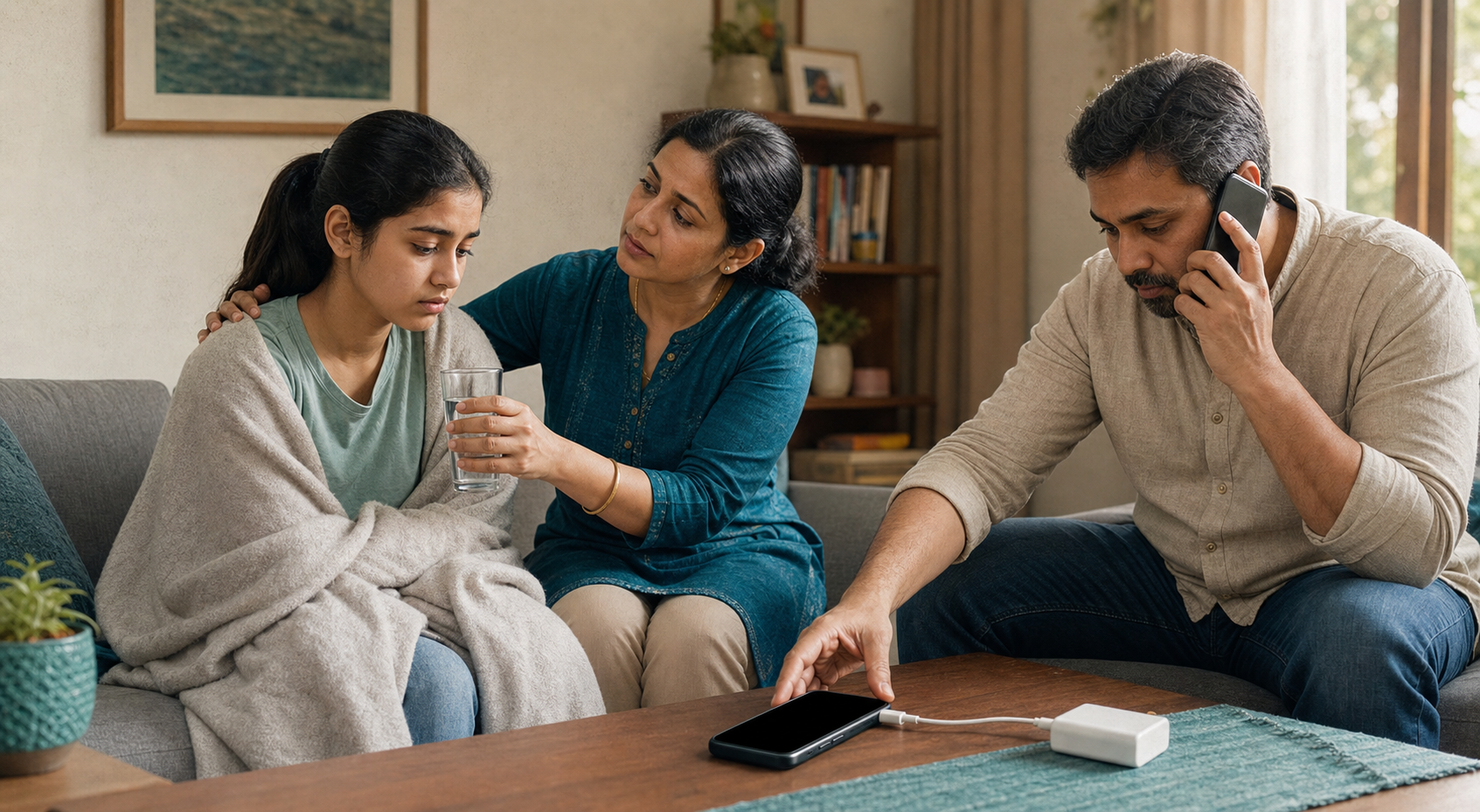
A family facing an active threat needs a short sequence that protects both the child and the evidence. Work through these steps without trying to conduct your own undercover investigation.
- Deal with immediate physical danger. If the contact is nearby, has arranged a meeting, is threatening imminent harm or knows enough to reach the child, contact local police. Use 112 when the danger is immediate. Move the child to a safe setting and tell police about any proposed meeting before attempting to cancel or alter it yourself.
- Stabilise the disclosure. Say plainly that the child is not in trouble for being deceived, sending something under pressure or asking for help late. Do not demand a confession, threaten loss of schooling or announce the incident to the wider family. Shame is one of the offender’s controls; a blaming response strengthens it.
- Stop further engagement. Once the necessary evidence has been preserved, the child should not bargain, comply with new demands or threaten the offender. A parent should not impersonate the child to draw out more admissions. Further contact can increase pressure and alert the offender that accounts or files may need to be deleted.
- Preserve what already exists. Keep the original phone, computer or tablet in its current condition. Do not factory-reset it, uninstall the relevant apps, run a cleaning tool or edit the messages. Capture account names, handles, profile links, URLs and enough surrounding conversation to preserve context. Note every platform involved and whether disappearing messages were used.
- Do not redistribute sexual material. Do not forward an image or clip to relatives, teachers, resident groups or friends, even to prove what happened. Do not place it in a general family cloud folder. Record where the material appears and let police advise how it should be handled. Creating extra copies can extend the child’s harm and create legal complications.
- Report through both routes. Use the platform’s reporting and grievance tools, but do not assume that an in-app report replaces a police complaint. Report to the National Cyber Crime Reporting Portal at cybercrime.gov.in or local police. Give investigators the list of accounts, apps and devices so that time-sensitive preservation requests can reach every relevant platform.
- Secure the child’s accounts without destroying evidence. After preservation and reporting, use the platform’s blocking controls, change compromised credentials, make profiles private where possible, disable unsolicited direct messages and review friend or follower lists. If police want the account or device left unchanged, follow their instructions.
- Arrange child-focused support. Ask about a trained counsellor or support person, especially if the child is frightened, unable to sleep, withdrawing from ordinary life or terrified that material will circulate. Childline 1098 can provide a child-focused support route. Psychological care supports recovery; it is not a substitute for reporting an ongoing crime.
Make one factual incident note while memories are fresh: what the child disclosed in their own words, the accounts involved, where the communication occurred, what threats were made and what actions the family took. Keep interpretation separate from observation. This gives police a clearer starting point without forcing the child to repeat the account to every relative who wants an explanation.
What Indian law protects, and why evidence handling matters

Your job is not to select criminal charges before making a complaint. Your job is to protect the child, preserve the available material and describe what occurred. Investigators and legal counsel must determine which provisions apply to the facts and which procedural law is in force for the relevant dates.
The central legal distinction is easy to understand: a minor’s apparent agreement does not turn sexual material into lawful adult content. The creation, solicitation, possession or circulation of sexual imagery involving a child is treated as Child Sexual Exploitation Material. That remains true when the child took the image, believed the recipient was another minor, or complied because of affection, deception or fear.
Several parts of Indian law may be engaged:
- The Protection of Children from Sexual Offences Act, 2012, as amended in 2019, addresses sexual harassment and the use of a child for pornographic purposes. Depending on the conduct, Sections 11-12 and 13-15 may be relevant.
- Section 67B of the Information Technology Act, 2000 addresses electronic material depicting children in sexually explicit circumstances and related online conduct.
- Threats, intimidation, conspiracy and sexual offences may attract additional criminal provisions. The precise charge depends on what was requested, created, transmitted, threatened or carried out.
- The Intermediary Guidelines and Digital Media Ethics Code Rules, 2021 place due-diligence and grievance-related responsibilities on online intermediaries. Law-enforcement requests and platform preservation are therefore important parts of a coordinated response.
This is general legal orientation, not advice for an individual case. Criminal codes, evidence rules and procedural requirements can change, and the applicable route may depend on when the conduct occurred. Ask the investigating officer or a legal-aid lawyer which current provisions govern the complaint rather than delaying a report while trying to resolve that question yourself.
POCSO also matters after the complaint. It provides for child-friendly procedures, protection of the child’s identity and in-camera proceedings. Statements should be taken in a setting that is safe and non-intimidating. Any required medical examination should be dignified. Families can ask the investigator, legal-aid lawyer or Special Court about a support person, counselling, protective measures and available interim or final compensation.
Protecting identity is not merely the court’s task. Do not publish the child’s name, school, face or recognisable family details. Do not circulate screenshots in community messaging groups. Even a well-meant appeal can expose the child, seed further copies of the material and make recovery harder.
Digital investigations depend on more than screenshots. Police may seek platform logs, metadata and preservation of cloud or account data; create forensic images of seized devices; compare file hashes to identify re-uploads; and map connected accounts across services. Original devices and unedited records help establish where material came from and whether it changed. An unbroken chain of custody and the correct electronic-evidence authentication process can determine whether technically useful material remains usable in court.
Tell investigators promptly if communication crossed several apps, devices or cloud services. A report limited to the final account can miss the earlier fake profile, a closed group or a second channel used for distribution. Platforms may hold different parts of the trail, and preservation requests are most useful before records disappear.
Law also requires fairness to the accused. An allegation must be investigated and proved through due process. That principle is compatible with immediate protection for the child: families can preserve confidentiality, seek safety measures and request platform action without organising public accusations or trying the case on social media.
Build safeguards that children will actually use

No parental-control setting can replace disclosure, and no conversation can replace safer platform design. Effective protection is layered: reduce unwanted access, make suspicious conduct easier to notice, give the child a rehearsed exit and keep a clear reporting route.
Start with a device and account review carried out with the child, not secretly around them:
- Set profiles to the most private practical option and check who can see posts, stories, location-linked content and friend lists.
- Disable direct messages from unknown accounts where the service offers that control.
- Review followers, friends and pending requests. Ask the child how each unfamiliar person became connected rather than assuming that a plausible profile is genuine.
- Use age-appropriate content filters and DNS-based parental controls, while explaining that these tools cannot detect every private message or false identity.
- Check whether disappearing-message features, closed groups or alternate accounts are in use. Their presence is not proof of wrongdoing, but it changes what can be preserved if a problem emerges.
- Keep platform reporting controls and the cybercrime.gov.in route easy to find before an emergency occurs.
Next, give the household a three-part tripwire: pressure, fear or secrecy. If an exchange produces any one of those, the child pauses and tells a trusted adult. This is more useful than expecting a young person to decide whether a friendly account legally qualifies as a groomer.
Make the intimate-content rule equally direct: do not create or send intimate images. If something has already been sent, do not send more to regain control. Tell an adult and preserve the account details. A safety rule must include a route back after the rule is broken; otherwise the first mistake becomes leverage for the offender.
Parents should make a reciprocal promise: asking for help will not trigger public humiliation, victim-blaming or an immediate family broadcast. Device limits may still need to change for safety, but do not disguise punishment as protection. The child needs to know that early disclosure reduces danger and that a late disclosure will still be heard.
Schools and community organisations need their own response plan. Ask five practical questions: Who receives a disclosure? Who preserves account information? Who contacts the family and police? How is the child’s identity restricted? Which counsellor or support person can be involved? If the answer is a staff messaging group in which screenshots are casually forwarded, the safeguarding process itself needs repair.
Digital-citizenship teaching should rehearse realistic decisions: a flattering stranger asks to move apps; a supposed peer requests secrecy; a private image becomes a threat; a friend reveals that they are being blackmailed. Children should practise blocking, preserving identifiers, using an in-app report and approaching a named adult. General warnings to be careful online do not tell a frightened child what to do next.
Platforms also carry responsibility. Useful safety-by-design measures include default protections for minors, limits or friction around unsolicited first contact, detection of suspicious patterns, reliable grievance channels, rapid takedown processes and hash-matching that can prevent known exploitative material from being uploaded again. Families should use the available controls, but they should not be expected to compensate for weak platform design by monitoring every conversation.
A dharmic response protects dignity as firmly as safety
Ahimsa requires us to stop the secondary harm caused by blame, gossip and repeated circulation. Karuna requires listening without making the child carry an adult’s anger. Seva becomes practical when a family preserves evidence, accompanies the child through reporting, finds counselling and protects their identity. These are not abstract virtues; they determine whether a frightened child asks for help.
The same discipline applies to public discussion. Criminal conduct should be investigated and punished on evidence. It should not be converted into a claim about an entire religion or community. Communal profiling distracts from the behaviour that families must learn to recognise and can expose innocent people to hostility while the actual safeguarding work remains undone.
You can begin before the next notification arrives. Check who can message your child, agree that pressure, fear and secrecy are automatic reasons to pause, identify the adult they would contact if you were unavailable, and save cybercrime.gov.in, 112 and 1098 where the family can find them. If coercion is already happening, skip the household lesson for now: secure the child, preserve the evidence and report.