
If you are trying to place Vaishakha 2026 on your household calendar, the first difficulty is not the puja. It is deciding what the word Vaishakha means in the Panchang your family actually follows. A North Indian, Telugu, Tamil, Kerala, or overseas calendar can place a different month name beside the same lunar tithi without any one of them being wrong.
Your workable plan is to settle the calendar system and location first, pencil in the sacred dates from 16 April through 1 May, and then verify each tithi locally. Once that is done, the month becomes manageable: ancestral remembrance, disciplined speech, study, duty, devotional music, and full-moon contemplation each receive their proper place.
Choose your Vaishakha before you choose the dates
The first date needs special care. The Amavasya tithi extends across 16 and 17 April 2026, so the applicable civil date depends on its presence at local sunrise and, for some rites, during the preferred daytime segment. In the North Indian purnimanta system, this is Vaishakh Amavasya. In the amanta calendars used in Andhra–Telangana, Karnataka, Maharashtra, and Gujarat, the same new moon closes Chaitra and is called Chaitra Amavasya.
Tamil and Kerala usage introduces another distinction. Tamil solar reckoning calls the observance Chithirai Amavasya, while Kerala solar reckoning uses Mesha Maasa Amavasya. These are not rival names for competing festivals. They are regional ways of locating the same new-moon observance within different calendrical structures.
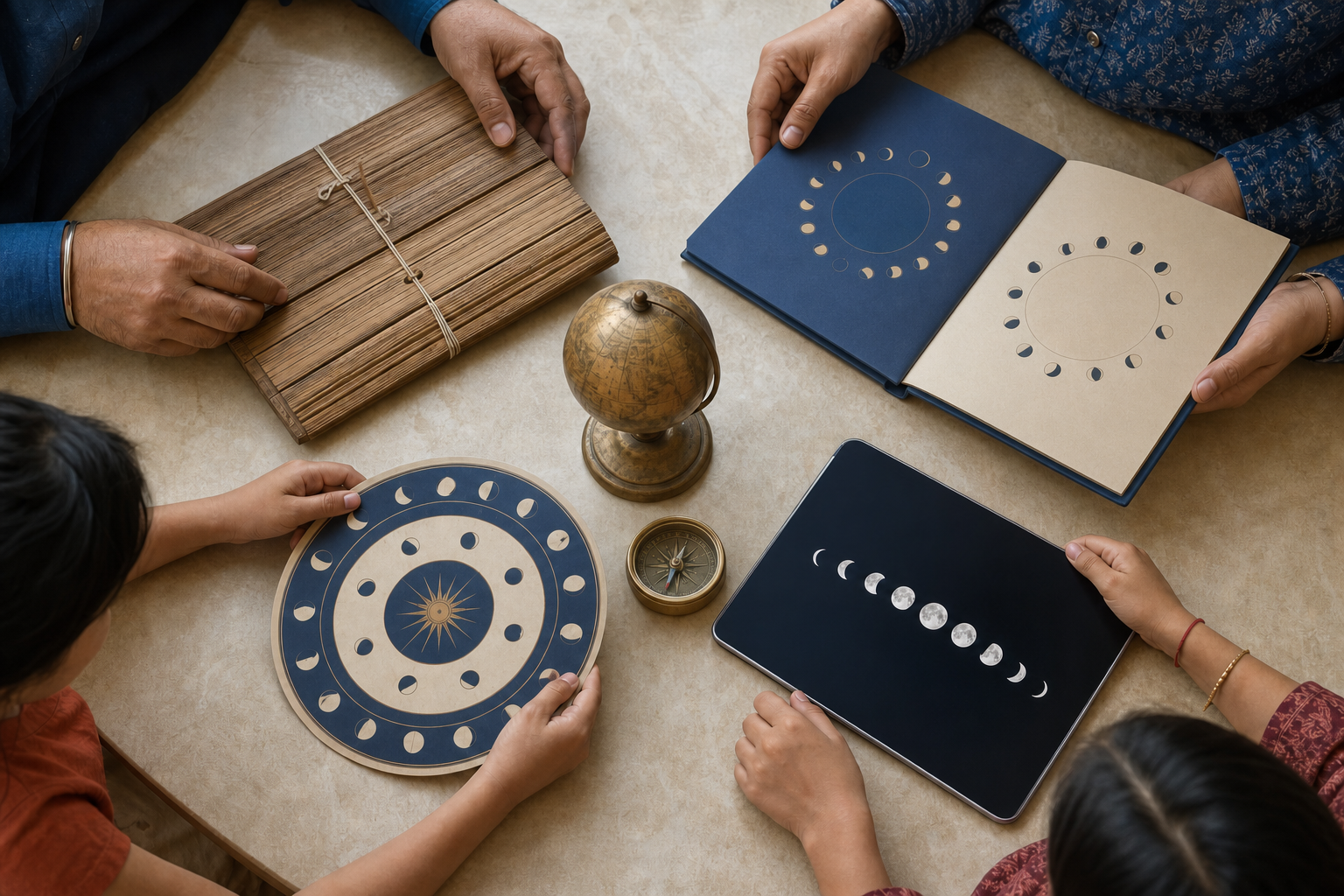
A tithi is defined by a 12-degree change in the angular separation of the Sun and Moon. It therefore does not begin at midnight or last for a fixed civil day. The sunrise-based application of a tithi is local, which is why an Indian date should not be copied automatically into a Toronto, London, Singapore, or California calendar.
- Identify the system your family or sampradaya uses: purnimanta, amanta, Tamil solar, Kerala solar, or another established regional reckoning.
- Consult a Panchang calculated for the city where you will perform the observance, not merely for the city where your family originated.
- Check whether the observance follows the tithi at sunrise or requires the tithi during a particular daytime segment. Amavasya tarpanam and other ancestral rites may follow rules that differ from a household vrata.
- Use the month name belonging to that same calendar in your sankalpa. Do not combine a North Indian month label with a South Indian ritual formula simply because both appeared in separate online calendars.
Vaishakha 2026 dates at a glance
| Civil date | Lunar marker | Commemoration | What you need to verify |
|---|---|---|---|
| 16 or 17 April | Krishna Paksha Amavasya | Vaishakh, Chaitra, Chithirai, or Mesha Amavasya, depending on the calendar | Local sunrise, applicable daytime segment, regional month name, and family tarpanam procedure |
| 19 April | Vaishakh Shukla Tritiya | Akshaya Tritiya and Matangi Jayanti | The local period during which Tritiya remains in effect |
| 23 April | Vaishakh Shukla Saptami | Vidyaranya Jayanti | Whether Saptami prevails at local sunrise |
| 25 April | Vaishakh Shukla Navami | Vashishta Jayanti | Local sunrise and any sampradaya-specific vrata practice |
| 1 May | Vaishakha Purnima | Annamacharya Jayanti, Buddha Purnima or Vesak, and Kurma Jayanti in several Vaishnava traditions | Local Purnima timings and the rules of the tradition you are observing |
These civil dates give you a planning framework, not a substitute for a local Panchang. The distinction matters most on 16–17 April, but overseas practitioners should verify every tithi because sunrise and tithi transitions move with location.
Key takeaways for planning the month
- Do not choose between 16 and 17 April from a generic national festival list. Use your location, your Panchang, and the rule applicable to the rite.
- A different month name does not necessarily mean a different lunar event. Vaishakh, Chaitra, Chithirai, and Mesha can all appear around the April new moon because the underlying calendars define months differently.
- Akshaya Tritiya is regarded as self-auspicious, but Matangi Jayanti worship should still be placed while Shukla Tritiya is operative locally. Self-auspiciousness removes the need to hunt for a separate electional muhurta; it does not make the tithi irrelevant.
- Use inherited family practice where it exists. A simple puja performed within your sampradaya is more coherent than an elaborate sequence assembled from unrelated ritual traditions.
- Vaishakha Purnima holds several distinct commemorations. Honor their shared dharmic values without blending Buddhist, Vaishnava, and regional Telugu observances into one invented ritual.
Make each observance do one thing well
A sacred calendar can become an exhausting festival checklist if every date is treated as a demand for maximum ritual. Vaishakha works better as a progression. Give each commemoration a clear purpose, then choose a practice that expresses that purpose honestly.
16 or 17 April: remember your ancestors without inventing details
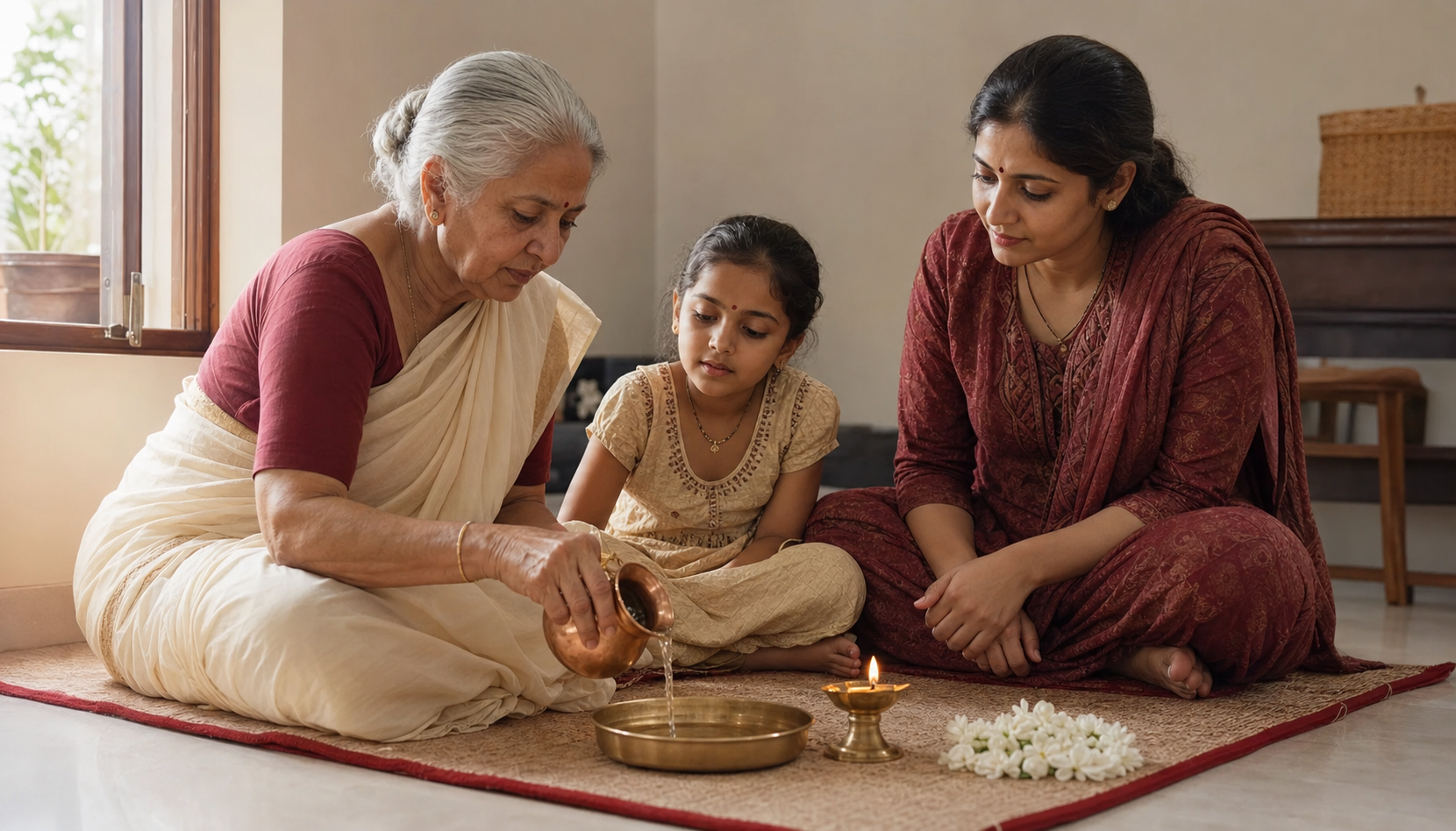
If Amavasya tarpanam belongs to your family practice, settle the date with your local Panchang before arranging the materials. Households may use clean water, black sesame, darbha or kusha grass, a spoon or the palms, a clean asana, and a vessel to receive the offerings. Facing south is customary for pitri-related offerings, but the precise order of oblations should follow your family method.
The sankalpa for April 2026 should use Vishvavasu samvatsara, Uttarayana, Vasanta ritu, the correct regional month, Krishna Paksha, Amavasya, and the applicable weekday. Use Vaishakh in the North Indian purnimanta system, Chaitra in the relevant amanta calendars, Mesha in Kerala usage, or the form prescribed for Chithirai in Tamil practice. Add gotra, sutra, and pravara only as they are genuinely known. Uncertainty should be acknowledged; it should not be filled with a guessed lineage.
Some families perform tarpanam in the morning or toward midday, while others give importance to aparahna. This is one of the points on which a family priest or established sampradaya instruction is more useful than a general festival calendar. The same applies to whether the sequence includes Deva, Rishi, and Pitri tarpanam or a Pitri-only form.
Keep the environmental conclusion as careful as the ritual beginning. If you cannot make the offering beside an appropriate natural setting, receive the water in a clean vessel and return it respectfully to soil or a plant bed. Do not introduce sesame, plastic, flowers, or puja waste into a public water body. Food-sharing or modest charity can extend ancestral gratitude into care for living people.
19 April: make Akshaya growth accountable through speech
Akshaya Tritiya and Matangi Jayanti coincide on Vaishakh Shukla Tritiya. Akshaya means that which does not diminish, while Matangi, the ninth Mahavidya, governs speech, learning, literature, music, and cultured expression. The conjunction makes a pointed demand: what you hope will grow should be guided by truthful and responsible speech.
A householder observance can remain sattvic. Clean the altar, make a clear sankalpa, invoke Matangi through the mantra or stotra received in your tradition, and offer fruit, coconut, akshata, betel leaves where customary, or a simple cooked offering. Green cloth, foliage, a veena image, or a book may be used as reminders of her iconography and her association with learning. Advanced Tantric practices involving ucchishta symbolism belong under qualified guru-guidance and should not be reconstructed from fragments found online.
Choose an action with a life beyond the puja: donate books, assist a student, support music or arts education, begin a serious course of study, or start a creative project whose language you are prepared to use ethically. A purchase may be culturally associated with Akshaya Tritiya, but ownership alone does not fulfill the day’s dharmic promise. Dana, disciplined learning, and care with words give the idea of enduring prosperity moral substance.
23 April: turn Vidyaranya Jayanti into a study appointment
Vidyaranya Jayanti honors the sage associated with Sringeri Sharada Peetham, early Vijayanagara, Advaita learning, and the counsel given to Harihara I and Bukka Raya I. Do not confuse Madhava Vidyaranya, also called Madhavacharya, with Madhvacharya of Udupi. The similar names belong to distinct teachers and philosophical lineages.
Light a lamp, remember the guru-parampara, and select one passage from Panchadasi or Jivanmuktiviveka for attentive reading. Works including these texts and Sarvadarshanasangraha are traditionally associated with Vidyaranya or his immediate intellectual circle, although details of authorship and dating remain debated. That uncertainty need not weaken the observance; it should make your study more careful.
Look for a practical question in the passage. Where do you need more viveka, or discrimination? Which public or family responsibility requires steadier judgement? Vidyaranya’s remembered conjunction of learning, spiritual discipline, and civilizational stewardship makes educational dana, annadana, or support for a serious study circle especially fitting. This keeps Vijayanagara from becoming mere nostalgia and turns cultural memory into present responsibility.
25 April: translate Vashishta’s teaching into one fulfilled duty
Vashishta Jayanti on Vaishakh Shukla Navami honors a Saptarishi, a seer associated with Rigveda Mandala 7, and the teacher of the Ikshvaku lineage, including Dasharatha and Sri Rama. His remembered role joins contemplation to counsel, making the date particularly relevant to householders and people carrying professional or civic responsibility.
Your home observance can include a lamp, guru-puja, Gayatri japa, a selected hymn from Rigveda Mandala 7, or a passage from Yoga Vasistha. Then identify one duty you have been performing carelessly and do it with greater attention. Fasting is not mandatory; for many households, moderation in food and speech is a more sustainable support for study and equanimity.
When the sky permits, the Arundhati–Vashishta pair may be contemplated through Alcor and Mizar in the Saptarishi asterism. Their place in Hindu marriage custom offers families a concrete subject for discussion: constancy is not passive attachment but shared commitment to virtue. Close the day with service to education, respectful food-sharing, or gratitude to a teacher who helped you carry a difficult responsibility.
1 May: keep the full moon shared without making it generic
Vaishakha Purnima brings Annamacharya Jayanti on 1 May. A useful home observance is participatory rather than decorative: worship Sri Venkateswara and Alamelu Manga according to your family practice, print or open the words of a sankeertana, learn its meaning, and sing it together. Brahmam Okate is an accessible choice for reflecting on divine oneness; Vinaro Bhagyamu Vishnu Katha and Adigo Alladigo Srihari Vasamu provide other paths into Annamacharya’s devotional world.
Listening to a reputable rendition can help families unfamiliar with Telugu pronunciation or Carnatic presentation, but listening need not replace participation. Reading a translation, singing a refrain, visiting a Vishnu temple, offering annadanam, or supporting classical arts education all carry the saint-poet’s legacy into practice.
The same full moon is Buddha Purnima or Vesak for Buddhist communities and is associated with Kurma Jayanti in several Vaishnava sampradayas. If you are organizing a community program, give these observances distinct space, informed speakers, and their own liturgical integrity. Their meeting on one full moon can illuminate shared commitments to truth, non-violence, self-cultivation, compassion, song, and sacred remembrance without pretending that their histories or practices are interchangeable.
Build a calendar your family can actually use
Name each calendar entry with its tithi and tradition, not just its English festival label. In the notes field, record the regional month name, the city used for the Panchang, the local tithi window once confirmed, the practice you intend to keep, and any materials that must be prepared. Mark 16 and 17 April as provisional until the applicable Amavasya rule is resolved.
If your household cannot observe every date, preserve inherited obligations first. Then choose the commemoration most closely connected to a need already present in your life: reconciliation with ancestry, discipline in speech, philosophical study, faithful performance of duty, devotional music, or full-moon contemplation. Depth on one day is better than hurried performance on all of them.
Before Vaishakha arrives, ask an elder or acharya which calendar your family follows, select a Panchang calculated for your present location, and enter the five date markers as provisional events. Once the local tithi windows are available, replace the provisional labels with the confirmed observance details. That small act of preparation lets sacred time shape your household instead of leaving the household to scramble after dates.
References
- DharmaRenaissance Blog — April 2026 Amavasya Tharpanam: Precise Sankalpam Mantras and Sacred Guide for Chithirai–Chaitra–Vaishakh
- DharmaRenaissance Blog — Matangi Jayanti 2026: Unlock Vak-Siddhi and Prosperity on Akshaya Tritiya (April 19)
- DharmaRenaissance Blog — Annamacharya Jayanti 2026: Definitive Vaishakha Purnima Guide to Date, Rituals and Legacy
- DharmaRenaissance Blog — Vidyaranya Jayanti 2026: Date, Puja Guide, and the Timeless Legacy of Vijayanagara’s Sage
- DharmaRenaissance Blog — Vashishta Jayanti 2026: Date, Puja Guide, and the Timeless Vedic Wisdom of a Saptarishi