

Someone wants an answer now. A project is failing, a family dispute is widening, or a leader has made a bad decision and expects you to rescue it. Because you have the strength to intervene, waiting can feel cowardly. Yet the first question is not whether you can act. It is whether acting now will serve dharma or merely quiet the panic of the moment.
Kumbhakarna’s forced awakening gives you a demanding way to answer that question. His fate shows that power can be real, loyalty can be sincere, and courage can be immense while the action itself remains mistimed. The practical lesson is neither to rush nor to wait blindly. It is to correct the cause of the crisis, respect the conditions that make action effective, and then move without hesitation.
Ravana’s error was deeper than moving too quickly
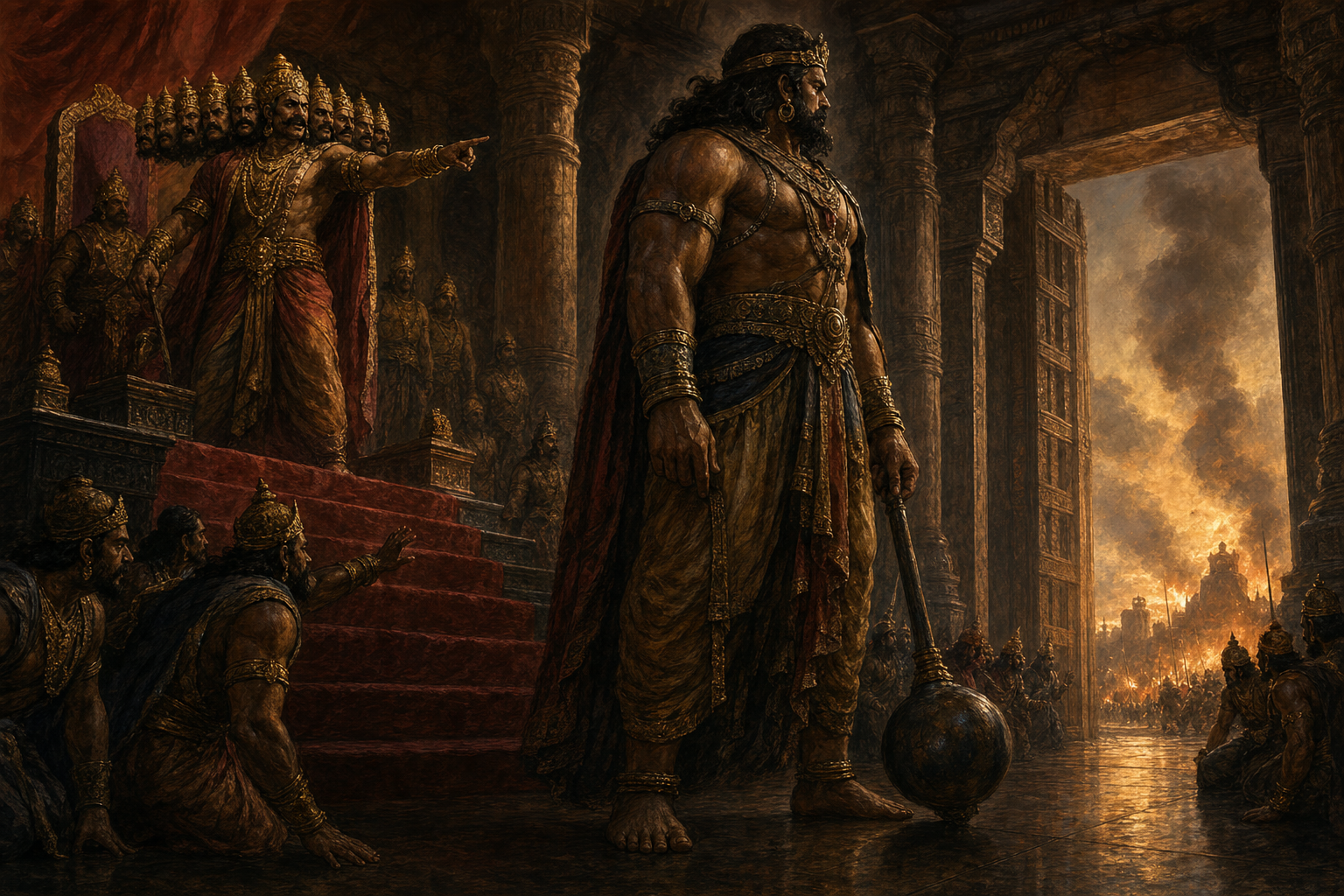
In the Yuddha Kanda of the Valmiki Ramayana, Ravana does not awaken Kumbhakarna as part of a considered plan. He does it after Lanka has suffered mounting battlefield losses and earlier commanders have fallen. The king is no longer setting the tempo. He is reacting to consequences he refused to prevent.
Kumbhakarna’s sleep is not ordinary laziness. The narrative traditions treat it as a divinely imposed condition, commonly described as six months of sleep followed by one day of wakefulness. One well-known strand connects the condition to a boon distorted through Saraswati’s intervention and later moderated after Ravana pleaded with Brahma. Whatever interpretive emphasis you place on that account, the operative point is clear: Kumbhakarna’s cycle is a constraint, not a preference that Ravana may erase by issuing an order.
Ravana nevertheless tries to overpower the constraint. Kumbhakarna is roused with noise, blows, torches, troops and elephants. Once awake, he cannot simply walk into battle. He must first consume enormous quantities of food and drink. The spectacle is not incidental comedy. It reveals the hidden bill attached to premature activation: before the supposedly available power can be used, extraordinary resources must be spent merely bringing it to a functional baseline.
The same error appears in ordinary life whenever we confuse possession with readiness. A capable person may be exhausted. A sound plan may lack a necessary dependency. A community may have numbers but not coordination. A truthful message may be delivered at a moment when nobody can hear it. In each case, the strength exists. What is missing is the condition that allows strength to become effective action.
But unreadiness is only part of Ravana’s failure. His objective is already disordered. He is trying to preserve the result of abducting Sita rather than undo the act that caused the war. Vibhishana had urged the restorative course: return Sita. Once awake, Kumbhakarna also rebukes Ravana for the abduction. Ravana responds to converging moral counsel by demanding more force.
This gives you the first rule of timing: a better hour cannot make an adharmic objective righteous. If the cause is wrong, do not search for a more auspicious way to defend it. Reverse it. Apologize, return what was taken, stop the harmful policy, or abandon the dishonest commitment. Timing matters only after the direction has been corrected.
Divine timing is disciplined readiness, not fortune-telling

It is easy to turn divine timing into a vague instruction to wait for a sign. That is not the discipline revealed here. Kala, or time, works together with dharma and order. You still have to judge the end, prepare the means and accept responsibility for the decision. Waiting does not relieve you of agency.
Nor is every obstacle proof that the time is wrong. Some obstacles are genuine gates; others are merely discomfort. Recovery, missing authority, absent information, an unprepared team and an unmet ethical obligation can be real gates. Fear of criticism, dislike of uncertainty and the wish to feel perfectly confident usually are not. If nothing relevant will be different later, delay may be avoidance wearing the language of patience.
Use three distinctions to identify what kind of moment you are actually in:
- Wrong direction versus incomplete preparation: If the intended result violates a duty, change the result. If the result is right but the means are unready, prepare the means.
- Emergency versus emotional urgency: An emergency contains harm that will materially worsen while you wait. Emotional urgency is the pressure to act mainly because uncertainty feels intolerable.
- Readiness gate versus perfectionism: A readiness gate can be named and tested. Perfectionism keeps asking for more assurance without identifying what evidence would ever be enough.
This distinction also prevents a common misuse of spirituality. You should not call indecision surrender to divine order when you have refused to define what you are waiting for. Name the condition. It might be recovery, consent, verified information, coordinated support or completion of a prior duty. Then name how you will know that it has been met. Patience becomes disciplined only when it has a purpose and a test.
The broader Dharmic vocabulary reinforces this posture without reducing distinct traditions to one doctrine. Hindu thought joins action to dharma, kala and rita, the ordering pattern within which power must operate. Buddhist practice asks whether effort is right and whether the chosen means are skillful. Jain samyama emphasizes restraint rather than obedience to impulse, while samayika cultivates steadiness. Sikh teachings on hukam and sehaj direct the person away from agitated self-will and toward action within divine order and natural equipoise.
Across these registers, restraint is not weakness. It is power that can remain under governance. Ask of your proposed action: does it arise from clarity and duty, or from the wish to escape discomfort? The external movement may look identical. The quality of attention behind it is not.
Use this five-part test before an irreversible move

When pressure is high, abstract advice is easy to admire and hard to use. Put the decision into five written lines instead. Writing matters because desperation collapses several questions into one demand: do something. The test separates them again.
- Name the harm that requires action. Describe what is happening and what will worsen if you do nothing. Do not write only that people are anxious, angry or demanding an answer. Those reactions may matter, but they are not automatically the underlying harm.
- Identify the decision that created or sustains the harm. Ask whether your proposed action repairs that cause or merely suppresses its consequences. Ravana wanted Kumbhakarna to defeat the opposition while leaving the abduction of Sita untouched. That is crisis management in service of the original error.
- Separate available capacity from ready capacity. List what the person, institution or resource needs before it can perform reliably. Rest, orientation, coordination, moral legitimacy and logistical support are not decorative extras. If they are necessary to the work, they are part of the work.
- Name the gate and the cost of waiting for it. State exactly what must become true, who can verify it and what harm could occur in the meantime. If the cost of waiting is serious, choose a protective interim action. Do not pretend that the only options are full deployment or total inaction.
- Choose the smallest dharmic move that preserves later options. Gather counsel, protect an exposed person, pause a damaging process, correct a false claim, withdraw an unjust demand or prepare the team. A reversible step can reduce immediate harm without locking you into a course chosen under panic.
The order of these questions matters. Readiness should not be assessed before righteousness, because efficient preparation for a wrong end only makes the wrong more dangerous. The cost of waiting should not be assessed before the readiness gate is named, because otherwise every anxious feeling can be promoted into an emergency.
You also need a stop condition. Before acting, write what evidence would show that the move is failing or causing more harm than it prevents. Ravana had already received warnings and battlefield evidence, yet each setback drove him further into escalation. A stop condition protects you from interpreting every new loss as a reason to commit still more strength.
Finally, define success beyond the first surge. Kumbhakarna’s arrival terrifies and scatters the Vanara forces. Immediate impact, however, is not durable success. Rama meets him with calibrated escalation and defeats him. If your plan can produce a dramatic opening but leaves no capacity for the next phase, the opening may be consuming the future rather than securing it.
When you are the Kumbhakarna in someone else’s crisis
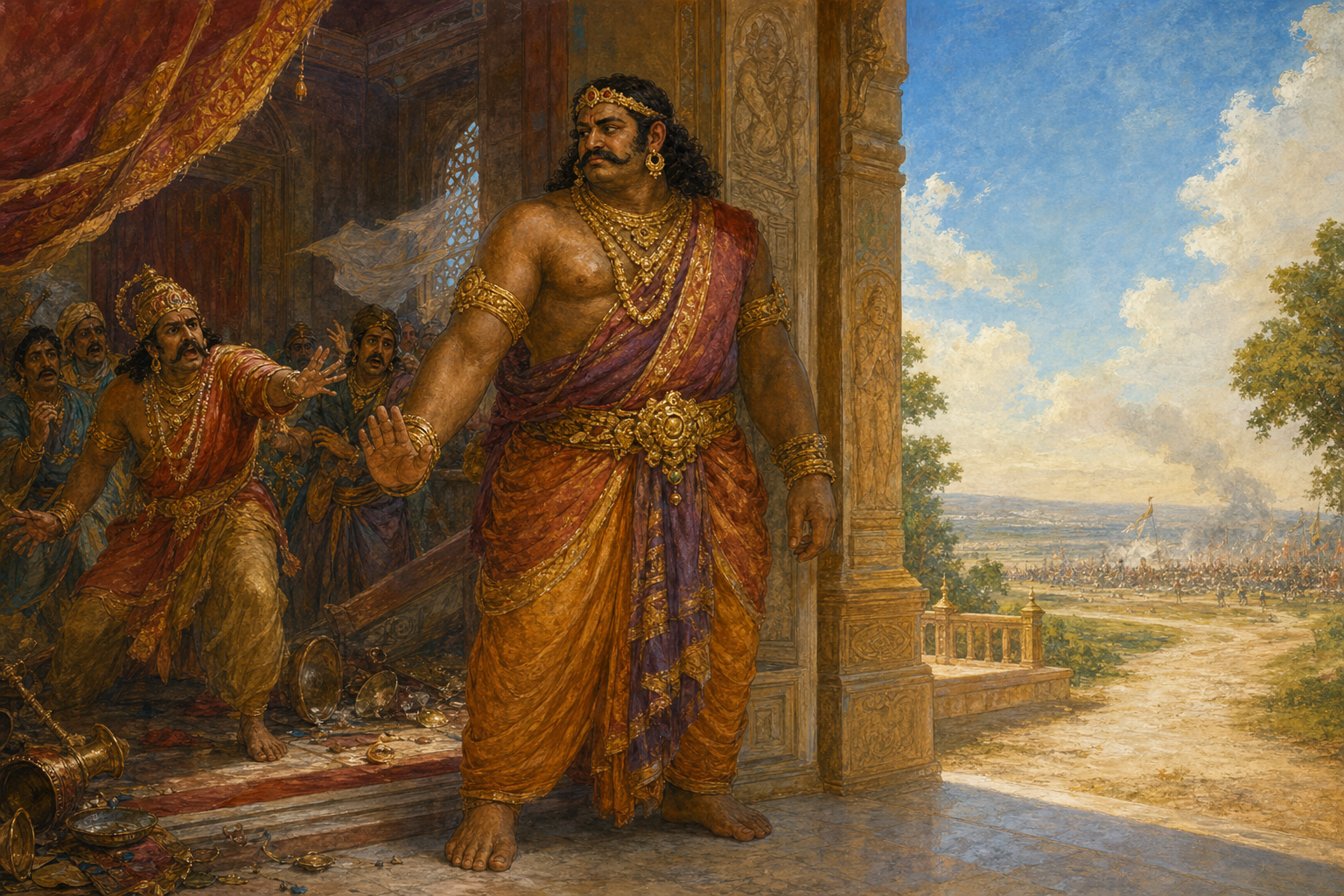
The episode becomes more personal when you are not the leader making the bad decision. You may be the relative summoned to settle a conflict you did not create, the competent employee called after warnings were ignored, or the loyal community member asked to defend an indefensible course. Your ability makes you useful, and your loyalty makes refusal painful.
Kumbhakarna is not portrayed as incapable of moral judgment. He sees Ravana’s error and says so. Yet fraternal loyalty and martial duty lead him to fight after his counsel is rejected. That tension gives the story its pathos. It also exposes a hard truth: private disagreement does not prevent your strength from extending the life of a destructive decision.
Before joining someone else’s emergency, ask four direct questions:
- Has the objective changed? If the leader still intends to preserve the original wrong, your help may strengthen the cause of the crisis.
- Will your intervention protect people or protect pride? Containing harm is different from shielding a decision-maker from accountability.
- Are you being given a real chance to prepare? A demand for immediate maximum performance may be an attempt to transfer the cost of someone else’s delay onto you.
- What boundary will you keep if your counsel is rejected? Decide this before loyalty, anger or public pressure narrows your choices.
A useful response is specific: “I will help protect those exposed to harm and prepare a workable recovery. I will not help repeat or conceal the decision that caused the crisis.” That is neither abandonment nor obedience. It ties assistance to a dharmic purpose.
If you lead others, reverse the view. Do not treat your most capable person as a reserve that can be awakened at any hour to rescue avoidable mistakes. Listen while counsel can still change the plan. Build recovery and orientation into deployment. Preserve scarce capacity for the point at which it can alter the outcome. Most of all, do not demand sacrifice merely to postpone your own admission that the objective must change.
The biological image is exact enough to remember: being awake is not the same as being ready. Forced arousal from deep sleep can temporarily impair judgment, reaction and coordination. The organizational equivalent is familiar even without literal sleep. A person pulled abruptly from recovery, grief, another responsibility or incomplete preparation may be physically present while still unable to offer their best judgment. Give readiness a sequence: awaken, restore, orient, test and only then commit.
Key takeaways
- Timing cannot sanctify an adharmic objective. Correct the cause before optimizing the response.
- Capability and readiness are different. Count the restoration, information and coordination required before deployment.
- A real readiness gate can be named and tested. A delay with no test may be avoidance.
- Urgency deserves immediate scrutiny, not automatic obedience. Ask what concrete harm will worsen while you wait.
- When full action is premature, take the smallest reversible step that protects people and preserves later choices.
- Loyalty does not require lending your strength to another person’s refusal of accountability.
Before your next pressured decision, write five lines: the harm, its cause, the readiness gap, the cost of waiting and the smallest dharmic move available now. If the objective is wrong, reverse it. If the objective is right and the gates are open, act. If a necessary gate is closed, prepare deliberately and state what will open it.
Time does not excuse indecision. It reveals whether strength can remain answerable to order. Your next move need not be dramatic. It needs to be right in purpose, ready in means and honest about the moment.