
If you bought biscuits or bread from a Pimpri-Chinchwad retailer and now wonder whether it came from Aqsa Bakery, the central question is narrower than the anger online: was beef actually found in a finished bakery product? The facts presently support an immediate closure for severe hygiene failures and a serious risk of cross-contamination. They do not establish that beef was detected in any biscuit, bread, or other finished item.
You do not have to dismiss the risk in order to respect that distinction. You can stop using a product, preserve its identifying details, demand answers from the seller and regulator, and defend Hindu religious concerns without turning a suspected route of contamination into a proven event.
Key takeaways
- The Maharashtra Food and Drug Administration did close Aqsa Bakery under Section 34 of the Food Safety and Standards Act, 2006. The closure is a regulatory action, not merely a social-media allegation.
- Inspectors recorded pervasive hygiene and structural failures, awarded the establishment only 1 mark out of 88, and identified a risk of cross-contamination from the adjoining meat business.
- Exposed raw beef, animal waste, flies, inadequate separation, contaminated water in broken refrigeration equipment, and poorly maintained food areas created a credible contamination pathway.
- No laboratory result, positive finished-product sample, or batch-specific finding currently establishes that beef entered a bakery product.
- If you still have a product of uncertain origin, do not taste it to investigate. Preserve the packaging and purchase details, ask the retailer to identify the manufacturer and batch, and report concrete information to the appropriate food-safety authority.
What the closure establishes – and what it does not
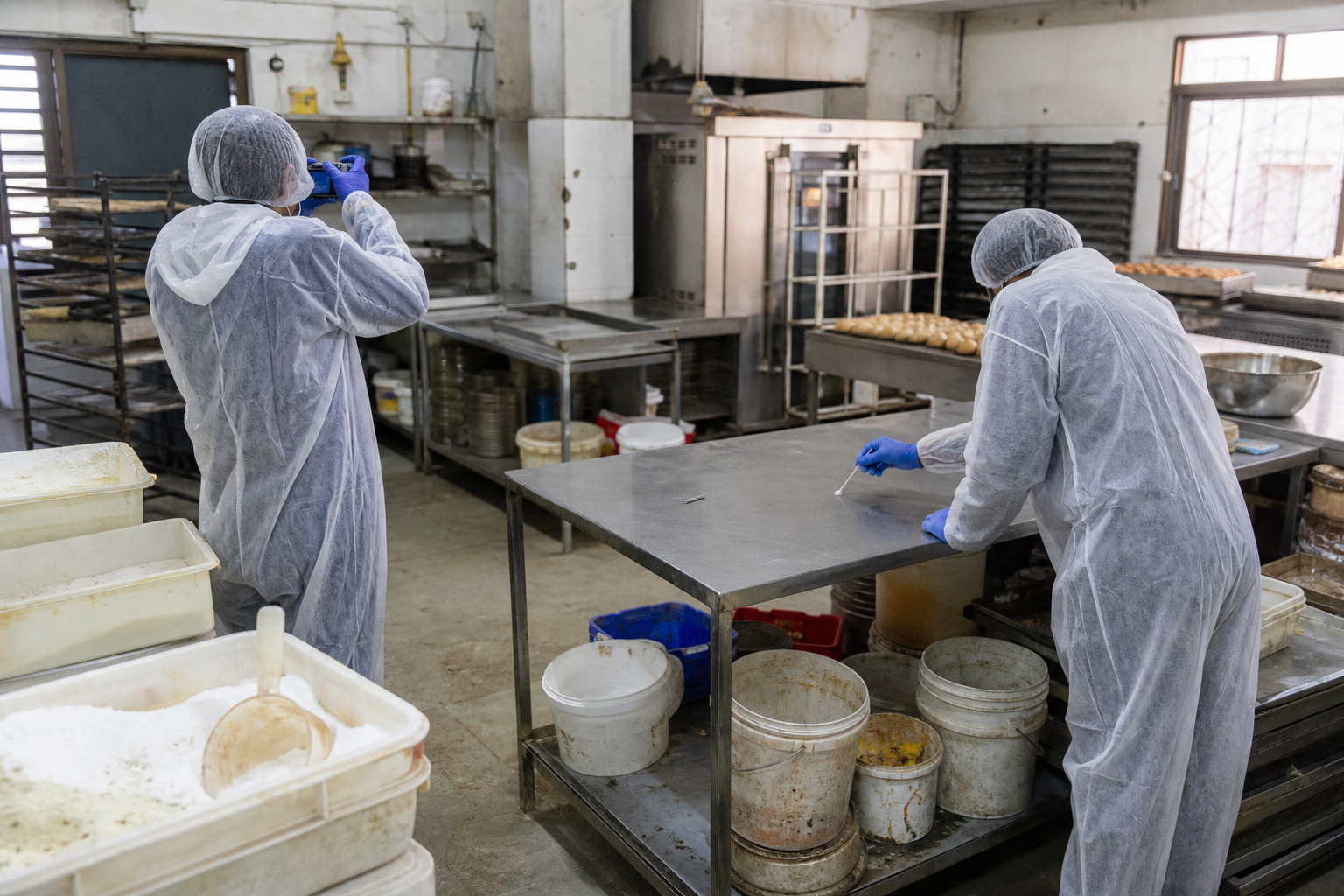
A Food Safety Officer inspected the Moshi premises on the night of 20 July 2026. The establishment received an overall non-compliance result and only 1 mark out of a possible 88. The Maharashtra FDA then prohibited the manufacture, storage, sale, and distribution of food at the premises under Section 34 of the Food Safety and Standards Act, 2006.
The deficiencies were not minor paperwork lapses. Inspectors recorded broken flooring, damaged walls, inadequate ventilation, deficient pest-proofing, poor storage, unclean preparation areas, and inadequate cleaning and maintenance. Flies, insects, and other pests were found throughout the premises. Broken refrigeration equipment containing contaminated water was allegedly being used for food storage. Officials concluded that continued operation posed a hazard to human health.
The religious concern arises from the physical relationship between the bakery and an adjoining beef and mutton business. Conditions visible around the units included exposed raw beef, discarded animal remains, uncovered bakery goods, and flies appearing to move between the meat and bakery areas. A broken or open partition was also visible. Inspectors recorded the adjoining operation as a serious cross-contamination risk and noted that a connecting opening appeared to have been sealed with brick and cement shortly before the inspection.
These facts establish a hazardous environment and a plausible route by which material from one area could reach the other. They do not establish that such a transfer actually occurred in a particular product. Three ideas must remain separate:
- A hazard is a condition capable of causing harm, such as pests, exposed waste, contaminated water, or improper storage.
- A cross-contamination risk means that the layout or handling practices permit unwanted material to move between areas or foods.
- Confirmed product contamination requires evidence tied to the product, such as a laboratory finding or other reliable product-specific proof.
No laboratory result, identified positive sample, or affected batch is presently provided. Nor is a named list of retail recipients available, even though the bakery reportedly supplied numerous local outlets in Pimpri-Chinchwad. That gap means it would be premature either to declare every product contaminated or to assure customers that every product was unaffected.
The legal status also needs precision. Officials recommended immediate suspension of the bakery’s FSSAI registration, but a recommendation is not the same as a final cancellation. The prohibition order stops operations until food-safety clearance is granted. The operator retains a right to appeal, and an appeal would test the order through the designated process; it would not, by itself, disprove the recorded hygiene conditions.
If you bought a possibly affected bakery product
You may not know the manufacturer’s name because bakery products are often sold through another shop. Asking only whether a retailer has heard about the dispute will produce little useful information. Ask for traceability instead.
- Pause consumption while the origin remains unclear. Do not taste the item to decide whether it seems normal. Appearance, smell, and taste cannot settle a question about cross-contamination.
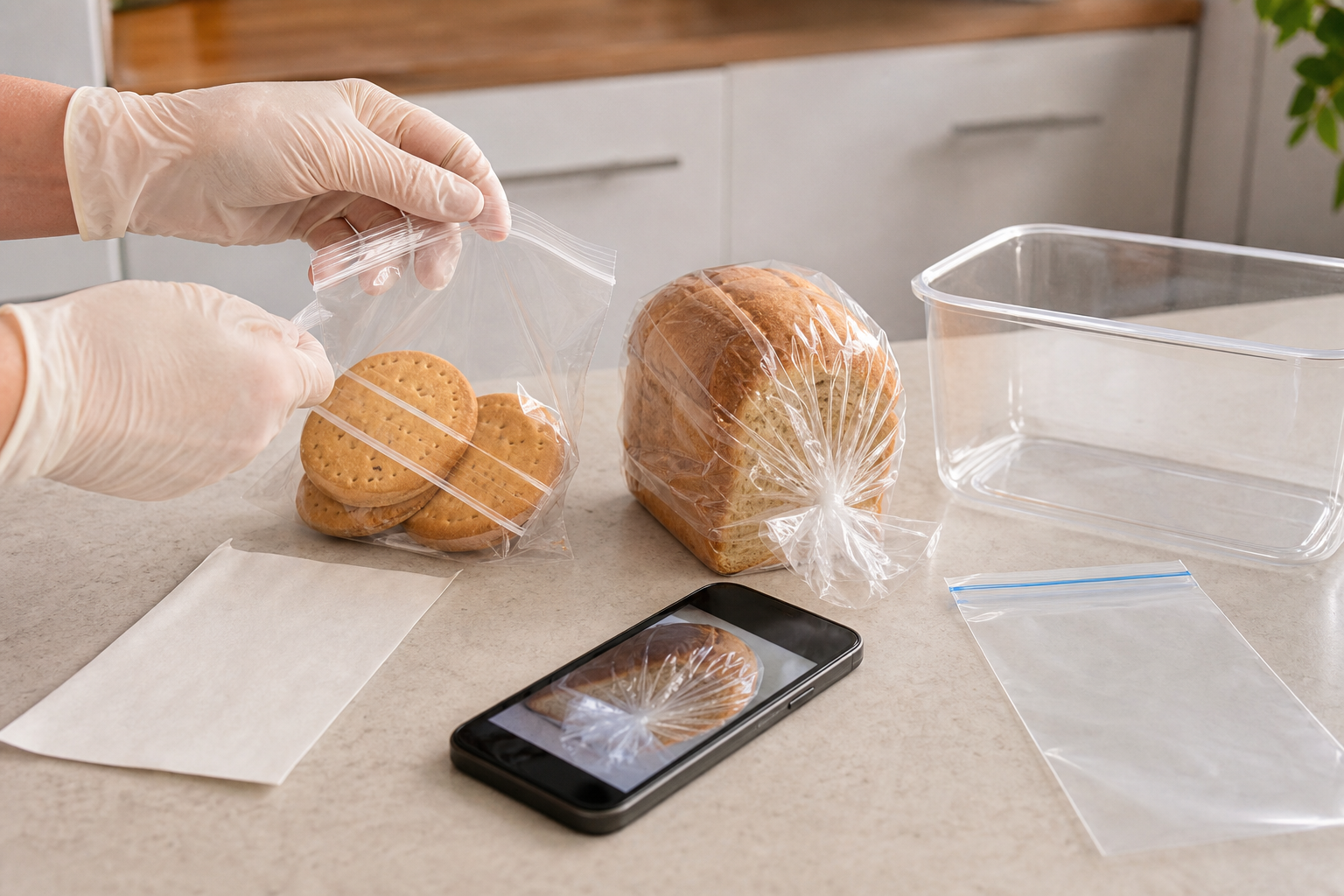
- Keep the product isolated. Leave it in its original packaging if possible, place that packaging in a separate bag, and keep it away from other food. Do not give it to another person or animal.
- Record the identifying details. Photograph the front and back of the label, manufacturer name, FSSAI number if displayed, batch or lot number, packed-on date, best-before date, retailer name, and receipt. If the item was sold loose, write down what you bought, when you bought it, and the exact shop location.
- Ask the retailer a specific question. Request the name of the bakery that manufactured the item and the batch or delivery date. Then ask whether the retailer has received a written hold, withdrawal, or clearance notice. A general assurance that the item is vegetarian is not a substitute for supplier identification.
- Report facts, not conclusions. A useful food-safety complaint includes the product, shop, date, label details, photographs, and the reason you believe it may be connected to the Moshi bakery. Avoid claiming that testing proved beef contamination when no such result has been made available.
- Seek medical help for illness rather than diagnosing it online. If you or another person becomes unwell after eating a product, contact a qualified healthcare professional and retain the packaging for identification. Serious or worsening symptoms require prompt medical attention.
Do not publicly name an unrelated retailer as complicit merely because it sells similar biscuits. The useful question is whether that retailer received products from this manufacturer during the relevant period. Supplier records, invoices, labels, and delivery dates can answer that; visual resemblance cannot.
What must be verified before reopening or buying again
Cleaning the visible surfaces would not be enough. The problems involved the physical layout, pest access, waste handling, storage equipment, worker hygiene, and the relationship between two adjoining food operations. Before renewed operation deserves public confidence, the establishment and the authorities should be able to show that the contamination pathways have been removed, not temporarily hidden.
- A permanent, intact separation between the bakery and meat-handling premises, with no shared opening or informal passage.
- Repaired floors and walls that can be cleaned properly, adequate ventilation, and effective pest-proofing.
- Covered ingredients and finished products, protected from insects, waste, raw meat, and contaminated surfaces.
- Functioning refrigeration and storage equipment, with no stagnant or contaminated water in food-storage areas.
- Safe removal and containment of animal waste outside the adjoining shop so that it does not attract flies and mosquitoes.
- Documented cleaning, maintenance, and pest-control routines rather than a one-time cleanup before inspection.
- Worker hygiene controls and clear separation of tools, storage, and work areas used for incompatible activities.
- Batch and customer traceability sufficient to identify which retailers received which products and when.
Consumers and Hindu organisations should also press for answers that only the enforcement process can supply:
- Were finished bakery products sampled, and which product names and batches were involved?
- Did testing detect any animal material or other contamination? If so, what were the exact results?
- Which retailers received products from the bakery during the period under examination?
- Has any stock been ordered withdrawn, held, destroyed, or recalled?
- Was the FSSAI registration suspended, or did the matter remain at the recommendation stage?
- Which corrections must be independently verified before the prohibition order can be lifted?
- Was an appeal filed, and what was its outcome?
A satisfactory inspection after repairs would answer whether the premises can operate safely from that point onward. It would not retroactively answer whether an earlier batch was contaminated. That requires product-specific evidence. Regulators should therefore disclose both kinds of information clearly: the conditions for reopening and the findings, if any, concerning products already distributed.
A dharmic response must defend both Gau Mata and satya

For many Hindus, possible beef contact is not an ordinary labelling mistake. The cow is revered as Gau Mata, and involuntary contact with beef can violate a devotee’s conscience, vegetarian discipline, and religious trust. Food businesses serving a mixed public have a responsibility to understand that separation and truthful disclosure are not cosmetic preferences.
That seriousness makes accuracy more important, not less. Dharma does not require us to choose between protecting Gau Mata and speaking truthfully. Ahimsa calls us to oppose practices that expose people to unwanted animal material and unsafe food. Satya requires us to describe the evidence at its actual strength. At this stage, the accurate phrase is risk of beef cross-contamination, not confirmed beef in bakery products.
This distinction does not weaken accountability. A bakery can deserve immediate closure because its conditions create an unacceptable risk even before a laboratory establishes what entered a particular biscuit. Preventive food-safety enforcement exists precisely because authorities need not wait for every possible harm to be completed.
If you fear that you unknowingly consumed an affected item, do not let a viral message dictate a religious remedy. Stop using the remaining product, establish its origin if possible, and consult an acharya or other trusted authority within your own sampradaya about any personal observance. Questions of accidental consumption, intention, and prayaschitta belong within the discipline of your tradition; a one-size-fits-all social-media instruction cannot replace that guidance.
Public action should remain equally disciplined. Demand testing, retailer traceability, publication of results, correction of the premises, and fair enforcement of food-safety law. Do not harass workers, customers, or an entire community, and do not circulate an unverified retailer list. Such behaviour can harm uninvolved people while making the legitimate case for transparency easier to dismiss.
Your next purchasing decision can be simple: if a seller cannot identify the manufacturer and batch of an unpackaged bakery item, choose a traceable alternative. If authorities later publish product tests, a retailer list, reopening conditions, or an appeal outcome, update your judgment to match those facts. Vigilance is strongest when it is precise enough to protect health, religious choice, and truth at the same time.